
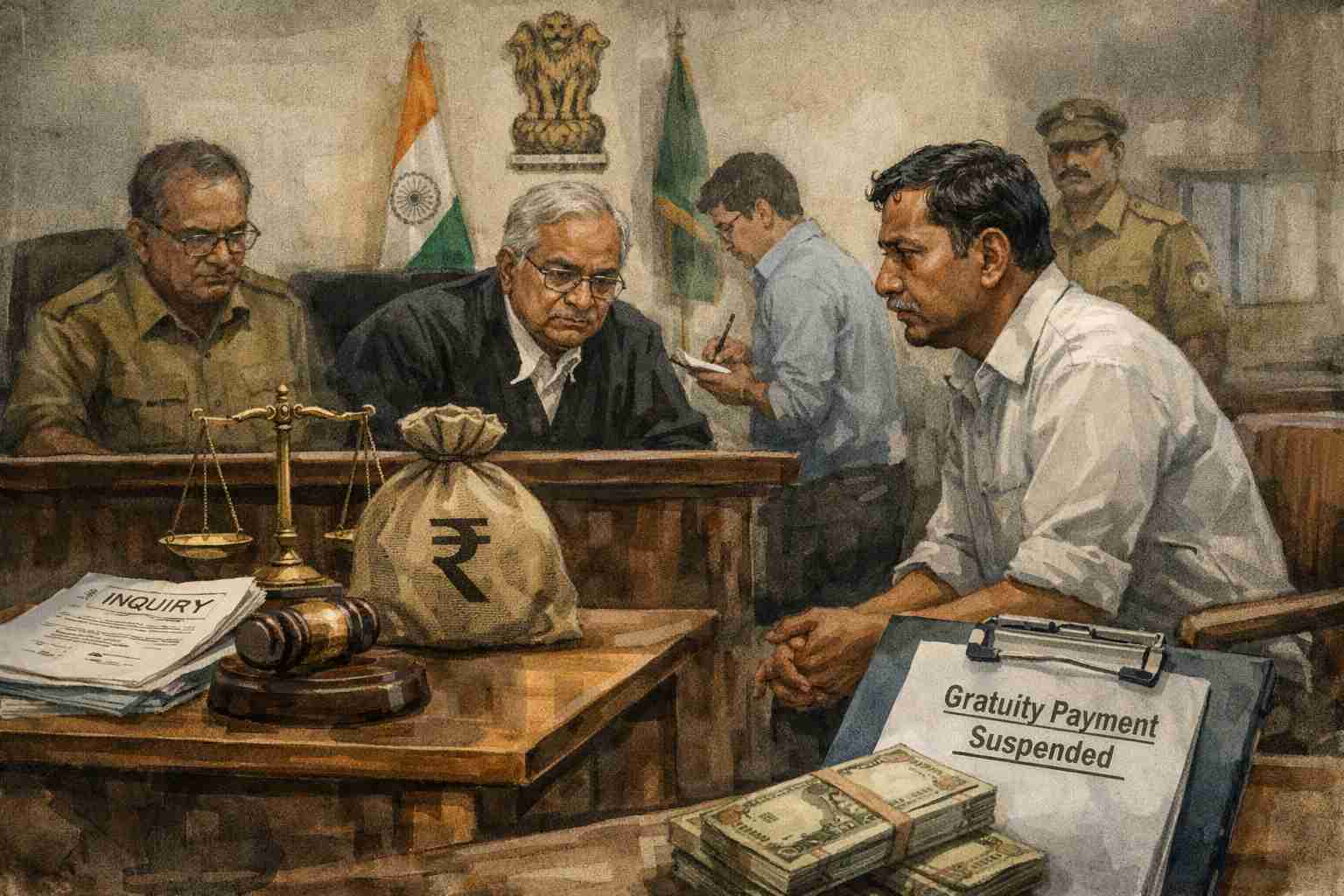
The Patna High Court has clarified when an employer may withhold or forfeit gratuity under the Payment of Gratuity Act, 1972, particularly where serious misconduct is alleged and departmental proceedings are in play. In this writ petition decided on 06 December 2022 by Hon’ble Mr. Justice Harish Kumar, the petitioner (a public sector undertaking) challenged orders of the Controlling Authority and the Appellate Authority under the Gratuity Act that had directed payment of gratuity with interest to an employee who had been compulsorily retired with forfeiture of gratuity after a stock shortage inquiry. The High Court set aside those authorities’ orders and held that gratuity would be payable only subject to the outcome of the pending adjudication arising from the departmental proceedings.
The background is straightforward. A special physical verification in 2011 revealed significant shortages in foodgrain bags at a depot. A departmental inquiry followed under the employer’s Service Regulations. The employee (respondent before the High Court) was punished with compulsory retirement and recovery/forfeiture directions against terminal dues including gratuity. Later, the Appellate Authority within the employer modified the punishment to compulsory retirement with forfeiture of the entire gratuity amount. Meanwhile, the employee approached the Central Government Industrial Tribunal (CGIT) at Dhanbad. While those proceedings took various turns, including an initial award and a remand by the Jharkhand High Court, the employee also invoked the Gratuity Act machinery. The Controlling Authority directed payment of gratuity with 10% interest from 31.09.2012, and the departmental Appellate Authority under the Gratuity Act upheld that direction. These orders were the subject of the Patna writ petition.
Before the High Court, the petitioner argued that Section 4(6) of the Gratuity Act permits forfeiture where the service is terminated for willful acts causing loss or for offences involving moral turpitude, and therefore gratuity could be withheld/forfeited in light of the proved shortages and the punishment of compulsory retirement. The petitioner relied on Supreme Court authority including State Bank of India v. Ramlal Bhaskar and, crucially, the three-Judge Bench decision in Chairman-cum-Managing Director, Mahanadi Coalfields Ltd. v. Sri Rabindranath Choubey.
The opposing side contended that the Gratuity Act is a self-contained welfare statute; that the employee had not been “dismissed” but was compulsorily retired; and that, consequently, Section 4(6) could not be invoked to deny gratuity. They maintained that the Controlling Authority and Appellate Authority were correct in directing gratuity payment with interest.
The High Court resolved the matter by aligning with the Supreme Court’s binding interpretation in Mahanadi Coalfields. The Supreme Court had authoritatively explained that Section 4(6) (which carries a non obstante clause) prevails over the general mandate to pay gratuity in Section 4(1); that recovery or forfeiture is permissible where services are terminated for the reasons in clauses (a) or (b); and that employers may, consistent with applicable service rules, continue and conclude disciplinary proceedings to determine guilt and the corresponding consequences for gratuity—even if the employee superannuates in the meantime. The larger Bench also distilled practical conclusions: employers may withhold gratuity during pendency of disciplinary proceedings; on conclusion, while certain substantive penalties may not be available post-retirement, forfeiture of gratuity commensurate with guilt and loss remains permissible; and if the employee is ultimately exonerated, gratuity (with statutory interest for delay) must follow.
Applying that ratio, the Patna High Court concluded that where an employee has been departmentally proceeded against and subjected to compulsory retirement with forfeiture of gratuity under the employer’s regulations, the right to receive gratuity depends on the outcome of those proceedings and related adjudication. Here, the matter between the parties was admittedly still pending before the CGIT on remand, and therefore the Controlling Authority and the Appellate Authority were not justified in directing immediate gratuity payment with interest. The Court accordingly set aside both orders and clarified that the ultimate payment of gratuity shall abide the final result of the CGIT case.
In essence, this judgment reaffirms a key equilibrium: gratuity is a statutory right, but it is not absolute in the face of proved misconduct causing loss or involving moral turpitude. Where disciplinary and allied adjudicatory processes are live, the law permits withholding and, where warranted, forfeiture, subject to strict compliance with Section 4(6) and service rules. For employers and employees in Bihar, the ruling offers a clear, Supreme Court-conforming roadmap on how gratuity claims interface with pending departmental proceedings and industrial adjudication.
Significance or Implication of the Judgment
For government departments, PSUs, and private establishments operating in Bihar, the judgment provides operational clarity:
- Authorities under the Gratuity Act should avoid short-circuiting ongoing departmental or tribunal processes. If misconduct proceedings are pending—and particularly where service rules contemplate consequences for gratuity—orders mandating immediate gratuity payment with interest can be premature and vulnerable to judicial correction.
- Employers may withhold gratuity during pendency of disciplinary proceedings, and on conclusion may impose forfeiture commensurate with guilt and loss, provided the legal thresholds in Section 4(6) are met and service rules permit. This is aligned with the Supreme Court’s three-Judge Bench in Mahanadi Coalfields.
- For employees, the judgment underscores that if they are ultimately exonerated, gratuity and statutory interest for delayed payment remain protected. Thus, while gratuity can be withheld pending outcome, the statute ensures compensation for delay in appropriate cases.
Legal Issue(s) Decided and the Court’s Decision with reasoning
- Whether gratuity could be directed to be paid (with interest) by the Controlling/Appellate Authorities under the Gratuity Act despite the employee having been compulsorily retired with forfeiture and while related proceedings were still pending before the CGIT.
• Decision: No. The High Court set aside both authorities’ orders and held that gratuity entitlement must abide the outcome of the pending proceedings. Reason: Section 4(6), read with service rules and the Supreme Court’s Mahanadi Coalfields ruling, permits withholding/forfeiture connected to termination for specified misconduct; authorities could not mandate immediate payment mid-stream. - How Section 4(6) interacts with Section 4(1) of the Gratuity Act.
• Decision: Section 4(6) prevails by virtue of its non obstante clause; gratuity is not automatically payable where the preconditions for forfeiture/recovery apply. - Whether employers may withhold gratuity during pending disciplinary proceedings and what penalties are permissible post-retirement.
• Decision: Yes, withholding is permissible; after retirement, while some substantive penalties may not be available, forfeiture of gratuity commensurate with guilt and loss remains available under Section 4(6) and the governing rules; if exonerated, gratuity must be paid with statutory interest for delay.
Judgments Referred by Parties (with citations)
- State Bank of India v. Ramlal Bhaskar & Ors., (2011) 10 SCC 249 — cited by the petitioner in support of the forfeiture/withholding position under Section 4(6).
- Chairman-cum-Managing Director, Mahanadi Coalfields Ltd. v. Sri Rabindranath Choubey, 2020 (3) PLJR (SC) 438 — cited to show that the issue stands settled by a three-Judge Bench.
Judgments Relied Upon or Cited by Court (with citations)
- Chairman-cum-Managing Director, Mahanadi Coalfields Ltd. v. Sri Rabindranath Choubey (Three-Judge Bench) — extracted and applied to hold that Section 4(6) prevails over Section 4(1), employers may withhold during pendency, and forfeiture commensurate with guilt is permissible; exoneration entails payment with statutory interest.
Case Title
Food Corporation of India v. Union of India & Ors.
Case Number
Civil Writ Jurisdiction Case No. 11529 of 2019.
Citation(s)
2023 (1) PLJR 354
Coram and Names of Judges
Hon’ble Mr. Justice Harish Kumar.
Names of Advocates and who they appeared for
- For the petitioner: Mr. Saket Tiwary, Advocate.
- For respondent no. 4 (employee): Mr. Uday Prakash Sharma, Advocate.
- For the Union of India: Mrs. Kanak Verma, Central Government Counsel.
Link to Judgment
https://patnahighcourt.gov.in/viewjudgment/MTUjMTE1MjkjMjAxOSMxI04=-yUaIxHP4e7A=
If you found this explanation helpful and wish to stay informed about how legal developments may affect your rights in Bihar, you may consider following Samvida Law Associates for more updates.







