
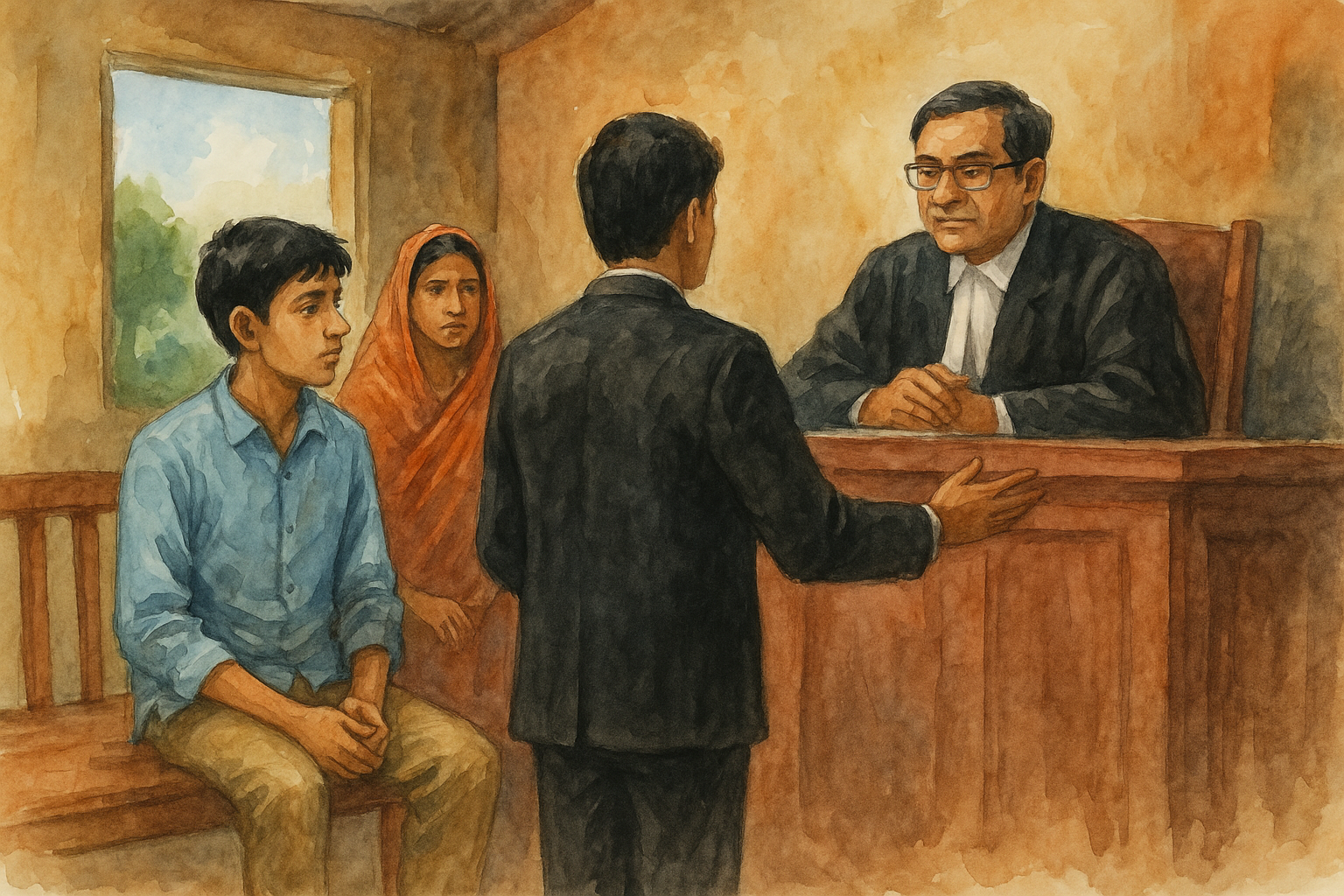
The Patna High Court in 2022 set aside an order of the Special Judge, West Champaran, and declared that the accused in a criminal case should be treated as a juvenile at the time of the alleged incident. The case arose from a police station case registered in 2017, involving allegations of eve teasing and use of abusive language under Sections 341, 354A and 506 of the IPC and Section 8 of the POCSO Act. The High Court’s reasoning turns on how courts must determine age when only a medical report is available and how to apply the “benefit of margin” under Rule 12(3)(b) of the Juvenile Justice Rules, 2007.
Simplified Explanation of the Judgment
This criminal revision came before the Patna High Court challenging a 2019 order of the Additional Sessions Judge-cum-Special Judge, West Champaran at Bettiah, which had refused to declare the accused as a juvenile. The accused (hereinafter “petitioner”) faced trial for offences under Sections 341, 354A(i)(ii)(iii), 506 of the Indian Penal Code and Section 8 of the Protection of Children from Sexual Offences (POCSO) Act. The complainant alleged that the petitioner engaged in eve teasing and used filthy language against the informant’s daughter. The alleged occurrence took place on 09.08.2017. The core legal question before the High Court was whether, on that date, the petitioner was a juvenile within the meaning of the Juvenile Justice (Care and Protection of Children) Act, 2015, and the governing Rules of 2007 regarding age determination.
The petitioner argued that his date of birth was 14.02.2003 and that, after the occurrence, he sat for the matriculation examination conducted by the Bihar School Examination Board in 2019 and passed in first division. His matriculation certificate recorded the same date of birth. However, at the time when juvenility was first claimed before the court below, the petitioner did not produce a school admission register from the first attended school or a municipal birth certificate. In that situation, the court below followed the Rules and ordered a medical assessment. The Medical Board, on 15.05.2019, opined that the petitioner’s age was between 19–20 years (as on the date of examination). Relying on that report and without giving the “benefit of margin” contemplated by Rule 12(3)(b), the court below rejected the claim of juvenility.
Before the High Court, the petitioner contended that even if the matriculation certificate came after the incident, the medical opinion could not be treated as a fixed, exact age. Rule 12(3)(b) of the Juvenile Justice Rules, 2007 provides that when documentary evidence such as school or municipal records is unavailable, the court must seek medical opinion from a duly constituted Medical Board. Crucially, if exact assessment cannot be done, the court may “give benefit to the child… by considering his/her age on lower side within the margin of one year,” and thereafter record a finding. In other words, medical age determination has recognized margins of error, and judges must apply them in favor of the child. The petitioner relied on the Supreme Court’s decision in Darga Ram @ Gunga v. State of Rajasthan, (2015) 2 SCC 775, and a Patna High Court decision in Karanvir Singh v. State of Bihar, 2020 (2) PLJR 279, which illustrate how courts should work backward from the medical estimate and extend the statutory benefit of reduction, ultimately determining age on the date of occurrence.
The State opposed the plea, arguing that the petitioner’s matriculation certificate was obtained much after the incident and that he had failed to produce primary school or municipal records at the relevant time. Therefore, according to the State, it was appropriate to rely on the medical opinion, and the rejection by the court below was justified.
After hearing both sides, the High Court agreed that the court below had correctly resorted to medical examination in the absence of earlier, cogent documentary proof. However, the High Court found fault with how the medical opinion was applied. The court emphasized that Rule 12(3)(b) obliges courts to extend the benefit of the lower-side margin when the exact age cannot be ascertained. On facts, the Medical Board had opined an age bracket of 19–20 years (as of 15.05.2019). Following the approach recognized in Karanvir Singh (which itself drew guidance from Darga Ram), the High Court took the “upper extremity” of the bracket—20 years—and then applied a permissible variation of ±2 years to account for the medical margin. Reducing from 20 by 2 years gave 18 years as on the date of the medical assessment. Applying Rule 12(3)(b), the court then provided an additional one-year benefit on the lower side for the date relevant to the offence. Working backward to the occurrence date (09.08.2017), the petitioner’s notional age would be 17 years, placing him squarely within the definition of a juvenile at the time of the alleged acts.
The High Court clarified that this method is consistent with the protective purpose of the Juvenile Justice framework, which requires that, in cases of doubt, age be considered in favor of the child in conflict with law. As the court below did not apply the mandatory benefit contemplated by Rule 12(3)(b), its refusal to declare juvenility was erroneous. Consequently, the High Court set aside the impugned order dated 14.11.2019 and allowed the application for juvenility. It directed that the inquiry/trial shall proceed treating the petitioner as a juvenile under the Juvenile Justice Act, 2015. The decision underscores that even when a medical opinion is the only available basis, it must be applied with sensitivity to statutory margins, ensuring that children are not deprived of their rights due to the inherent imprecision of age determination through ossification or similar tests.
Significance or Implication of the Judgment (For general public or government)
This ruling strengthens the protective shield of the Juvenile Justice system by reaffirming that medical age assessments are estimates, not exact science, and must be applied with statutory caution. For the general public, it serves as a reminder that juvenility is not defeated merely because a Medical Board suggests a higher age range; the court is duty-bound to consider margins of error and to lean toward the child. For investigators and prosecutors, it signals the importance of collecting and preserving primary documentary proof of age wherever possible, while also respecting the legal requirement to extend the benefit of doubt when relying on medical opinion. For trial courts, it is guidance to strictly apply Rule 12(3)(b) and relevant precedents, thereby preventing miscarriages of justice in POCSO and other juvenile-involved prosecutions.
Legal Issue(s) Decided and the Court’s Decision with reasoning (Use bullet points)
- Whether the petitioner was a juvenile on the date of occurrence (09.08.2017).
— Decision: Yes. The High Court held that, applying Rule 12(3)(b) to the medical assessment (19–20 years on 15.05.2019), the correct approach is to take the upper limit (20), reduce it by two years for medical margin (to 18), and then allow a further one-year benefit under the Rule. On that reasoning, the petitioner’s age on the date of occurrence would be 17 years, making him a juvenile. - Whether the court below erred in refusing juvenility solely on the medical opinion without extending statutory benefit.
— Decision: Yes. The refusal ignored the mandatory benefit-of-margin under Rule 12(3)(b). The impugned order was set aside, and juvenility was declared. - What directions should follow upon declaration of juvenility.
— Decision: The inquiry/trial shall continue, treating the petitioner as a juvenile under the Juvenile Justice Act, 2015, with all consequential protections and procedures applicable to a child in conflict with law.
Judgments Referred by Parties (with citations)
- Darga Ram @ Gunga v. State of Rajasthan, (2015) 2 SCC 775 — relied on to illustrate margin-of-error application to medical age assessment.
- Karanvir Singh v. State of Bihar, 2020 (2) PLJR 279 — cited to show Patna High Court’s own application of the Supreme Court guidance in computing age on the occurrence date.
Judgments Relied Upon or Cited by Court (with citations)
- Darga Ram @ Gunga v. State of Rajasthan, (2015) 2 SCC 775 — followed for the principle that courts should use the upper limit of medical age, apply permissible variation, and extend benefit in favor of the child.
- Karanvir Singh v. State of Bihar, 2020 (2) PLJR 279 — quoted and applied to compute age backwards to the date of occurrence, leading to a finding of juvenility.
Case Title
XXX (juvenile) v. State of Bihar & Another.
Case Number
Criminal Revision No. 324 of 2020; arising out of Matiyaria P.S. Case No. 45 of 2017 (West Champaran).
Citation(s)
2023 (1) PLJR 309
Coram and Names of Judges
Hon’ble Mr. Justice Rajeev Ranjan Prasad.
Names of Advocates and who they appeared for
- Mr. Bimlesh Kumar Pandey — for the petitioner.
- Mr. Akhileshwar Dayal, APP — for the State.
Link to Judgment
NyMzMjQjMjAyMCM3I04=-rj0xsnsqvP4=
If you found this explanation helpful and wish to stay informed about how legal developments may affect your rights in Bihar, you may consider following Samvida Law Associates for more updates.







