

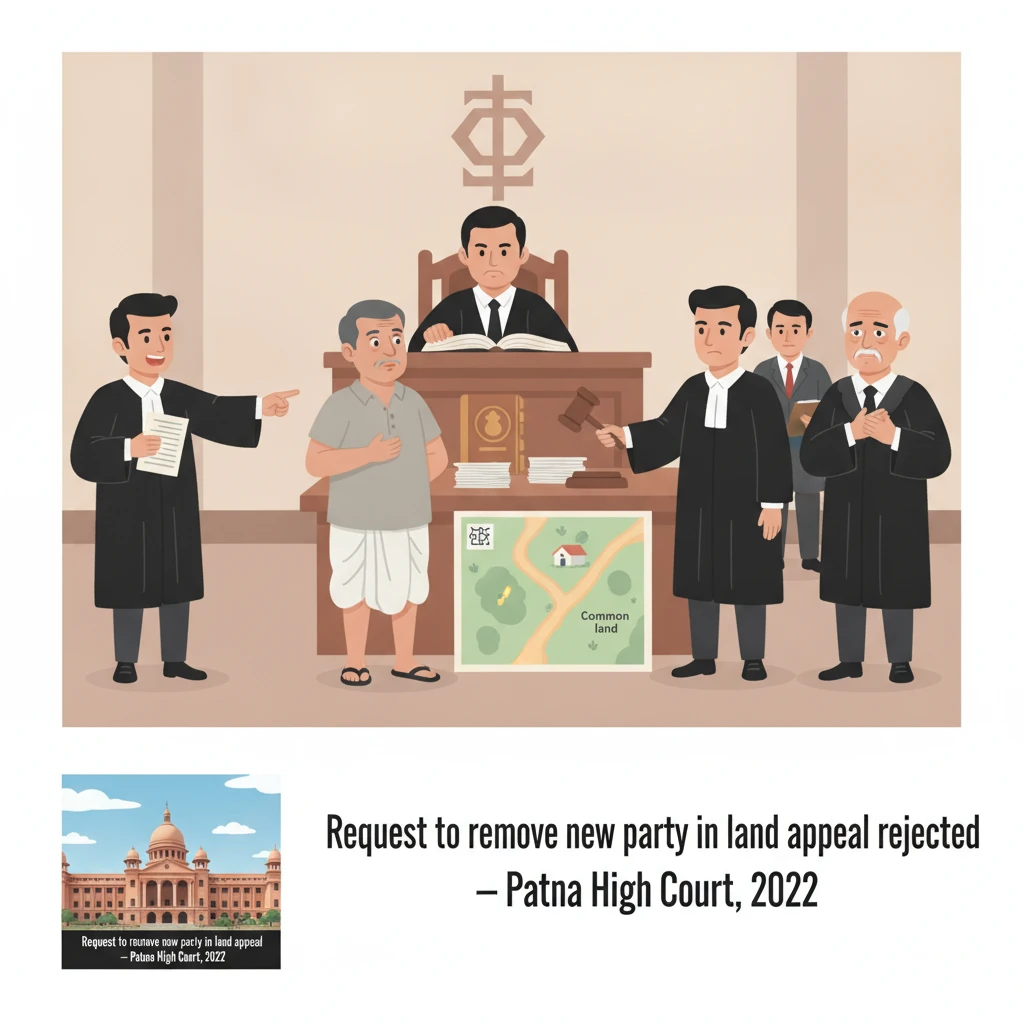
Case Background
The dispute began with a title suit over a piece of land in Village Labedaha, P.S. Ramgarh, District Kaimur. The petitioner claimed to be the khatiyani owner of the suit land. He stated that he had constructed his residential house on this land and had been living there for many years.
On this basis, the petitioner filed Title Suit No. 157 of 2003. In that suit, he asked the civil court to declare his title and to correct the entry made in the revisional survey khatiyan. According to him, the existing survey entry did not reflect his ownership correctly.
Later, the matter reached the appellate stage. Title Appeal No. 39 of 2014 came to be filed before the court of the learned Additional District Judge-III, Kaimur at Bhabhua. During the pendency of this appeal, an adjoining villager (who is respondent no. 4 in the High Court proceedings) moved an application dated 16.10.2017.
By this application under Order I Rule 10 of the Code of Civil Procedure, respondent no. 4 requested that he be added as a party-respondent in the title appeal. The lower appellate court heard the parties and, by order dated 31.08.2019, allowed this application. Respondent no. 4 was added as a respondent in the appeal, subject to payment of costs of Rs. 10,000/-.
Feeling aggrieved by this impleadment, the original plaintiff approached the Patna High Court. He filed Civil Miscellaneous Jurisdiction Case No. 3 of 2020, challenging the order of the Additional District Judge-III.
What the Court Examined and Decided
The Patna High Court, through Hon’ble Mr. Justice Anil Kumar Sinha, heard counsel for the petitioner, the State, and respondent no. 4. The central question before the Court was narrow: whether the lower appellate court was right in allowing respondent no. 4 to be added as a party to the pending title appeal.
The petitioner’s side argued that the impleadment order was legally unsustainable. According to the petitioner, respondent no. 4 had no right, title, or interest in the suit land itself. He was not claiming ownership. Instead, he was only claiming an easementary right, meaning a right of passage over the land.
The petitioner contended that such an easementary claim could not and should not be decided within the framework of the pending title appeal. In his view, introducing a person with only an alleged easementary interest would unnecessarily complicate the appeal regarding title and survey entry.
To support this position, learned counsel for the petitioner relied on the Supreme Court judgment in Ramesh Hirachand Kundanmal v. Municipal Corporation of Greater Bombay and Others, reported in (1992) 2 SCC 524. Though the High Court’s judgment does not detail the facts of that Supreme Court case, it records that the petitioner cited it to argue that the addition of respondent no. 4 as a party was not justified in law.
On the other hand, respondent no. 4 gave a very different picture of the land. His counsel submitted that the disputed land, according to both old and new survey khatiyan, is recorded as “Sarv Saadharan Aam” land. In plain terms, this means it is recorded as land for general common use of the public.
Respondent no. 4’s case was that villagers, including himself, had been using this land as a passage. Therefore, the outcome of the title appeal directly affected his interest and the interest of other villagers who used the passage. Once he came to know about the pending appeal, he approached the appellate court with an impleadment application under Order I Rule 10 CPC, so that the appeal could be decided justly, in his presence.
His counsel argued that because he had a bona fide interest in the land, he was a proper party. Without hearing him, the appellate court might pass an order prejudicial to his right of user over the land. Thus, his presence was necessary for an effective and complete adjudication of the appeal.
To support this stand, reliance was placed on a Patna High Court decision in Shakuntala Devi and Others v. Malik Mandal and Others, reported in 2008 (1) PLJR 479. That judgment, in turn, had relied on the Supreme Court decision in Dhanurdhar Prasad Singh v. Jai Prakash University and Others, reported in AIR 2001 SC 2552.
The High Court then closely examined the impugned order of the lower appellate court. The Additional District Judge-III had reasoned that, for proper adjudication of the appeal and in the interest of justice, respondent no. 4 should be added as a party. The appellate court also imposed a cost of Rs. 10,000/- on respondent no. 4 while allowing the impleadment.
The High Court reproduced paragraph 4 of the Shakuntala Devi judgment. In that paragraph, the earlier Patna High Court decision had discussed the Supreme Court ruling in Dhanurdhar Prasad Singh. There, the Supreme Court had held that when an interest in property devolves upon a person after the institution of a suit, that person is a necessary party under Order XXII Rule 10 CPC. Further, the Supreme Court clarified that a prayer to add such a party can be made not only by the person on whom the interest has devolved, but also by the plaintiff, or any other party, or any person interested.
From this, the Patna High Court in the present case drew a broader principle: a person who has some genuine interest in the subject matter of the litigation may seek to be added as a party, and courts have the power to allow such impleadment if it helps in complete and effective adjudication.
The Court then turned to the petitioner’s reliance on the Supreme Court judgment in Ramesh Hirachand Kundanmal. After considering the submissions, the Patna High Court concluded that this authority did not apply to the facts of the present case. The judgment does not elaborate further on the reasons for non-applicability, but it clearly states that the precedent does not support the petitioner’s challenge here.
Importantly, the Court examined both the factual background and the “nature of interest” put forward by respondent no. 4. Respondent no. 4 asserted that the land is recorded as general common land used as a passage, and that he and other villagers are users of this passage. In the Court’s view, this claim showed that he has some interest in the decision of the appeal relating to the same land.
On this basis, the High Court held that the lower appellate court had not committed any material irregularity or jurisdictional error by allowing the application under Order I Rule 10 CPC. The addition of respondent no. 4 as a party was found to be a proper exercise of judicial discretion aimed at doing complete justice between all interested persons.
Having reached this conclusion, the Patna High Court dismissed Civil Miscellaneous Jurisdiction Case No. 3 of 2020. It found no merit in the petitioner’s challenge to the impleadment order. No further directions were given, and the Court ordered that there would be no order as to costs in the High Court proceedings.
As a result, the title appeal before the Additional District Judge-III, Kaimur at Bhabhua, will continue with respondent no. 4 as one of the respondents. His rights and claims regarding use of the land as a passage can now be considered as part of the appeal proceedings, along with the petitioner’s claim of exclusive title and the request for correction of the survey entry.
Why This Judgment Matters
This judgment is important for villagers and landowners who are involved in civil disputes about land that may also be used by others, such as passages, pathways, or common areas.
The Patna High Court has confirmed that if a person can show a genuine interest in the land which is the subject of a court case, the court can allow that person to be added as a party in order to decide the matter fairly. This is true even when the person is not claiming full ownership but is affected by the outcome.
For people living in rural areas of Bihar where survey records and village pathways are often disputed, this ruling shows that neighbours and users of common land can ask the court to hear them if the case may impact their lawful use. At the same time, the original parties must be ready for such persons to participate in the case if the court finds their interest to be bona fide.
The decision also signals that the Patna High Court will not interfere with a lower court’s discretionary order of impleadment under Order I Rule 10 CPC unless there is a clear irregularity or jurisdictional error. If the lower court has applied its mind and acted to secure a proper adjudication, the High Court is likely to uphold that decision.
Legal Issues and Answers
- Issue: Whether the lower appellate court was wrong in allowing a neighbouring villager, claiming use of the land as a passage, to be added as a respondent in a pending title appeal under Order I Rule 10 CPC.
Answer: The Patna High Court held that the lower appellate court acted correctly and committed no material irregularity or jurisdictional error in adding respondent no. 4 as a party, since he had an interest in the suit land and his presence would help in proper adjudication. - Issue: Whether the Supreme Court decision in Ramesh Hirachand Kundanmal v. Municipal Corporation of Greater Bombay and Others barred such impleadment in the present facts.
Answer: The Court held that the judgment in Ramesh Hirachand Kundanmal was not applicable to this case. - Issue: Whether any person other than the original parties can seek impleadment when they are interested in the subject matter of the case.
Answer: Relying on Shakuntala Devi and the Supreme Court’s ruling in Dhanurdhar Prasad Singh, the Court recognised that leave to add a party may be sought not only by a person upon whom interest has devolved, but also by the plaintiff or any other party or person interested.
Cases Cited by the Court
- Ramesh Hirachand Kundanmal v. Municipal Corporation of Greater Bombay and Others, (1992) 2 SCC 524 (cited by petitioner; held not applicable).
- Shakuntala Devi and Others v. Malik Mandal and Others, 2008 (1) PLJR 479 (relied upon by respondent no. 4 and discussed by the Court).
- Dhanurdhar Prasad Singh v. Jai Prakash University and Others, AIR 2001 SC 2552 (Supreme Court decision relied on in Shakuntala Devi and referred to by the Court).
Case Details
Case Number: Civil Miscellaneous Jurisdiction No. 3 of 2020
Case Title: Shujan Singh v. The State of Bihar and Others
Coram: Hon’ble Mr. Justice Anil Kumar Sinha
Citation: 2022 (3) PLJR 243
Nature of the Case: Civil miscellaneous application challenging an order of the lower appellate court allowing impleadment of a new respondent in a title appeal under Order I Rule 10 CPC.
Advocates:
- For the petitioner: Mr. Waliur Rahman, Mr. Shyam Bihari Singh
- For the State: Mr. Abhay Kumar Kashyap
- For respondent no. 4: Mr. Yogendra Kumar
Date of High Court Judgment: 28.06.2022
Link to Full Judgment: https://patnahighcourt.gov.in/viewjudgment/NDQjMyMyMDIwIzEjTg==-f5sU668Cokc=
If you found this explanation helpful and wish to stay informed about how legal developments may affect your rights in Bihar, you may consider following Samvida Law Associates for more updates.







