

Case Background
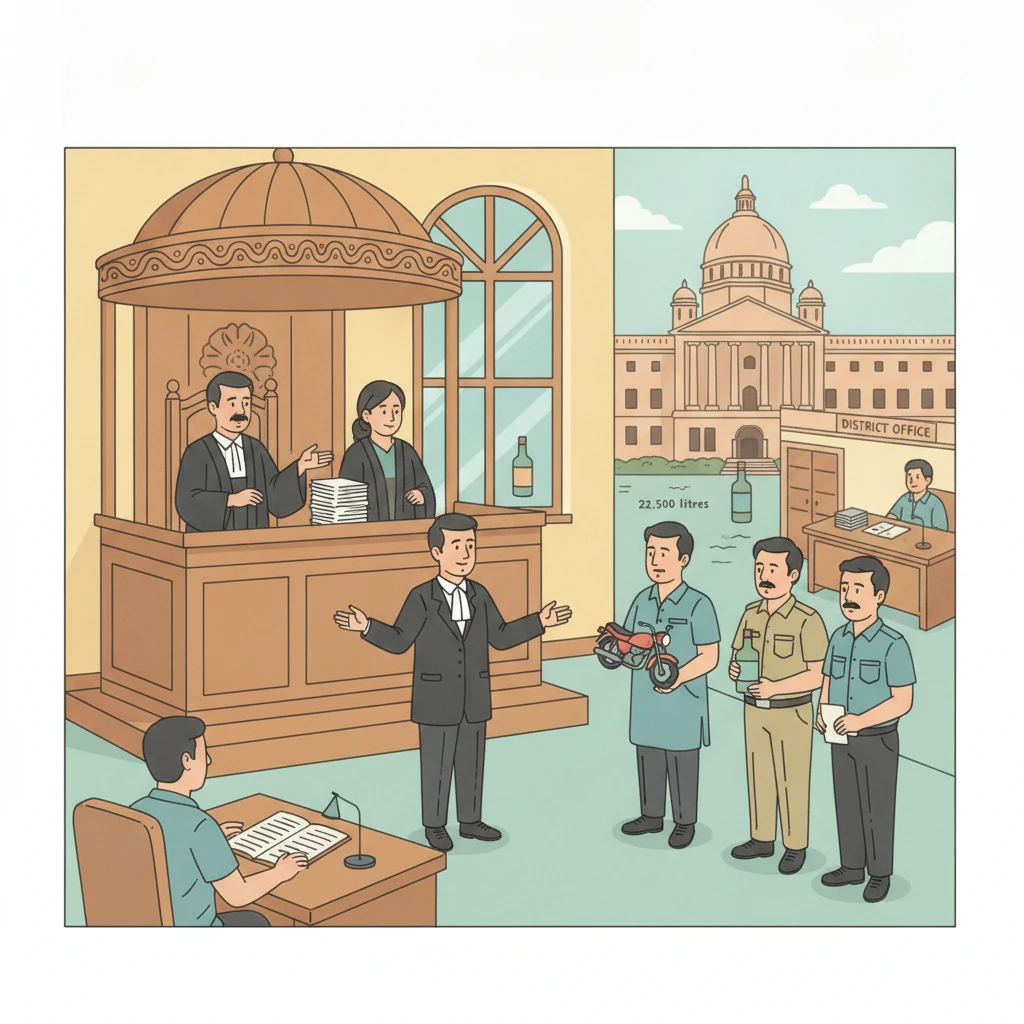
The case arose from Alamganj Police Station Case No. 12 of 2020, which was later registered as Special Case No. 3449 of 2020 under the Bihar Prohibition and Excise Act, 2016. According to the First Information Report (FIR), 22.500 litres of foreign liquor were recovered from the bag of accused persons named in that FIR. The present petitioner was not one of those accused persons.
However, during the investigation, the police seized a motorcycle bearing Registration No. BR-01DV-0767, Chassis No. MD637AE71J2E16743, Engine No. AE7EJ2616380. The motorcycle belonged to the petitioner. The seizure was in connection with the same liquor case.
Feeling aggrieved, the owner approached the Patna High Court by filing Civil Writ Jurisdiction Case No. 10665 of 2020. He asked for release of his motorcycle and for directions that the authorities should not confiscate it or proceed further with confiscation while the writ case was pending.
The petitioner also asked for a declaration that the Collector‑cum‑District Magistrate, Patna, had no jurisdiction to start confiscation proceedings regarding the motorcycle when a criminal case was already pending against other accused persons in the FIR, not against him.
What the Court Examined and Decided
When the matter came up on 11 May 2022, the Patna High Court (Division Bench comprising the Hon’ble Chief Justice and Hon’ble Mr. Justice S. Kumar) heard counsel for the petitioner and for the State of Bihar.
At the very outset, learned counsel for the petitioner requested that this writ petition be disposed of in terms of earlier orders of the Court passed in similar matters. These included:
Order dated 9 January 2020 in CWJC No. 20598 of 2019 (Md. Shaukat Ali v. State of Bihar);
Order dated 14 January 2020 in CWJC No. 17165 of 2019 (Umesh Sah v. State of Bihar & Ors.); and
Order dated 29 January 2020 in CWJC No. 2050 of 2020 (Bunilal Sah @ Munilal Sah v. State of Bihar & Ors.).
Learned counsel for the State had no objection to this course.
The Bench then took note of the larger background under the Bihar Prohibition and Excise Act, 2016. Section 13 of the Act completely prohibits manufacture, storage, distribution, transportation, possession, sale, purchase and consumption of any intoxicant or liquor, except as allowed under the Act.
The Court explained that in addition to criminal penalties for offences, Section 56 of the Act provides for confiscation of “things” used in the commission of such offences. This includes liquor, materials, utensils, receptacles, vehicles and even premises used for storage or manufacture of liquor.
Further, Section 58 vests the power of confiscation in the District Collector or an authorised officer. Once a seizing officer reports detention of any property, the Collector must initiate confiscation proceedings and pass an order.
The Court recorded that, over the years, it had been flooded with petitions because confiscation proceedings were either not being started or not being concluded in reasonable time. In many cases, vehicles and properties lay seized for long periods, leading to national loss and hardship to owners, while the authorities failed to move under the Act.
On earlier occasions, the Patna High Court had identified several recurring problems:
(a) seizure of vehicles or property with no initiation of confiscation under Section 58;
(b) confiscation proceedings started but not concluded promptly;
(c) parties obtaining interim release of vehicles through writ petitions, but thereafter not participating in confiscation proceedings;
(d) confiscation orders not being communicated, preventing owners from filing appeals under Section 92 or revisions under Section 93; and
(e) appeals or revisions under Sections 92 or 93 also not being decided within a reasonable time because of inaction or non-cooperation.
Because of this, the Court had already issued detailed directions in earlier cases to streamline the process. In Manish Kumar Chaudhary v. State of Bihar (CWJC No. 3245 of 2017, order dated 18 January 2020), the Court set out a detailed framework. Key features included:
interim release of vehicles or properties already granted by the Court to continue until completion of confiscation proceedings and appeals, subject to cooperation by owners and no transfer of property;
a mandate that where confiscation had not started, the appropriate authority must begin proceedings within four weeks and conclude them within two months of initiation, after following principles of natural justice;
a direction that appeals under Section 92 must be filed within statutory time and be decided within two months;
a relaxation that if confiscation orders already existed, appeals filed within a fixed period would not be rejected as time-barred and must be decided on merits; and
permission for the authorities to take back possession and sell the property in accordance with the Act if the owner did not cooperate or did not file appeal in time.
Similarly, in Md. Shaukat Ali (CWJC No. 20598 of 2019), the Court ordered that where vehicles had been seized but confiscation had not started, the proceedings must be initiated within 15 days and concluded within 30 days. The petitioner was to appear before the Collector on a specific date, and if proceedings could not be concluded in time, the authority could consider interim release on suitable terms.
In that case, the Court also clarified, for future guidance, that the phrase “reasonable delay” in Section 58 should generally mean a maximum of three months to decide confiscation proceedings.
These directions were reiterated in Umesh Sah (CWJC No. 17165 of 2019) and later expanded in Bunilal Sah @ Munilal Sah (CWJC No. 2050 of 2020). In Bunilal Sah, the Court expressed serious concern that despite its earlier orders, authorities were still not initiating confiscation proceedings, resulting in thousands of cases in trial courts and the High Court for release of vehicles under the Prohibition Act.
The Bench recorded that, in some previous decisions such as Diwakar Kumar Singh v. State of Bihar and Shobha Devi v. State of Bihar, the Court had also laid down that:
District Magistrates must pass speaking orders in confiscation proceedings, especially where vehicles were seized only on allegations of drunken driving and no liquor was recovered from the vehicle;
without deciding the applicability of Section 56 as a preliminary issue, further confiscation proceedings could not continue; and
in cases of wrongful seizure where no liquor was recovered from the vehicle, the owner might be entitled to compensation recoverable from the erring police officer.
In yet another case, Vishal Kumar v. State of Bihar (CWJC No. 6148 of 2020), this very Bench had reiterated that all proceedings must be concluded within three months from the date the owner appears before the authority. If the authority failed to do so, the vehicle or property should be released on conditions considered fit by the competent authority.
Against this extensive background, the Bench in the present case decided to apply the same framework. It noted that, in many cases, proceedings under Sections 58, 92 or 93 were still not being concluded in time.
The Court therefore directed that all proceedings under Section 58 must be both initiated and concluded within ninety days from the date the parties appear before the authority. Similarly, any appeal or revision must be decided within thirty days from initiation. If this is not done, the seized “things” (including vehicles and properties) shall be deemed to have been released in terms of the earlier orders, particularly those referenced in Bunilal Sah @ Munilal Sah.
The Court also protected owners who had missed limitation for appeal or revision. It stated that wherever confiscation proceedings had already concluded and parties could not file appeal or revision within the statutory period, if they now filed such proceedings within thirty days, the plea of limitation would not defeat them and the matters would be decided on merits.
As far as the present petitioner was concerned, his counsel undertook that he would appear before the appropriate authority on 30 May 2022 at 10:30 A.M. That authority could be the Collector of Patna District, the Appellate Authority or the Revisional Authority, depending on the stage of the case.
If the Collector himself was not dealing with the matter due to delegation, he was directed to fix another date within one week for appearance before the authorised officer and inform that officer accordingly. The Court also clarified that, considering the Covid‑19 pandemic, authorities could hear parties using technology such as video conferencing.
Importantly, during the hearing the State’s counsel informed the Court that, while the writ petition was pending, the Bihar Prohibition and Excise Rules, 2021, had been amended and a new Rule 12(A) had been inserted.
Rule 12(A) provides a specific mechanism for release of seized vehicles, conveyances, vessels and animals on payment of penalty. In brief, it states that:
On an application in Form IV by the owner, the Collector or authorised officer may release the seized vehicle on payment of a penalty assessed at 50% of the latest insured value or, if necessary, the value determined by the District Transport Officer.
If the owner is not identifiable or does not come forward within 15 days of seizure, the Collector must proceed to confiscate and auction the vehicle.
If the Collector feels that release of the vehicle would not be in public interest, he may proceed directly with confiscation and auction.
Where valuation or insurance is not possible, the Collector may impose such fine as deemed fit, keeping in view the economic status of the individual, nature of involvement and quantity of intoxicant recovered.
The penalty is non‑refundable regardless of the outcome of the criminal trial, and the owner must produce the vehicle whenever required.
There is also an explanation that in all pending or ongoing cases of confiscation or auction, the Collector may give an opportunity to the existing owner to pay this penalty and get the vehicle released, and on payment the ongoing confiscation or auction can be dropped.
Taking this amendment into account, the Court concluded that the proper course was not to itself order release of the motorcycle but to leave the matter to the statutory authority under the new Rule 12(A).
Accordingly, the writ petition was disposed of with liberty to the petitioner to avail the remedy of Rule 12(A) of the Bihar Prohibition and Excise (Amendment) Rules, 2022. The Court expressly stated that it had not expressed any opinion on the merits of the case.
The petitioner was also given general liberty to take such other remedies as are available in law if needed in future.
Why This Judgment Matters
This decision is important for vehicle owners whose cars, bikes, or other conveyances have been seized in liquor cases under Bihar’s prohibition law.
First, the Patna High Court again made it clear that authorities cannot keep seized vehicles indefinitely without completing confiscation proceedings. If the Collector and appellate authorities do not act within the specified time, the vehicle is to be treated as released.
Second, the Court recognised the new Rule 12(A) which allows owners to get back their vehicles by paying a fixed penalty based on insured value or valuation. This gives a clear, time‑bound route outside long court battles.
Third, by not deciding the merits and directing the owner to use Rule 12(A), the Court reinforced that statutory remedies under the Bihar Prohibition and Excise Act and Rules are the primary path. Writ petitions are not meant to bypass this framework.
In practice, this means that if a vehicle is seized in a liquor case, the owner should promptly approach the Collector under Rule 12(A) instead of waiting years or depending only on High Court orders. It also puts pressure on authorities to respect the deadlines fixed by the Court.
Legal Issues and Answers
Issue: Can the Patna High Court directly order release of a seized vehicle in a liquor case when confiscation machinery under the Bihar Prohibition and Excise Act exists and has been further strengthened by Rule 12(A)?
Answer: The Court chose not to order direct release. Instead, it applied its earlier directions on time-bound confiscation and referred the owner to the statutory remedy under new Rule 12(A), leaving merits open.
Issue: Within what time must confiscation, appeal and revision proceedings under the Bihar Prohibition and Excise Act be completed to avoid undue hardship and misuse of seizure powers?
Answer: Confiscation proceedings under Section 58 must be initiated and concluded within ninety days from appearance of the parties, and appeals or revisions under Sections 92 and 93 must be decided within thirty days of initiation, failing which the seized property is deemed to be released.
Issue: What happens where parties could not file appeal or revision against confiscation orders within the prescribed limitation period due to the earlier confusion and delays?
Answer: If such parties now file appeal or revision within thirty days, the plea of limitation will not be allowed to defeat their cases; matters must be decided on merits.
Cases Cited by the Court
- CWJC No. 3245 of 2017, Manish Kumar Chaudhary v. State of Bihar & Ors. (order dated 18.01.2020)
- CWJC No. 20598 of 2019, Md. Shaukat Ali v. State of Bihar & Ors. (order dated 09.01.2020)
- CWJC No. 17165 of 2019, Umesh Sah v. State of Bihar & Ors. (order dated 14.01.2020)
- CWJC No. 2050 of 2020, Bunilal Sah @ Munilal Sah v. State of Bihar & Ors. (order dated 29.01.2020)
- CWJC No. 5049 of 2018, Diwakar Kumar Singh v. State of Bihar & Ors.
- CWJC No. 15003 of 2019, Shobha Devi v. State of Bihar & Ors.
- CWJC No. 6148 of 2020, Vishal Kumar v. State of Bihar & Anr. (order dated 04.06.2020)
- Other co‑ordinate Bench decisions listed within Md. Shaukat Ali and Umesh Sah, referenced for the practice on provisional release and confiscation, are also cited.
Case Details
Case Number: Civil Writ Jurisdiction Case No. 10665 of 2020
Case Title: Jitendra Kumar v. The State of Bihar & Ors.
Court: High Court of Judicature at Patna
Coram: Hon’ble the Chief Justice; Hon’ble Mr. Justice S. Kumar (oral judgment by Hon’ble Mr. Justice S. Kumar)
Date of Judgment: 11-05-2022
Citation: 2022 (3) PLJR 245
Advocates: Mr. Jharkhandi Upadhyay, Advocate for the petitioner; Mr. Kumar Manish, S.C. 5 for the respondents/State
Nature of the Case: Writ petition under civil writ jurisdiction seeking release of seized motorcycle, restraint and challenge to confiscation proceedings under the Bihar Prohibition and Excise Act, 2016
Statutory Provisions Involved: Sections 13, 30(a), 32(1), 32(B), 41(1), 42(2), 56, 58, 92, 93, 57B(1) of the Bihar Prohibition and Excise Act, 2016; Rule 12(A) of the Bihar Prohibition and Excise Rules, 2021, as amended by Bihar Prohibition & Excise (Amendment) Rules, 2022
Related Criminal Case: Alamganj P.S. Case No. 12 of 2020; Special Case No. 3449 of 2020
Link to Judgment: Full text of judgment on Patna High Court website
If you found this explanation helpful and wish to stay informed about how legal developments may affect your rights in Bihar, you may consider following Samvida Law Associates for more updates.







