

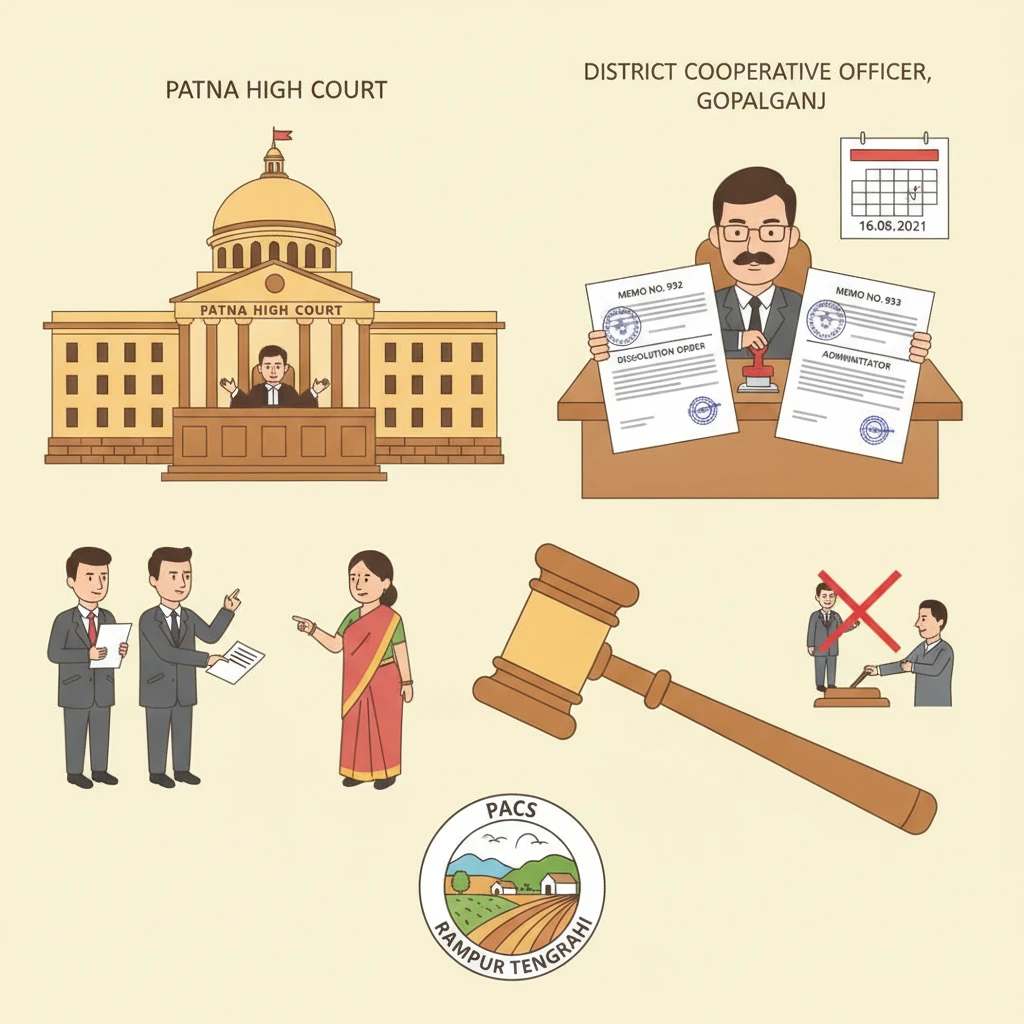
Case Background
The case arose from actions taken against Rampur Tengrahi Primary Agriculture Credit Society (PACS) under Gopalganj Sadar Block in Gopalganj district.
On 16.08.2021, the District Cooperative Officer, Gopalganj, passed an order dissolving the PACS. This was done by Memo No. 932. The officer acted under Section 41(iv) of the Bihar Cooperative Societies Act, 1935, stating that there was a stalemate in the constitution and functioning of the PACS Board.
On the same date, 16.08.2021, by a separate order issued under Memo No. 933, the District Cooperative Officer appointed an Administrator for the PACS. This appointment was made under Section 14(10) of the Bihar Cooperative Societies Act, 1935.
The petitioner, associated with the PACS at village Rampur in Gopalganj district, felt aggrieved by these two orders. Instead of filing an appeal before the statutory appellate authority under the Act, she approached the Patna High Court under Article 226 of the Constitution of India by filing Civil Writ Jurisdiction Case No. 17214 of 2021.
In this writ, she challenged both orders dated 16.08.2021, namely, the dissolution of the Executive Committee of the PACS and the appointment of an Administrator.
What the Court Examined and Decided
The Division Bench of the Patna High Court, comprising Hon’ble Mr. Justice Chakradhari Sharan Singh and Hon’ble Mr. Justice Madhuresh Prasad, heard the matter on 09.05.2022.
The Court recorded that it had heard learned counsel appearing for the petitioner as well as for the State respondents.
The central facts before the Court were straightforward. First, the District Cooperative Officer, Gopalganj, had exercised power under Section 41(iv) of the Bihar Cooperative Societies Act, 1935. By using this provision, he dissolved the Rampur Tengrahi PACS through an order dated 16.08.2021, issued under Memo No. 932. The reason cited was a stalemate in the constitution and functioning of the PACS Board.
Secondly, after dissolving the Executive Committee, the same officer appointed an Administrator for the PACS. This was done under Section 14(10) of the Act, by another order of the same date, 16.08.2021, issued under Memo No. 933.
The writ petition directly questioned the legality and correctness of both these orders.
On behalf of the petitioner, learned counsel attempted to convince the Court that the District Cooperative Officer had first accepted the resignation of some members of the Executive Committee. According to the petitioner, this acceptance of resignation was not permissible for the District Cooperative Officer. In other words, the petitioner’s counsel wanted the Court to treat the subsequent dissolution and appointment of an Administrator as tainted because, in his view, the officer had acted beyond his powers in accepting resignations of committee members.
The Court, however, was not persuaded to examine these arguments in depth. Instead, it focused on two clear reasons for refusing to interfere in the writ jurisdiction.
First, the Bench looked at the nature and duration of the impugned orders. Under Clause (iv) of sub-section (1) of Section 41 of the Bihar Cooperative Societies Act, 1935, an order dissolving the managing committee and appointing an Administrator operates only for a limited period of six months from the date of issuance.
The Court noted that, as per the law itself, the impugned order dated 16.08.2021 issued under Memo No. 932, and the related order under Memo No. 933, were each operative only for six months from 16.08.2021.
In fact, in the order appointing the Administrator (Memo No. 933 dated 16.08.2021), it was specifically written that the appointment would be for a term of six months from the date of issuance of that order.
By the time the writ petition was being heard on 09.05.2022, this six-month period from 16.08.2021 had already expired. The Court therefore found that the challenged orders were, by their own terms and by the statutory scheme, no longer in force.
The Bench also noted another important factual gap. In the pleadings filed by the petitioner, there was no mention at all of what happened in the PACS after the expiry of these six months. There was no disclosure or update about developments after issuance of the orders under Memo Nos. 932 and 933, both dated 16.08.2021.
Because of this, the Court had no material to show any continuing effect of those orders or any present injury that still needed correction. This weakened the petitioner’s request for intervention under Article 226.
The second major reason the Court highlighted was the availability of an alternative statutory remedy.
The Bench observed that if the petitioner was genuinely aggrieved by the orders dated 16.08.2021, she had a clear remedy of appeal under Section 41(vi) of the Bihar Cooperative Societies Act, 1935.
This provision allows an appeal before the appropriate appellate authority against such orders passed under Section 41. The petitioner, however, had not availed this remedy. Instead, she directly approached the High Court in writ jurisdiction.
The Court considered this conduct important. Generally, High Courts under Article 226 are slow to interfere where an effective statutory appeal is available, unless there are exceptional circumstances. In this case, no such exceptional ground was shown in the judgment.
Putting these two reasons together, the Division Bench formed the view that interference was not warranted.
First, the impugned orders had a limited life of six months and appeared to have already run their course by the time of hearing. Second, an appellate forum under the cooperative societies law was available, but the petitioner did not pursue that remedy.
In paragraph 9 of the judgment, the Court clearly stated that, in its opinion, the matter did not require interference in view of the above facts and circumstances.
Consequently, in paragraph 10, the Court dismissed the writ application. There is no direction for costs or any further relief mentioned in the judgment.
Why This Judgment Matters
This judgment is significant for members and office bearers of cooperative societies in Bihar, especially those connected with Primary Agriculture Credit Societies.
First, it shows that orders dissolving a PACS managing committee and appointing an Administrator under Section 41 and Section 14 of the Bihar Cooperative Societies Act are, by design, temporary. They normally last only six months unless the statute provides otherwise. Once that period is over, it becomes harder to challenge such orders in a writ petition because the immediate effect may have already ended.
Second, the judgment underlines that when the Act gives a clear right of appeal, affected persons are expected to use that remedy. Skipping the appeal and directly coming to the High Court under Article 226 is risky. The Court may refuse to interfere, as it did here, simply because a statutory appeal was available and not used.
For ordinary members of cooperative societies, this decision emphasises the importance of understanding the time limits and remedies under the Cooperative Societies Act. If an order dissolves a managing committee or appoints an Administrator and a member feels it is illegal, they should promptly file an appeal under Section 41(vi) instead of waiting and later trying a writ petition after the six-month period is nearly over or already expired.
In short, the case reinforces two practical points: act quickly, and follow the appeal process provided in the law.
Legal Issues and Answers
Issue: Should the Patna High Court, in writ jurisdiction, interfere with the orders dated 16.08.2021 dissolving the PACS Executive Committee under Section 41(iv) of the Bihar Cooperative Societies Act, 1935 and appointing an Administrator under Section 14(10)?
Answer: No. The Court held that the orders were only operative for six months and that an appeal remedy under Section 41(vi) was available but not availed, so interference was not required.
Cases Cited by the Court
- No earlier judgments or case law are cited or relied upon in the text of this decision.
Case Details
Case Number: Civil Writ Jurisdiction Case No. 17214 of 2021
Case Title: Tara @ Tara Devi Wife of Shivji Yadav v. The State of Bihar & Ors.
Coram: Hon’ble Mr. Justice Chakradhari Sharan Singh and Hon’ble Mr. Justice Madhuresh Prasad
Citation: 2022 (3) PLJR 268
Advocates: For the petitioner – Mr. Sanjay Kumar, Advocate; For the respondents – Mr. Uday Shankar Saran Singh, GP XIX
Nature of the Case: Writ petition under Article 226 of the Constitution of India challenging orders dissolving a Primary Agriculture Credit Society’s Executive Committee and appointing an Administrator under the Bihar Cooperative Societies Act, 1935.
Date of Judgment: 09.05.2022
Link to Judgment: https://patnahighcourt.gov.in/viewjudgment/MTUjMTcyMTQjMjAyMSMxI04=-gOz6DFEr–am1—-am1–Q=
If you found this explanation helpful and wish to stay informed about
how legal developments may affect your rights in Bihar,
you may consider following Samvida Law Associates for more updates.







