
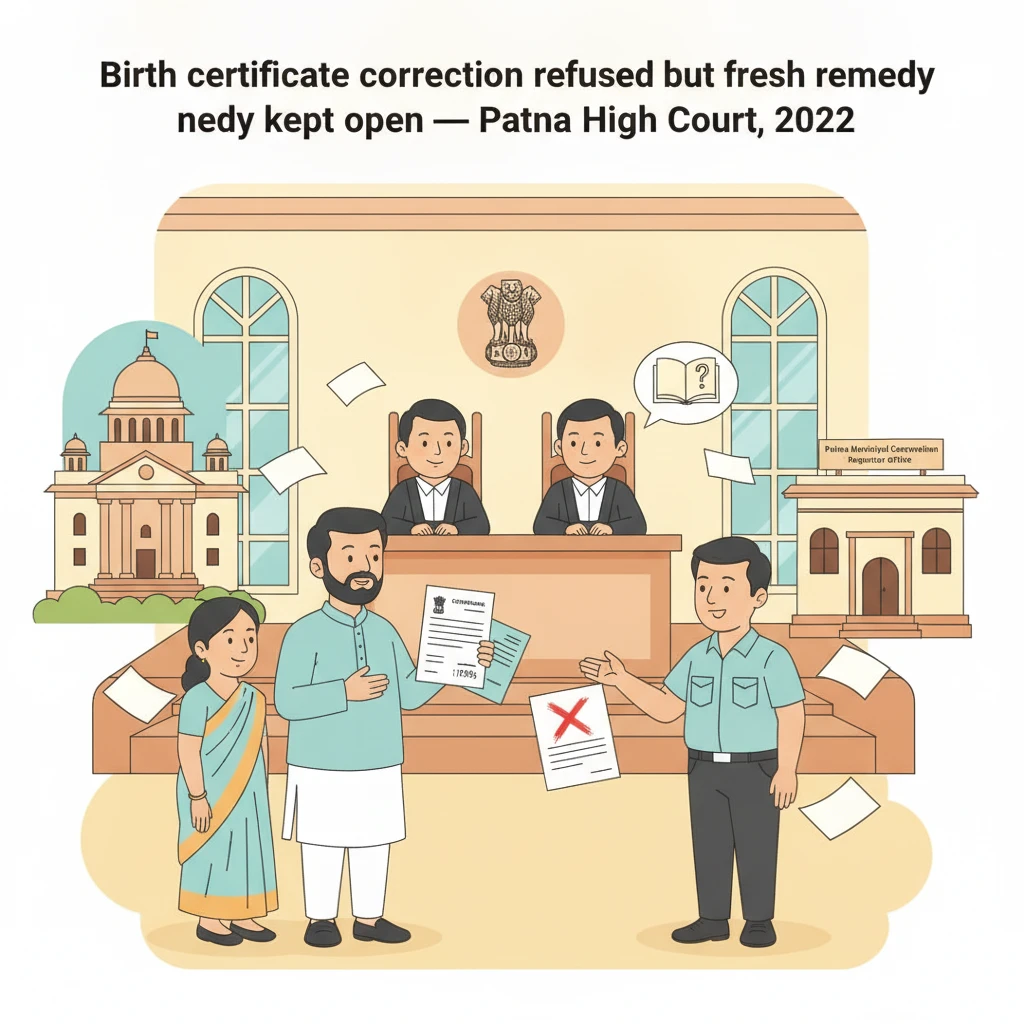
Case Background
The writ case was filed before the Patna High Court by a father. He said he is the father of twins, a son and a daughter, born on 06.01.1998.
According to him, the Patna Municipal Corporation, through the Registrar of Births and Deaths, issued birth certificates for both children mentioning their date of birth as 06.01.1999 instead of 06.01.1998.
To correct this alleged mistake, the father submitted two separate applications on 10.10.2017 before the Registrar, Births and Deaths, Patna Municipal Corporation. He sought correction of the dates of birth from 06.01.1999 to 06.01.1998.
On 18.05.2018, the Registrar rejected these applications. The endorsement was made on the very applications, stating in substance that two certificates had already been issued by the Corporation and, therefore, there was no need for any correction.
Feeling aggrieved by this rejection, the father approached the Patna High Court under its civil writ jurisdiction in CWJC No.17855 of 2019. He challenged the Registrar’s order dated 18.05.2018 and sought a direction for correction of the dates of birth.
What the Court Examined and Decided
The Division Bench of the Patna High Court, consisting of Hon’ble Mr. Justice Chakradhari Sharan Singh and Hon’ble Mr. Justice Madhuresh Prasad, heard the matter. The oral judgment was delivered on 21.04.2022 by Justice Chakradhari Sharan Singh.
The petitioner-father argued that his twins were actually born on 06.01.1998 and that the date 06.01.1999 printed in the municipal birth certificates was a clear error. To support this, he relied on certain documents.
First, he produced certificates issued by the Central Board of Secondary Education (CBSE), Delhi, in which the date of birth of both children was mentioned as 06.01.1998. Second, he relied on birth certificates issued by the doctor, which also recorded their date of birth as 06.01.1998. Third, he brought on record copies of the passports of the twins, where their date of birth was shown as 06.01.1999, matching the municipal record but contradicting the other documents on which he relied.
The Court heard the petitioner’s counsel and also counsel for Patna Municipal Corporation. The counsel for the Corporation drew the Court’s attention to Section 15 of the Registration of Births and Deaths Act, 1969 and Rule 11 of the Bihar Registration of Births and Deaths Rules, 1999.
These provisions govern how entries in the birth and death register can be corrected or cancelled.
Section 15 of the Act was quoted in the judgment. It empowers the Registrar, if satisfied that an entry of a birth or death in any register kept under the Act is erroneous in form or substance, or has been fraudulently or improperly made, to correct the error or cancel the entry. This is to be done by making a suitable marginal entry, without altering the original entry itself, and the Registrar must sign and date this marginal correction or cancellation. This power is expressly “subject to such rules” as may be made by the State Government.
The Court then referred to Rule 11 of the Bihar Rules, which lays down conditions and circumstances for correction or cancellation of entries. Sub-rule (4) of Rule 11, extracted in the judgment, is especially important in cases where a person claims that an entry is “erroneous in substance”.
Rule 11(4) says that if any person asserts that an entry in the register of births and deaths is erroneous in substance, the Registrar may correct the entry in the manner prescribed under Section 15 only when that person produces a declaration. This declaration must set out the nature of the error and the true facts of the case. It must be made by two credible persons who have knowledge of the facts.
The High Court observed that Section 15 of the Act and Rule 11(4) of the Rules together control how a date of birth can be corrected. The Registrar’s power is not unlimited. It operates only when the conditions laid down in the Rules are fulfilled.
The Court then turned to the specific facts of this case. It noted that the applications for correction were filed not by the twins themselves but by their father. During the hearing, the Bench directly asked the petitioner’s counsel why the applications were filed by the father when the persons whose dates of birth were to be corrected had already attained majority by the time of the applications.
The Court recorded that the petitioner’s counsel could not give any reasonable justification, apart from citing convenience, for the father filing the applications instead of the twins themselves. It is also recorded in the judgment that Adarsh Raj and Pallavi Raj had attained majority on the date when the applications were filed.
Before deciding whether to interfere with the Registrar’s rejection, the Court examined whether the applications met the legal requirements under Rule 11(4). On going through the applications dated 10.10.2017, the Court found that they did not comply with Rule 11(4).
The judgment clearly states that the applications were not in conformity with the requirements of sub-rule (4) of Rule 11. Specifically, there was no indication that the applications were supported by the required declaration made by two credible persons having knowledge of the facts, setting out both the nature of the error and the true facts of the case, as required by Rule 11(4).
At the same time, the Court commented on the manner in which the Registrar had rejected the applications. It observed that it did not approve of the Registrar simply writing on the same applications that two certificates had been issued by the Corporation and therefore there was no need for correction. The Court clearly disapproved this brief and unreasoned way of dealing with such applications.
Despite that criticism, the Court looked at the overall “facts and circumstances”. It concluded that the applications made by the father were “apparently defective”. Because of this defect, the Bench decided not to interfere with the Registrar’s refusal to correct the dates of birth.
Thus, the impugned order dated 18.05.2018 was not set aside. The writ petition, to that extent, failed.
However, the Court did not close the door for the twins themselves. While disposing of the writ application, it observed that Adarsh Raj and Pallavi Raj would be at liberty to apply for correction of their own dates of birth in accordance with Section 15 of the Act read with Rule 11(4) of the Rules.
The judgment further records an expectation from the Court. If the twins approach the Registrar, Births and Deaths with proper applications for correction of date of birth, the Registrar is expected to take a decision strictly in accordance with Rule 11(4) of the Rules.
In this way, the High Court balanced two aspects. On one side, it upheld the statutory scheme that demands strict compliance with procedural requirements for correction of birth entries, especially when adults are involved. On the other side, it recognised that any genuine mistake could still be corrected in future, provided the proper person applies and follows the legal conditions.
Why This Judgment Matters
This judgment is important for families and individuals who want to correct a date of birth in official birth records in Bihar.
First, it shows that even if you have school certificates or doctor’s records showing a different date, the Registrar cannot simply change the municipal birth register unless the legal procedure is followed.
Second, when the person whose birth is recorded has already become an adult, that person should normally file the application, not the parent, unless the law clearly allows otherwise. Here, the father’s applications were found defective.
Third, Rule 11(4) of the Bihar Registration of Births and Deaths Rules requires a declaration by two credible persons who know the facts, and this must explain both the error and the true facts. Without this, the Registrar is not bound to make corrections.
For ordinary citizens, the message is simple: if you believe your birth certificate carries a wrong date, you must move an application in the prescribed manner, especially after you turn 18. The Patna High Court has made it clear that courts will not easily override statutory requirements just on the basis of other documents.
At the same time, the judgment reassures affected persons that they are not left without remedy. Even after the father’s writ failed, the twins were specifically allowed to file fresh applications. The Registrar has been reminded to decide such applications strictly as per law, not through casual endorsements.
Legal Issues and Answers
Issue: Whether the Patna High Court should interfere with the Registrar’s refusal to correct the dates of birth of two individuals when the applications for correction were filed by their father and did not comply with Rule 11(4) of the Bihar Rules.
Answer: The Court refused to interfere, holding that the applications were defective and not in conformity with Rule 11(4), though it allowed the twins themselves to file fresh applications under Section 15 of the Act read with Rule 11(4).
Issue: What procedure must be followed to correct an erroneous date of birth in the register of births in Bihar.
Answer: Correction can be made by the Registrar under Section 15 of the Registration of Births and Deaths Act, 1969, only in line with Rule 11(4) of the Bihar Registration of Births and Deaths Rules, 1999, which requires a declaration explaining the error and true facts, made by two credible persons having knowledge of the case.
Cases Cited by the Court
- No earlier judgments or case law have been cited or relied upon in the text of this judgment.
Case Details
Case Number: Civil Writ Jurisdiction Case No.17855 of 2019
Case Title: Mrityunjay Prasad Sinha v. The State of Bihar and Others
Coram: Hon’ble Mr. Justice Chakradhari Sharan Singh and Hon’ble Mr. Justice Madhuresh Prasad
Citation: 2022 (3) PLJR 269
Date of Judgment: 21.04.2022
Advocates:
- For the petitioner: Mr. Hari Shankar Roy, Advocate
- For the State of Bihar: Mr. Rakesh Ambastha, AC to AAG-7
- For the Union of India: Mr. Anshay Bahadur Mathur, Advocate
- For Patna Municipal Corporation: Mr. Prasoon Sinha, Advocate and Mr. Jawed Gaffar Khan, Advocate
Nature of the Case: Writ petition under civil writ jurisdiction challenging rejection of applications for correction of date of birth in birth register.
Link to Judgment: View full judgment on Patna High Court website
If you found this explanation helpful and wish to stay informed about how legal developments may affect your rights in Bihar, you may consider following Samvida Law Associates for more updates.







