
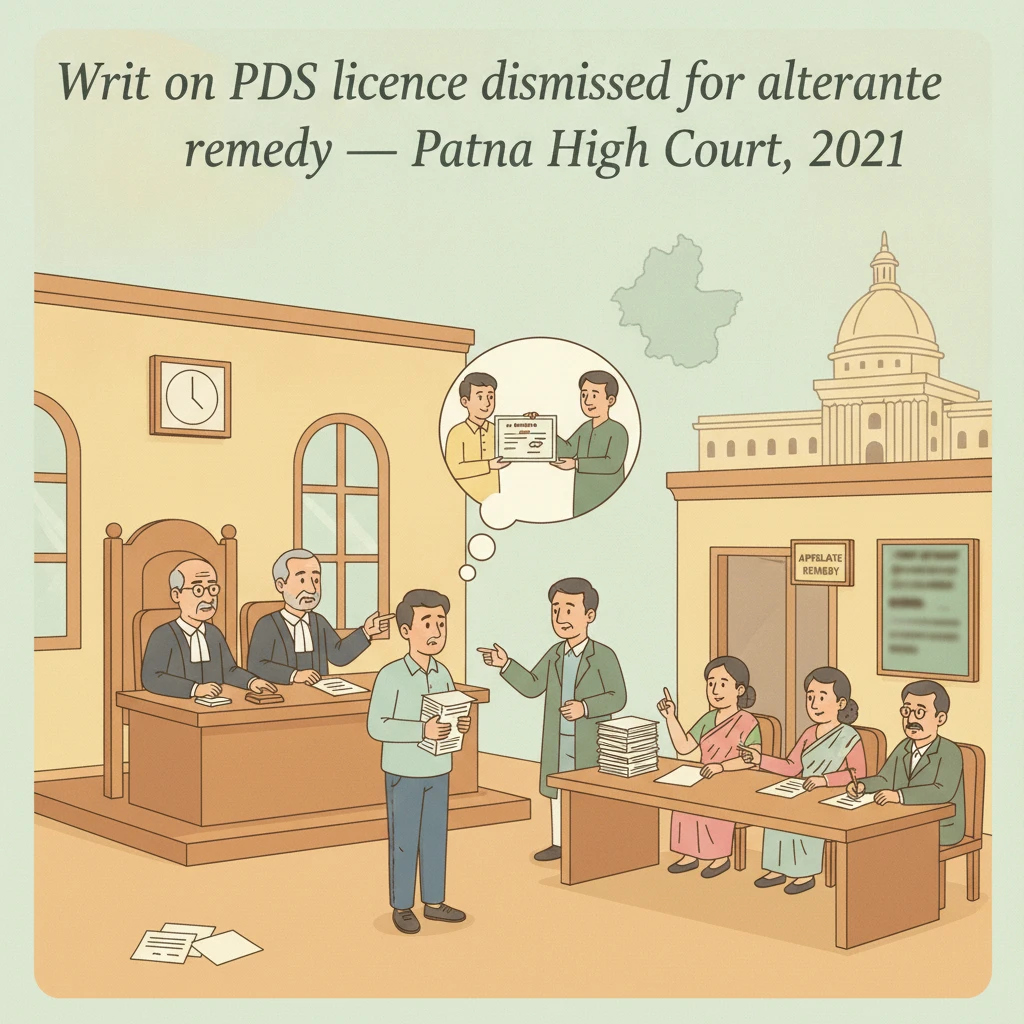
Case Background
This case arose from a dispute regarding the grant of a Public Distribution System (PDS) licence in Rohtas district, Bihar.
The petitioner, a resident of Village Gopalpur, Block Nokha, in Rohtas (Sasaram), claimed that his name had been recommended by the Sub-Divisional Officer, Sasaram, for grant of a PDS licence for the Backward (Male) category for Panchayat Modiha, Block Nokha, District Rohtas.
He felt that despite this recommendation, a meeting of the District Level Selection Committee, Rohtas, was not being held, and a PDS licence was not being issued in his favour.
Because of this, he approached the Patna High Court under its civil writ jurisdiction in CWJC No. 1375 of 2021. The writ petition was directed mainly against the State of Bihar through the Food and Consumer Protection Department and the district authorities involved in the selection and licensing process.
The matter came up before a Division Bench of the Patna High Court, consisting of Hon’ble the Chief Justice and Hon’ble Mr. Justice S. Kumar. The oral judgment was delivered on 06-12-2021 by Hon’ble Mr. Justice S. Kumar.
What the Court Examined and Decided
The petitioner’s main prayer was for a direction to the respondents, especially the District Level Selection Committee, the District Magistrate, the District Supply Officer, and the Sub-Divisional Officer, to convene a meeting of the District Selection Committee, Rohtas.
He wanted the Committee to consider his case and issue a PDS licence in his favour, on the basis that the Sub-Divisional Officer, Sasaram, had already recommended his name for the Backward (Male) category for Panchayat Modiha, Block Nokha, District Rohtas.
He also clarified that he had not earlier approached the High Court on the same subject matter.
During the hearing, the Court took note that the petitioner had filed the writ petition directly in the High Court challenging an “impugned order”. While the text of that specific order is not reproduced in the judgment, the Court clearly recorded that there exists a statutory remedy of appeal against that order.
This point was crucial. Indian high courts, including the Patna High Court, generally expect a person to first use the remedies provided under the relevant statute or rules before invoking the extraordinary writ jurisdiction under Article 226 of the Constitution.
In plain terms, if the law itself provides that you can file an appeal against an order of a government authority, the High Court will usually insist that you try that appeal first. Only in special cases—like clear lack of jurisdiction or gross violation of natural justice—does the High Court directly interfere without insisting on the alternate remedy.
Here, the Bench found that the petitioner had come to the High Court “without exhausting the statutory remedy of appeal against the impugned order”. This means that before filing the writ petition, he could, and should, have filed an appeal before the concerned appellate authority as provided by law, but he did not do so.
Because of this, the Court did not go into the factual details about the PDS licence claim, the recommendation of the Sub-Divisional Officer, or whether the District Level Selection Committee had acted correctly or incorrectly. Instead, the Court focused purely on process: the petitioner must first take the legal route that the statute offers.
At the same time, the Court showed concern that the petitioner should not be prejudiced merely because he approached the wrong forum first. Since his writ petition had been pending before the High Court, some time had already passed.
To balance this, the Court adopted a middle path. It did not grant the main relief sought, but it also ensured that the petitioner would not lose his right to appeal due to delay.
The Court, therefore, granted explicit liberty to the petitioner to avail the remedy of appeal against the impugned order before the concerned authority. It then laid down a clear time-frame and directions for both the petitioner and the appellate authority.
First, the Court directed that if the petitioner files such an appeal within four weeks from the date of the judgment, the concerned authority shall condone the delay in filing the appeal. The reason for condoning the delay was recorded: the matter had remained pending before the High Court during this period.
This is important for ordinary readers: normally, appeals must be filed within a specified time limit. If the time is over, the appeal can be rejected as “time-barred”. But by giving this direction, the Court ensured that the delay from filing and pending of the writ petition would not harm the petitioner’s chances. The appellate authority has been told in advance that this delay must be excused.
Second, the Court instructed that the appeal, once filed, should be decided “on its own merit” and “preferably within 8 weeks from the date of its filing”. This means the appellate authority must look at the facts, the documents, and the law independently, without being influenced by the High Court’s order, because the High Court has not made any finding on whether the petitioner is right or wrong on the substance.
The eight-week time frame is also significant from a practical standpoint. Many applicants suffer due to long delays in administrative decision-making. Here, by setting a preferred outer limit of eight weeks, the Court attempted to ensure a reasonably speedy decision so that the petitioner is not left waiting indefinitely for the outcome of his appeal.
Finally, in view of this liberty and these directions, the Court disposed of the writ petition. It clearly did not grant the prayer for direct issue of PDS licence, nor did it compel the District Level Selection Committee to hold a meeting in a particular way. Instead, it told the petitioner to first use the appeal mechanism and left the merits to be decided there.
The oral judgment concludes by recording that, with the aforesaid liberty, the writ petition stands disposed of.
Why This Judgment Matters
This judgment from the Patna High Court is important for anyone dealing with government schemes, licences, or permits in Bihar, especially in areas like the Public Distribution System.
It reinforces a simple but powerful principle: before approaching the High Court, you must normally use the appeal or review procedure already available in the law or rules. Skipping that step can lead to your case being thrown out without a full hearing on the facts.
At the same time, the decision shows that the Court is willing to protect genuine claimants from being punished for approaching the wrong forum first. By directing condonation of delay and fixing a time frame for decision, the Court ensured that the petitioner’s legal rights will still be examined properly by the appropriate authority.
For other candidates or license applicants who feel aggrieved by government orders, this case serves as a reminder to check what remedies are available under the scheme or statute. If an appeal is provided, they should usually file it first. If they come directly to the Patna High Court, they may only get the kind of limited relief seen here: permission to go back and file an appeal.
Legal Issues and Answers
Issue: Can a person directly invoke the writ jurisdiction of the Patna High Court against an order relating to PDS licensing without first filing the statutory appeal available under the law?
Answer: No. The Court held that since a statutory remedy of appeal existed and had not been exhausted by the petitioner, he must first approach the appellate authority. The writ petition was disposed of with liberty to file an appeal, and directions were issued for condonation of delay and expeditious disposal of that appeal.
Cases Cited by the Court
The judgment, as available, does not mention or rely upon any specific earlier cases or citations. It proceeds on the general principle regarding exhaustion of alternate statutory remedies.
Case Details
Case Number: Civil Writ Jurisdiction Case No. 1375 of 2021
Case Title: Mukesh Kumar v. The State of Bihar & Ors.
Coram: Hon’ble the Chief Justice and Hon’ble Mr. Justice S. Kumar
Citation: 2022 (3) PLJR 42
Nature of the Case: Writ petition under civil writ jurisdiction concerning grant of PDS licence
Advocates:
For the petitioner: Mr. Vijay Anand, Advocate
For the respondents (State and authorities): Mr. Lalit Kishore, A.G.
Link to Judgment: View full judgment on Patna High Court website
If you found this explanation helpful and wish to stay informed about
how legal developments may affect your rights in Bihar,
you may consider following Samvida Law Associates for more updates.







