
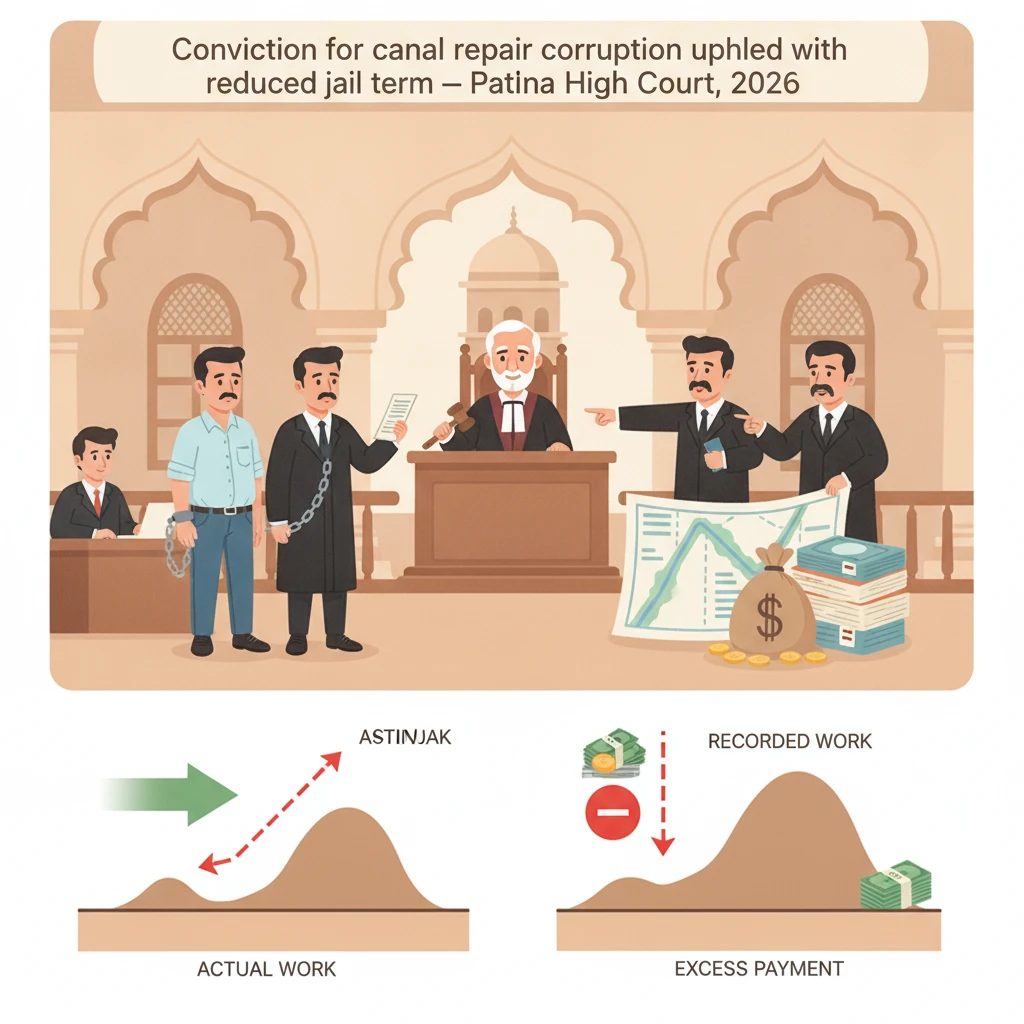
Case Background
The case arises from repair works carried out in 1986–87 on the embankments of the Ghorasahan Branch Canal and Triveni Canal in East Champaran district.
Complaints of serious irregularities in these works were raised before the 20-Point Programme Committee. On the recommendation of the concerned Minister, the State Government, by order dated 27.04.1987, directed the Vigilance Investigation Bureau, Bihar, to conduct an enquiry.
The Vigilance Bureau alleged that repair work was done at about 1000 places through different contractors. Because it was practically difficult to inspect all locations, the Vigilance team inspected 13 places on a sample basis.
At these spots, the team allegedly found that the quantities of work recorded in the Measurement Books did not match the work actually done on the ground. Bills were allegedly raised and paid on inflated measurements, leading to excess withdrawal of government money.
In the particular stretch involved in the present appeals (between R.D. 171.600 to 174.200), the estimated cost of work was Rs. 84,745/-. Against this, Rs. 62,113/- was actually paid, but the technical assessment later valued the work done at only Rs. 18,699/-. According to the Vigilance case, this meant an excess payment of Rs. 43,414/-, which, after allowing a 20% “tolerance”, came to Rs. 39,647/-.
The appellants were government engineers posted on this canal: one a Junior Engineer, the other an Assistant Engineer. The allegation was that they, in conspiracy with the contractor and others, dishonestly prepared false measurements and official records to enable fraudulent withdrawal of government funds.
A Vigilance case (Vigilance P.S. Case No. 17 of 1987, District Patna) was registered. After investigation, a Special Case No. 101 of 2002 was tried by the Special Judge, Vigilance (North Bihar), Muzaffarpur. By judgment dated 04.05.2011 and order dated 07.05.2011, the trial court convicted the appellants under Sections 467, 468, 471, 420, 120B IPC and Sections 13(1)(d) read with 13(2) of the Prevention of Corruption Act, 1988.
The trial court imposed rigorous imprisonment of ten years under Section 467 IPC, seven years under Section 468 IPC, five years under Section 420 IPC, and seven years under Section 13(1)(d) read with 13(2) of the P.C. Act, with fines. All sentences were to run concurrently, and no separate sentence was passed under Sections 471 and 120B IPC.
Aggrieved, the engineers filed Criminal Appeal (SJ) Nos. 577 and 578 of 2011 before the Patna High Court, challenging both their conviction and sentence.
What the Court Examined and Decided
The Patna High Court, through Hon’ble Mr. Justice Purnendu Singh, heard both appeals together. The Court examined the prosecution evidence, the defence arguments, and the trial court’s reasoning.
On the defence side, counsel for the appellants argued that the entire Vigilance case was based on vague and general allegations that there was misappropriation at about 1000 repair points, while only 13 locations were selectively inspected. This, they claimed, made the foundation of the case doubtful.
The appellants stressed that they were responsible only for a specific stretch of canal. They submitted that proper estimates were prepared, sanctioned by competent authorities, work orders issued as per the PWD Code, and the Measurement Book was regularly maintained. Payments, according to them, were sanctioned and released through proper treasury procedure.
The crucial challenge was to the later technical measurement and the comparative chart (Exhibit 6). Defence counsel submitted that this chart was made on plain paper, allegedly in pencil, not in accordance with prescribed technical procedure, and without signatures of the appellants, the vigilance team, or even the author.
They also pointed out that the re-measurement was done about four months after completion of work and in the rainy season, when soil erosion could reduce the visible work, making such later measurements unreliable. This concern, they noted, was indirectly admitted by the prosecution by allowing a 20% tolerance margin.
The defence further attacked the prosecution witnesses. They argued that:
- P.W.1, the Vigilance Inspector and informant, was not a technical expert and his evidence on measurement was hearsay.
- P.W.2, the treasury accountant, was a purely formal witness who only proved that a cheque had been issued.
- The entire case on excess payment rested on P.W.3, the retired Executive Engineer, whose testimony, they said, contained contradictions about rules of tolerance, delay in measurement, non-availability of records, and unexplained methodology.
The appellants also claimed they had been exonerated in departmental proceedings on similar allegations, allegedly on the finding that measurement was not done scientifically. They contended there was no mens rea, no dishonest intention, and no direct evidence of conspiracy, only suspicion. For this, they relied on the Supreme Court judgment in C. Chenga Reddy v. State of A.P. (1996) 10 SCC 193, where mere violation of codes and circulars was held insufficient to prove criminal guilt.
On the other hand, counsel for the Vigilance Department argued that the prosecution had clearly established misappropriation of government funds. They pointed to Measurement Books, vouchers, agreements, payment records and technical reports as proof that official records were deliberately falsified to release payment for work not done or exaggerated.
The Vigilance side stressed that the appellants, being the engineers in charge, had a direct role in recording and certifying measurements. Their signatures in the Measurement Book fixed their responsibility. It was also argued that conspiracy is usually proved through surrounding circumstances, not direct evidence, and reliance was placed on Supreme Court decisions in Kehar Singh, Navjot Sandhu @ Afsan Guru, and Yogesh @ Sachin Jagdish Joshi.
The High Court first outlined the legal provisions involved: cheating (Section 420 IPC), forgery (Sections 467 and 468 IPC), conspiracy (Section 120B IPC), and criminal misconduct by a public servant (Section 13(1)(d) read with 13(2) of the P.C. Act). The Court explained, in substance, that criminal misconduct under Section 13(1)(d) is made out where a public servant, by corrupt or illegal means or abusing his position, obtains for himself or another a valuable thing or pecuniary advantage without any public interest.
The Court then scrutinised the evidence. Five prosecution witnesses were examined:
P.W.1, the Vigilance Inspector, described the Government order, the enquiry into canal repairs, discovery of large-scale irregularities, and approximate defalcation of Rs. 1.5 crores in the larger project. He proved the written report (Exhibit 2), the formal FIR (Exhibit 3) and identified the Measurement Book (Exhibit 1). He admitted in cross-examination that he was not a technical man and his conclusions were based on the technical officer’s report.
P.W.2, the treasury accountant, formally proved that a cheque (Exhibit 4) was issued to the contractor and the seizure list (Exhibit 5). He candidly admitted that the cheque was not issued in his presence and that he had no personal knowledge about the contractor or the underlying work. His role was limited to explaining treasury procedure.
P.W.3, the retired Executive Engineer and technical expert, was the most crucial witness. He stated that he re-measured the canal repair work along with vigilance officers. According to his measurement, the work actually done was only worth Rs. 18,699/-, whereas Rs. 62,113/- had been paid. He prepared the comparative chart (Exhibit 6) and confirmed an excess payment of Rs. 43,414/-, which became Rs. 39,647/- after giving tolerance.
He admitted that there was no formal rule for 20% tolerance, that the measurement was done some time after completion and during the rainy season, and that some technical records were not available. He also admitted that the report did not carry all signatures. Despite this, he stood firm that substantial excess payment had been made.
P.W.4, a retired Chief Engineer, and P.W.5, a typist in the Law Department, were formal witnesses who proved the sanction orders for prosecution (Exhibits 7 and 7/1). The Court found that sanction under Section 19 of the P.C. Act was validly granted by the competent authority after applying its mind.
The High Court noted that the trial court had already considered the inconsistencies in the prosecution evidence but still found the overall case reliable. The appellate court emphasised that in corruption and financial irregularity cases, a chain of circumstances, supported by documents, is often sufficient.
The Court highlighted that documentary evidence such as Measurement Books, vouchers, agreements, payment records and the technical comparative chart are official records prepared in the course of duty and carry a presumption of correctness unless effectively rebutted. In this case, the appellants did not offer any convincing explanation or rebuttal.
Relying on the legal principles from Supreme Court cases on conspiracy and criminal misconduct, the Court held that the way measurements were inflated and payments processed clearly showed a coordinated scheme among the engineers and the contractor to siphon off government funds. The Court treated the excess payment, proved through the comparative chart and Measurement Book entries, as the pecuniary advantage obtained without public advantage, satisfying Section 13(1)(d) of the P.C. Act.
The Court distinguished the reliance on C. Chenga Reddy by noting that in that case, the prosecution had failed even to show that work was not done or that payments were for excessive work, whereas here, the technical evidence showed that the amount paid was “substantially disproportionate” to the work executed.
On this basis, the Patna High Court concluded that the prosecution had succeeded in proving beyond reasonable doubt that the appellants were part of a conspiracy, that records were manipulated, and that government funds were misappropriated through excess payment for canal repair work. The conviction under Sections 467, 468, 471, 420, 120B IPC and Sections 13(1)(d) read with 13(2) of the P.C. Act was affirmed.
However, while upholding the conviction, the Court reconsidered the quantum of sentence. It noted that the excess amount in this particular stretch was Rs. 43,414/- (Rs. 39,647/- after tolerance) and that other accused persons were also equally responsible. Taking these factors into account, the Court reduced the substantive sentence for the appellants to rigorous imprisonment of two years, instead of the much higher terms given by the trial court. The conviction and fines otherwise remained.
The Court directed that the period of custody already undergone by the appellants during investigation, enquiry and trial shall be set off against this reduced sentence in terms of Section 468 of the Bharatiya Nagarik Suraksha Sanhita (corresponding to Section 428 of the old Code of Criminal Procedure). If they have not yet completed two years in custody, they must be taken into custody forthwith to serve the remaining period.
With this modification in sentence, the appeals were partly allowed.
Why This Judgment Matters
This judgment is significant for public servants, contractors, and citizens affected by substandard public works, especially in Bihar.
First, the Patna High Court makes it clear that when official records like Measurement Books and vouchers show inflated work and excess payment, and there is a technical report supporting this, the Court will not easily accept excuses about delay in inspection or missing records unless strong rebuttal is produced.
Second, the Court reinforces that engineers and other officers responsible for certifying work cannot escape liability by blaming procedural lapses alone. When excess payment is clearly shown, courts can infer dishonest conduct and conspiracy.
At the same time, the Court recognises the scale of the alleged loss and balances punishment. Instead of the maximum ten-year sentence, it reduces the imprisonment to two years, linked to the specific excess payment in this stretch of canal. This shows that sentencing will take into account the actual proven wrongful gain or loss.
For ordinary people, the decision highlights that complaints about misuse of government funds in schemes like canal repair can lead to vigilance enquiries, criminal trials, and ultimately conviction of responsible officials, even if many years have passed since the work was done.
Legal Issues and Answers
- Issue: Whether the later technical measurement and comparative chart, despite procedural shortcomings and delay, could be relied upon to prove excess payment and misappropriation of government funds by the appellants.
Answer: Yes. The High Court held that the Measurement Book entries, comparative chart (Exhibit 6) and supporting documents, taken together, reliably established substantial excess payment, and the minor discrepancies in methodology did not shake the core prosecution case. - Issue: Whether the conduct of the appellants amounted only to departmental or “codal” violations, or whether it constituted criminal conspiracy, cheating, forgery and criminal misconduct under the P.C. Act.
Answer: The Court held that this was not a case of mere procedural lapses. The deliberate inflation of measurements and consequent excess payment showed a coordinated scheme, satisfying the ingredients of conspiracy, cheating, forgery and criminal misconduct under Section 13(1)(d) read with 13(2) of the P.C. Act. - Issue: Whether the sentence of up to ten years’ rigorous imprisonment imposed by the trial court needed interference in appeal.
Answer: Yes, partly. While affirming the conviction on all counts, the Patna High Court reduced the substantive sentence to rigorous imprisonment for two years, with set-off for custody already undergone.
Cases Cited by the Court
- Kehar Singh & Ors. v. State (Delhi Administration), 1988 (3) SCC 609 – on proof of criminal conspiracy through agreement inferred from circumstances.
- State (NCT of Delhi) v. Navjot Sandhu @ Afsan Guru, (2005) 11 SCC 600 – on cumulative effect of circumstances in conspiracy cases.
- Ram Narayan Popli v. CBI, (2003) 3 SCC 641 – on rationale for punishing conspiracy.
- Yogesh @ Sachin Jagdish Joshi v. State of Maharashtra, (2008) 10 SCC 394 – on inferring conspiracy from conduct and surrounding facts.
- C. Chenga Reddy & Ors. v. State of A.P., (1996) 10 SCC 193 – on difference between procedural violations and criminal guilt.
- Abdulla Mohd. Pagarkar v. State (Union Territory of Goa, Daman and Diu), (1980) 3 SCC 110 – referred within C. Chenga Reddy extract.
- Palanikar v. State of Bihar, (2002) 1 SCC 241 – on need for dishonest intention in criminal breach of trust.
- Dalpat Singh v. State of Rajasthan, AIR 1969 SC 17 – on ingredients of criminal misconduct under the earlier Prevention of Corruption Act.
- Rajiv Kumar v. State of U.P., (2017) 8 SCC 791 – on the independent and disjunctive nature of clauses in Section 13(1)(d) P.C. Act.
- A. Sivaprakash v. State of Kerala, 2016 (12) SCC 273 – referring to C. Chenga Reddy.
Case Details
Case Number: Criminal Appeal (SJ) No. 577 of 2011 with Criminal Appeal (SJ) No. 578 of 2011; arising out of Vigilance P.S. Case No. 17 of 1987, District Patna; Special Case No. 101 of 2002 (Vigilance), North Bihar, Muzaffarpur.
Case Title: Parash Nath Sharma v. The State of Bihar; Devanand Singh v. The State of Bihar through Vigilance Bihar.
Coram: Hon’ble Mr. Justice Purnendu Singh.
Citation: 2026(3) PLJR 572.
Advocates: For the appellants in both appeals – Mr. Pramod Kumar Singh, Advocate; Mr. Kamlesh Kumar, Advocate. For the Vigilance/State – Mr. Rana Vikram Singh, Advocate.
Nature of the Case: Criminal appeals (single judge) against judgment of conviction and order of sentence passed by Special Judge, Vigilance (North Bihar), Muzaffarpur, in a corruption and misappropriation case relating to canal repair works.
Final Outcome: Conviction under Sections 467, 468, 471, 420, 120B IPC and Sections 13(1)(d) read with 13(2) of the Prevention of Corruption Act, 1988 affirmed; substantive sentence reduced to two years’ rigorous imprisonment with benefit of set-off for custody already undergone; appeals partly allowed.
If you found this explanation helpful and wish to stay informed about
how legal developments may affect your rights in Bihar,
you may consider following Samvida Law Associates for more updates.







