

Case Background
The case arose from a writ petition filed by a registered contractor against the Building Constructions Department of the State of Bihar. The petitioner holds Registration No. 18260982 and used to participate in government tenders.
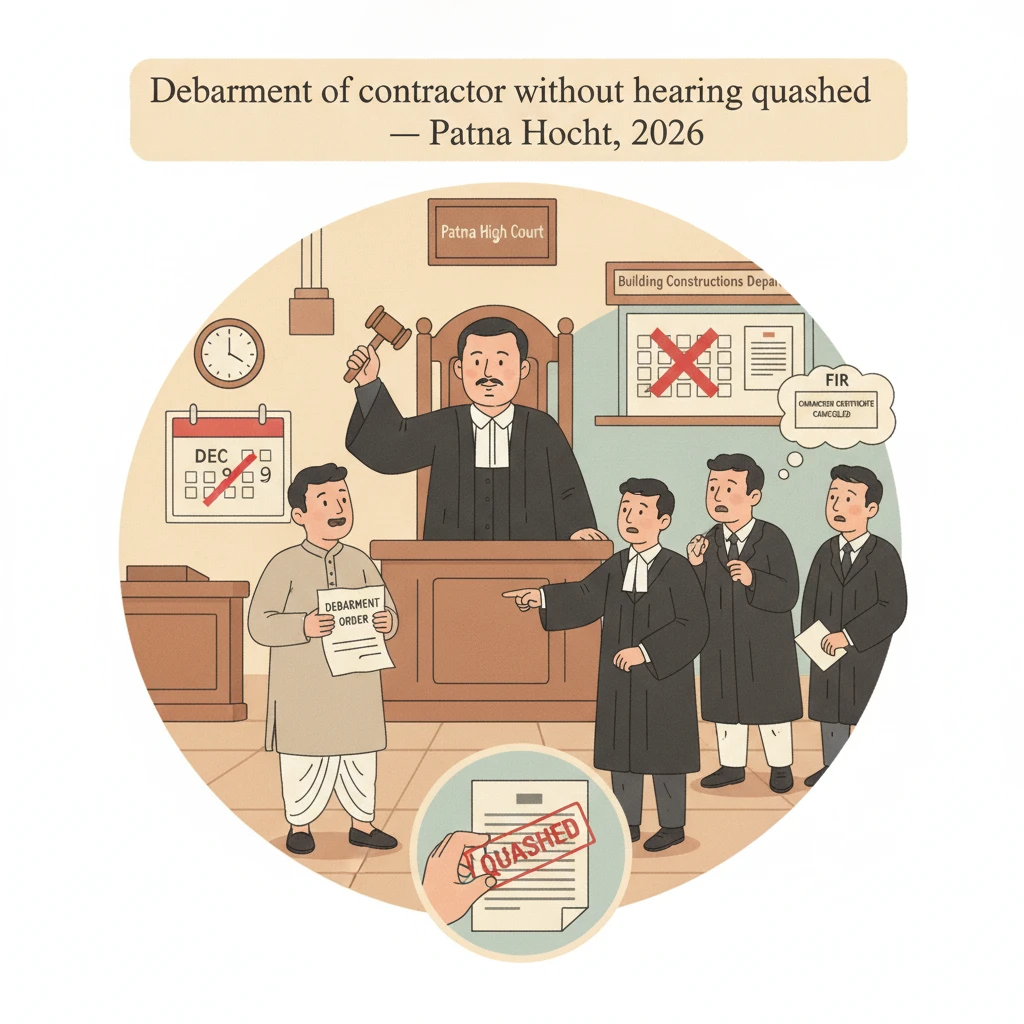
On 06.12.2024, an FIR was lodged as Gandhi Maidan P.S. Case No. 726 of 2024, in which the petitioner was implicated. After this, the Senior Superintendent of Police, Patna cancelled the petitioner’s character certificate bearing No. BCHC/2024/1111991 by Letter No. 11562 dated 09.12.2024, on the basis of an order dated 08.12.2024.
Relying on this police communication, the Executive Engineer, Gardanibagh Building Division (respondent no. 2) on the very same day issued Letter No. 3016 dated 09.12.2024. By this letter, the petitioner was debarred from participating in tenders of the department.
Feeling aggrieved, the contractor approached the Patna High Court under its civil writ jurisdiction. He sought quashing of the debarment order and other consequential directions against the authorities.
What the Court Examined and Decided
The writ petition challenged several aspects of the departmental action. The petitioner asked for writs of mandamus and certiorari against the State authorities, particularly targeting the debarment order dated 09.12.2024 issued by respondent no. 2.
He also requested directions that the respondents should not exercise their powers arbitrarily, or interfere with matters stated to be sub judice before the competent court, and claimed damages for the loss and mental agony allegedly caused by the illegal debarment without show cause notice.
The Bench of Hon’ble Mr. Justice Sudhir Singh and Hon’ble Mr. Justice Shailendra Singh heard both sides and narrowed the case down to a specific legal question: whether the respondents could legally impose debarment without specifying any definite period for which it would remain in force.
On facts, the Court noted that the debarment order was passed immediately after the cancellation of the character certificate by the police. There was nothing in the record to show that the department had started any independent proceeding before debarring the contractor.
The Court recorded that admittedly no show cause notice was given to the petitioner. He was not informed in advance that debarment was being considered. No opportunity of hearing was granted before the order was issued.
The petitioner argued that this was a direct violation of the principles of natural justice. He submitted that simply because a criminal case was pending, the department could not deprive him of participation in tenders, especially in the absence of any court verdict holding him guilty.
He further pointed out that the impugned order did not even mention for how long he was being debarred. In practice, such an order would work as an indefinite or permanent ban, which he described as arbitrary and unsustainable.
On the other hand, the State defended the action. The respondents’ counsel submitted that the petitioner had deliberately concealed the lodging of the FIR dated 06.12.2024. According to them, furnishing a valid character certificate is an essential condition in tender processes, to ensure that persons with criminal antecedents are not awarded government contracts.
They pointed out that the character certificate was cancelled by the competent authority through an order dated 08.12.2024, which had not been challenged in the present case. The authority who cancelled the certificate was also not made a party. Therefore, they argued, the consequential debarment based on that cancellation could not be faulted.
After considering the submissions, the Court turned to the governing legal principles relating to blacklisting and debarment by State authorities. It emphasised that such orders carry “serious civil consequences” because they deprive a person of the opportunity to participate in public contracts, affecting both business prospects and reputation.
The Court held that an order of this nature cannot be passed mechanically or merely on the basis of a communication from another authority. Even where the department has the power to blacklist or debar a contractor, that power must be exercised fairly, reasonably and in accord with natural justice.
To explain and support this, the Bench relied on several landmark Supreme Court decisions.
First, it cited Erusian Equipment & Chemicals Ltd. v. State of West Bengal & Anr., (1975) 1 SCC 70. In that judgment, the Supreme Court held that blacklisting affects a person’s right to equality in matters of public contracts under Article 14 of the Constitution. Since blacklisting prevents a person from entering into a lawful relationship with the Government, fair play requires observance of natural justice before passing such an order.
From Erusian Equipment, the Patna High Court extracted the principle that when the State acts to the prejudice of a person, the action must be supported by legality and must satisfy equality and fairness standards.
The Court then referred to Gorkha Security Services v. Government of NCT of Delhi & Ors., (2014) 9 SCC 105. In this case, the Supreme Court described blacklisting as “civil death” for a contractor, because it carries severe, often long-term consequences.
The Supreme Court in Gorkha Security Services laid down that, before blacklisting, the person concerned must be clearly informed through a show cause notice: one, of the specific allegations or breaches; and two, of the precise action proposed, such as blacklisting or debarment. Only then can the person meaningfully reply and contest both the allegations and the proposed penalty.
The Patna High Court quoted these principles and underlined that absence of such a show cause notice itself vitiates the action of blacklisting.
Next, the Bench discussed Kulja Industries Ltd. v. Western Telecom Project BSNL & Ors., (2014) 14 SCC 731. The Supreme Court in that case held that while the power to blacklist is inherent in any contracting party, State action in this field is subject to judicial review on the grounds of natural justice and proportionality.
Importantly, Kulja Industries clarified that debarment can never be permanent or indefinite. The period of debarment must be proportionate to the nature and gravity of the alleged misconduct, and the authority must consciously apply its mind to this aspect while passing orders.
The Patna High Court observed that the impugned order in the present case did not mention any period at all, leading in effect to an open-ended disqualification.
Finally, the Court referred to Vetindia Pharmaceuticals Limited v. State of Uttar Pradesh & Anr., (2021) 1 SCC 804. There, the Supreme Court reiterated that blacklisting without following principles of natural justice cannot stand, and noted how such orders can operate as a “civil death” with wide-ranging repercussions, even in other states or tenders.
Applying these settled principles, the Patna High Court found that the debarment order suffered from multiple legal defects. First, there was no show cause notice or opportunity of hearing. Second, there was no independent application of mind by the department, as the order appeared to rest solely on cancellation of the character certificate by the police. Third, the order did not specify any fixed duration of debarment, effectively resulting in indefinite exclusion.
The Court stated that the impugned order neither showed consideration of proportionality nor disclosed any independent satisfaction recorded by the respondent authority. On these grounds, it held that the action could not survive judicial scrutiny.
Consequently, the Court quashed and set aside the debarment order dated 09.12.2024 contained in Letter No. 3016.
However, the Court did not close the door completely for the department. It remitted the matter back to the concerned respondent authority with a direction to pass a “reasoned and speaking order” in accordance with law, clearly specifying the period of debarment if it still considered such action necessary.
With these directions, the writ application was allowed and all pending applications were disposed of.
Why This Judgment Matters
This decision is significant for contractors and suppliers who work with government departments, especially in Bihar. It confirms that departments cannot simply rely on police communications or FIRs to blacklist a contractor overnight.
Before cutting off a person’s livelihood through debarment, authorities must issue a proper show cause notice, explain the allegations, indicate the proposed penalty, and give a fair chance to reply. Orders must also clearly state how long the debarment will last, and that period must be proportionate to the alleged misconduct.
For ordinary citizens, this judgment shows that the Patna High Court closely watches whether the State respects natural justice and fairness when using its power to deny participation in public contracts.
Legal Issues and Answers
Issue: Could the respondent authorities debar the petitioner from participating in tenders without prior notice, hearing, or specifying any definite period of debarment?
Answer: No. The Patna High Court held that such debarment, passed without show cause notice, without opportunity of hearing, without independent satisfaction, and without a fixed period, violates principles of natural justice and proportionality and therefore cannot be sustained.
Cases Cited by the Court
Erusian Equipment & Chemicals Ltd. v. State of West Bengal & Anr., (1975) 1 SCC 70.
Gorkha Security Services v. Government of NCT of Delhi & Ors., (2014) 9 SCC 105.
Kulja Industries Ltd. v. Western Telecom Project BSNL & Ors., (2014) 14 SCC 731.
Vetindia Pharmaceuticals Limited v. State of Uttar Pradesh & Anr., (2021) 1 SCC 804.
Case Details
Case Number: Civil Writ Jurisdiction Case No. 6309 of 2025
Case Title: Rakesh Kumar Singh v. The State of Bihar & Ors.
Coram: Hon’ble Mr. Justice Sudhir Singh and Hon’ble Mr. Justice Shailendra Singh
Date of Judgment: 07.05.2026
Citation: 2026 (3) PLJR 536
Advocates: For the petitioner: Mr. Abhinav Kumar Singh, Advocate; Mr. Ankur Apurv Singh, Advocate. For the respondents: Mr. Sajid Salim Khan, Sr. Advocate.
Nature of the Case: Writ petition (civil) challenging an order of debarment/blacklisting from participation in government tenders.
Link to Judgment: Patna High Court official judgment link
If you found this explanation helpful and wish to stay informed about
how legal developments may affect your rights in Bihar,
you may consider following Samvida Law Associates for more updates.







