

Case Background
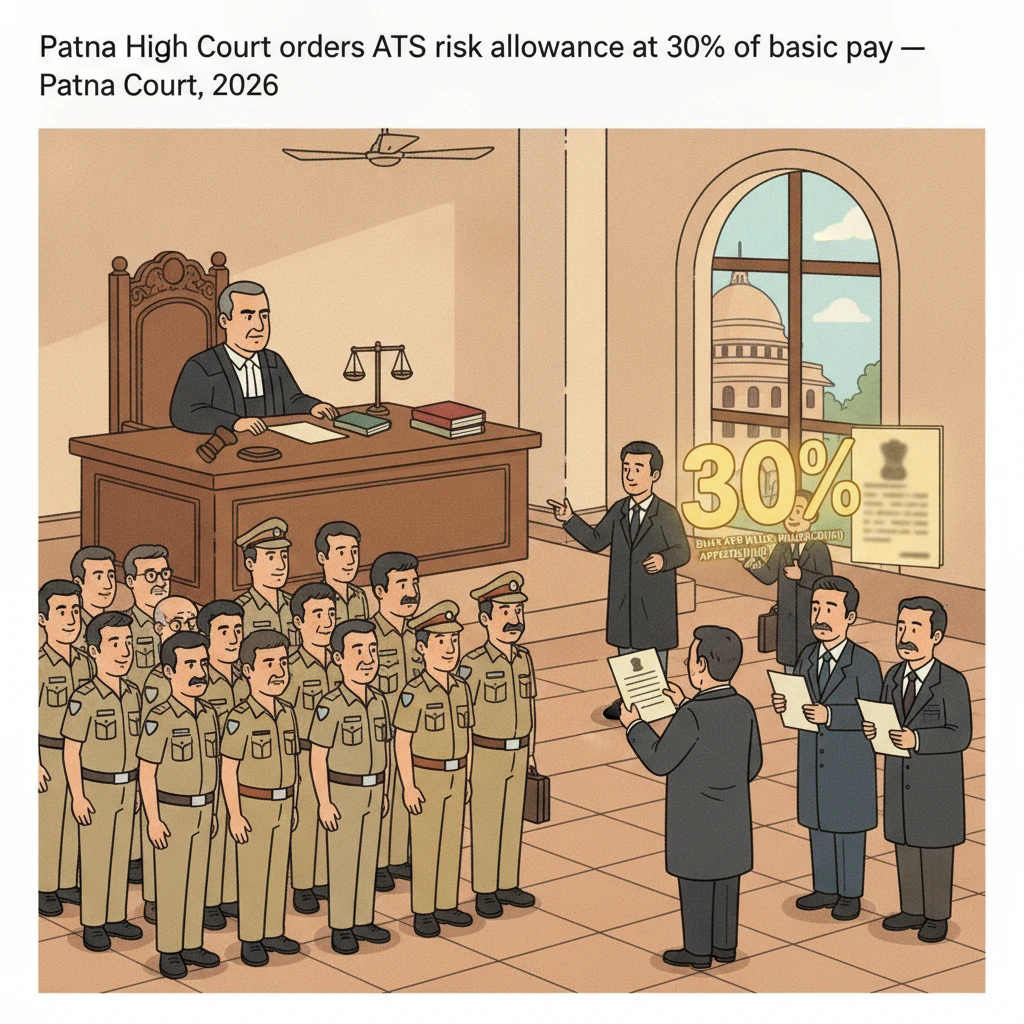
Thirty police personnel approached the Patna High Court in Civil Writ Jurisdiction Case No. 21006 of 2021. They stated that they had served in the Anti Terrorist Squad (ATS) of Bihar Police at different points of time.
Their main grievance was that during the period they worked with the ATS, they were not paid the “risk allowance” promised under the Bihar Anti Terrorist Squad Rules, 2014, later referred to in the judgment as the Bihar Anti Terrorist Squad Rules, 2024.
The petitioners said that the State itself had declared ATS duty as extremely high-risk and had fixed a special risk allowance for such personnel. Despite this, the allowance was allegedly not paid for the period of their deputation or posting in ATS. By the time of the judgment, petitioner nos. 1 and 25 had already retired.
In support of their claim, the petitioners relied upon Rule 20(1) and Appendix I(iii) of the Bihar Anti Terrorist Squad Rules, 2024, which clearly speak of a risk allowance at 30% of the basic pay for ATS personnel.
What the Court Examined and Decided
The matter was heard by Hon’ble Mr. Justice Nani Tagia on 06.05.2026. The Court heard counsel for the petitioners and counsel for the State of Bihar.
The Court first recorded that there were 30 petitioners, all working in different positions and ranks in Bihar Police. Their claim was simple: they had served with the ATS and, under the ATS Rules, were entitled to a risk allowance of 30% of their basic pay for that period. They alleged that this had not been paid.
To test this claim, the Court closely examined the relevant legal provisions, namely Rule 20(1) and Appendix I(iii) of the Bihar Anti Terrorist Squad Rules, 2024, which had been produced as Annexure-2.
Rule 20(1) states that the State Government has declared the “duty charter enjoined upon the personnel of the Squad as extremely High-Risk” and that such personnel “shall therefore, be entitled for special risk allowance as notified by the State Government.”
Appendix I(iii) then clarifies the quantum of this allowance. It provides that the personnel of the ATS will be entitled to 30% of their basic pay as risk allowance. The Court noted that Appendix I(iii) was issued by the Joint Secretary to the Government.
From these provisions, the Court drew a clear conclusion: the Bihar Anti Terrorist Squad Rules, 2024 statutorily prescribe payment of 30% of the basic pay of ATS personnel as risk allowance. Thus, any eligible ATS personnel, including the petitioners for the period they served in ATS, have a statutory entitlement.
The Court then turned to the stand of the State. The respondents, including the State of Bihar and senior police authorities, had filed counter affidavits and a supplementary counter affidavit.
In these affidavits, the Court noted an important point: at no place did the respondents deny that, under Rule 20(1) and Appendix I(iii), ATS personnel are entitled to a 30% risk allowance. Instead, the only defence taken was that this allowance could not be paid because the Finance Department had not given its approval.
While the writ petition was pending, another development took place. The petitioners filed Interlocutory Application (I.A.) No. 1 of 2025. Through this I.A., they challenged an order dated 04.09.2025, issued by the Secretary, Finance Department, Government of Bihar, vide Memo No. 3,&3&Hkrk&03/2025&9539/fo0.
By this Finance Department order, a consolidated amount of Rs. 25,000 (maximum) was proposed to be paid as risk allowance to ATS personnel. This was in place of the 30% of the basic pay prescribed under Appendix I(iii). The petitioners contended that this memo was contrary to the ATS Rules and therefore illegal.
The State’s counsel informed the Court that he had not received any instructions on the I.A. However, the record showed that I.A. No. 1 of 2025 had been filed on 13.11.2025 and that a copy had been served upon the learned counsel for the State on 14.11.2025. Despite this, the State had not filed any counter affidavit in response to the I.A.
The Court took note of this inaction and proceeded to consider the legality of the Finance Department’s memo on the basis of the statutory rules already on record.
The Court held that there was no dispute that the ATS Rules, 2024 are statutory in nature and that they prescribe a 30% risk allowance on the basic pay of ATS personnel. The Finance Department’s order of 04.09.2025 was, on the other hand, an executive order.
The Court reasoned that where a statutory rule prescribes a particular benefit, an executive order cannot reduce or override that benefit. Therefore, an executive decision fixing a different, lower amount of risk allowance could not stand if it conflicted with the rules framed under statutory authority.
Applying this principle, the Court found that the memo dated 04.09.2025, which sought to cap risk allowance at a maximum of Rs. 25,000 as a consolidated amount, was contrary to Rule 20(1) and Appendix I(iii) of the Bihar Anti Terrorist Squad Rules, 2024.
Because of this conflict, the Court held that the Finance Department’s order could not be treated as valid in the eyes of law. It was, therefore, liable to be set aside and quashed.
The Court accordingly set aside and quashed the order dated 04.09.2025 (Memo No. 3,&3&Hkrk&03/2025&9539/fo0) issued by the Secretary, Finance Department, Government of Bihar, as annexed to I.A. No. 1 of 2025.
Having cleared the legal hurdle created by the Finance Department memo, the Court then directly addressed the petitioners’ entitlement.
The Court declared that the petitioners are entitled to 30% of their basic pay as risk allowance for the period they actually worked with the ATS, in terms of Rule 20(1) and Appendix I(iii) of the Bihar Anti Terrorist Squad Rules, 2024.
However, the Court also noted a practical difficulty. The petitioners had not, in the writ petition, given specific details as to exactly what period each of them had served in the ATS. Without these details, the Court could not straightaway quantify the amount due to each petitioner.
To resolve this, the Court disposed of the writ petition with a set of directions rather than calculating amounts itself. It directed the respondents to verify the period during which each of the petitioners had worked with the ATS.
After verifying the individual service periods, the respondents were ordered to pay the petitioners the risk allowance at the rate of 30% of their basic pay for those periods, strictly as mandated under Rule 20(1) and Appendix I(iii).
The Court fixed a time limit for compliance. It ordered that the payment of the risk allowance, as directed, must be made within two months from the date of receipt of the certified copy of the judgment.
With these directions, the Patna High Court disposed of the writ petition.
Why This Judgment Matters
This judgment is important for police personnel and other government employees working in high-risk units in Bihar. It confirms that when a statutory rule grants a financial benefit, such as risk allowance, that benefit cannot be cut down by a later executive order from a department.
For ATS personnel, the Court has made it clear that they are legally entitled to risk allowance at 30% of their basic pay, not a lower consolidated amount. The Finance Department’s attempt to fix a cap of Rs. 25,000 has been clearly rejected.
For serving and retired ATS staff, this decision opens the door to claiming unpaid risk allowance for periods when they actually worked in the Squad. The judgment also directs that such dues must be processed within a fixed time once the court’s order is received.
More broadly, the ruling sends a message that government departments cannot by themselves dilute monetary benefits already fixed by statutory rules. Any such change must be made through proper amendment of the rules, not by executive memos.
Legal Issues and Answers
Issue: Whether police personnel who have worked with the Anti Terrorist Squad are entitled to risk allowance at the rate of 30% of their basic pay under the Bihar Anti Terrorist Squad Rules, 2024.
Answer: Yes. The Court held that Rule 20(1) and Appendix I(iii) statutorily prescribe 30% of basic pay as risk allowance for ATS personnel, and this entitlement was not denied by the State.
Issue: Whether the Finance Department’s order dated 04.09.2025, fixing a maximum consolidated risk allowance of Rs. 25,000, could lawfully override the statutory rules.
Answer: No. The Court held that the executive order was contrary to the statutory provisions and therefore invalid, and it set aside and quashed the order.
Issue: What directions should be issued regarding payment of risk allowance to the petitioners.
Answer: The Court directed the respondents to verify the period each petitioner worked with the ATS and to pay risk allowance at 30% of basic pay for those periods within two months of receiving the certified copy of the order.
Cases Cited by the Court
- No earlier judicial precedents are cited or relied upon in the text of this judgment.
Case Details
Case Number: Civil Writ Jurisdiction Case No. 21006 of 2021
Case Title: Shaukat Ali Khan & Ors. v. The State of Bihar & Ors.
Coram: Hon’ble Mr. Justice Nani Tagia
Citation: 2026 (3) PLJR 544
Advocates:
For the petitioners: Mr. Abhinav Srivastava, Senior Advocate; Mr. Helal Ahmad, Advocate; Md. Tahmeed Helal, Advocate; Mr. Fakhra Tanaz Akhter, Advocate.
For the respondents (State): Mr. Md. Nadim Seraj, GP-5; Mr. Shailesh Kumar, AC to GP-5.
Nature of the Case: Writ petition (civil) seeking payment of statutory risk allowance under the Bihar Anti Terrorist Squad Rules, 2024, and challenging a Finance Department order altering the quantum of such allowance.
Link to Judgment: View full judgment of Patna High Court
If you found this explanation helpful and wish to stay informed about
how legal developments may affect your rights in Bihar,
you may consider following Samvida Law Associates for more updates.







