

Case Background
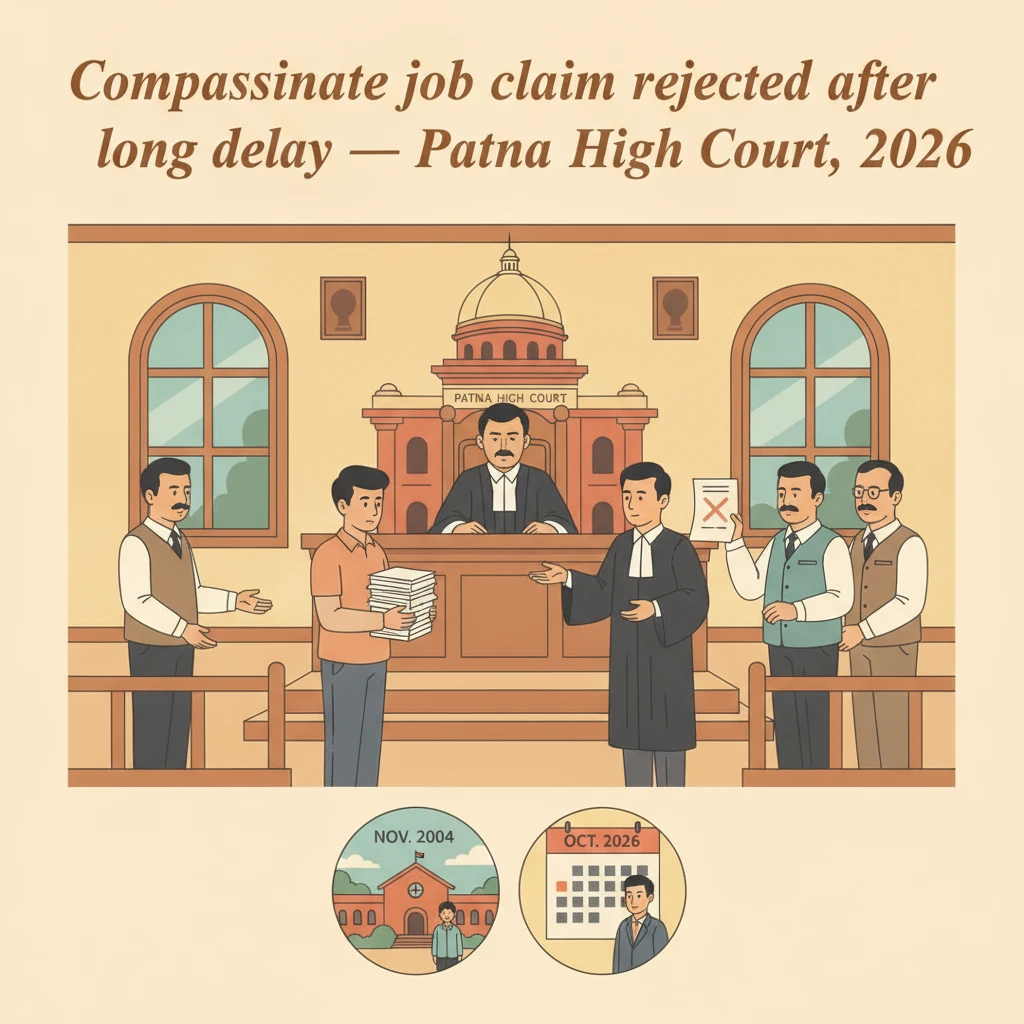
The petitioner’s father was appointed as an Assistant Teacher in 1975. He worked in a primary school in Saran district until his death in harness on 11.11.2004.
At the time of his father’s death, the petitioner was about 16 years old and therefore a minor. After he became a major, he applied to the authorities for appointment on compassionate ground. He submitted documents as and when asked by the officers.
When the authorities did not take any decision, the petitioner approached the Patna High Court by filing C.W.J.C. No.5404 of 2012. On 21.03.2012, a Co-ordinate Bench directed the District Programme Officer (Establishment), Saran at Chapra, to ensure that the petitioner’s application was placed before the proper committee and decided within three months. The officer was also directed to point out any shortcomings in the application so that the petitioner could remove them.
According to the record, the District Compassionate Appointment Committee had already considered the petitioner’s case on 06.04.2010 along with other candidates. All applications, including that of the petitioner, were returned to the District Education Officer/District Superintendent of Education in view of General Administration Department Letter No.2958 dated 22.06.2009. The petitioner’s name appeared at serial no.16, and his claim stood refused.
When the 2012 order was not complied with to his satisfaction, the petitioner filed Contempt Petition M.J.C. No.566 of 2017. That contempt case was dismissed on 08.02.2018, with liberty to the petitioner to pursue appropriate relief before the authorities because a decision had already been taken in 2010 and had not been challenged.
The petitioner then filed another writ petition, C.W.J.C. No.23696 of 2018. On 08.07.2019, another Co-ordinate Bench again directed the authorities to take an appropriate decision on his claim for compassionate appointment within about 60 days from receipt of the order.
When this second order also was not followed in the manner the petitioner expected, he filed Contempt Petition M.J.C. No.1314 of 2021. During that contempt proceeding, the District Education Officer, Saran at Chapra, passed a reasoned order vide Memo No.206 dated 11.01.2020, rejecting the petitioner’s claim. Therefore, on 23.02.2024, the contempt petition was disposed of, leaving it open to the petitioner to challenge Memo No.206.
In 2024, the petitioner filed the present writ petition, C.W.J.C. No.7863 of 2024, before the Patna High Court, challenging the rejection order contained in Memo No.206 dated 11.01.2020.
What the Court Examined and Decided
The writ petition sought three main reliefs. First, it requested quashing of order dated 11.01.2020 issued by the District Education Officer (respondent no.4) via letter no.206, by which the claim for compassionate appointment was refused. Second, it sought a direction to appoint the petitioner on compassionate ground to any suitable post according to his qualification, in place of his father who died in harness on 11.11.2004. Third, it asked the Court to direct appointment on the basis of letter no.581 dated 06.04.2010 issued by the District Compassionate Committee, where the petitioner’s name was shown at serial no.16.
On behalf of the petitioner, it was argued that the District Compassionate Appointment Committee had recommended his case in its meeting dated 06.04.2010. He contended that despite this, the authorities deliberately did not give him an appointment. He stressed that he had passed the matriculation examination and was fit to be appointed on a Class IV post. He further submitted that his family had suffered for a long period since his father’s death in 2004 due to the denial of compassionate appointment.
On the other hand, the State counsel, relying on a counter affidavit filed for respondent no.5, gave a different picture. According to the State, the petitioner’s claim was indeed considered on 06.04.2010 by the District Compassionate Appointment Committee, Saran, along with other candidates. However, in light of General Administration Department, Bihar Letter No.2958 dated 22.06.2009, all applications were returned to the District Education Officer/District Superintendent of Education. The Committee, therefore, did not finally recommend his appointment, and his claim stood refused.
The State pointed out that after the petitioner moved C.W.J.C. No.23696 of 2018 and the High Court directed fresh consideration, the petitioner again submitted a representation with documents. At the time of his father’s death, he was 16 years old and had passed matriculation. But under Government Circular Letter No.2955 dated 22.06.2009, dependents of deceased employees were to be appointed on the post of Teacher under the compassionate appointment scheme.
The State further informed the Court that pursuant to the earlier order dated 21.03.2012 in C.W.J.C. No.5404 of 2012, the petitioner’s application was sent to the Block Development Officer-cum-Member Secretary, Block Employment Unit, Masharak, for consideration under the Bihar Panchayat Employment Rules, 2006. The Block Employment Unit examined his case on 01.08.2017 and rejected it. The reason was that he did not possess the minimum qualifications required under the Bihar Panchayat Employment Rules, 2012 for appointment as Panchayat/Block Teacher, namely intermediate and TET/STET.
According to the counter affidavit, the District Education Officer, Saran, considered the petitioner’s grievance again and found that he lacked intermediate and TET/STET qualifications. Therefore, in Memo No.206 dated 11.01.2020, his claim for compassionate appointment was rejected on the ground that he did not meet the required qualifications.
After hearing both sides and reviewing the records, the Court noted several key facts. It was admitted that the petitioner’s father died in harness on 11.11.2004. It was also accepted that the petitioner applied for compassionate appointment after he attained majority and that his case had been considered multiple times.
The Court observed that the District Compassionate Appointment Committee had considered his case on 06.04.2010 but had not recommended him. The matter was sent back to the District Education Officer for appropriate action. Later, under directions from the High Court, the case was reconsidered, leading to the impugned order dated 11.01.2020 again rejecting his claim.
Importantly, the Court pointed out that the death in harness occurred in 2004 and that by the time of present consideration it had been about 22 years. The Court held that, in these circumstances, compassionate appointment could not be granted after such a long passage of time.
To support this view, the Court relied on settled law from the Supreme Court of India. First, it cited Jagdish Prasad v. State of Bihar and Another, (1996) 1 SCC 301. In paragraph 3 of that decision, the Supreme Court explained that the object of compassionate appointment is to relieve the immediate hardship and distress caused to the family by the sudden death of the breadwinner. It held that a dependent cannot claim such appointment many years later, after becoming a major, because that would convert compassionate appointment into another mode of regular recruitment, which is impermissible.
Second, the Court referred to Umesh Kumar Nagpal v. State of Haryana and Others, (1994) 4 SCC 138. In paragraph 6, the Supreme Court clarified that compassionate employment cannot be granted after a long lapse of time. It is not a vested right to be exercised at any future time. Its purpose is only to help the family tide over the financial crisis at the time of the employee’s death, not to provide employment long after the crisis has passed.
Third, the Court cited Local Administration Department and Another v. M. Selvanayagam @ Kumaravelu, (2011) 13 SCC 42. In paragraph 11, the Supreme Court again underlined that compassionate appointment is meant to provide immediate support to the family of a government employee who dies in harness. Appointments made many years after the death, without regard to the financial condition of the dependents, only because the claimant is a dependent, would violate Articles 14 and 16 of the Constitution.
The Patna High Court also referred to its own earlier judgment dated 07.04.2026 in C.W.J.C. No.20429 of 2013 (Sanjay Kumar Srivastava v. The State of Bihar & Ors.), where a similar claim had been rejected on the ground of delay and laches, following the Supreme Court decisions mentioned above.
Applying these principles, the Court concluded that the petitioner’s request for compassionate appointment could not be entertained. More than two decades had passed since the death of his father, and the very basis of compassionate appointment—immediate relief in a financial crisis—was no longer present in the manner contemplated by law.
Therefore, the Court held that there was no merit in the writ petition. It dismissed the petition and upheld the rejection order contained in Memo No.206 dated 11.01.2020.
Why This Judgment Matters
This judgment reinforces that compassionate appointment is an emergency support, not a long-term promise of government job for children of deceased employees.
Families must apply promptly and meet the qualifications prescribed in the applicable rules. Even where there is sympathy for the family’s hardship, courts will not grant appointments after long delays or contrary to recruitment norms.
The decision is especially important for dependents of teachers and other government staff in Bihar. It shows that repeated litigation, contempt petitions, or earlier directions for reconsideration cannot overcome basic legal limits: long delay and lack of required educational qualifications will defeat a claim.
For low-income families, this judgment is a reminder to seek timely advice and to understand clearly what documents and qualifications are required under the current rules for any compassionate appointment scheme.
Legal Issues and Answers
- Issue: Can a dependent claim compassionate appointment about 22 years after the employee’s death in harness, and after earlier refusals by the compassionate committee and authorities?
Answer: No. The Court held that compassionate appointment is meant to address the immediate financial crisis arising from the death and cannot be granted after such a long delay. - Issue: Was the rejection of the petitioner’s claim by Memo No.206 dated 11.01.2020 legally valid?
Answer: Yes. The Court upheld the rejection, noting the long delay since the death in 2004 and applying Supreme Court rulings that prohibit treating compassionate appointment as a general mode of recruitment. - Issue: Does a dependent have a vested right to a government job on compassionate ground if his name appeared in the list of a District Compassionate Committee?
Answer: No. The Court treated compassionate appointment as a limited scheme subject to rules and eligibility, not as a vested right that can be enforced after many years.
Cases Cited by the Court
- Jagdish Prasad v. State of Bihar and Another, (1996) 1 SCC 301.
- Umesh Kumar Nagpal v. State of Haryana and Others, (1994) 4 SCC 138.
- Local Administration Department and Another v. M. Selvanayagam @ Kumaravelu, (2011) 13 SCC 42.
- C.W.J.C. No.20429 of 2013, Sanjay Kumar Srivastava v. The State of Bihar & Ors., Patna High Court, judgment dated 07.04.2026.
Case Details
Case Number: Civil Writ Jurisdiction Case No.7863 of 2024
Case Title: Baijnath Tripathi v. The State of Bihar & Ors.
Citation: 2026 (3) PLJR 551
Coram: Hon’ble Mr. Justice Ritesh Kumar
Date of Judgment: 07.05.2026
Advocates:
For the Petitioner: Mr. Ajay Kr Singh No.1, Advocate
For the State: Mr. Jitendra Kumar, A.C. to Ex-A.A.G.11
Nature of the Case: Writ petition (civil) seeking quashing of rejection of compassionate appointment and direction for appointment on compassionate ground.
Impugned Order: Memo No.206 dated 11.01.2020 issued by the District Education Officer, Saran at Chapra, rejecting compassionate appointment claim.
Link to Judgment: Click here to read the full Patna High Court judgment
If you found this explanation helpful and wish to stay informed about
how legal developments may affect your rights in Bihar,
you may consider following Samvida Law Associates for more updates.







