

Case Background
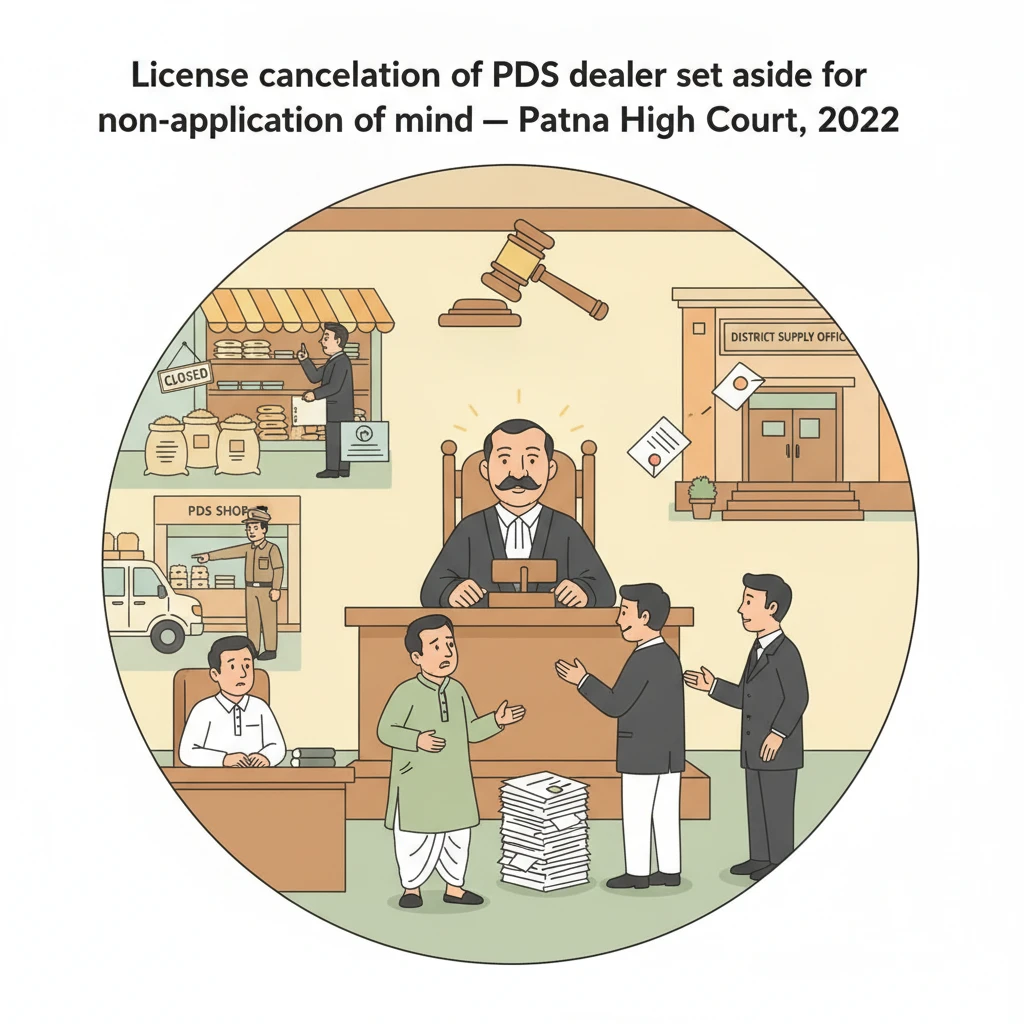
This case arose from action taken against a Public Distribution System (PDS) dealer in Saharsa district after seizure of foodgrains from a vehicle.
According to the judgment, 48 bags of wheat were found loaded on a vehicle parked in front of the PDS shop of one Narain Yadav. On this seizure, Nauhatta (Darhaar O.P.) P.S. Case No. 47 of 2019 was registered against the owner and driver of the vehicle under Section 7 of the Essential Commodities Act, 1955.
After receiving this information, the Collector, Saharsa, ordered an enquiry about the source of the seized wheat and directed inspection of all PDS shops in the surrounding area. When officials went to inspect the PDS shop of the present petitioner, they found it closed, and the premises were sealed.
The judgment clearly notes that, up to the date of sealing, the petitioner had not been made an accused in the criminal case. Later, the premises were de-sealed, the stock was inspected, and the stock position was found to be completely up to date, with no shortage. A report to that effect was brought on record.
Almost two years later, the Superintendent of Police, Saharsa, wrote to the Licensing Authority. He stated that during investigation of the FIR, the supervising police officer (Sub-Divisional Police Officer) had recorded the statement of the vehicle’s driver. The driver suspected that the petitioner was involved in transporting the rice for sale in the black market. On this basis alone, the Superintendent of Police suggested cancellation of the petitioner’s licence.
Acting thereafter, the Licensing Authority (Sub-Divisional Officer, Sadar, Saharsa) issued notice to the petitioner. After considering his explanation—which was found unsatisfactory—the Licensing Authority passed order dated 18.06.2021 cancelling the PDS licence. The appellate authority, namely the Collector, Saharsa, by order dated 31.12.2021, upheld this cancellation.
The petitioner approached the Patna High Court under its civil writ jurisdiction in 2022, challenging both the cancellation order and the appellate order.
What the Court Examined and Decided
The Patna High Court examined whether the cancellation of the PDS licence had been done in a lawful and fair manner, particularly under the Bihar Targeted Public Distribution System (Control) Order, 2016.
The petitioner’s counsel attacked the two orders on several grounds. First, he argued that if the petitioner had been made an accused in a criminal case involving any breach of the Essential Commodities Act, 1955, then action against his PDS licence could only be taken under Clause 28 of the 2016 Control Order.
Clause 28, as summarised in the judgment, requires that in such a situation the licence must first be suspended with immediate effect. Thereafter, a show cause notice must be served in accordance with the Code of Civil Procedure, and the dealer must be given sufficient opportunity to present his case. Any lawful action is to be taken within 180 days, as far as possible.
The petitioner argued that this procedure was not followed. His licence was never suspended at the time of the sealing and inspection, nor when the criminal case was registered. The authorities acted only years later, after a letter from the Superintendent of Police, and even then they did not follow the safeguards of Clause 28.
He further submitted that the Superintendent of Police had gone beyond his jurisdiction by recommending cancellation of the licence. The Licensing Authority, instead of forming its own independent opinion on proper materials, merely accepted this suggestion. According to the petitioner, this was a “knee‑jerk reaction”.
Another important argument highlighted in the judgment was that when the petitioner replied to the notice, he specifically stated that he had been falsely implicated by the vehicle driver. He pointed out that his alleged involvement surfaced only two years after the incident, during which period he had continuously run his PDS shop. He also relied on the earlier inspection report which found his stock fully intact. The petitioner complained that neither the Licensing Authority nor the Appellate Authority properly considered or discussed these explanations.
The petitioner also contended that the very initiation of proceedings could not be treated as one under Clause 28, since there had been no suspension of his licence at any stage. The sealing of his shop was only temporary when he was not present, and on de-sealing there had been no shortage in stock. Still, the authorities proceeded to cancel his licence without dealing with these favourable facts.
On behalf of the State, the learned counsel admitted that the licence had not been suspended before cancellation. However, he argued that this did not automatically mean that proceedings were not under the 2016 Control Order. He submitted that upon receiving the Superintendent of Police’s letter, the Licensing Authority issued notice, considered the petitioner’s explanation, and only then cancelled the licence. According to the State, this showed that proper procedure had been followed.
After hearing both sides, the Patna High Court found merit in the petitioner’s submissions. The Court held that the orders of both the Licensing Authority and the Appellate Authority did not show proper application of mind.
The Court noted that the opinion of the Sub-Divisional Police Officer (as supervising authority) seemed to have weighed heavily—and wrongly—on both authorities. They did not discuss when the petitioner was actually made an accused in the criminal case on the basis of the driver’s statement, nor did they mention the current status of the criminal case.
Crucially, the Court pointed out that the authorities had ignored the stock position of the PDS shop, which had been found intact at the time of de-sealing. This oversight, according to the Court, showed that the order appeared to have been passed “merely on the asking” of the Superintendent of Police, who had no jurisdiction to recommend cancellation of the licence.
On this reasoning, the High Court held that it was not persuaded to sustain either of the impugned orders. Both the cancellation order of the Licensing Authority and the affirming order of the Appellate Authority were set aside.
However, the Court did not give a final clean chit to the petitioner or restore the licence outright. Instead, it remitted the matter back to the Licensing Authority for fresh consideration in accordance with law.
The Court directed the Licensing Authority to issue a fresh notice to the petitioner. This notice must include all materials that have been collected against him during the investigation of the criminal case, as well as information about the final outcome of that case, if it has reached finality. The petitioner must be given ample opportunity to explain these materials.
After hearing the petitioner and considering his explanation, the Licensing Authority is to pass a reasoned order. While doing so, the authority has been specifically asked to look into:
- The fact that the PDS shop was sealed only for a while.
- The fact that, at the time of de-sealing, the stock position was found completely intact.
- Any other grounds which the petitioner may advance in support of his bona fides.
The High Court has fixed a clear timeline. The entire exercise, from notice to final order, must be completed within 60 days from the date on which a copy of the High Court’s order is received or produced before the Licensing Authority.
With these directions, the writ petition was disposed of.
Why This Judgment Matters
This judgment is significant for PDS dealers and other small licence holders in Bihar, especially those in rural areas.
First, it shows that a licence cannot be cancelled just because a police officer suspects someone’s involvement. Administrative authorities must look at all material, including inspection reports and stock records, and apply their own independent mind.
Second, the Patna High Court has emphasised that when the Control Order prescribes a particular procedure—like suspension, show cause, and proper hearing under Clause 28—that procedure cannot be lightly ignored. Dealers are entitled to notice of all materials against them and a fair chance to explain.
Third, the decision reminds authorities that they must record clear reasons in writing. A bare reference to a police letter is not enough when a person’s livelihood is at stake.
For citizens, especially PDS dealers, this judgment from the Patna High Court gives a clear message: if your licence is cancelled without following due process, courts can step in, set aside the order, and insist on a fair hearing.
Legal Issues and Answers
Issue: Can a PDS dealer’s licence be cancelled mainly on the basis of a supervising police officer’s suspicion, without properly considering stock records and procedural safeguards under Clause 28 of the Bihar Targeted Public Distribution System (Control) Order, 2016?
Answer: No. The Patna High Court held that such cancellation shows non‑application of mind, especially when the stock was found intact and the authorities failed to consider when and how the dealer was made an accused and what was the status of the criminal case.
Issue: What must the Licensing Authority do before taking fresh action against the dealer after the High Court’s order?
Answer: The Licensing Authority must issue a fresh notice enclosing all materials gathered in investigation, consider the final outcome of the criminal case (if any), give the dealer ample opportunity to explain, examine the earlier stock position and any other defences, and then pass a reasoned order within 60 days.
Cases Cited by the Court
- No prior judicial precedents or case law have been cited or relied upon in the text of this judgment.
Case Details
Case Number: Civil Writ Jurisdiction Case No. 2669 of 2022
Case Title: Amrendra Kumar Yadav v. The State of Bihar & Ors.
Citation: 2022 (2) PLJR 341
Court: High Court of Judicature at Patna
Coram: Hon’ble Mr. Justice Ashutosh Kumar and Hon’ble Mr. Justice Anjani Kumar Sharan
Date of Judgment: 20-04-2022
Advocates:
- For the Petitioner: Mr. Dhananjaya Nath Tiwari, Advocate
- For the Respondents (State): Mr. Anisul Haque, AC to AAG-5
Nature of the Case: Writ petition challenging cancellation of PDS licence and affirming appellate order.
Relevant Statute/Orders Mentioned: Section 7 of the Essential Commodities Act, 1955; Clause 28 of the Bihar Targeted Public Distribution System (Control) Order, 2016.
Link to Judgment: Click here to access the official Patna High Court judgment
If you found this explanation helpful and wish to stay informed about
how legal developments may affect your rights in Bihar,
you may consider following Samvida Law Associates for more updates.







