

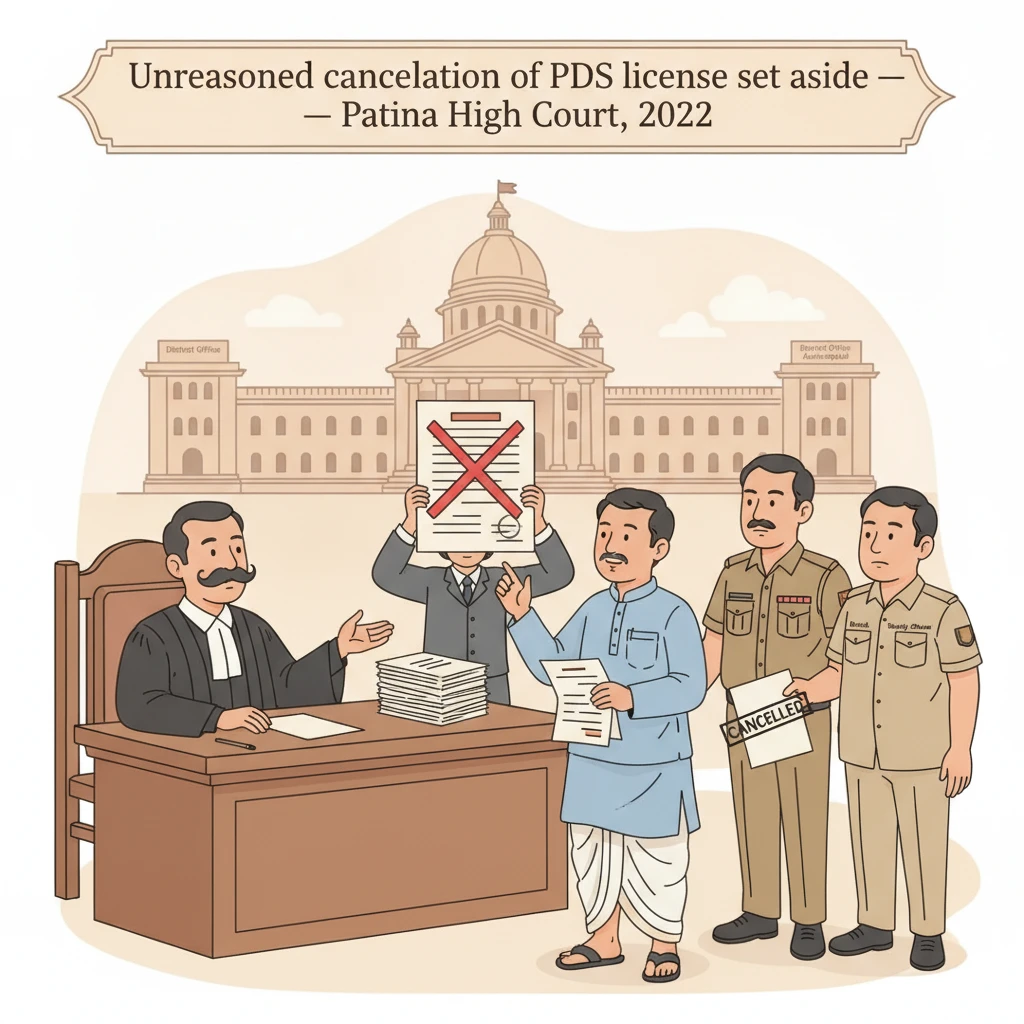
Case Background
The petitioner in this case held a licence as a Public Distribution System (PDS) dealer. His shop fell under the jurisdiction of Obra Block in Aurangabad district, Bihar.
On 29.01.2021, the Sub-Divisional Officer, Daudnagar, Aurangabad, who is the licensing authority, passed an order cancelling the petitioner’s PDS licence. The text of that order is not fully reproduced in the judgment, but the Patna High Court records that it generally referred to the responsibilities of a PDS licensee and rejected the petitioner’s representation in a single line as “unsatisfactory”.
The petitioner challenged this cancellation before the appellate authority. The appeal was dismissed on 23.12.2021. The appellate authority upheld the cancellation but did not give any reasons explaining why the original order was correct.
Aggrieved by the loss of his PDS licence and the unreasoned dismissal of his appeal, the petitioner approached the Patna High Court under its civil writ jurisdiction in CWJC No. 2772 of 2022.
What the Court Examined and Decided
The Division Bench of the Patna High Court, comprising Hon’ble Mr. Justice Ashutosh Kumar and Hon’ble Mr. Justice Anjani Kumar Sharan, heard the matter on 09.03.2022. The Court examined three key aspects: the original cancellation order, the appellate order, and an internal communication marked as Annexure-5 to the writ petition.
First, the Court looked at the cancellation order dated 29.01.2021 passed by the Sub-Divisional Officer, Daudnagar. The Bench noted that the order did not clearly state why the licence was being cancelled. It only contained general statements about the responsibilities of a PDS licensee.
The order also mentioned that the representation filed by the petitioner had been found unsatisfactory, but this was done in just one line, without any supporting reasoning. The High Court observed that from a reading of the order, it was “not possible to get any idea” of the actual reasons that led the authority to cancel the licence.
In simple terms, the Court found that the cancellation order did not explain:
- what specific allegations were made against the petitioner,
- what material or inquiry report was relied on, and
- why the authority thought cancellation was necessary.
Secondly, the Court examined the appellate order dated 23.12.2021, by which the petitioner’s appeal was dismissed. The Bench found that this order also completely lacked reasoning.
The appellate authority had simply sustained the cancellation order without adding or recording any reasons of its own. The High Court held that where the original order itself did not disclose reasons, the appellate authority could not pass a sustainable order either, unless it independently examined the matter and gave clear reasons.
Thirdly, the Court considered Annexure-5, which the judges described as “really surprising”. This document was a communication issued by the same licensing authority (the Sub-Divisional Officer, Daudnagar) to the Block Supply Officer, Obra, Aurangabad.
In this communication, the licensing authority informed the Block Supply Officer that the inquiry conducted at the petitioner’s shop and the report dated 06.01.2021 submitted by the Block Supply Officer were “incomplete and misleading”. The authority stated that the report could not be relied upon and called upon the Block Supply Officer to explain the circumstances under which such a report had been filed.
This created a serious doubt in the mind of the Court. The cancellation order against the petitioner did not state on which report of the Block Supply Officer the petitioner had been issued notice or on which basis his explanation had been sought.
The judgment records that the cancellation order failed to mention the date of the inquiry report relied upon. At the same time, the only identified report on record, dated 06.01.2021, had been declared “misleading and incomplete in all respects” by the licensing authority itself.
The High Court reasoned that if the report dated 06.01.2021 was considered unreliable and incomplete, there could be “no way in which a proper notice could have been given to the licensee” on the basis of that report. Without a clear and reliable basis, issuing a show cause notice and cancelling the licence would be legally suspect.
Therefore, two serious defects emerged:
- The authority had not clearly identified which inquiry report formed the basis of action against the petitioner.
- The only known report had been discredited by the authority itself as incomplete and misleading, yet there was no further explanation or fresh inquiry disclosed in the cancellation order.
The Court held that because the date of the report was not mentioned, and because the report dated 06.01.2021 had been found unreliable, the cancellation order itself became “suspect in the eyes of law”.
Alongside these defects, the complete absence of reasons in both the cancellation order and the appellate order made the entire process untenable. The Court underscored that where an authority exercises power to cancel a licence, which affects a person’s livelihood, it must:
- conduct a fair inquiry,
- properly inform the licensee about the allegations and supporting material,
- consider the explanation given by the licensee, and
- record clear reasons in support of its conclusions.
Since none of these basic safeguards were visible in the orders placed before it, the Patna High Court set aside both the cancellation order of 29.01.2021 and the appellate order of 23.12.2021.
However, the Court did not restore the licence finally or bar further action. Instead, it chose to remit the matter back to the licensing authority for a fresh decision, ensuring that proper procedure would now be followed.
The Bench directed the petitioner to place a copy of the High Court’s order before the licensing authority within 30 days. Upon receiving the order, the licensing authority has been instructed to:
- issue a fresh notice to the petitioner, clearly asking him to show cause why his licence should not be cancelled,
- grant him an opportunity to submit his reply within the time allowed, and
- after receiving the reply, pass a fresh order on the question of cancellation, this time giving reasons for whatever conclusion is reached.
The Court has also fixed a time limit for this fresh exercise. It has directed that the licensing authority must take a final decision within 60 days from the date on which the petitioner submits his reply to the show cause notice.
With these directions and observations, the writ petition was disposed of.
Why This Judgment Matters
This judgment is important for PDS dealers and other small license holders across Bihar and beyond. Many such licences are a primary source of livelihood.
The Patna High Court has made it clear that government authorities cannot cancel a licence in a vague manner. They must disclose what report or material they rely on and must give clear reasons for cancelling a licence.
The decision also highlights that if an inquiry report is considered incomplete or misleading, authorities cannot casually rely on it to punish a licensee. They must either conduct a proper inquiry or clearly explain the factual basis for their decision.
For citizens, this judgment shows that if a licence is cancelled without proper notice, without reference to a specific report, or without any reasons, such orders can be questioned before the High Court.
Legal Issues and Answers
- Issue: Whether the cancellation of a PDS licence and the dismissal of the appeal, without disclosing the inquiry report relied upon and without recording reasons, could be sustained in law.
Answer: No. The Patna High Court held that the cancellation order and the appellate order were unsustainable as they did not specify the report relied upon, were based on a report that had itself been termed incomplete and misleading, and did not record any reasons. Both orders were set aside and the matter was remitted for fresh proceedings.
Cases Cited by the Court
- The judgment does not record or rely on any cited precedents.
Case Details
Case Number: Civil Writ Jurisdiction Case No. 2772 of 2022
Case Title: Sudama Sharma v. The State of Bihar & Ors.
Coram: Hon’ble Mr. Justice Ashutosh Kumar and Hon’ble Mr. Justice Anjani Kumar Sharan
Citation: 2022(2) PLJR 136
Advocates: Mr. Ashok Kumar, Advocate for the petitioner; Mr. Upendra Pratap Singh, Advocate for the State
Nature of the Case: Writ petition under civil writ jurisdiction challenging cancellation of PDS licence and confirmation of cancellation in appeal
Link to the Judgment: Click here to read the full judgment of the Patna High Court
If you found this explanation helpful and wish to stay informed about
how legal developments may affect your rights in Bihar,
you may consider following Samvida Law Associates for more updates.







