

Case Background
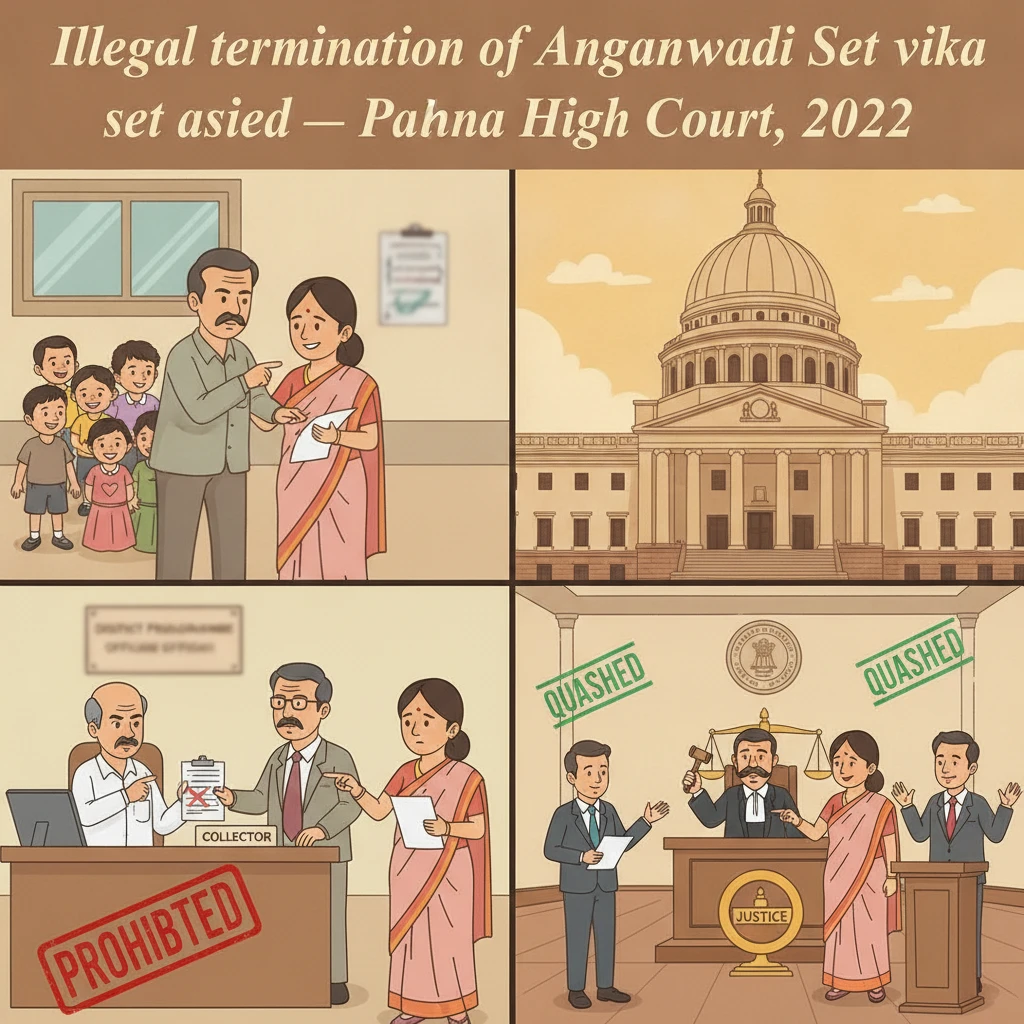
The case concerns an Anganwadi Sevika who was appointed on 12.05.2007 at an Anganwadi Centre in Aurangabad district, Bihar.
On 18.01.2016, the concerned centre was inspected by an inspecting authority. During this inspection, some irregularities were allegedly found and attributed to the Sevika.
Based on this inspection, a report was submitted to the appointing authority recommending further action. Thereafter, by order dated 22.07.2016, the District Programme Officer, Aurangabad, terminated the petitioner’s services.
Feeling aggrieved by the termination order, the Sevika filed Anganwari Appeal No. 09 of 2016 before the Collector, Aurangabad. On 26.09.2019, the Collector dismissed the appeal and also prohibited her from being selected as Anganwadi Sevika in future.
The worker then approached the Patna High Court in Civil Writ Jurisdiction Case No. 6105 of 2020, challenging both the termination order dated 22.07.2016 and the appellate order dated 26.09.2019.
What the Court Examined and Decided
The Patna High Court, through Hon’ble Mr. Justice P. B. Bajanthri, heard the matter on 30.03.2022. The Court examined whether the authorities had followed the basic principles of natural justice while terminating the services of the Anganwadi Sevika and while deciding her appeal.
The starting point for the Court was the inspection conducted on 18.01.2016. During this visit, the inspecting authority claimed to have found irregularities at the Anganwadi Centre, allegedly committed by the Sevika. A report was prepared and submitted to the appointing authority, which became the basis for action against the petitioner.
The Court noted that the competent authority, i.e., the District Programme Officer, Aurangabad, dispensed with the petitioner’s services on 22.07.2016. However, this was done “without looking into the report of the inspecting authority” in the proper manner.
The crucial flaw highlighted by the Court was that the inspection report itself was not properly brought on record in the domestic process. The report was not cited as evidence, and the author of the inspection report was not examined as a witness. As a result, the allegations contained in the inspection report were treated as proved without the worker getting a fair chance to challenge them.
It was also recorded in the judgment that the State’s counsel did not dispute the fact that the inspection report was not cited and that its author had not been examined or cross-examined. This admission strengthened the Court’s view that the procedure adopted by the authorities was defective.
On these facts, the Court held that there was a prima facie violation of the principles of natural justice. In simple terms, the Sevika was punished without being given a fair and proper opportunity to defend herself against the allegations contained in the inspection report.
The Court further observed an important aspect specific to Anganwadi workers. It noted that, for initiating an enquiry against an Anganwadi Sevika, there are no specific disciplinary rules or detailed regulations or guidelines, except that authorities may impose certain penalties like warning or disengagement of service.
However, the absence of formal disciplinary rules does not mean that authorities can act arbitrarily. The Court clearly stated that even in the absence of such rules, when allegations are made against an Anganwadi Sevika, a domestic enquiry is still required in order to prove those allegations.
This means that before terminating an Anganwadi Sevika, the authorities must follow a basic fair procedure. They must put the allegations to the worker, rely on proper evidence, allow the worker to cross-examine witnesses, and give her an opportunity to present her defence. Skipping these steps and directly issuing a termination order is not permissible.
In the petitioner’s case, the inspection report was the main material against her. Yet, the author of the report was never examined. The worker was not given a proper opportunity to challenge the contents of that report. The Court held that such lapses amounted to serious procedural irregularities.
Because of these “lacunas committed by the officials,” the Court decided that both the termination order dated 22.07.2016 and the appellate order dated 26.09.2019 could not stand. Accordingly, the Patna High Court set aside both orders.
After quashing the orders, the Court gave specific directions for relief. It directed that the petitioner “shall be taken back to duty forthwith.” This means that her services as Anganwadi Sevika must be restored immediately.
Along with reinstatement, the Court also addressed her monetary entitlements. It held that she is entitled to monetary benefits from the date of disengagement of her services, i.e., from 22.07.2016, till the date of her reinstatement into service. In effect, she is to receive back wages for the entire period during which she remained out of service because of the illegal termination.
At the same time, the Court preserved the right of the authorities to proceed afresh if they considered it necessary. The judgment expressly reserves liberty to the official respondents to initiate an enquiry, if warranted at this stage.
However, the Court placed a clear time limit on such a future enquiry. It ordered that any such enquiry must be completed within a period of three months from the date of receipt of a copy of the Court’s order.
Thus, while protecting the worker’s rights and undoing the injustice caused by the defective process, the Patna High Court also ensured that the administration retained a limited window to hold a proper, lawful enquiry, should there still be serious concerns about her conduct.
With these observations and directions, the writ petition was allowed. No further directions were recorded beyond reinstatement, payment of monetary benefits, and the option of holding a time-bound enquiry.
Why This Judgment Matters
This judgment is significant for Anganwadi workers and other similarly placed frontline workers in Bihar and beyond.
First, it makes clear that even where there are no formal, detailed disciplinary rules, authorities cannot simply terminate a worker on the basis of an inspection report or complaint. A fair domestic enquiry, following the principles of natural justice, is still necessary.
Second, the Patna High Court’s decision shows that workers who are removed without such a fair process can seek reinstatement and claim monetary benefits for the period they were wrongly kept out of service.
Third, the judgment reminds district-level officers and programme officials that they must base their decisions on evidence tested in an enquiry. Treating untested reports as conclusive proof and denying the worker an opportunity to cross-examine or defend herself will not be upheld in court.
Finally, the time-bound liberty given to the authorities balances administrative concerns with individual rights. It allows the State to hold a proper enquiry if needed, but prevents indefinite harassment of the worker.
Legal Issues and Answers
Issue: Whether the termination of an Anganwadi Sevika on the basis of an inspection report, without examining the author of that report or conducting a proper domestic enquiry, is valid in law.
Answer: No. The Patna High Court held that failure to cite the inspection report properly and to examine its author as a witness, thereby denying the worker an opportunity to challenge the allegations, amounts to violation of principles of natural justice. The termination and its confirmation in appeal were set aside.
Issue: Whether, in the absence of specific disciplinary rules for Anganwadi Sevikas, authorities can dispense with a domestic enquiry while imposing major penalties like disengagement from service.
Answer: No. The Court held that even in the absence of specific disciplinary rules, a domestic enquiry is still warranted to prove allegations before imposing such penalties.
Issue: What relief is appropriate where an Anganwadi Sevika has been terminated in violation of natural justice.
Answer: The Court directed reinstatement forthwith with monetary benefits from the date of disengagement till reinstatement, while reserving liberty to the authorities to initiate and complete a proper enquiry within three months.
Cases Cited by the Court
- No prior judicial decisions or precedents are cited or relied upon in the text of this judgment.
Case Details
Case Number: Civil Writ Jurisdiction Case No. 6105 of 2020
Case Title: Suman Kumari v. The State of Bihar & Ors.
Coram: Hon’ble Mr. Justice P. B. Bajanthri
Citation: 2022 (2) PLJR 421
Advocates: For the petitioner – Mr. Manish Kumar No. 2; For the respondents – Mr. S. K. Mandal, SC-3
Nature of the Case: Writ petition challenging termination of Anganwadi Sevika and dismissal of statutory appeal
Link to Judgment: Click here to read the full judgment of the Patna High Court
If you found this explanation helpful and wish to stay informed about
how legal developments may affect your rights in Bihar,
you may consider following Samvida Law Associates for more updates.







