

Case Background
The petitions arose from the State Government’s decision to convert the rural area of Baheri in Darbhanga district into an urban local body under the Bihar Municipal Act, 2007.
A notice dated 26.12.2020 was issued by the State Government under Section 4 of the Bihar Municipal Act, 2007. Through this notice, the Government declared its intention to notify Baheri as a Nagar Panchayat. As required by law, objections from inhabitants of the area were invited under Section 5 of the Act.
The petitioners in these two writ petitions were the elected Mukhiyas of Gram Panchayat Raj Baheri East and Baheri West. Despite having the opportunity, it is admitted in the judgment that they did not raise any objection to the proposal when the Section 4 notice was published.
While their writ petitions challenging the Section 4 notice were pending, the State Government issued a final notification dated 03.03.2021 under Section 6 of the Act, formally notifying Baheri as a Nagar Panchayat. The petitioners then filed interlocutory applications in both writ petitions seeking to amend their pleadings so as to challenge this final notification as well.
Since both cases involved the same petitioners’ challenge to the same Section 4 notice dated 26.12.2020 and the subsequent Section 6 notification dated 03.03.2021, the Patna High Court heard them together and disposed them of by a common oral judgment dated 04.04.2022.
What the Court Examined and Decided
The Division Bench of the Patna High Court, comprising Hon’ble Mr. Justice Chakradhari Sharan Singh and Hon’ble Mr. Justice Madhuresh Prasad, first allowed the interlocutory applications in both matters. The Court observed that the notification dated 03.03.2021 was a sequel to the same Section 4 notification dated 26.12.2020. Therefore, the amendments were permitted, and the averments in the interlocutory applications were treated as part of the main writ petitions.
On merits, the Court considered the main submissions addressed by the petitioners’ counsel, Mr. Shashi Bhushan Kumar Manglam. The first ground of attack was based on a letter dated 17.11.2016, marked as Annexure-B to the counter affidavit of the Block Development Officer, Baheri, Darbhanga.
This letter related to a proposal regarding constitution of Baheri as a Nagar Parishad. The petitioners argued that, although the original proposal was for a Nagar Parishad, the State Government, allegedly without holding any further enquiry after 2016, chose on the basis of the same proposal to issue the 26.12.2020 notification to constitute Baheri as a Nagar Panchayat.
According to the petitioners, this shift from Nagar Parishad to Nagar Panchayat without a fresh enquiry made the Section 4 notification bad in law. They suggested that, after 2016, no enquiry had been conducted on which the Government could rely for issuing the 2020 notice.
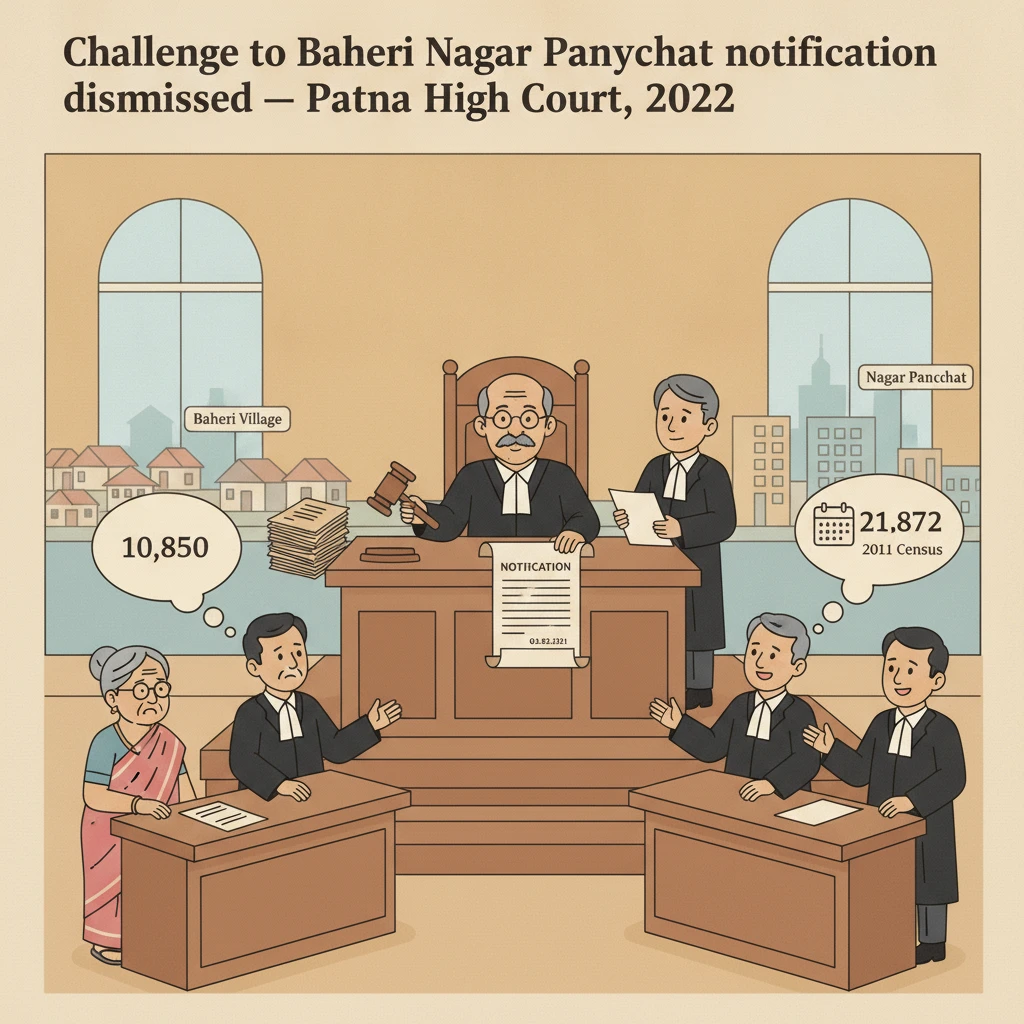
The second line of argument related to population. In paragraph 14 of the writ application, the petitioners asserted that the total population of village Baheri was only 10,850. On this basis, they claimed that constituting Baheri as a Nagar Panchayat did not meet the requirement of Section 3(1)(c) of the Bihar Municipal Act, 2007, which prescribes minimum population thresholds for declaring a municipal body.
The Court examined these submissions against the legal scheme of the Act and prior precedent. A critical turning point in the judgment was the Court’s reliance on an earlier Division Bench ruling in Usha Devi vs. The State of Bihar & Ors. (CWJC No. 7446 of 2021), particularly paragraph 16 of that decision.
In Usha Devi, the Division Bench had laid down that a person who does not file objections under Section 5 of the Act in response to a Section 4 notice cannot later be permitted to challenge either the draft notification or the final notification before the High Court under Article 226 of the Constitution of India.
The Patna High Court reproduced paragraph 16 of the Usha Devi decision. That paragraph states that petitioners who chose not to make any objection when they were afforded opportunity have no basis to maintain writ proceedings. Having failed to avail the statutory opportunity, they cannot be heard to allege infirmities in the statutory process or complain of non-consideration of objections. Therefore, they cannot invoke the writ jurisdiction of the Court.
Applying this principle, the Court held that, since the present petitioners had admittedly not raised objections under Section 5 when the Section 4 notification was published, they fell squarely within the rule laid down in Usha Devi. As a result, their writ petitions challenging the notifications were not maintainable.
Turning to the population-based challenge, the Court noted the petitioners’ contention that the population of village Baheri was 10,850, allegedly below the prescribed threshold. However, the Court pointed out that this argument was unsustainable for a clear reason drawn from the statutory scheme and the contents of the Section 4 notification itself.
The Section 4 notification expressly mentioned that the total population of the proposed Baheri Nagar Panchayat was 21,872. It also clarified that this figure was based on the 2011 census. The Court stressed that the calculation of population for purposes of Sections 3 and 7 of the Bihar Municipal Act is not confined to a single village alone.
Relying again on the decision in Usha Devi, the Court observed that the requisite population under Sections 3 and 7 has to be specified for the entire municipal area that is proposed to be constituted. That is, the law contemplates population of the whole area of the municipality that comes into existence following the statutory process under Chapter II of the Act, and not just the population of a single constituent village.
Therefore, even if the population of only “village Baheri” was 10,850, that figure by itself could not invalidate the constitution of Baheri as a Nagar Panchayat when the notified municipal area, as a whole, had a population of 21,872 as per the 2011 census.
The Court did not accept the attack based on the alleged absence of enquiry post-2016. While the details of the State’s enquiry are not elaborated in the judgment, the Bench clearly recorded that it did not notice any illegality in the impugned notifications when examined in light of the law declared in Usha Devi.
Summing up, the Bench held that the petitions were hit on two fronts. First, they were not maintainable because the petitioners had slept over their statutory right to file objections under Section 5. Second, there was no illegality in either the Section 4 notice dated 26.12.2020 or the final Section 6 notification dated 03.03.2021, particularly with respect to population, as the required figures were clearly specified and based on the 2011 census for the whole proposed Nagar Panchayat area.
On this reasoning, the Court concluded that both writ applications were devoid of merit. Consequently, the petitions were dismissed, and the notifications constituting Baheri Nagar Panchayat stood affirmed.
Why This Judgment Matters
This judgment is important for local representatives and residents in Bihar who may be affected by decisions to convert rural areas into urban bodies like Nagar Panchayats or Nagar Parishads.
The Patna High Court has made it clear that if people do not use the formal chance to object when the first notice is published under Section 4 of the Bihar Municipal Act, they cannot later come to the High Court to challenge the process. The statutory process of inviting objections under Section 5 is treated as a crucial safeguard.
The decision also highlights that, for determining whether an area qualifies to become a municipality, the Government will look at the population of the entire proposed municipal area, not just one village within it. Figures stated in the notification, especially when linked to the census, carry strong weight.
Practically, this means that local leaders and residents must stay alert when a Section 4 notice is published. If they disagree with the proposal, they should file written objections within time. Waiting to challenge the move only after a final notification is issued may leave them without a legal remedy in the High Court.
Legal Issues and Answers
Issue: Can elected representatives who did not file objections under Section 5 of the Bihar Municipal Act later challenge the draft and final notifications constituting a Nagar Panchayat by filing a writ petition?
Answer: No. Following the Division Bench ruling in Usha Devi, persons who do not avail the statutory opportunity to object under Section 5 cannot maintain writ proceedings challenging the Section 4 and Section 6 notifications.
Issue: Was the constitution of Baheri as a Nagar Panchayat invalid because the population of village Baheri alone was allegedly below the threshold in Section 3(1)(c) of the Act?
Answer: No. The Court held that the relevant population is that of the entire proposed Nagar Panchayat area, which was stated as 21,872 in the Section 4 notification based on the 2011 census, and no illegality was found.
Issue: Did the use of a 2016 proposal for Nagar Parishad without a fresh enquiry after 2016 invalidate the 2020 notification for Nagar Panchayat?
Answer: The Court did not find any illegality in the impugned notifications and rejected this challenge in light of the law laid down in Usha Devi.
Cases Cited by the Court
- Usha Devi vs. The State of Bihar & Ors., CWJC No. 7446 of 2021 (Division Bench of Patna High Court), particularly paragraph 16.
Case Details
Case Numbers: Civil Writ Jurisdiction Case No. 5886 of 2021; Civil Writ Jurisdiction Case No. 6592 of 2021
Case Title: Ashok Kumar vs. The State of Bihar & Ors.; Domni Devi vs. The State of Bihar & Ors.
Coram: Hon’ble Mr. Justice Chakradhari Sharan Singh; Hon’ble Mr. Justice Madhuresh Prasad
Date of Judgment: 04.04.2022
Citation: 2022 (2) PLJR 455
Advocates:
- For the petitioners (in both cases): Mr. Shashi Bhushan Kumar Manglam, Advocate
- For the respondents (CWJC No. 5886 of 2021): Mr. Yogendra Pd. Sinha, AAG-7; Mr. Rajeev Kr. Sinha, AC to AAG-7
- For the respondents (CWJC No. 6592 of 2021): Mr. Subhash Prasad Singh, GA-3; Mr. Dilip Kumar, AC to GA-3
Nature of the Case: Writ petitions under Article 226 of the Constitution challenging notifications under Sections 4 and 6 of the Bihar Municipal Act, 2007, declaring Baheri as a Nagar Panchayat.
Link to Judgment: Click here to view the full judgment of the Patna High Court
If you found this explanation helpful and wish to stay informed about how legal developments may affect your rights in Bihar, you may consider following Samvida Law Associates for more updates.







