

Case Background
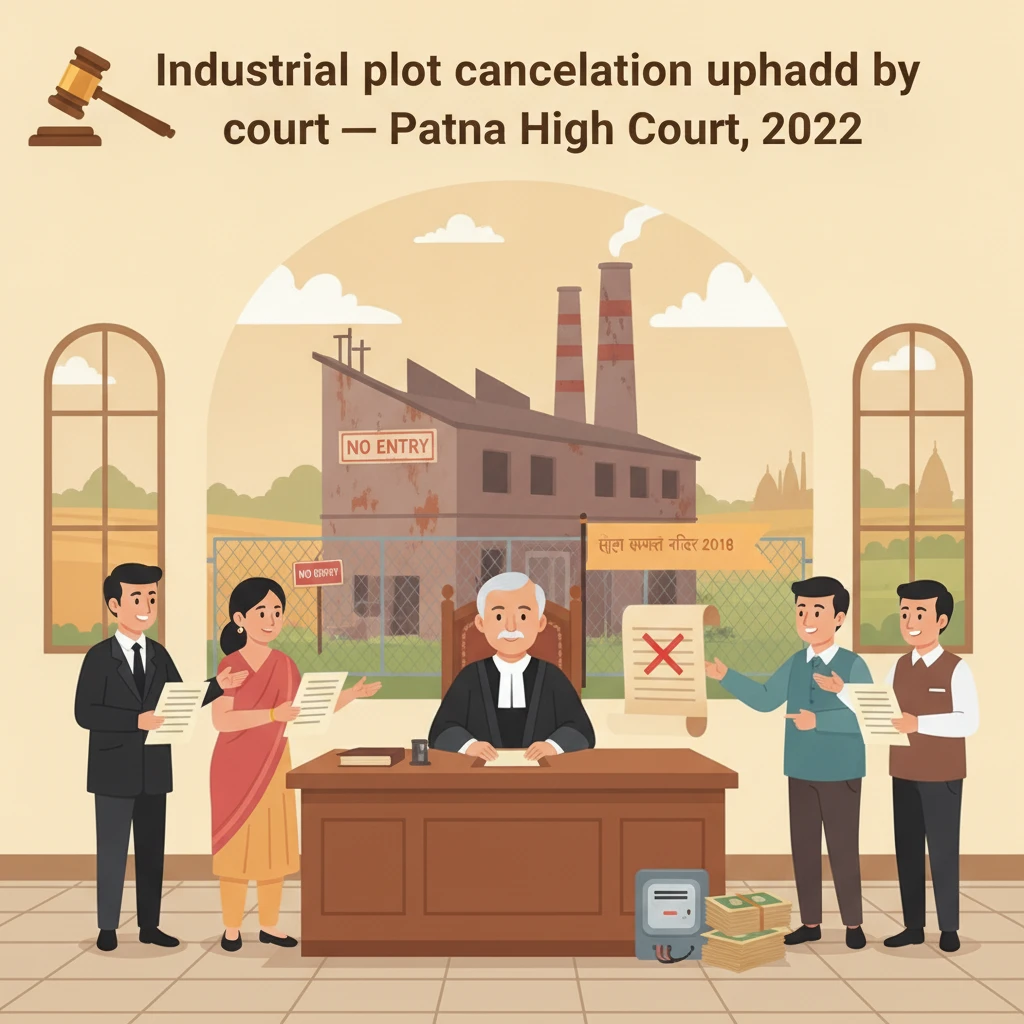
The case arose from allotment of a 2.27 acre plot in the Raxaul Industrial Area to Prabha Electro Castings Private Limited by the Bihar Industrial Area Development Authority (BIADA). The allotment was meant for setting up and running an industrial unit.
According to the record referred to by the Patna High Court, the unit functioned for some time after allotment in 1992 but then stopped operations. For years, there was no industrial activity on the plot. BIADA issued repeated notices over at least 15 years, asking the company to start production or face cancellation of the allotment.
In 2012, BIADA sent a letter dated 28.04.2012 calling upon the company to commence production on the allotted plot, failing which the land would be cancelled. At that time, Certificate Case No. 04/Electricity/2002-03 was pending against the company for recovery of electricity dues.
The company challenged the 2012 letter before the Patna High Court in CWJC No. 8906 of 2013. On 17.07.2018, that writ petition was disposed of. The Court gave the company liberty to clear its outstanding electricity dues of Rs. 10,96,536/- within two weeks and then file a representation before BIADA within a further two weeks. If allotment had not already been cancelled, BIADA was to consider the representation for granting permission to start the unit, after hearing the company.
Following that order, the company paid the dues and filed a representation dated 05.09.2018. BIADA considered this favourably and, via order dated 18.07.2019, granted three months’ time to start industrial activity, warning that failing this, the allotment would be cancelled, possession resumed and the deposit forfeited.
The company did not challenge the 18.07.2019 order. Instead, it sought to take advantage of the three-month period granted.
Later, BIADA’s Area In-Charge reported that the plot remained deserted and the unit was in a dilapidated state. A show cause notice dated 20.03.2020 gave a final 15-day opportunity to start production, warning of cancellation and forfeiture.
Eventually, by order dated 20.06.2020 (memo no. 556), the Executive Director, under the order of BIADA’s Managing Director, cancelled the allotment, forfeited the amount deposited towards the land, and decided to resume possession.
Aggrieved by this step, the company filed the present writ petition, Civil Writ Jurisdiction Case No. 9647 of 2020, before the Patna High Court seeking quashing of the cancellation order and an injunction preventing BIADA from resuming possession.
What the Court Examined and Decided
The Division Bench of the Patna High Court, speaking through Hon’ble Mr. Justice Madhuresh Prasad (with Hon’ble Mr. Justice Chakradhari Sharan Singh agreeing), examined whether BIADA’s cancellation of the allotment by order dated 20.06.2020 was lawful and whether the Court should exercise its writ jurisdiction to interfere.
The company argued that the cancellation violated Rule 3(1) of the Bihar Industrial Area Development Authority Rules, 1981 and Section 6(2)(a) of the Bihar Industrial Area Development Authority Act, 1974. It claimed that its unit had suffered heavy losses due to insufficient and intermittent power supply by the Bihar State Electricity Board, leading to the certificate case for recovery of electricity dues. It contended that BIADA knew the closure was for reasons beyond its control.
The company further alleged that the cancellation was done without following principles of natural justice. It said that the show cause notice dated 20.03.2020 had never been served on it, and that the inspection dated 27.05.2020 took place during the COVID-19 lockdown without the required one month statutory notice.
On the strength of a Division Bench judgment in Bihar Industrial Area Development Authority & Ors. vs. Deepak Paints Pvt. Ltd. & Ors. (LPA 353/2008 in CWJC No. 7352 of 2007), the company also requested at least six months’ more time to start production, arguing that intervening factors like illegal electricity dues had delayed commencement.
BIADA opposed the writ petition at the threshold. Its counsel argued that the company had repeatedly violated the allotment terms and could not seek relief in the Court’s equitable and discretionary writ jurisdiction. BIADA also pointed out that the cancellation order could be appealed before the Principal Secretary, Department of Industries, acting as the appellate authority under Section 6(2)(a) of the Act. Since an adequate alternative remedy existed and was not availed, the High Court should be slow to interfere.
On facts, BIADA stated that the Area In-Charge had reported that the unit was deserted and in a dilapidated state. The show cause notice of 20.03.2020 clearly gave a final 15-day opportunity to start production, failing which the allotment would be cancelled and the deposit forfeited. Since there was continued breach of allotment conditions, BIADA cancelled the allotment by office order dated 20.06.2020.
BIADA’s counsel highlighted that BIADA is a statutory authority which develops industrial areas by carving out plots, providing infrastructure and offering them on nominal rent to promote industrial activity and the State’s economy. When allottees fail to set up or run units, infrastructure and concessions are wasted and genuine entrepreneurs are deprived of opportunity.
The Court first examined the long history of non-use of the plot. It noted that the earliest notice on record was from 2007, and that even that notice recorded that industrial activity had been closed on the plot for years and BIADA’s dues were outstanding. The Court observed that for at least 19 years there had been no industrial activity on the land, for one reason or another.
The Court then considered its earlier order dated 17.07.2018 in CWJC No. 8906 of 2013. There, the Court had refused to interfere with BIADA’s decision but allowed the company to clear its electricity dues and then file a representation, which BIADA was to consider if the allotment had not already been cancelled.
Pursuant to that order, BIADA passed the favourable order dated 18.07.2019 granting three months to initiate industrial activity, failing which cancellation, resumption of possession and forfeiture were clearly stipulated. The company did not challenge this 18.07.2019 order at any time. On the contrary, it took benefit of the three-month window.
Against this backdrop, the Court considered the company’s subsequent representation dated 18.09.2019, where it, for the first time, claimed that the Electricity Board had not given a fresh connection and that machinery had been destroyed as the unit remained closed for 19 years. On this basis, it sought time until the end of the financial year 2019-20 (31.03.2020).
The Bench noted that these grounds were available to the company even earlier when it had filed its representation dated 05.09.2018 pursuant to the 2018 writ order, yet it had not raised them then. Moreover, by 18.09.2019, the company had already used two out of the three months granted under the 18.07.2019 order, but still had not taken concrete steps to restart.
The Court observed that when the matter was taken up nearly two years later, neither had the company obtained any fresh electricity connection nor was there any statement that machinery had been repaired or made operational. This, according to the Court, showed lack of bona fides. The new pleas appeared to be a desperate attempt to delay the consequences of the 18.07.2019 order.
On this basis, the Court held that, having accepted and acted upon the three-month period given by BIADA, the company was now estopped from taking inconsistent stands to avoid the stipulated consequences. To support this reasoning, the Bench relied on the Supreme Court decision in The Joint Action Committee of Airlines Pilots Associations of India & Ors. vs. The Director General of Civil Aviation & Ors., (2011) 5 SCC 435. It quoted paragraph 12 of that judgment, explaining the doctrine of election and estoppel, and noting that law does not permit parties to “blow hot and cold” or to take inconsistent pleas to prolong proceedings.
As regards the reliance on Deepak Paints, the Court pointed out that the Division Bench in that case, by judgment dated 18.03.2015, had only given six months’ time to establish or revive industries that had become sick, after which BIADA could resume land for fresh allotment. In the present case, BIADA’s grant of three months under its 18.07.2019 order occurred more than four years after that judgment. Effectively, the company got much more than four years’ time from the date of Deepak Paints to start or revive operations.
The Bench emphasised that the order dated 18.07.2019 was never challenged and had become a fait accompli as far as its ultimatum on cancellation, resumption and forfeiture was concerned. Therefore, the issue of cancellation of the allotment had attained finality between the parties. The attack on the later order dated 20.06.2020 was essentially an indirect challenge to what had already been accepted.
The Court also underlined that the company had an available statutory appeal before the appellate authority under the Act against the cancellation order, which it did not pursue.
Considering all these aspects—the long and admitted non-use of the industrial plot, repeated notices, prior judicial indulgence, BIADA’s clear warning in the 18.07.2019 order, the inconsistent and belated pleas regarding electricity and machinery, and the existence of an unutilised appellate remedy—the Court concluded that no case was made out to invoke its extraordinary and discretionary writ jurisdiction.
The writ petition was held to be devoid of merit and was dismissed. Consequently, the cancellation of allotment by BIADA’s order dated 20.06.2020 stood confirmed, along with resumption of possession and forfeiture of the deposit.
Why This Judgment Matters
This judgment shows that the Patna High Court will not easily interfere in decisions of BIADA where an industrial plot remains unused for long periods.
For industrial allottees, it sends a clear message: if a unit remains closed for years and repeated notices are ignored, later seeking relief on grounds like power issues or damaged machinery may not succeed, especially if those grounds were available earlier but not raised.
The Court also highlighted that when an authority grants time with clear consequences—for example, three months to restart operations failing which allotment will be cancelled—and the allottee accepts this without challenge, they cannot later take contradictory stands to avoid those consequences. Accepting the benefit brings along the burden.
For BIADA and similar authorities, the decision confirms that they can, after due notice and opportunity, cancel allotments and resume land that is not being used for industrial purposes, so that it can be given to other genuine entrepreneurs.
The judgment further reinforces that writ jurisdiction is discretionary. Where a specific appeal is provided under the statute and has not been used, and where the conduct of the petitioner does not inspire confidence, the Court may refuse to step in.
Legal Issues and Answers
- Issue: Should the Patna High Court quash BIADA’s order dated 20.06.2020 cancelling the industrial plot allotment, forfeiting the deposit, and resuming possession?
Answer: No. The Court held that the company had long failed to run the unit despite repeated notices and opportunities, had accepted the three-month ultimatum in BIADA’s order dated 18.07.2019 without challenge, took inconsistent and belated pleas to delay consequences, and had an unavailed statutory appeal. Hence, no interference was warranted in writ jurisdiction. - Issue: Did the company’s pleas regarding non-supply of electricity and destruction of machinery justify further extension or protection against cancellation?
Answer: No. The Court held these pleas lacked bona fides, as they were available earlier but raised only after availing most of the time granted under the 18.07.2019 order, and even after seeking time till 31.03.2020, no meaningful steps were shown to have been taken to obtain power or repair machinery. - Issue: Could the company rely on the Deepak Paints judgment to claim at least six months’ time to start or revive its unit?
Answer: No. The Court held that, in effect, the company had already enjoyed more than four years after the 2015 Deepak Paints judgment, and had also been granted a specific three-month period under BIADA’s 18.07.2019 order, which it never challenged.
Cases Cited by the Court
- The Joint Action Committee of Airlines Pilots Associations of India & Ors. vs. The Director General of Civil Aviation & Ors., 2011 (5) SCC 435 (relied upon for the doctrine of election and estoppel, and against taking inconsistent stands).
- Bihar Industrial Area Development Authority & Ors. vs. Deepak Paints Pvt. Ltd. & Ors., LPA 353/2008 in CWJC No. 7352 of 2007 (referred to and distinguished while dealing with the plea for more time to revive the unit).
Case Details
Case Number: Civil Writ Jurisdiction Case No. 9647 of 2020
Case Title: Prabha Electro Castings Private Limited vs. The State of Bihar & Ors.
Coram: Hon’ble Mr. Justice Chakradhari Sharan Singh and Hon’ble Mr. Justice Madhuresh Prasad
Citation: 2022 (2) PLJR 72
Advocates: For the petitioner – Mr. Suraj Samdarshi; For the respondents – Mr. Prashant Pratap
Nature of the Case: Writ petition under civil writ jurisdiction challenging BIADA’s order cancelling industrial plot allotment, forfeiting deposit, and resuming possession.
Link to Judgment: Click here to read the full judgment of the Patna High Court
If you found this explanation helpful and wish to stay informed about
how legal developments may affect your rights in Bihar,
you may consider following Samvida Law Associates for more updates.







