

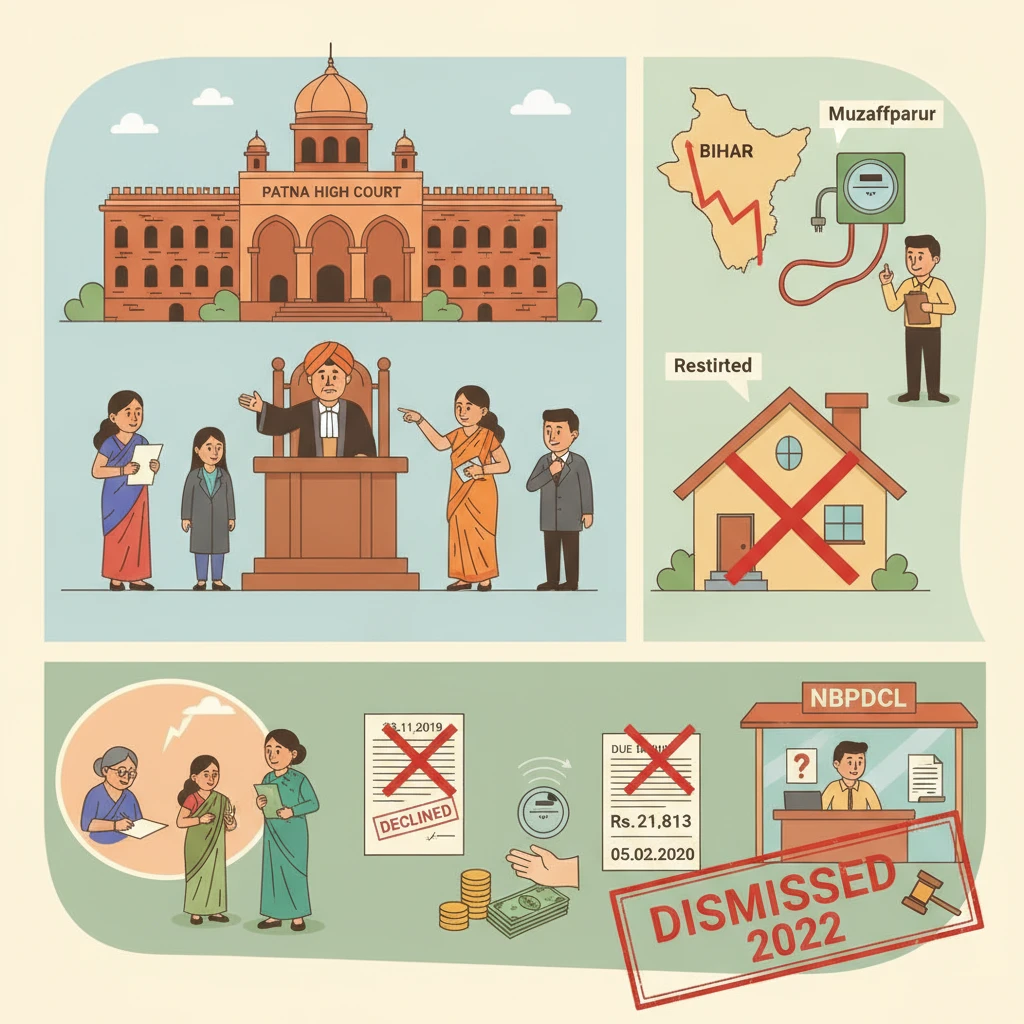
Case Background
This writ petition under Article 226 of the Constitution of India concerned a dispute over an electricity connection in a residential house at Majhaulia Chak Abdul Wahid, Ward No. 27, Muzaffarpur, described as holding No. 336/359, Khata No. 433, Plot No. 473.
The original owner of the house, Sita Devi, had an electricity connection in her name. Sita Devi passed away on 15.03.2010, as recorded in a later civil court judgment. Respondent No. 7 is her daughter.
The petitioner claimed that Sita Devi executed a registered sale deed in her favour about one and a half months before her death, transferring the house to her. On that basis, she said she was in occupation of the premises.
However, in Title Suit No. 371 of 2011 (Poonam Prakash vs. Anuradha Kumari and Ors.), the Sub Judge-XIV, Muzaffarpur, by judgment dated 23.11.2019, declared that sale deed to be fraudulent and set it aside. The trial court also directed the petitioner to vacate the property. A copy of that judgment was placed before the High Court. A First Appeal (F.A. No. 27 of 2020) against that decree is pending before the Patna High Court.
Meanwhile, electricity dues of Rs. 44,767/- accumulated on the connection in Sita Devi’s name, leading to disconnection on 07.01.2020. The petitioner said that on the assurance of officials of North Bihar Power Distribution Company Limited (NBPDCL), she paid Rs. 25,000/- towards the arrears and supply was restored, but the connection was again disconnected on 05.02.2020 due to the remaining dues of Rs. 21,813/-.
The petitioner alleged that the second disconnection was not really due to arrears but was done at the instance of respondent No. 7, who was asserting title over the house on the strength of the civil court decree.
On 07.03.2020, the petitioner applied for a fresh electricity connection in her own name for the same premises. She did so more than a year after the judgment in the title suit and about ten years after Sita Devi’s death.
By letter dated 22.06.2020, the Junior Engineer, Electric Supply Division, Maripur, told her that her application (referred to as dated 13.02.2020) would be considered after guidelines were obtained from headquarters. Earlier, on 15.03.2020, the Junior Electrical Engineer had asked her to produce documents showing her title over the premises for the purpose of processing a new connection.
In the writ petition (CWJC No. 17983 of 2021), the petitioner challenged these communications and sought a direction (mandamus) to NBPDCL and other respondents to grant a new electricity connection on the basis of her application dated 07.03.2020.
What the Court Examined and Decided
The Division Bench of the Patna High Court, consisting of Hon’ble Mr. Justice Chakradhari Sharan Singh (who delivered the judgment) and Hon’ble Mr. Justice Madhuresh Prasad, first examined the nature of the two key letters dated 15.03.2020 and 22.06.2020.
The Court held that these letters were not orders and did not contain any decision adverse to the petitioner. One letter simply stated that the application would be considered after receiving guidelines, and the other asked for documents in support of title. Therefore, the Court observed that the challenge to these communications was misconceived.
The more substantial relief sought was a direction to the electricity company to grant a new connection on the petitioner’s application dated 07.03.2020. The Bench examined this request in light of admitted facts, the Electricity Act, the Electricity (Rights of Consumers) Rules, 2020, and the Bihar Electricity Supply Code, 2007.
On a prior date of hearing, the petitioner had relied on Rule 4(9) of the Electricity (Rights of Consumers) Rules, 2020, arguing that the licensee could not demand more documents than those mandatorily required. The Court had asked NBPDCL to address this point in its counter affidavit.
In its counter affidavit, NBPDCL explained that “occupier” under Rule 2(1)(k) of the 2020 Rules means the owner, tenant, or person in occupation of the premises where electricity is used or proposed to be used.
NBPDCL relied on Section 43(1) of the Electricity Act, 2003, which imposes a duty on every distribution licensee to supply electricity to the owner or occupier of any premises within one month of receiving a complete application. The explanation to Section 43 defines “application” as one complete in all respects, in the specified form, with all necessary documents and charges.
The company also cited the Bihar Electricity Supply Code, 2007, framed under Section 50 of the Electricity Act. There, “occupier” is similarly defined as the owner or person in occupation of the premises where electric energy is used or proposed to be used.
Chapter 4.I of the Supply Code states that if there are arrears of electricity dues against the owner, occupier, or tenant of any premises, a new connection should not be denied to a subsequent owner or occupier. NBPDCL argued that although the petitioner called herself an occupier, she had not disclosed or proved the circumstances under which she was occupying the house, and there were admitted outstanding dues against the existing connection.
NBPDCL further relied on Clause 4.16 of the Supply Code, which placed a duty on the licensee to verify applications and documents at the time of receipt. It said that Clause 4.9 of the Supply Code only lays down broad guidelines on two mandatory types of documents for a new connection: proof of identity and proof of ownership or occupancy over the premises. It did not remove the licensee’s duty to verify the genuineness and legality of the claim.
On that basis, NBPDCL stated that the petitioner had failed to establish either ownership or lawful occupancy and thus could not insist on a connection in her name.
The petitioner, through her counsel, argued that her physical possession of the premises was admitted even in the civil court’s judgment, as the title suit decree directed her to vacate the property. She contended that as an occupier she was entitled to electricity.
She also repeated that Sita Devi had executed a sale deed in her favour and that her husband had been adopted by Sita Devi’s husband, Bhola Prasad, in 1983, making her the daughter-in-law of Sita Devi. She said her title and possession were under challenge and the matter was sub judice in First Appeal No. 27 of 2020. Until the appeal was decided, she argued, it was unfair to treat her as an unlawful occupier.
To support her case, the petitioner relied on:
- A judgment dated 03.05.2017 in CWJC No. 2963 of 2017 (Ashok Kumar vs. The Principal Secretary, Department Energy and Ors.)
- A judgment dated 11.04.2014 in CWJC No. 181 of 2014 (Suresh Chaudhary vs. The Bihar State Power Holding Company Ltd. and Ors.)
- The Division Bench judgment of the Calcutta High Court in Jai Narayan Patel vs. Sanboth Chakraborthy, 2012 (3) CHN 548
- The Division Bench judgment in Bihar State Electricity Board vs. Bihar State Human Rights Commission, 2012 (3) PLJR 882, to argue that denial of electricity violates Article 21 of the Constitution.
NBPDCL’s senior counsel responded that the petitioner could not be treated as a “lawful” occupier because the civil court had already declared the sale deed in her favour to be fraudulent and had directed her to vacate. He argued that “occupier” in the statutory scheme could not include an unlawful occupier, and that the petitioner had not produced any receipt of the claimed Rs. 25,000/- payment.
The High Court then carefully assessed the surrounding facts and the petitioner’s conduct. It noted that there had been no valid electricity connection for the house since Sita Devi’s death on 15.03.2010. Yet the petitioner applied for a new connection only on 07.03.2020, about ten years later.
The Court specifically observed that the petitioner had offered no explanation for not seeking a fresh connection soon after the sale deed in her favour or after Sita Devi’s death. The electricity had been disconnected again on 05.02.2020, and the writ petition was filed much later, on 01.10.2021, almost one year after the application for a fresh connection.
The Bench highlighted that the questions of how the petitioner had been getting electricity after Sita Devi’s death in 2010, and how she managed from 2020 despite disconnection, remained unanswered.
The Court referred to the trial court’s findings in Title Suit No. 371 of 2011, including that the matriculation and intermediate certificates relied on by the petitioner’s husband to prove adoption had been cancelled by the Bihar School Examination Board because they recorded Bhola Prasad as his father’s name.
While the High Court did not go into the merits of the title dispute, as the appeal was pending, it clearly stated that the petitioner’s overall conduct did not inspire confidence to warrant exercise of its discretionary writ jurisdiction under Article 226. Her unexplained delay in applying for a connection and in moving the writ petition after the decree in the title suit indicated lack of bona fide.
The Court distinguished the judgments relied on by the petitioner. In Ashok Kumar, the dispute was between landlord and tenant and the tenant’s status was not in doubt; the Court allowed the tenant’s application for connection. In Suresh Chaudhary, the applicant was admittedly the son of the original consumer. The Calcutta High Court judgment in Jai Narayan Patel was also held inapplicable in the present factual scenario.
Ultimately, the Bench concluded that the petitioner had not made out any case for issuance of a writ of mandamus directing NBPDCL to provide a new electricity connection in her name for the disputed premises.
The writ petition was dismissed, with the Court expressly recording that it found no merit in the case.
Why This Judgment Matters
This judgment is important for people seeking new electricity connections for disputed properties or houses where title and possession are under challenge.
The Patna High Court makes it clear that an applicant must show at least lawful or bona fide occupancy. Mere physical possession is not enough when a civil court has already held the person’s sale deed to be fraudulent and directed eviction.
The Court also shows that writ jurisdiction under Article 226 is discretionary. If a petitioner’s conduct appears doubtful, with long delays and unanswered questions (such as how electricity was being used for years without a valid connection), the Court may refuse relief even if electricity is a basic necessity.
For electricity consumers and occupants in Bihar, this judgment underlines that documents of title or lawful occupancy must be clear and complete. For distribution companies like NBPDCL, it confirms that they can insist on proof of lawful status and verify applications; they are not bound to grant electricity simply on a bare claim of occupation where fraud and adverse civil decrees are on record.
Legal Issues and Answers
Issue: Can the High Court, in writ jurisdiction, compel NBPDCL to grant a fresh electricity connection to a person whose sale deed over the premises has been declared fraudulent and who has not explained long delays and past use of electricity?
Answer: No. The Court held that the petitioner failed to prove lawful or bona fide occupancy, her conduct did not inspire confidence, and therefore no writ of mandamus could be issued to direct a new connection in her name.
Issue: Were the letters dated 15.03.2020 and 22.06.2020, calling for documents and stating that guidelines would be sought, illegal orders liable to be quashed?
Answer: No. The Court held that these letters were neither orders nor decisions adverse to the petitioner and that the challenge to them was misconceived.
Issue: Do earlier decisions allowing tenants or family members of original consumers to obtain electricity connections automatically apply to a person facing an adverse civil decree declaring her sale deed fraudulent?
Answer: No. The Court distinguished those precedents on facts, noting that in those cases the applicants’ status (as tenant or son of the consumer) was admitted, unlike the present case where the petitioner’s very basis of occupation was tainted by a finding of fraud.
Cases Cited by the Court
- CWJC No. 2963 of 2017, Ashok Kumar vs. The Principal Secretary, Department Energy and Ors. (Patna High Court, judgment dated 03.05.2017) – distinguished.
- CWJC No. 181 of 2014, Suresh Chaudhary vs. The Bihar State Power Holding Company Ltd. and Ors. (Patna High Court, judgment dated 11.04.2014) – distinguished.
- Jai Narayan Patel vs. Sanboth Chakraborthy, 2012 (3) CHN 548 (Calcutta High Court) – held not applicable to present facts.
- Bihar State Electricity Board vs. Bihar State Human Rights Commission, 2012 (3) PLJR 882 – cited by petitioner to invoke Article 21; relief still declined on facts.
Case Details
Case Number: Civil Writ Jurisdiction Case No. 17983 of 2021
Case Title: Anuradha Kumari vs. The State of Bihar & Ors.
Coram: Hon’ble Mr. Justice Chakradhari Sharan Singh; Hon’ble Mr. Justice Madhuresh Prasad
Citation: 2022 (1) PLJR 761
Date of Judgment: 07.02.2022
CAV Date: 04.02.2022
Nature of Case: Writ petition under Article 226 of the Constitution of India seeking quashing of communications regarding electricity connection and mandamus for grant of a new electricity connection.
Petitioner’s Advocate: Mr. Ranjan Kumar Dubey, Advocate
Advocate for Respondent State: Mr. Kinkar Kumar (SC-9)
Advocate for Electricity Board / NBPDCL: Mr. Vinay Kirti Singh, Senior Advocate
Link to Judgment: Click here to read the full judgment of the Patna High Court
If you found this explanation helpful and wish to stay informed about how legal developments may affect your rights in Bihar, you may consider following Samvida Law Associates for more updates.







