

Case Background
A criminal case was registered as Guraru P.S. Case No. 100 of 2020 in District Gaya under Section 30(a) of the Bihar Prohibition and Excise Act, 2016. The case arose after a raid conducted by the Assistant Sub-Inspector (Excise), Tikari Circle, Gaya.
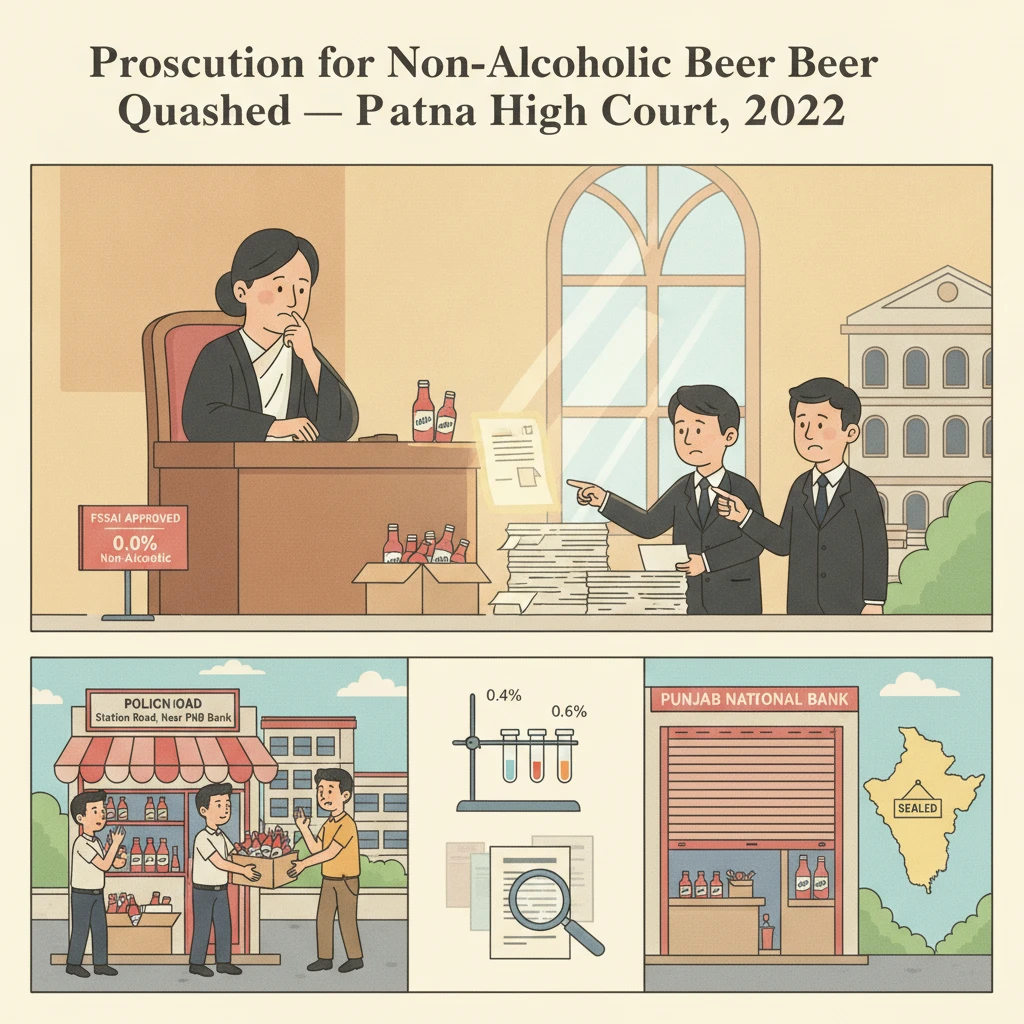
During the raid, the officer seized from a shop 40 cans of 330 ml Budwiser/Non-Alcoholic Beer and 88 bottles of 330 ml Budwiser fruit beer. The petitioner was working only as a salesman in this shop.
Samples of the seized drinks were sent to a laboratory for chemical examination. The report showed that the samples contained 0.6% v/v ethyl alcohol. Based on this report, the case was treated as a violation of the complete prohibition regime in Bihar and prosecution was launched against the petitioner.
Later, a charge-sheet was submitted after completion of investigation. However, the trial court had not yet taken any action on the charge-sheet when the petitioner approached the Patna High Court in Criminal Writ Jurisdiction Case No. 144 of 2021.
In the writ petition, the petitioner sought quashing of the entire criminal prosecution and a direction to the authorities not to take any coercive steps against him. An additional prayer was made for unsealing the premises near Station Road in front of Punjab National Bank, Gaya, but the judgment primarily addresses the criminal case.
What the Court Examined and Decided
The central point before the Patna High Court was whether the seized Budwiser non-alcoholic and fruit beer could legally be treated as “liquor” or “intoxicant” under the Bihar Prohibition and Excise Act, 2016, so as to justify prosecution under Section 30(a).
On behalf of the petitioner, it was argued that non-alcoholic drink or fruit beer is not an “intoxicating drink” and therefore does not fall within the mischief of the Act. Counsel drew the Court’s attention to specific provisions of the Excise Act, 2016, including Sections 13, 30(a) and 30(f), and the definitions of “intoxicant” and “liquor” in Sections 2(40) and 2(44).
The Court reproduced and examined Section 30(f), which prohibits manufacture, possession, sale, distribution, bottling, import, export and transportation of any preparation or ingredient made with or without use of any intoxicant or liquor that serves as an alcohol or substitute for alcohol and is used or likely to be used for getting intoxicated. This provision links the offence to the use or likely use of the substance for intoxication.
Section 2(40) defines “intoxicant” to include liquor or any preparation that serves as an alcohol or substitute for alcohol and is consumed for getting intoxicated. Thus, mere presence of some alcohol is not enough; the drink must be of such nature that it is consumed for intoxication.
The petitioner also relied on Section 2(3), which defines “alcoholic drink” as a solution or mixture containing alcohol, of any strength and purity, and Section 2(4), which defines “alcoholic beverage or potable liquor” as any beverage containing alcohol that conforms with Bureau of Indian Standards (BIS) norms and is fit for human consumption. The argument was that if the drink conforms to BIS/FSSAI standards for non-alcoholic beverages, it cannot be treated as prohibited liquor under the Excise Act even if it contains trace alcohol.
The Court noted that BIS standards are recognised by the Excise Act, and that the definition of BIS in the Act is inclusive of standards prescribed by any other Central Government authority under a relevant Act. This includes the Food Safety and Standards Authority of India (FSSAI), set up under the Food Safety and Standards Act, 2006.
The Court referred to the notification dated 19 March 2018 of the Ministry of Health and Family Welfare (FSSAI) which defines alcoholic beverage as a liquor or brew containing more than 0.5% ethanol. It further noted that under FSSAI regulations the tolerance limit for ethyl alcohol content is:
| S. No. | Category of Beverage | Tolerance Limit |
|---|---|---|
| I. | For beverage with ethyl alcohol content upto 20% abv | ±0.3% |
| II. | For beverage with ethyl alcohol content of more than 20% abv | ±1.0% |
| III. | For Wines | ±0.5% |
The Court observed that non-alcoholic beverages would fall in the first category. Thus, a small variation around the declared alcohol content is legally permitted.
It was also brought on record that, according to the petitioner, consignments from the same source had been tested at two different places. At one place, the ethyl alcohol content was found to be 0.4%, and in the other, 0.6%. The second result was only marginally above the 0.5% mark.
The petitioner submitted that he was only a salesman of one Sujit Kumar, who had purchased the products from an authorised distributor on 15 July 2020. The product had been imported into India and tested by FSSAI under the Food Safety and Standards Act, 2006. It was described as 0.0% non-alcoholic beer, tested across various laboratories and certified to be non-alcoholic.
Taking note of these submissions, the Court, by interim order dated 19 March 2021, had earlier directed that no coercive steps be taken against the petitioner during the pendency of the case.
In the final hearing, the Court closely examined how alcohol can naturally occur in food and beverages, and how its content may change due to climatic conditions, temperature, sunlight, and natural processes. It accepted that the alcohol content of a beverage is susceptible to a margin of error.
The Court further noted that no rules had been framed under the Bihar Excise Act prescribing any procedure or protocol for testing samples for alcohol content. In the absence of such rules, the testing process itself could be prone to error and deficiencies.
On the facts, the Court found no evidence of any intention on the part of the petitioner to breach the excise law. It emphasised that there is no prohibition on the sale of non-alcoholic beverages in Bihar. The object of the prohibition law is to enforce complete prohibition of liquor and intoxicants, not to criminalise marginal, technical deviations in non-alcoholic drinks.
The Court held that a minor infraction in ethyl alcohol content of a non-alcoholic beverage such as fruit beer does not offend the object and purpose of the Bihar Prohibition and Excise Act. It considered it highly unreasonable to treat such marginal variation as a ground for compulsory prosecution.
The judgment then turned to the High Court’s power to quash criminal proceedings. Relying on the Supreme Court’s well-known decision in State of Haryana and Others v. Bhajan Lal and Others (Supp (1) SCC 335), the Court recalled that one of the situations where an FIR can be quashed is where, even if the allegations are taken at face value and accepted in their entirety, they do not prima facie make out any offence.
The Court also referred to the more recent Supreme Court decision in Neeharika Infrastructure Pvt. Ltd. v. State of Maharashtra and Others, (2021) SCC OnLine SC 315, where the Supreme Court reiterated the Bhajan Lal principles and cautioned that the power to quash must be used sparingly so as not to unnecessarily interfere with investigation.
In addition, the Court cited Anand Kumar Mohatta and Another v. State (Government of NCT of Delhi), Department of Home and Another, (2019) 11 SCC 706, to underline that even after investigation is complete and a report under Section 173 of the Code of Criminal Procedure has been filed, the High Court can still quash proceedings if no offence is made out.
Applying these principles, the Patna High Court found that the prosecution of the petitioner was based only on the finding that some samples showed ethyl alcohol marginally beyond the tolerance limit. The seized items were not being sold as intoxicants and could not be consumed as intoxicants. Therefore, they did not fall in the category of “liquor” prohibited under the Act.
The Court recognised that a margin of error is inherent in such a strict legislation and that, in the facts of this case, the ingredients of the offence were not satisfied. It concluded that the case did not warrant prosecution at all.
Accordingly, the Court held that it “matters not” that a charge-sheet had already been filed. Since the FIR itself did not disclose a prima facie offence, the High Court was justified in exercising its writ jurisdiction to quash the proceedings.
The Patna High Court therefore quashed Guraru P.S. Case No. 100 of 2020 and all criminal prosecution emanating from it. The writ application was allowed.
Why This Judgment Matters
This decision is important for shopkeepers, salesmen, and distributors dealing with non-alcoholic beverages in Bihar. It clarifies that mere trace or marginal alcohol content in a drink certified as non-alcoholic by national food safety authorities does not automatically expose them to prosecution under the Prohibition Act.
The judgment stresses that prohibition laws must be applied with common sense. The focus should be on actual intoxicants and products meant to be consumed for intoxication, not on technical variations in non-alcoholic drinks where the person has no intention to break the law.
For citizens, it also shows that the Patna High Court can step in and quash criminal cases even after filing of charge-sheet when the basic ingredients of the offence are missing. This is especially relevant for those who may face cases due to overzealous enforcement of prohibition laws.
Legal Issues and Answers
-
Issue: Does sale and possession of a branded non-alcoholic/fruit beer, certified under FSSAI norms but showing marginal ethyl alcohol content above 0.5%, constitute an offence under Section 30(a) of the Bihar Prohibition and Excise Act, 2016?
Answer: No. The Patna High Court held that such a beverage is not an “intoxicant” or “liquor” for purposes of the Act, particularly when the variation is within or around prescribed tolerance limits and the product is not sold or used as an intoxicant. - Issue: Can the High Court quash an FIR and criminal proceedings under Article 226/Section 482 CrPC even after a charge-sheet is filed?
- Answer: Yes. Relying on Bhajan Lal and Anand Kumar Mohatta, the Court held that if, on the face of the FIR and material, no offence is made out, the High Court can quash the FIR and all proceedings, notwithstanding submission of charge-sheet.
Cases Cited by the Court
- State of Haryana and Others v. Bhajan Lal and Others, Supp (1) SCC 335.
- Neeharika Infrastructure Pvt. Ltd. v. State of Maharashtra and Others, (2021) SCC OnLine SC 315.
- Anand Kumar Mohatta and Another v. State (Govt. of NCT of Delhi), Department of Home and Another, (2019) 11 SCC 706.
Case Details
Case Number: Criminal Writ Jurisdiction Case No. 144 of 2021; arising out of Guraru P.S. Case No. 100 of 2020, District Gaya.
Case Title: Rahul Kumar v. The State of Bihar and Others.
Coram: Hon’ble Mr. Justice Ashutosh Kumar.
Citation: 2022 (1) PLJR 703.
Advocates: For the petitioner – Mr. Mrigank Mauli, Senior Advocate, assisted by Mr. Avinash Shekhar, Advocate. For the State – Mr. P.K. Verma, Additional Advocate General.
Nature of the Case: Criminal writ petition seeking quashing of FIR and criminal prosecution under the Bihar Prohibition and Excise Act, 2016, and protection from coercive action.
Date of Judgment: 09-02-2022 (oral judgment).
Link to Judgment: Patna High Court Judgment – Criminal WJC No. 144 of 2021
If you found this explanation helpful and wish to stay informed about
how legal developments may affect your rights in Bihar,
you may consider following Samvida Law Associates for more updates.







