

Case Background
The petitioner was an elected Pramukh of the Block Panchayat Samiti, Keshariya, in East Champaran district. During his tenure, a dispute arose regarding his functioning as Pramukh.
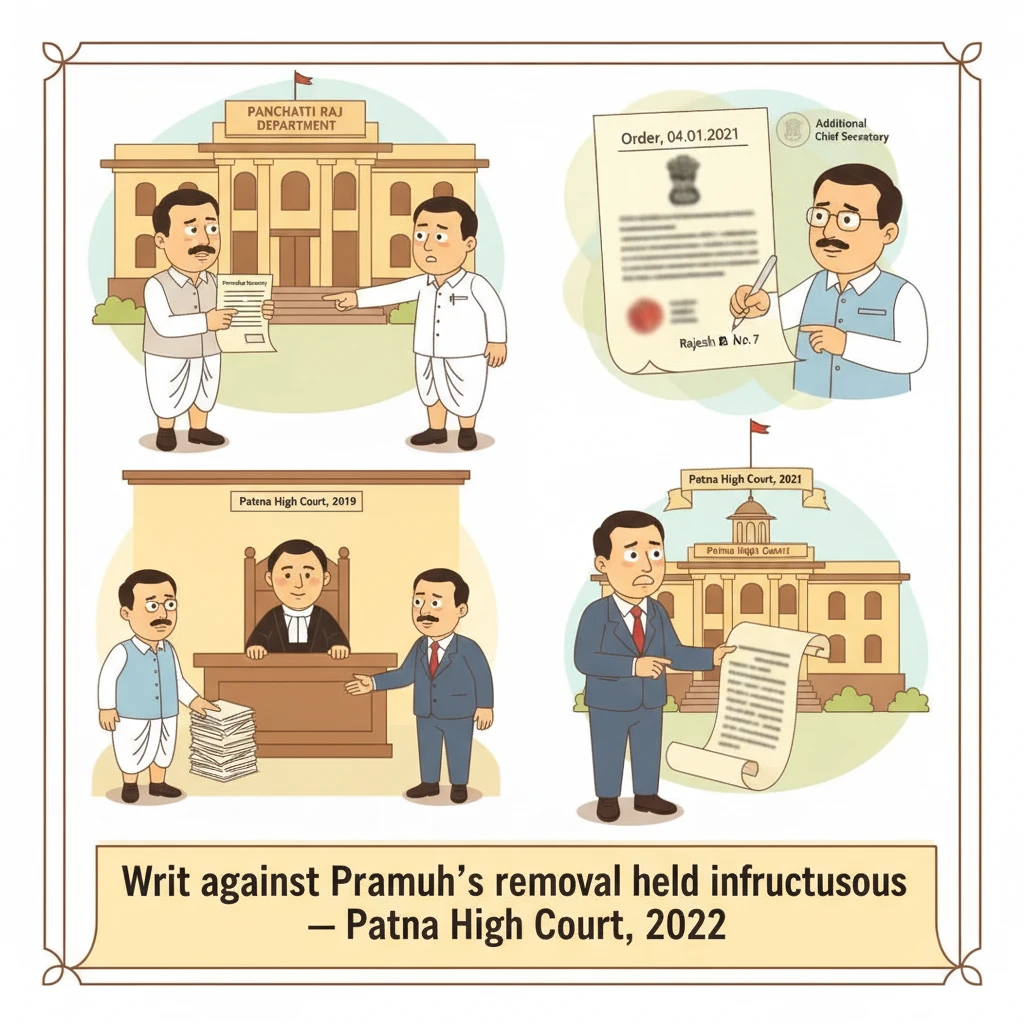
Respondent No. 7, who was the Up-Pramukh of the same Block Panchayat Samiti, lodged a complaint before the Principal Secretary, Panchayati Raj Department, Government of Bihar. He alleged that the petitioner had failed to convene the required number of meetings of the Panchayat Samiti as mandated by Section 46 of the Bihar Panchayat Raj Act, 2006.
When the Department allegedly did not act on this complaint, respondent No. 7 approached the Patna High Court by filing CWJC No. 6776 of 2019. On 21.11.2019, that writ petition was disposed of with a direction to the Principal Secretary, Panchayati Raj Department, to look into the grievance and pass an appropriate order after hearing all concerned within three months.
In compliance with this earlier High Court direction, the Additional Chief Secretary, Panchayati Raj Department, passed an order dated 04.01.2021 under Section 44(4) of the Bihar Panchayat Raj Act, 2006, removing the petitioner from the post of Pramukh. The order described him by a wrong name “Rajesh Kumar” instead of “Rakesh Kumar Singh”, which was noted in the cause title of the present writ petition.
The petitioner then filed the present Civil Writ Jurisdiction Case No. 5522 of 2021 before the Patna High Court. He challenged the 04.01.2021 removal order primarily on the ground that there had been no valid service of notice in the removal proceedings under Section 44(4). He claimed that this amounted to violation of principles of natural justice and procedural requirements, and therefore the order should be set aside under Article 226 of the Constitution of India.
By the time the writ petition came to be finally decided, the petitioner’s tenure as Pramukh had already ended. It was his own case that the impugned order was passed about two months before his tenure was to expire.
What the Court Examined and Decided
The Division Bench of the Patna High Court, comprising Hon’ble Mr. Justice Chakradhari Sharan Singh and Hon’ble Mr. Justice Madhuresh Prasad, heard the matter. The C.A.V. judgment was delivered on 01.02.2022.
At the outset, the Court noted an admitted and undisputed fact: even if the petitioner succeeded in challenging the impugned order, he could not be restored to the office of Pramukh because his term had already come to an end. This created an immediate question for the Court: what real relief could now be granted?
The Bench posed this question directly to the petitioner’s counsel. In response, counsel submitted that the challenge still mattered because of the consequences that, in the petitioner’s understanding, flowed from an order under Section 44(4). He argued that if the removal order was allowed to stand, the petitioner would suffer disqualification from contesting elections to any panchayat bodies for five years from the date of removal. On this basis, he contended that the writ petition had not become infructuous merely because the petitioner was no longer Pramukh.
Accepting that this was the real concern of the petitioner, the Court examined the nature and basis of the impugned order and the exact language of Section 44(4) of the Bihar Panchayat Raj Act, 2006.
From the impugned order, the Court found it “evident” that the proceeding under Section 44(4) was initiated on the complaint of respondent No. 7 to the Principal Secretary. The allegation was specifically that the petitioner had failed to convene the requisite number of Panchayat Samiti meetings under Section 46.
The Court then reproduced the full text of Section 44(4). The provision allows the State Government, which has territorial jurisdiction over the Panchayat Samiti, to remove a Pramukh or Up-Pramukh on certain grounds. These include:
- Absence without sufficient cause for more than three consecutive meetings or sittings.
- Wilful omission or refusal to perform duties and functions under the Act.
- Abuse of powers vested in the office.
- Being found guilty of misconduct in discharge of duties.
- Disobedience of an order of an authority established by law.
- Becoming physically or mentally incapacitated from performing duties.
- Absconding as an accused in a criminal case for more than six months.
The provision further states that if a Pramukh or Up-Pramukh is removed on the charge of “misuse of vested powers” or “misconduct in the discharge of his duties,” such a person becomes ineligible for election to any panchayat body for five years from the date of removal. However, a person removed on any of the other grounds (for example, absence, incapacity, or absconding) is only barred from contesting for the posts of Pramukh or Up-Pramukh of the same Panchayat Samiti during the remaining term.
After setting out this legal framework, the Court turned back to the impugned order to identify the precise ground used for the petitioner’s removal. The judgment clearly records that the removal was on the ground that the petitioner had failed to convene meetings of the Panchayat Samiti as required by the Act.
The Bench then drew an important distinction. It held that the petitioner’s removal was not based on a finding that he was guilty of “misuse of vested powers” or of “misconduct in the discharge of his duties.” Instead, it was based on his alleged failure to convene meetings as per the statutory requirement.
On a plain reading of Section 44(4), the Court concluded that only when removal is on the ground of misuse of powers or misconduct does the additional five-year disqualification for any panchayat election arise. Since the petitioner was not removed on either of these two specific grounds, there was no statutory basis for treating him as disqualified for future elections to any panchayat body.
In other words, the Bench found that the “answer” to the petitioner’s apprehension lay in the provision itself. The law did not support his fear of a five-year disqualification in the facts of his case. Therefore, the very justification for continuing the writ petition, after his term had expired, disappeared.
Having thus addressed the potential future consequence, the Court then examined whether it was necessary to go into the validity of the removal order itself, especially in light of the petitioner’s plea that the proceeding violated the principles of natural justice due to alleged invalid service of notice.
The petitioner’s counsel had argued that the notice of the Section 44(4) proceeding was never validly served, and therefore the order was patently illegal and fit to be set aside. However, the Court took the view that, given the circumstances, it would be an “exercise in futility” to examine this issue in detail.
The reasoning was simple yet decisive: the petitioner’s term of office had already come to an end, and there was no statutory disqualification arising from the removal order that could affect his future political rights. As such, the impugned order had become “inconsequential” in practical terms.
The Bench further held that no “useful purpose” would be served by entering into a detailed dispute about notice and natural justice at this stage. With the office term over and no ongoing disqualification, there was no live controversy that required adjudication in the exercise of writ jurisdiction under Article 226.
On this basis, the Court held that the writ application had become infructuous and disposed it of accordingly, without ruling on the alleged defects in notice or on the validity of the removal order on merits.
Hon’ble Mr. Justice Madhuresh Prasad expressly recorded his agreement with the judgment authored by Hon’ble Mr. Justice Chakradhari Sharan Singh.
Why This Judgment Matters
This judgment is important for elected panchayat representatives and future candidates under the Bihar Panchayat Raj Act, 2006.
First, it clarifies that not every removal under Section 44(4) results in a blanket five-year disqualification from all panchayat elections. That harsh consequence arises only when the removal is specifically on grounds of misuse of powers or misconduct in discharge of duties. Where removal is based on other grounds, such as failure to convene meetings, the person is not barred from contesting future elections to panchayat bodies beyond the limited restriction stated in the provision.
Second, the judgment shows how the Patna High Court approaches petitions that have lost practical significance due to the passage of time. Even where a petitioner alleges violation of natural justice, the Court may decline to go into the merits if no effective relief can be granted and no real disability continues.
For local body representatives, this decision underlines the importance of understanding the exact grounds of any removal order and the specific consequences built into Section 44(4). It also shows that courts will read the statute carefully rather than assume automatic long-term disqualification.
Legal Issues and Answers
Issue: Did the removal of the petitioner as Pramukh under Section 44(4) automatically disqualify him from contesting elections to any panchayat body for five years from the date of removal?
Answer: No. The Patna High Court held that the petitioner was removed for failure to convene required meetings, not for misuse of powers or misconduct, so the five-year disqualification clause in Section 44(4) was not attracted.
Issue: Should the High Court examine the validity of the removal order on the ground of alleged violation of natural justice when the petitioner’s term has already expired and no statutory disqualification survives?
Answer: No. The Court held that, as the term had ended and the order did not create a five-year bar on future elections, examining the validity of the order would be an exercise in futility. The writ petition was therefore treated as infructuous and disposed of.
Cases Cited by the Court
- The judgment refers to an earlier writ petition, CWJC No. 6776 of 2019, filed by respondent No. 7, which led to the direction to the Principal Secretary to decide the complaint. No other judicial precedents are cited or relied upon in the text of this judgment.
Case Details
Case Number: Civil Writ Jurisdiction Case No. 5522 of 2021
Case Title: Rakesh Kumar Singh @ Rakesh Kumar vs. The State of Bihar & Ors.
Coram: Hon’ble Mr. Justice Chakradhari Sharan Singh; Hon’ble Mr. Justice Madhuresh Prasad
Citation: 2022 (1) PLJR 769
Advocates:
- For the petitioner: Mr. Radha Mohan Pandey, Advocate; Mr. Niranjan Prasad Singh, Advocate
- For the State (respondents 1 to 6): Mr. Prateek Kumar Sinha, AC to GA-5
- For respondent No. 7: Mr. S.B.K. Manglam, Advocate
Nature of the case: Writ petition (civil) under Article 226 of the Constitution of India challenging an order of removal of an elected Pramukh under Section 44(4) of the Bihar Panchayat Raj Act, 2006.
Date of Judgment: 01.02.2022
C.A.V. Date: 24.01.2022
Link to Judgment: Click here to view the official Patna High Court judgment
If you found this explanation helpful and wish to stay informed about how legal developments may affect your rights in Bihar, you may consider following Samvida Law Associates for more updates.







