

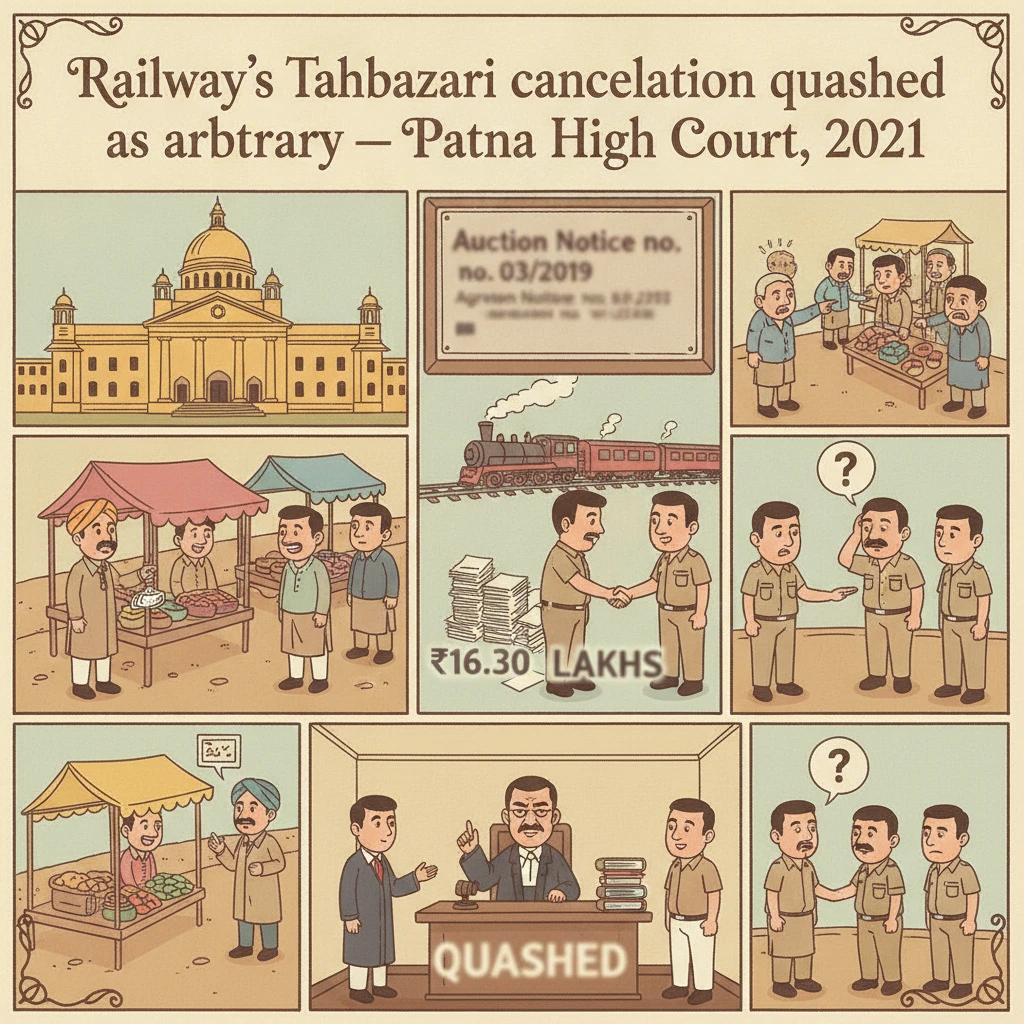
The Patna High Court held that the cancellation was arbitrary and against natural justice.
The Court set aside the cancellation letter and allowed the writ petition.
This means the Railways cannot end such concluded contracts without valid reasons and fair procedure.
Case Background
The dispute arose from an open tender issued by the East Central Railway, Sonpur Division, for Tahbazari (stallage) rights over a piece of vacant railway land near Shahpur Patoree Railway Station in Samastipur district.
A tender notice dated 5.8.2019 was issued under the signature of the Assistant Engineer (Line), Sonpur. The notice invited bidders for an open tender to grant Tahbazari rights for two years. The stated objective was twofold: to control encroachment over the railway plot and to generate revenue for the Railways.
The petitioner participated in this open tender. After bids were opened, he was declared the highest bidder. He was then asked to deposit the earnest money, which he did. Thereafter, a written agreement for Tahbazari was executed between the petitioner and the Railways on 18.12.2019.
By letter dated 20.12.2019, the Assistant Zonal Engineer (Line), Sonpur, informed the Station Master and other concerned officials that the petitioner was the highest bidder with an offer of Rs. 75,01,000/-. The letter clearly stated that an agreement had been entered into on 18.12.2019 and that the petitioner would have the right to hold Tahbazari over the specified vacant railway land at Shahpur Patoree from 1.1.2020 to 31.12.2022.
The letter directed all concerned to cooperate with the petitioner in running the Tahbazari. Acting on this, the petitioner deposited about Rs. 16.30 lakhs and started collecting rent from small shopkeepers and temporary movable shops on the railway land from 1.1.2020.
However, within a short period, the Railway authorities reversed course. By letter dated 19.3.2020, issued under the signature of the Divisional Railway Manager (Engineering), Sonpur, the Railways cancelled the petitioner’s Tahbazari rights, with effect from 19.2.2020. This cancellation letter became the central subject of the writ petition.
What the Court Examined and Decided
The petitioner approached the Patna High Court seeking quashing of the cancellation letter dated 19.3.2020. He also asked for directions to allow him to continue holding the Tahbazari as the highest bidder and licensee, and to protect his peaceful possession and right to collect rent.
According to the petitioner, the Railways had followed all legal procedures: issuing a tender, inviting bids, selecting the highest bidder, and executing a written agreement on 18.12.2019. This resulted in a concluded contract for the period 1.1.2020 to 31.12.2022.
He argued that the cancellation was done without any show cause notice or opportunity of hearing. From the face of the impugned letter, the only reason mentioned for cancelling the contract was reliance on a Railway Board letter dated 10.2.2005, which allegedly imposed restrictions on allotment of Tahbazari.
The petitioner further pointed out that the Railways’ counter affidavit referred to a complaint allegedly made by some villagers and an internal enquiry. However, he was never informed of this complaint, nor was he given any participation in the enquiry. He maintained that no fault on his part was found in the enquiry, and yet the Railways tried to invoke an old policy decision of 2005 to cancel a valid fresh contract entered into in 2019.
For legal support, the petitioner relied on the Full Bench judgment of the Patna High Court in M/s Pancham Singh v. State of Bihar [AIR 1991 Pat 168 (FB)], to argue that once a contract is validly executed in accordance with constitutional and legal requirements, cancellation on grounds not contained in the contract and in an arbitrary manner can be examined and struck down under Article 226 of the Constitution.
The Railways filed a counter affidavit and a supplementary counter affidavit. They stated that auction notice no. 03/2019 dated 5.8.2019 was issued after obtaining approval from the competent authority. The purpose was to control encroachment near the station and earn revenue by allowing a successful bidder to collect rent from small shopkeepers and temporary stalls on the vacant land from 1.1.2020 to 31.12.2022.
The Railways admitted that the petitioner was the highest bidder, that an agreement dated 18.12.2019 was executed, and that he started collecting rent from 1.1.2020. They then claimed that on 12.2.2020 some villagers filed a written complaint against the petitioner, alleging irregularities, dust, and littering in the area.
An enquiry was conducted and a report submitted on 27.2.2020. Interestingly, the enquiry report, which was later reproduced in the judgment, recorded that the persons whose signatures appeared on the complaint denied having filed any such complaint. Most of them were illiterate and unable to sign. The enquiry also found that:
- The area of 3911 sq. ft. for Tahbazari had already been properly demarcated and handed over to the petitioner after removal of unauthorized encroachments.
- The Tahbazari was functioning within the demarcated area as per Railway directions.
- The complaint appeared to be motivated by rivalry between the successful bidder (the petitioner) and a local person running his own market adjacent to the railway land, who was instigating shopkeepers against the petitioner.
- Signatures on the complaint were found to be forged and the allegations baseless.
The enquiry, however, did note certain practical issues. The rate collected from shopkeepers was outside the contractual terms, though the contractor was asked to display the rates transparently. Running of a chicken shop was also beyond the contract’s scope, and the licensee was instructed not to sell chicken in open space and to keep the area clean. It was also observed that access to some local villagers’ shops abutting the railway land was obstructed because there was no gap between private and railway land.
After this enquiry, the Senior Divisional Engineer, Sonpur, wrote to the Principal Chief Engineer, East Central Railway, Hajipur, by letter dated 27/28.2.2020. In this letter, he clearly recorded that the complaint was forged and baseless, and that the Tahbazari had been tried on an experimental, temporary basis to stop encroachment and earn revenue from unused land. He highlighted that the Railways had unexpectedly received a high royalty of Rs. 75,01,000/- for a small piece of land already encroached by sabzi mandi and thela shops.
He then requested instructions whether the Tahbazari should continue or be terminated. In response, by letter dated 5.3.2020, the headquarters directed the divisional authority to follow the Railway Board letter no. 2005/LML/18 dated 10.2.2005 and paragraph 821L of the Indian Railway Works Manual.
Based on this direction, the Railways concluded that no new plot of railway land could be added for Tahbazari/licensing. They treated the petitioner’s allotment as a new license and decided to cancel it. In contrast, they continued Tahbazari at another station, Sahdei Buzurg, on the ground that that license was old and ongoing, not a fresh allotment.
The Railways relied on clause 5 of the agreement dated 18.12.2019 to issue a one-month notice on 19.3.2020, cancelling the licence with effect from 19.4.2020. They also stated that disciplinary proceedings had been initiated against erring railway officials for having made the allotment contrary to policy.
Justice Partha Sarthy first noted that there was no dispute about the existence of a concluded contract between the petitioner and the Railways for the period 1.1.2020 to 31.12.2022. There was also no allegation of any breach of the terms of the contract by the petitioner.
The Court then examined the Railway Board letter dated 10.2.2005, which was relied upon to justify the cancellation. Clause 2 of that letter was quoted. It showed that:
- Leasing of land was generally not permitted except with specific approval of the Railway Board.
- Temporary licensing of railway land to private individuals for shops, stalls, clinics etc. not connected with railway working had been stopped, and that ban would continue.
- Licensing of ordinary commercial plots connected with railway working needed approval of the General Manager and consultation with finance.
- Existing licences not connected with railway working could be renewed from time to time as long as the land was not required for railway use, but on new terms and conditions.
- In each case a proper agreement had to be executed before possession was given, and any official violating this instruction would be personally responsible.
The Court observed that even this policy letter was not drafted as an absolute bar on all leasing or renewal of railway land. It laid down conditions and approvals, but did not itself automatically cancel validly executed agreements.
Turning to the law on cancellation of government contracts, the Court relied on the Full Bench decision in M/s Pancham Singh. That judgment held that when a government contract executed in accordance with Article 299 of the Constitution is cancelled on a ground not referable to any term of the contract, and the cancellation is in itself violative of Article 14, the High Court can exercise writ jurisdiction to strike it down.
The Court also referred to the Supreme Court’s decision in Mahabir Auto Stores v. Indian Oil Corporation (AIR 1990 SC 1031), as discussed in Pancham Singh. The principle extracted was that government action— even in entering into or refusing to enter into contracts— must be reasonable, non-arbitrary, and informed by rule of law. Any arbitrary state action in such matters is open to judicial review under Article 14.
Applying these principles, the Court held that the Railways did not claim any breach of contract by the petitioner. Instead, they cancelled the contract on the basis of an old policy circular, after having themselves invited tenders, taken approval of competent authorities, executed a written agreement, and allowed the petitioner to start work.
Moreover, the complaint against the petitioner was found to be forged and motivated by local rivalry. Yet, despite this clean chit, and without issuing any show cause notice or giving the petitioner an opportunity to be heard, the Railways terminated the licence.
In these circumstances, the Court concluded that the action of the Railways and the impugned cancellation order were neither reasonable nor fair. They were arbitrary and in violation of principles of natural justice.
Accordingly, the Patna High Court set aside the cancellation letter dated 19.3.2020. The writ application was allowed.
Why This Judgment Matters
This judgment is significant for small traders, market organizers, and contractors dealing with government bodies such as the Railways.
It makes clear that once a government authority has followed due process, invited tenders, accepted a bid, and signed a written agreement, it cannot cancel that agreement casually by citing an old policy, especially when there is no fault of the contractor.
The Court stressed that even though such rights arise from contracts, government decisions remain subject to Article 14 of the Constitution. Authorities must act reasonably, avoid arbitrariness, and respect natural justice by giving notice and hearing before taking adverse action.
For people who win government tenders and invest their savings in reliance on valid agreements, this decision of the Patna High Court offers protection. It shows that courts can and will intervene when state authorities try to walk away from their own contracts without lawful and fair reasons.
Legal Issues and Answers
-
Issue: Can the Railways cancel a concluded Tahbazari licence, without any breach by the licensee, solely by invoking a prior policy circular and without issuing a show cause notice?
Answer: No. The Patna High Court held that such cancellation is unreasonable, arbitrary, violates principles of natural justice and Article 14, and is therefore unsustainable in law. -
Issue: Does a contractual dispute involving a government body fall within writ jurisdiction when the cancellation is based on grounds outside the contract terms?
Answer: Yes. Relying on M/s Pancham Singh and Mahabir Auto Stores, the Court held that where cancellation is de hors the contract and arbitrary, the High Court can exercise jurisdiction under Article 226.
Cases Cited by the Court
- M/s Pancham Singh v. State of Bihar and others, AIR 1991 Pat 168 (Full Bench).
- Mahabir Auto Stores v. Indian Oil Corporation, AIR 1990 SC 1031 (referred within Pancham Singh and quoted in the judgment).
Case Details
Case Number: Civil Writ Jurisdiction Case No. 5706 of 2020
Case Title: Ram Naresh Rai v. Union of India & Ors.
Citation: 2022(1) PLJR 222
Court: High Court of Judicature at Patna
Coram: Hon’ble Mr. Justice Partha Sarthy
Date of Judgment: 20.09.2021
Advocates:
- M/s Rajendra Narain, Sr. Advocate, with Surendra Kishore Thakur, Advocate – for the petitioner.
- M/s P.K. Verma, Sr. Advocate, with Dr. Anand Kumar, Advocate – for the Railways.
Nature of the Case: Writ petition under Article 226 of the Constitution challenging cancellation of a Tahbazari (stallage) licence granted through open tender.
Link to Judgment: Click here to read the full judgment on the Patna High Court website
If you found this explanation helpful and wish to stay informed about
how legal developments may affect your rights in Bihar,
you may consider following Samvida Law Associates for more updates.







