

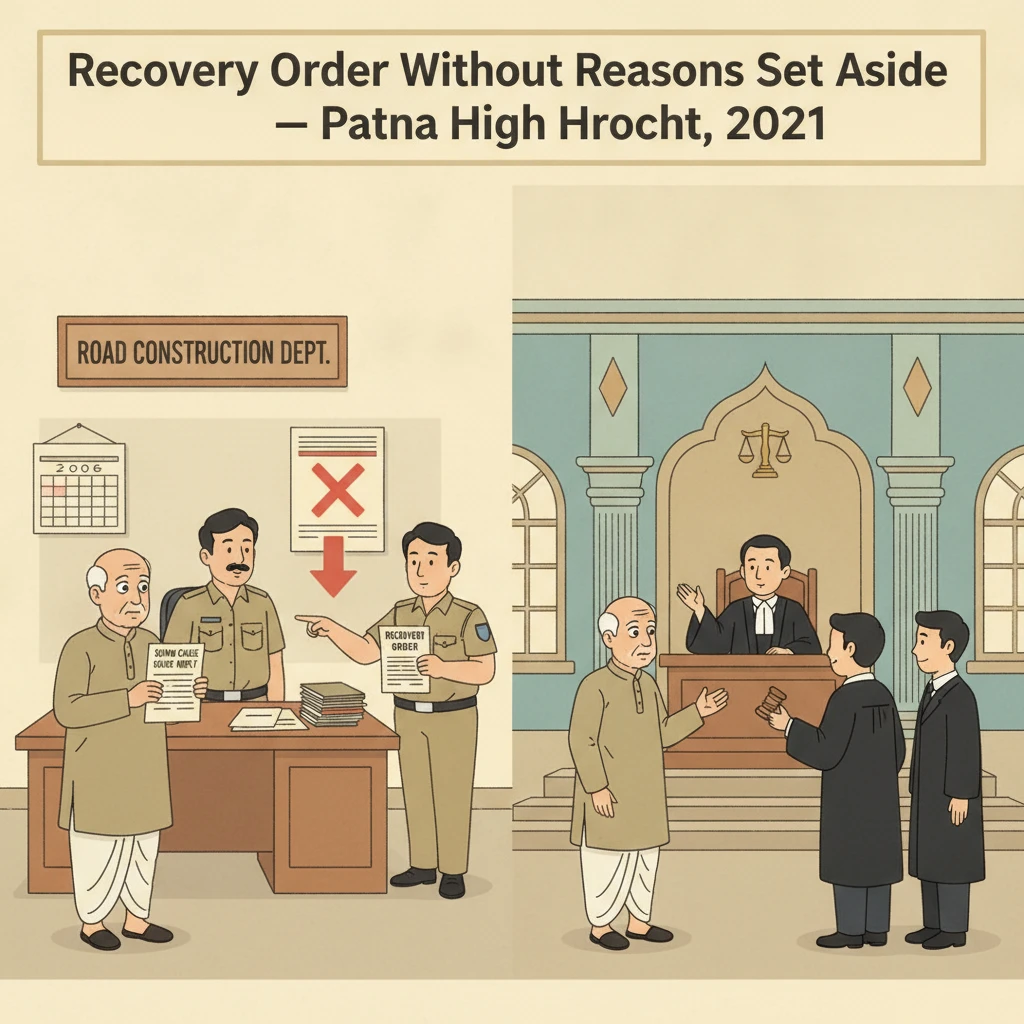
The Patna High Court held that the punishment order was illegal because it gave no reasons.
The Court cancelled the order and directed full payment of retiral dues and suspension salary.
Any recovery already made must be refunded to the retired employee.
Case Background
The petitioner in this case was serving as an Assistant Engineer in the Road Construction Division at Jehanabad under the Government of Bihar.
On 31.03.1999, the department issued a resolution placing him under suspension with effect from 08.03.1999. This suspension was in contemplation of a departmental proceeding.
While the departmental proceeding was still pending, the petitioner retired from government service on 31.01.2001.
Later, in the departmental proceeding, a punishment order was passed against him on 14.03.2005, contained in Annexure-9 to the writ petition. This punishment was awarded without giving him an opportunity of hearing.
The petitioner challenged that punishment order before the Patna High Court in Civil Writ Jurisdiction Case No. 7854 of 2005. On 27.10.2005, the High Court quashed the punishment order and directed the authorities to pass a fresh order after giving the petitioner an opportunity of hearing.
Following this direction, the department asked the petitioner to file a show-cause reply. He submitted his show cause on 04.01.2006, which appears as Annexure-11 to the present writ petition.
Thereafter, by notification dated 03.10.2006 (Annexure-12), the authorities again decided to proceed with recovery, stating briefly that his show cause had been considered and rejected, and that in light of the earlier order dated 14.03.2005, recovery of the specified amount would be made.
Feeling aggrieved by this fresh but cryptic order, the petitioner approached the Patna High Court once more in Civil Writ Jurisdiction Case No. 15018 of 2006.
What the Court Examined and Decided
The Patna High Court, presided over by Hon’ble Mr. Justice Birendra Kumar, heard both sides. The core question before the Court was whether the second punishment and recovery order, passed after the earlier writ, complied with the law and the Court’s earlier direction.
On behalf of the petitioner, it was argued that the disciplinary authority, while passing the fresh order after receiving the show cause, was acting in a quasi-judicial capacity. That means the authority had a duty to objectively consider the defence raised and to record reasons for accepting or rejecting it.
The petitioner’s counsel submitted that the order dated 03.10.2006 was merely a one-line conclusion. It simply stated that the show cause was rejected and that recovery would be made in terms of the earlier order dated 14.03.2005. It did not discuss what points the petitioner had raised in defence. It also did not give any reasons as to why those points were not acceptable.
According to the petitioner, such a non-speaking order showed non-application of mind and amounted to arbitrariness. In law, an order affecting civil consequences, especially in a disciplinary context, must disclose reasons. Without reasons, a person cannot understand why he has been punished or whether the authority has actually considered his defence.
The State respondents filed a detailed counter affidavit. They sought to justify the departmental action and contested the claims made by the petitioner about the merits of the case.
However, the State did not dispute one crucial aspect: that the impugned notification dated 03.10.2006 did not record the defence raised by the petitioner in his show cause, nor did it set out reasons for rejecting that defence.
At this stage, the Court examined the legal position on the nature of departmental proceedings. The petitioner relied on a decision of the Hon’ble Supreme Court in Roop Singh Negi vs. Punjab National Bank & Ors., reported in (2009) 2 SCC 570.
In that case, the Supreme Court had clearly held that a departmental proceeding is a quasi-judicial proceeding. The enquiry officer performs a quasi-judicial function, and the charges against the delinquent officer must be found proved on the basis of materials on record. The enquiry officer has a duty to arrive at findings after considering the materials brought by both sides.
The Supreme Court further held that orders of disciplinary and appellate authorities must be supported by reasons. As such orders may have severe civil consequences, appropriate reasons must be assigned.
Applying this principle, the Patna High Court looked at the impugned notification dated 03.10.2006. The Court found that it did not show any discussion of the petitioner’s show-cause reply dated 04.01.2006. The order did not summarise his defence, did not analyse the materials, and did not give any justification for upholding the punishment and recovery.
The Court observed that, clearly in this case, the disciplinary authority had not given any reason for awarding punishment to the petitioner in the impugned order.
Departmental punishment and recovery orders in service matters directly affect the livelihood and retirement benefits of government employees. Given these severe civil consequences, the authority must demonstrate that it has applied its mind, considered the reply, and reached a logical conclusion. A mere recital that the show cause is “rejected” is not enough.
The earlier writ (CWJC No. 7854 of 2005) had been allowed specifically to give the petitioner an opportunity of hearing and to require the authority to pass an appropriate order thereafter. That direction implied a proper, reasoned, and speaking order. By repeating almost the same result without reasons, the authority effectively failed to comply with the spirit of the earlier High Court order.
Considering the legal requirement of speaking orders in quasi-judicial proceedings and the admitted absence of reasons, the Court held that the impugned notification dated 03.10.2006 was not sustainable in law.
The Court, therefore, quashed the impugned order.
On the question of further course of action, the Court took note of the long passage of time and the hardship already faced by the petitioner.
The suspension had started from 08.03.1999, and the petitioner had retired on 31.01.2001. The present writ petition was being decided in 2021, roughly two decades after his retirement.
The Court observed that “sufficient injustice” had already been done to the petitioner, who was a retired employee. In these circumstances, the Court felt that there was no need to remand the matter back to the authorities for yet another round of decision-making.
Instead, the Court directed the authorities to make payment of the petitioner’s entire retiral dues. This included the entire salary for the period of suspension, with adjustment of whatever amounts had already been paid.
The judgment specifically noted that the suspension period ran from 08.03.1999 to 30.11.2000. For this period, the petitioner was to receive his full salary minus any already paid amount.
Further, the Court ordered that if any recovery had been made from the petitioner in pursuance of the impugned order, that recovery amount too must be refunded to him.
With these directions, the writ application was allowed.
Why This Judgment Matters
This judgment is important for government employees and pensioners facing departmental proceedings in Bihar and beyond.
It clearly reinforces that departmental and disciplinary authorities of the State act as quasi-judicial bodies. When they impose punishment, especially involving recovery of money or impact on retirement benefits, they must issue a reasoned and speaking order.
For employees, this means that if an order only says that their defence is “rejected” without explaining why, they may have strong grounds to challenge it before the High Court.
The decision also shows that the Patna High Court is willing to protect retired employees from prolonged injustice. Here, instead of sending the matter back again to the department, the Court directly ordered payment of retiral dues and suspension salary, considering the long delay and the petitioner’s retirement in 2001.
Practically, this judgment signals to departments that they cannot casually uphold earlier punishment orders after a court has directed reconsideration. They must genuinely apply their mind to the employee’s defence and record reasons, or risk their orders being struck down.
Legal Issues and Answers
Issue: Whether the disciplinary authority can uphold punishment and recovery by a cryptic order that merely rejects the employee’s show cause without recording reasons.
Answer: No. The Patna High Court held that in a quasi-judicial departmental proceeding, the authority must record and consider the defence and pass a reasoned order. The impugned non-speaking order was quashed.
Issue: What relief should be granted when a retired employee has already suffered long delay and an unlawful punishment order.
Answer: The Court declined to remand the matter and instead directed payment of the entire retiral dues, full salary for the suspension period (08.03.1999 to 30.11.2000) minus amounts already paid, and refund of any recovery made under the quashed order.
Cases Cited by the Court
- Roop Singh Negi vs. Punjab National Bank & Ors., (2009) 2 SCC 570
Case Details
Case Number: Civil Writ Jurisdiction Case No. 15018 of 2006
Case Title: Jeneshwar Sinha vs. The State of Bihar & Ors.
Citation: 2022 (1) PLJR 169
Court: High Court of Judicature at Patna
Coram: Hon’ble Mr. Justice Birendra Kumar
Judgment Date: 02.12.2021
Advocates: Mr. Subodh Kumar Jha, Advocate for the petitioner; Mr. Sanjay Kumar, AC to GA-13 for the respondents.
Nature of the Case: Civil writ petition challenging departmental punishment and recovery order passed after retirement.
Link to Judgment: Click here to read the full judgment of the Patna High Court
If you found this explanation helpful and wish to stay informed about
how legal developments may affect your rights in Bihar,
you may consider following Samvida Law Associates for more updates.







