

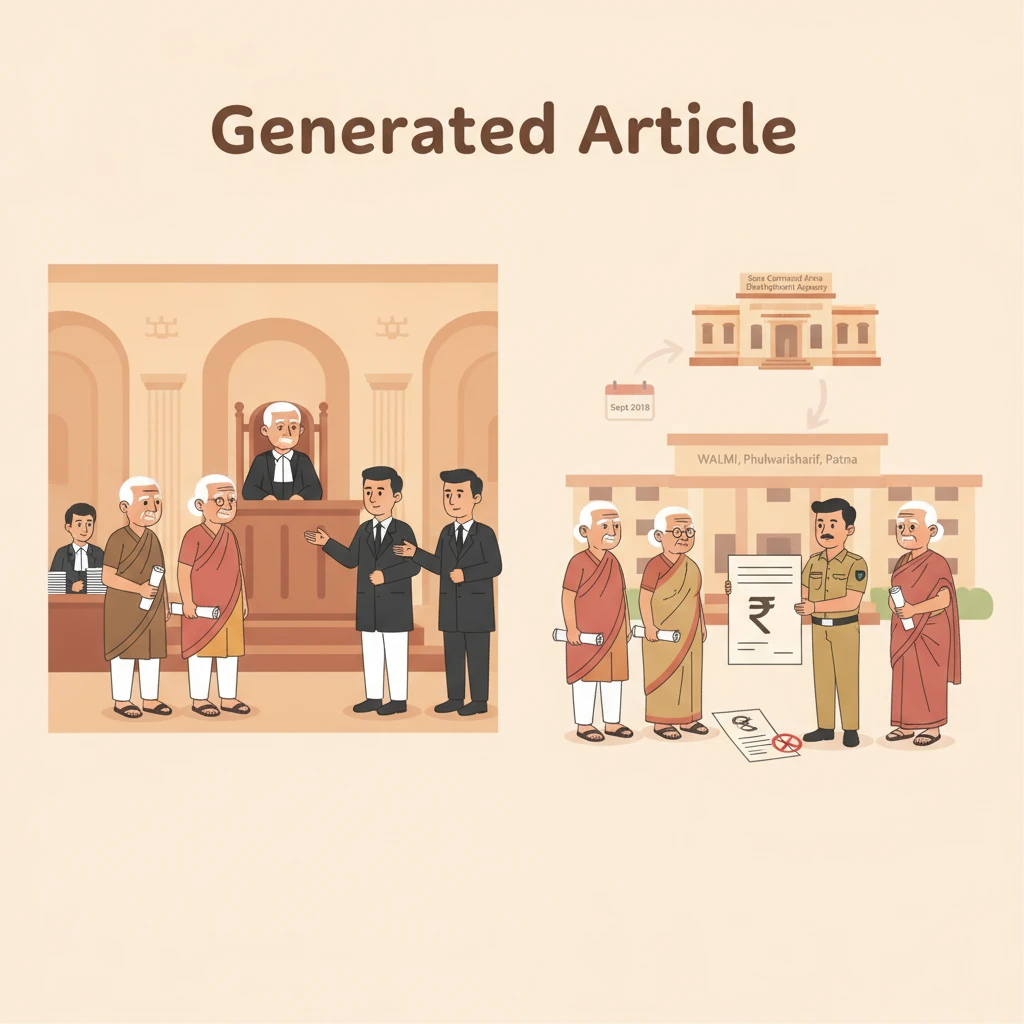
Case Background
The judgment arises from two writ petitions: Civil Writ Jurisdiction Case No. 17738 of 2019 and Civil Writ Jurisdiction Case No. 17772 of 2019. Both were heard together because the facts and legal questions were the same.
The petitioners were employees of the Sone Command Area Development Agency. They had been appointed on various posts around 1975 and later. The Agency was created after the Bihar Agricultural and Rural Area Development Agency Ordinance, 1974 and later governed by the Bihar Agricultural and Rural Area Development Agency Act, 1978 (BARADA Act, 1978).
In September 2018, the Sone Command Area Development Agency was merged with the Water and Land Management Institute (WALMI), Phulwarisharif, Patna. By the time of the writ petitions, all petitioners had already retired at the age of 60 years.
On retirement, they were paid Contributory Provident Fund (CPF) amounts with interest, gratuity, group insurance and leave encashment. Their only remaining grievance was non-payment of pension. In the first writ, they also directly challenged Memo No. 2621 dated 17.09.1983 by the Regional Development Commissioner-cum-Chairman, Sone Command Area Development Agency. That memo directed maintenance of CPF accounts for agency employees.
What the Court Examined and Decided
The core claim of the petitioners was that the Bihar Pension Rules applied to them, so they should receive monthly pension and other pensionary benefits like government servants. To support this, they relied heavily on decisions taken in 1974 by an earlier body, the Sone Command Area Development Authority.
The petitioners’ counsel pointed out that in the second meeting of the Sone Command Area Development Authority held on 07.02.1974, Agenda Item No. 4 resolved that several sets of rules would apply to its employees, including:
(i) Bihar Service Code, (ii) Bihar T.A. Rules, (iii) G.P. Fund Rules, (iv) Bihar Financial Rules, (v) Bihar Treasury Rules, (vi) Bihar Treasury Code, and (vii) Pension Rules.
Further, an order dated 22.06.1974 issued by the Chairman of the Authority repeated that these rules, including the Pension Rules, would apply to its staff. Petitioners stressed that very senior State Government officials, including the Chief Secretary, were present in the Authority’s meeting, so the decision was conscious and binding.
They argued that, under Sections 38 and 39 of the BARADA Act, 1978, the State Government and the Board were empowered to make rules and regulations about service conditions of agency employees, to be notified in the Official Gazette. According to them, because no such service rules or regulations were ever framed for the Sone Command Area Development Agency, the 22.06.1974 order of the earlier Authority should fill the gap and automatically govern the Agency staff.
They also cited Section 43 of the BARADA Act, 1978 (repeal and saving) to say that actions taken under the repealed Ordinance should continue under the Act. On this foundation, they claimed they were originally under a pension (GPF) scheme which was illegally converted later into a CPF scheme by the Agency. Based on Supreme Court judgments, they contended that any action against a statute or rules was a nullity, and therefore no estoppel could operate against them.
On the other side, WALMI and the State opposed the claim. The WALMI counsel explained the institutional history. Initially, by Resolution No. 2240 dated 20.10.1973 (effective 01.11.1973), the State created three Command Area Development Authorities: Koshi, Gandak and Sone. Later, the Bihar Agricultural and Rural Area Development Agency Ordinance, 1974 converted these authorities into separate “Agencies”, including the Sone Command Area Development Agency. The Ordinance was then replaced by the BARADA Act, 1978.
Under the Act, these Agencies became independent body corporates with a Board of Directors empowered to take decisions in the interest of the Agency and its employees. WALMI’s stand was that any decision taken in 1974 by the earlier Sone Command Area Development Authority could not automatically bind the later Sone Command Area Development Agency created under a different legal regime.
WALMI emphasized that all petitioners had been appointed only after the Sone Command Area Development Agency came into existence under the Ordinance of 1974. None of them was ever an employee of the earlier Authority. Therefore, the 22.06.1974 order of the Authority did not govern their service conditions.
They relied on Memo No. 2621 dated 17.09.1983 issued by the Regional Development Commissioner-cum-Chairman of the Sone Command Area Development Agency. That memo directed that CPF accounts should be maintained for employees directly appointed in the Agency. Following this, CPF accounts for all such employees, including petitioners, were opened and maintained. On retirement, petitioners accepted the full CPF corpus with interest plus other terminal benefits.
WALMI argued that having chosen, and benefited from, the CPF scheme, petitioners could not later turn around and demand switch-over to a pension scheme. They emphasized that the Agency’s expenditure was entirely dependent on grant-in-aid from the State Government and that the Agency never generated its own income until its dissolution in September 2018.
The State adopted WALMI’s arguments and further relied on Bihar Pension Rule 60. Rule 60(2) specifically states that employees of grant-in-aid schools and institutions are excluded from pension. As the Sone Command Area Development Agency functioned wholly on government grant-in-aid, the State claimed that its employees fell into the “grant-in-aid institution” category and therefore outside the government pension net.
The State also referred to earlier Patna High Court decisions. Particularly, it pointed to Jagdish Narain Sinha and others (reported in (2011) 1 PLJR 652), where the Court held that although the agency performed welfare functions for the State, no service regulations for its employees had been framed and benefits like pay revision and gratuity had to be handled on that basis. The judgment directed framing of regulations and State funding but did not hold that Bihar Pension Rules already applied to agency employees.
Another important plank of the State’s defence was the principle that a person cannot “approbate and reprobate” at the same time. Relying on the Supreme Court’s ruling in R.N. Gosain v. Yashpal Dhir, they said petitioners could not accept benefits under one legal position and then later challenge that very position when it suited them.
Similarly, they cited the Supreme Court’s decision in Union of India v. M.K. Sarkar, where an employee who had consciously opted to remain under the provident fund scheme, taken all PF benefits, and after decades attempted to opt into the pension scheme, was refused relief. The Supreme Court held that allowing such belated switch would give a “double benefit” and was barred by delay and laches.
After considering all materials and rival submissions, the Patna High Court, per Hon’ble Mr. Justice Mohit Kumar Shah, analyzed the statutory scheme. It noted that under Section 3 of the BARADA Act, 1978, Agencies are separate body corporates. The Sone Command Area Development Agency was created under this framework and not under the earlier Resolution that had constituted the Authority.
Crucially, the Court found that all petitioners joined service only after the Sone Command Area Development Agency had been set up under the 1974 Ordinance. They were never employees of the Sone Command Area Development Authority. Therefore, the 22.06.1974 order of the Authority declaring Pension Rules applicable could not apply to them. Section 43 of the BARADA Act (repeal and saving) only protected acts done under the Ordinance that was repealed; it did not extend the Authority’s internal decisions to a different statutory body, especially vis-à-vis people who were not its employees at the time.
The Court then turned to the Bihar Pension Rules, 1950. Under Rule 60(2), employees of grant-in-aid institutions are excluded from pension. It was an admitted position that the Sone Command Area Development Agency had no independent income and was entirely dependent on State grant-in-aid till its dissolution on 01.09.2018. On this basis, the Court held that employees of the Agency, including the petitioners, were not entitled to pension under the Bihar Pension Rules.
The Court observed that in the absence of pension entitlement, employees’ service conditions were governed by the Contributory Provident Fund scheme. It noted that CPF accounts had been opened for petitioners, deductions had been made from salaries, matching contributions deposited by the Agency, and on superannuation, petitioners received their full CPF amounts with interest and also gratuity, group insurance and leave encashment. All this happened without any protest at the time.
In such circumstances, and especially as no rules or regulations under Sections 38 and 39 of the BARADA Act, 1978 had been notified to bring them into the pension net, the Court held the petitioners could not later retract and claim pension. Drawing strength from M.K. Sarkar, the Court reasoned that allowing them to shift after retirement would effectively permit double benefits and undermine the finality of the CPF scheme.
The Court also referred to the Bihar Contributory Provident Fund Rules, 1948, which apply to every non-pensionable government service. This, it held, provided legal basis for bringing Agency employees like the petitioners under the CPF framework rather than the pension rules.
Finally, the Court considered the Supreme Court decisions relied on by the petitioners—H.C. Puttaswamy, Dipak Babaria and I.T.C. Bhadrachalam Paperboards—and found them inapplicable to the facts. Those cases dealt with illegality where authorities had clearly violated mandatory statutory procedures. Here, by contrast, the Court concluded that the petitioners never had a statutory right to pension to begin with; hence there was no question of illegal conversion of a pension scheme into CPF for them.
On this reasoning, the Patna High Court dismissed both writ petitions, holding that the petitioners were not entitled to pension and that their acceptance of CPF benefits closed the door on any later claim to a government pension scheme.
Why This Judgment Matters
This judgment is significant for employees of grant-in-aid bodies and agencies in Bihar, especially those linked to irrigation and rural development projects. It clarifies that simply performing “government-like” work or being funded by the State does not automatically make staff government pensioners.
For workers who have long retired and already taken CPF and related dues, the ruling underscores that courts will be slow to reopen settled benefit choices years later. If an employee has accepted CPF throughout service and at retirement, it becomes very difficult to claim a switch to pension afterwards.
The case also highlights the importance of formal rules and gazette notifications. Where no service regulations are notified under the governing Act, employees cannot rely on internal resolutions of an earlier, different body to claim pensionary rights. For agencies dependent on government grants, this decision confirms that, unless laws or notified rules say otherwise, Bihar Pension Rules may not apply.
Legal Issues and Answers
Issue: Were retired employees of the Sone Command Area Development Agency entitled to pension under the Bihar Pension Rules based on 1974 decisions of the Sone Command Area Development Authority?
Answer: No. The Court held that the petitioners were never employees of the earlier Authority and that the Authority’s 22.06.1974 order did not apply to them. As employees of a grant-in-aid Agency with no pension regulations, they were outside the Bihar Pension Rules and properly covered by the CPF scheme.
Issue: Could petitioners, after accepting CPF benefits and other terminal dues without protest, later demand a switch to a pension scheme?
Answer: No. Relying on Supreme Court precedent, the Court found that having enjoyed CPF benefits, petitioners were estopped from resiling and seeking pension at this belated stage. Allowing such a switch would lead to double benefits and was not permissible.
Issue: Did Section 43 (repeal and saving) of the BARADA Act, 1978 or absence of framed service regulations create a right to pension for the petitioners?
Answer: No. Section 43 only saved acts done under the repealed Ordinance and did not enlarge pension rights. The absence of regulations did not import Bihar Pension Rules to agency employees, particularly when Rule 60(2) itself excluded employees of grant-in-aid institutions from pension.
Cases Cited by the Court
- Jagdish Narain Sinha & Anr. v. The State of Bihar & Anr., (2011) 1 PLJR 652.
- Ramesh Prasad Singh & Ors. v. The State of Bihar & Ors., CWJC No. 21105 of 2013, judgment dated 24.03.2014; affirmed in L.P.A. No. 11 of 2015, judgment dated 16.05.2016.
- Jagdish Narain Sinha & Ors. v. The State of Bihar & Ors., CWJC No. 9446 of 2009 & analogous case, judgment dated 20.05.2010.
- R.N. Gosain v. Yashpal Dhir, AIR 1993 SC 352.
- Union of India & Ors. v. M.K. Sarkar & Ors., (2010) 2 SCC 59.
- H.C. Puttaswamy & Ors. v. Chief Justice of Karnataka High Court, AIR 1991 SC 295 (held inapplicable on facts).
- Dipak Babaria v. State of Gujarat & Ors., (2014) 3 SCC 502 (held inapplicable on facts).
- I.T.C. Bhadrachalam Paperboards & Anr. v. Mandal Revenue Officer, A.P. & Ors., (1996) 6 SCC 634 (held inapplicable on facts).
Case Details
Case Numbers: Civil Writ Jurisdiction Case No. 17738 of 2019; Civil Writ Jurisdiction Case No. 17772 of 2019.
Case Title (CWJC No. 17738 of 2019): Lakshaman Kishor & Ors. v. The State of Bihar & Ors.
Case Title (CWJC No. 17772 of 2019): Narendra Prasad Singh & Ors. v. The State of Bihar & Ors.
Coram: Hon’ble Mr. Justice Mohit Kumar Shah.
Citation: 2022(1) PLJR 146.
Advocates (in both cases):
For the petitioners: Mr. Vindhyachal Singh, Advocate; Mr. Manoj Kumar Singh, Advocate; Mr. Uday Pratap Singh, Advocate; Mr. Anil Kumar Dwivedi, Advocate.
For WALMI (respondent no. 5): Mr. Harshvardhan Shivsundram, Advocate.
For the State/Respondents: Mr. Harish Kumar (GP-8), Advocate.
Date of Judgment: 14.12.2021 (CAV judgment; CAV date 20.02.2021).
Court: High Court of Judicature at Patna, Civil Writ Jurisdiction.
Nature of Case: Writ petitions under Article 226 seeking a direction to apply Bihar Pension Rules and grant pension and other pensionary benefits; in CWJC No. 17738 of 2019, additional prayer to quash Memo No. 2621 dated 17.09.1983 regarding CPF accounts.
Outcome: Both writ petitions dismissed; petitioners held not entitled to pension; CPF and other terminal benefits already paid stand undisturbed.
Link to Judgment: Click here to read the full Patna High Court judgment
If you found this explanation helpful and wish to stay informed about
how legal developments may affect your rights in Bihar,
you may consider following Samvida Law Associates for more updates.







