

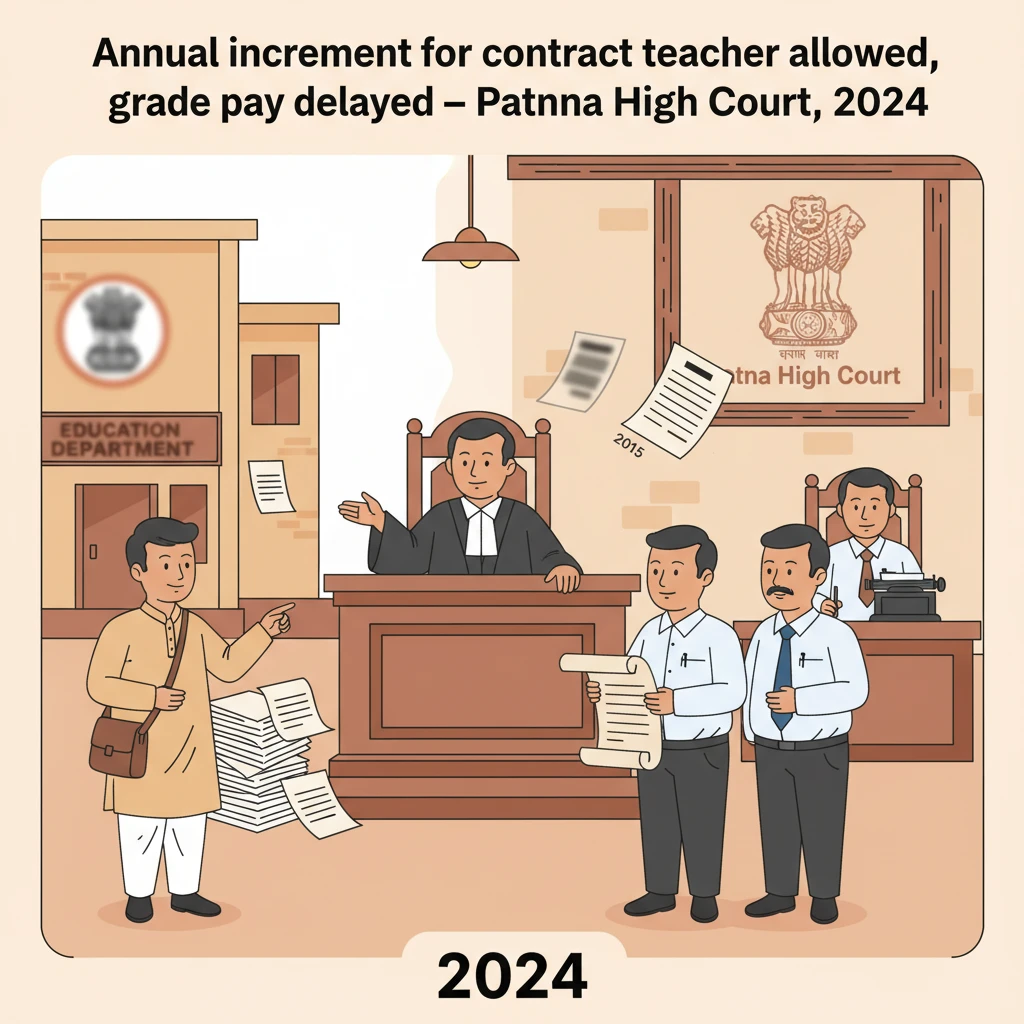
Case Background
The petitioner in this case was first appointed as a Panchayat Teacher on 05.02.2007 at Primary School, Madhubani Tole, Bakhri Panchayat, Block Bathnaha, District Sitamarhi.
Later, the Education Department issued notification no. 429 dated 22.06.2012. This notification was issued under Rule 17 of the Bihar Panchayat Primary Teachers (Appointment and Service Condition) Rules, 2012 and the Bihar Nagar Nikay Primary Teacher (Appointment and Service Condition) Rules, 2012 for appointment of teachers in primary schools for 2012–2013.
Clause 8 of this notification allowed teachers who were already employed and had passed the Teacher Eligibility Test (TET) to apply for fresh appointment. Such teachers could apply only after getting their applications forwarded by their first appointing authority. It further stated that the second appointment would be treated as the first appointment and, except for pay protection, their past service would not be counted for any other benefit.
The petitioner passed the TET examination in 2011. He then sought permission from the Panchayat Secretary to take part in the fresh selection process. Permission was granted through memo no. 08 dated 28.06.2012.
He participated in the 2012–2013 selection for appointment as a Nagar Teacher. He was selected as a Basic Grade Urdu Nagar Teacher at Primary School, Badi Bazar, Sitamarhi by memo no. 1621 dated 08.02.2014 issued by the Executive Officer-cum-Member Secretary, Nagar Parishad, Sitamarhi.
After being relieved from his first Panchayat posting, he joined the new school on 18.02.2014. His salary was fixed at Rs. 9600/-, while other teachers were getting Rs. 9000/-. Because he had been drawing Rs. 9600/- at his previous school, his higher pay was continued by giving him pay protection under clause 8 of the 22.06.2012 notification.
The State Government then issued departmental resolution no. 1530 dated 11.08.2015, introducing a new pay scale scheme for teachers, effective from 01.07.2015. This resolution shifted teachers from consolidated pay to pay scale. It fixed different pay bands and grade pay for various categories of primary teachers.
After this change, the petitioner submitted a representation seeking pay protection and other benefits under the new resolution, but his grievance was not addressed by the authorities. This led him to file the present writ petition before the Patna High Court.
What the Court Examined and Decided
The writ petition was filed seeking a direction (mandamus) to the State authorities to fix the petitioner’s salary under the new scheme in furtherance of resolution no. 1530 dated 11.08.2015, and to grant him pay protection as per notification no. 429 dated 22.06.2012, clause 8.
During the hearing, the petitioner’s counsel initially argued that the petitioner’s participation in the fresh selection and his appointment as a Nagar Teacher were on the clear condition that his past pay would be protected. He submitted that this basic condition of appointment could not later be taken away.
He pointed out a practical problem: the software used for pay fixation had no field to enter the date of joining in the first appointment unit. Because of this, the petitioner could not feed that date into the system, and so the software did not recognise his past service. According to him, such technical limitations could not be a reason to deny the benefit of pay protection or related benefits.
Counsel further submitted that even after the new pay scale scheme of 11.08.2015, the resolution itself clearly provided for annual increments at 3% for past service of teachers. Therefore, this benefit should flow to the petitioner as well.
However, at a later stage of the hearing, the petitioner’s counsel stated that the petitioner was not pressing his claim for pay protection in view of the introduction of the new pay scale system. The focus of his claim was limited to:
Grant of annual increment as prescribed in clauses 2.3 and 2.4 of the 11.08.2015 resolution.
Grant of grade pay of Rs. 2000/- without the requirement of completing two years of service from the date of his latest appointment.
On the issue of grade pay, counsel argued that clause 2.3 did not say that the benefit of grade pay of Rs. 2000/- was available only after two years of service. He suggested that the State was incorrectly relying only on clause 2.8, instead of reading it along with the clarificatory order issued later through memo no. 1811 dated 22.09.2015 (clause 6).
On the other side, the State’s counsel submitted that the old system of consolidated pay for teachers appointed under the Panchayati Raj system had been replaced by a pay scale system through resolution no. 1530 dated 11.08.2015. In this new scheme there was no provision for pay protection.
He also referred to letter no. 2153 dated 05.09.2017 issued by the Deputy Secretary to the Government. According to query no. 5 in that letter, benefit of pay protection is not available to teachers who shifted from one employment unit to another under the new pay scale regime.
On the specific question of grade pay, the State relied on clause 2.8 of the 11.08.2015 resolution. This clause provides that trained Niyojit Primary Teachers will be entitled to grade pay only after completion of two years of service from the date of joining as trained Niyojit teachers. Before completion of two years, they are to be given the pay scale applicable to untrained Niyojit primary teachers.
Applying this clause, the State explained that the petitioner joined as a trained Niyojit Nagar primary teacher on 18.02.2014. Therefore, he was to be treated as an untrained Niyojit teacher for pay purposes till 17.02.2016, and only from 18.02.2016 could he be given the trained teacher’s grade pay of Rs. 2000/-.
On the issue of increments, the State argued that clause 2.3 of the resolution covered trained Niyojit primary teachers and allowed annual increment at 3% for every three years of their past service. The petitioner became trained only on 19.01.2014; before that he was working as an untrained Niyojit primary teacher. Therefore, according to the State, he could not claim the 3% increments for the earlier period as if he was trained during that time.
After hearing both sides, the Court identified two surviving issues: whether the petitioner was entitled to:
Annual increment at 3% per annum for every three years of past service rendered by him, and
Grade pay of Rs. 2000/- without completion of two years of service as a trained teacher.
On pay protection, the Court recorded that the petitioner himself was not pressing that claim.
The Court then examined clauses 2.3 and 2.4 of the 11.08.2015 resolution. Clause 2.3 deals with trained teachers and provides one annual increment for every three years of past service. Clause 2.4 extends a similar benefit of annual increment at 3% for every three years of past service to untrained teachers as well.
From this, the Court held that both trained and untrained teachers are entitled to annual increment at 3% for every three years of past service. The date on which the petitioner completed training was thus not decisive for this purpose.
The Court noted that the petitioner had been working as a Panchayat primary teacher since 2007, and later as a Primary Nagar Shikshak, before the pay scale resolution came into force. These past services were not in dispute. Therefore, in the Court’s view, the petitioner was entitled to the benefit of annual increment at 3% per annum for every three years of past service rendered by him as a primary teacher.
Turning to grade pay, the Court again looked at clause 2.8 of the resolution. This clause, according to the Court, clearly restricts the grade pay of Rs. 2000/- to trained teachers who have completed two years of service counted from the date of joining. For the first two years, such a trained teacher is to receive only the pay scale of an untrained teacher.
The petitioner was appointed as a trained Niyojit Nagar primary teacher on 18.02.2014 under clause 8 of notification no. 429 dated 22.06.2012, which treats this second appointment as his first appointment. On a combined reading of clause 8 of the notification and clause 2.8 of the resolution, the Court held that he would be eligible for grade pay of Rs. 2000/- only after completing two years of service from 18.02.2014.
The Court rejected the argument that, when clause 2.8 is read with clause 6 of the clarificatory notification dated 22.09.2015, there is no need to wait for two years. The Court termed this argument “preposterous” and unsustainable, and reaffirmed that grade pay of Rs. 2000/- is payable only after two years of service irrespective of the date of training.
The Court therefore found no infirmity in the State’s action of granting grade pay of Rs. 2000/- to the petitioner with effect from 18.02.2016, that is, after completion of two years from his joining as a Nagar primary teacher.
In the result, the writ petition was partly allowed. The Court directed the respondent authorities to pay 3% annual increment to the petitioner for every three years of past service rendered by him starting from his initial appointment in 2007. It further directed that all consequential monetary benefits and admissible arrears of pay be paid within three months from the date of receipt or production of a copy of the order.
Why This Judgment Matters
This judgment is significant for Niyojit teachers in Bihar who have shifted from Panchayat to Nagar postings or have long years of service before the 2015 pay scale scheme.
The Patna High Court has clarified that under resolution no. 1530 dated 11.08.2015, annual increments at 3% for every three years of past service are available to both trained and untrained teachers. This means that even years served before training and before the new pay scale came into force must be counted for increment purposes.
At the same time, the Court has confirmed that grade pay of Rs. 2000/- is strictly linked to completion of two years’ service as a trained teacher from the date of the latest appointment. Teachers cannot demand this grade pay earlier by relying only on their earlier training or earlier postings.
For contract-based Niyojit teachers, the ruling offers partial relief: they can insist on proper counting of their past service for increments, but they must accept the statutory waiting period for higher grade pay. It also underscores that software or administrative systems cannot be used to deny benefits that the resolution itself grants.
Legal Issues and Answers
Issue: Is a Niyojit teacher who has served since 2007 entitled to annual increment at 3% for every three years of his past service under resolution no. 1530 dated 11.08.2015?
Answer: Yes. The Court held that clauses 2.3 and 2.4 grant such increments to both trained and untrained teachers, so the petitioner must receive 3% increments for every three years of past service from 2007 onwards.
Issue: Is the petitioner entitled to grade pay of Rs. 2000/- from a date earlier than completion of two years of service from 18.02.2014?
Answer: No. The Court held that clause 2.8 read with the clarificatory notification restricts grade pay of Rs. 2000/- to trained teachers only after they complete two years of service from the date of joining, so the State rightly granted it from 18.02.2016.
Issue: Can the petitioner insist on pay protection after the introduction of the new pay scale scheme?
Answer: The Court did not decide this question because the petitioner did not press his claim for pay protection during the hearing.
Cases Cited by the Court
The judgment does not mention or rely upon any previous case law. No earlier cases are cited.
Case Details
Case Number: Civil Writ Jurisdiction Case No. 13716 of 2016
Case Title: Intekhab Alam v. The State of Bihar & Ors.
Coram: Hon’ble Mr. Justice Anil Kumar Sinha
Citation: 2024 (4) PLJR 702
Advocates: For the petitioner – Mr. Ashhar Mustafa, Advocate; For the State – Mr. Kumar Alok, SC 7 and Mr. Rakesh Kumar, AC to SC 7
Nature of the Case: Writ petition (civil) seeking mandamus for proper pay fixation, annual increments, pay protection, and grade pay under State resolutions governing Niyojit teachers.
Link to Judgment: Patna High Court Judgment in CWJC No. 13716 of 2016
If you found this explanation helpful and wish to stay informed about
how legal developments may affect your rights in Bihar,
you may consider following Samvida Law Associates for more updates.







