

Case Background
The appellant was a government employee who joined service in 1971. He was working under the Home (Police) Department of the State of Bihar.
He remained absent from duty from 08.09.1998. Because of this absence, a charge memo (charge-sheet in departmental terms) was issued against him on 15.04.1999. Soon afterwards, he was placed under suspension on 30.04.1999.
A departmental inquiry was started to examine the allegation of unauthorized absence. In that inquiry, the appellant did not participate and the proceedings went on ex parte, meaning only the department’s side was considered.
The Inquiry Officer submitted a report holding that the charge of unauthorized absence from 08.09.1998 to 30.04.1999 was proved. Based on this, the disciplinary authority issued a second show cause notice on 03.12.2001, enclosing the inquiry report and asking the appellant to explain why a major punishment should not be imposed.
The appellant asked for 15 days’ extra time to file his reply to this second show cause notice. This request was submitted, but after that he did not file any explanation. Treating the matter as closed, the disciplinary authority imposed the penalty of dismissal from service on 06.12.2003.
Against the dismissal order, the appellant filed a departmental appeal on 14.02.2007. The appellate authority rejected his appeal and passed an order on 12.06.2009.
The appellant then approached the Patna High Court in Civil Writ Jurisdiction Case No. 12945 of 2009 under Article 226 of the Constitution of India, challenging the dismissal and the appellate order. The learned Single Judge of the High Court, by order dated 16.08.2018, dismissed his writ petition and upheld the departmental action.
Aggrieved by that decision, the appellant filed the present Letters Patent Appeal No. 1352 of 2019 before a Division Bench of the Patna High Court.
What the Court Examined and Decided
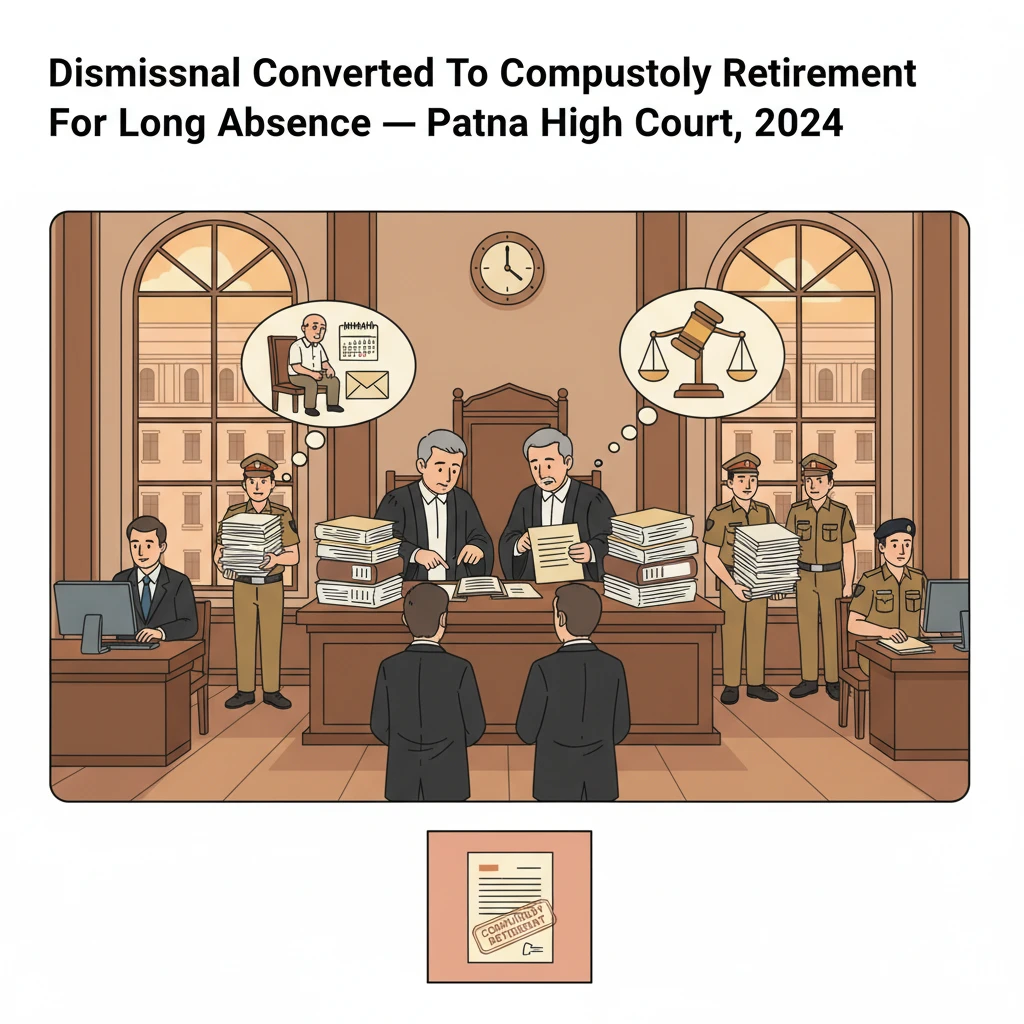
The Division Bench, consisting of Hon’ble Mr. Justice P. B. Bajanthri and Hon’ble Mr. Justice Alok Kumar Pandey, heard the appeal and perused the original records of the departmental proceedings. A police officer, Ms. Ayushi Kumari, Sergeant, Sub-Inspector, RSI–II, Bhojpur, Ara, was present in Court with the records in compliance with an earlier order dated 27.08.2024.
The Court first focused on a crucial fact: whether the charge memo had been properly communicated to the appellant. The officer present in Court stated that there were no records to show how communications in the departmental proceedings were served on the appellant at different stages, including the charge memo and other materials before the penalty was imposed.
This meant there was no documentary proof about how the charge memo and related documents were actually served on the appellant. The Court recorded that it was an admitted fact that the charge memo was not communicated in the manner known to law.
On the other hand, the State’s counsel argued that the appellant had remained ex parte in the inquiry despite the charge of unauthorized absence. According to the State, the Inquiry Officer had found the charge proved and therefore the dismissal was justified and not disproportionate. The State supported the Single Judge’s order affirming the dismissal.
The appellant’s counsel argued that the punishment of dismissal from service was too harsh in the circumstances. He stressed that the appellant had joined service in 1971 and had put in long years of service. The absence was for about seven months, from 08.09.1998 to 30.04.1999, when he was placed under suspension. There was no allegation of defalcation or misappropriation of government money. For such a period of absence, counsel argued, dismissal from service was disproportionate.
The Division Bench examined the Inquiry Officer’s report in detail. It noted that the charge memo had cited certain documents as the basis of the charge. However, these documents had not been marked as exhibits in the inquiry. The Court observed that, in a proper departmental inquiry, the Presenting Officer must produce relevant documents and get them marked as exhibits. After that, the author of each document must be examined as a witness, and an opportunity for cross-examination must be provided.
Here, the Inquiry Officer had examined one witness, described as S.H.O., Thakur Sitaram Singh. But the Court found that his chief examination on behalf of the Presenting Officer was not available in the record. The necessary procedural steps—marking documents as exhibits and examining the authors of those documents—were missing from the record.
The Court held that these were serious procedural lapses in the conduct of the departmental inquiry. It also noted that the disciplinary authority, while passing the dismissal order, did not consider these defects. Similarly, the appellate authority also failed to apply its mind to these aspects. Because of this, the Court concluded that there was non-application of mind by both the disciplinary authority and the appellate authority.
The Division Bench further observed that the learned Single Judge had not appreciated these important aspects. Specifically, the Single Judge had not examined the Inquiry Officer’s report in the light of the admitted fact that the charge memo was never properly communicated to the appellant as required by law. Nor had the Single Judge considered the absence of proper marking of exhibits and examination of witnesses.
The Court explained, in clear terms, what is expected in a domestic or departmental inquiry. First, the Inquiring Officer must ensure that documents relied on in the charge memo are brought on record as exhibits through the Presenting Officer. Second, the authors of those documents must be examined as witnesses. Third, if the charged employee wants to cross-examine them, that opportunity must be given. These steps were not followed in this case, as seen from the Inquiry Officer’s report.
The Bench then considered what relief would be appropriate at this stage. The appellant had joined service in 1971 and his services were terminated by dismissal on 06.12.2003. By the time of the High Court’s decision in 2024, a very long period had passed. The Court noted that, given these circumstances, it would not be appropriate to remand the matter to restart the departmental inquiry from the defective stage and to complete it again within a fixed time.
The Court also took into account that this was not a case involving misappropriation or defalcation of government money. The only charge was unauthorized absence for about seven months. Keeping in mind both the long length of service and the nature of the charge, the Court found that the punishment of dismissal was too harsh.
Taking a balanced view, the Division Bench decided to interfere with the punishment. It held that the order of dismissal dated 06.12.2003, the appellate order dated 12.06.2009, and the Single Judge’s order dated 16.08.2018 all deserved to be set aside. At the same time, the Court did not direct full reinstatement with back wages or a fresh inquiry.
Instead, the Court chose to substitute the penalty. It remanded the matter to the disciplinary authority with a clear direction: the authority must pass an order treating the appellant as compulsorily retired from service with effect from the date of his dismissal, i.e., 06.12.2003.
The Court further directed that the appellant’s retiral benefits be settled as if he had retired from service on 06.12.2003. His entire service from the date of initial appointment in 1971 up to 06.12.2003 must be taken into account. Pension must be fixed with effect from 07.12.2003, the day after the deemed date of compulsory retirement.
All arrears of pension and other retiral benefits, calculated accordingly, must be disbursed to the appellant. The Court fixed a clear time limit: the entire exercise is to be completed within four months from the date the authorities receive a copy of the judgment.
With these directions, the Letters Patent Appeal was allowed in part.
Why This Judgment Matters
This judgment is important for government employees and police personnel in Bihar and elsewhere who face departmental action for unauthorized absence.
First, the Patna High Court has underlined that even when an employee remains absent and does not participate in the inquiry, the department must still follow proper procedure. Charge memos must be properly served. Documents relied upon must be exhibited, and their authors examined. Failure to do so can render the inquiry legally defective.
Second, the Court has recognized that punishment must be proportionate to the misconduct. For a person who has served from 1971 to 2003, dismissal from service for seven months’ absence, with no allegation of financial loss to the Government, was held to be too harsh.
Third, instead of sending the matter back for a fresh inquiry after more than 20 years, the Court chose a practical remedy by converting the dismissal into compulsory retirement. This ensures that the employee gets pension and other retiral benefits, while the employer is not forced to reopen an old dispute.
For many older employees facing similar situations, this decision shows that the courts can step in to correct disproportionate punishment and serious procedural lapses in departmental inquiries, especially where long service and livelihood after retirement are at stake.
Legal Issues and Answers
- Issue: Whether the departmental inquiry and dismissal order against the appellant for unauthorized absence were legally sustainable when the charge memo was not properly served and inquiry procedures were not followed.
Answer: No. The Patna High Court held that non-communication of the charge memo in the manner known to law and failure to mark documents as exhibits and examine their authors showed serious procedural defects and non-application of mind by the disciplinary and appellate authorities. - Issue: Whether dismissal from service for about seven months of unauthorized absence, in the case of an employee who had served since 1971 and against whom there was no allegation of financial misappropriation, was a proportionate punishment.
Answer: No. The Court held that dismissal was too harsh and disproportionate. It set aside the dismissal and substituted it with compulsory retirement from the date of dismissal, with consequential pensionary benefits. - Issue: What consequential relief should be granted after setting aside the dismissal and appellate orders.
Answer: The Court directed the disciplinary authority to treat the appellant as compulsorily retired with effect from 06.12.2003, to reckon his entire past service for retiral benefits, to fix his pension from 07.12.2003, and to calculate and disburse all arrears within four months.
Cases Cited by the Court
- The judgment text does not record any specific earlier case law citations relied upon by the Court.
Case Details
Case Number: Letters Patent Appeal No. 1352 of 2019 in Civil Writ Jurisdiction Case No. 12945 of 2009
Case Title: Pashupati Nath Thakur @ Pasupati Nath vs. The State of Bihar & Ors.
Coram: Hon’ble Mr. Justice P. B. Bajanthri and Hon’ble Mr. Justice Alok Kumar Pandey
Citation: 2024(4) PLJR 788
Advocates: For the appellant – Mr. Rajkumar Rajesh, Advocate; Mr. Girish Chandra, Advocate; Mr. Jeet Kishor Mahto, Advocate. For the State – Mr. Saroj Kumar Sharma, AC to AAG 3.
Nature of the Case: Letters Patent Appeal against the dismissal of a writ petition challenging departmental dismissal from service.
Link to Judgment: Full text of Patna High Court judgment
If you found this explanation helpful and wish to stay informed about
how legal developments may affect your rights in Bihar,
you may consider following Samvida Law Associates for more updates.







