
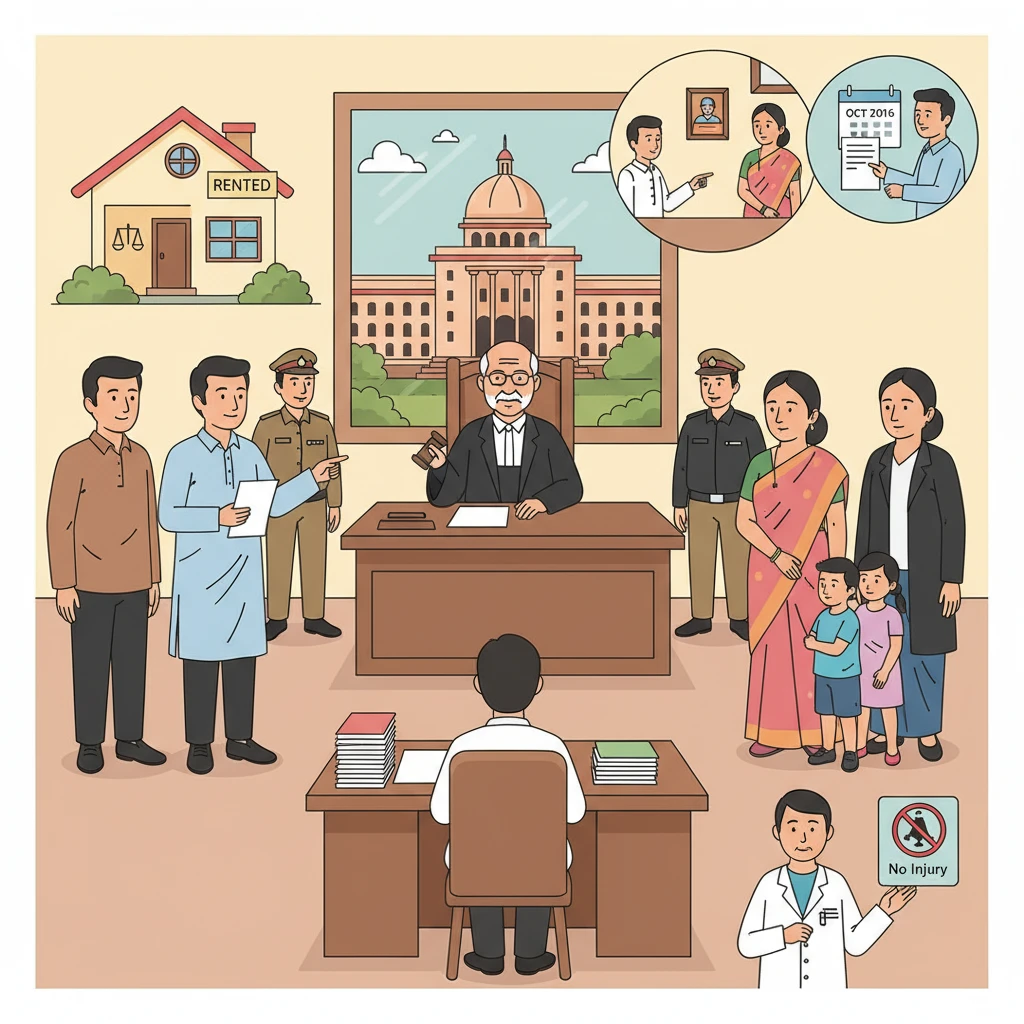
Case Background
The case started with a written complaint by a woman (PW-3) at Mahila Police Station, Patna, leading to Mahila P.S. Case No. 132 of 2018. She stated that she was already married to one Raj Kumar Singh and had two children from that marriage. According to her, her husband left Bihar in 2008 and never returned, and later solemnised another marriage elsewhere.
From 2013, the appellant began living in her house as a tenant. The woman alleged that the appellant knew her husband had left her and remarried. She claimed that taking advantage of her situation, the appellant developed physical relations with her on the false promise of marrying her.
She further stated that in October 2016, the appellant said he was going to Bhagalpur for work but would return every week or two, during which he would stay with her and have consensual physical relations. When she pressed him to marry her, he allegedly demanded that she transfer the house in his name. Later, when she came to know that he was going to marry some other woman, she complained to the local police.
According to her complaint, the appellant’s parents and family members admitted his fault and promised that he would marry her. In 2018, the appellant allegedly stayed at her house for two nights and again insisted that she transfer the house to his name. When she refused, he declined to marry her. She then lodged the present FIR against the appellant and his parents.
On the basis of her written information, Mahila P.S. Case No. 132 of 2018 was registered under Sections 376, 506, 509, 420 and 34 of the Indian Penal Code. After investigation, police filed charge-sheet No. 109/2019 dated 31.10.2019 for the same offences.
The case was committed to the Sessions Court and registered as Sessions Trial No. 244/2020 (CIS No. 244/2020). The 1st Additional District & Sessions Judge, Patna framed charges, which the appellant denied, claiming innocence, and the trial proceeded.
The prosecution examined five witnesses: PW-1 (tutor of the victim’s children), PW-2 (victim’s mother), PW-3 (victim), PW-4 (Investigating Officer) and PW-5 (doctor). Several documents, including the victim’s Section 164 CrPC statement and medical reports, were exhibited.
On 24.06.2024, the trial court convicted the appellant under Section 376(1) IPC and sentenced him on 27.06.2024 to 10 years’ rigorous imprisonment and a fine of Rs. 5,000, with six months’ imprisonment in default. He was also sentenced to two years’ rigorous imprisonment under Section 506 IPC, with both sentences to run concurrently.
Aggrieved, the appellant filed Criminal Appeal (SJ) No. 3191 of 2024 before the Patna High Court under Section 374(2) CrPC. On the appellant’s request, and with no objection from the State, the High Court took up the appeal for final hearing under Section 374(4) CrPC. The judgment was delivered on 21.10.2024 by Hon’ble Mr. Justice Chandra Shekhar Jha.
What the Court Examined and Decided
The core question before the Patna High Court was whether the appellant’s conviction could stand when it was mainly based on the sole testimony of the victim (PW-3). The Court closely re-examined the statements, cross-examinations, and medical evidence placed on record.
First, the Court considered the victim’s own deposition. She stated that the appellant had become a co-tenant at her parental house and that everything was normal up to 2016. Her husband Raj Kumar Singh had been missing since 2008. She claimed that, taking advantage of his absence, the appellant developed physical relations with her in 2016 on the promise of marriage.
During trial, she identified her signatures on the written information to the police and on her statement recorded under Section 164 CrPC. These documents were marked as Exhibit P-1/PW-3 and Exhibit P-2/PW-3.
However, when the High Court turned to what she had actually told the Magistrate under Section 164 CrPC, an important gap emerged. The Court noted that in this earlier statement, she had not stated that any physical relationship had taken place between her and the appellant. Instead, what appeared from that statement was that marriage negotiations with the appellant were going on and that he had demanded that the flat/house, where he was a tenant, be given to him in dowry.
The house in question belonged to the victim and her husband Raj Kumar Singh. The allegation of rape arising out of a consensual relationship was mentioned for the first time only in her deposition before the trial court as PW-3, not in her earlier Section 164 CrPC statement.
In cross-examination, the victim admitted that the house had been purchased by her husband and that several co-tenants lived there. She also said her mother later came to live with her. She accepted that many WhatsApp messages had been exchanged between her and the appellant, but she did not say that the promise of marriage was made in the presence of any co-tenant or even her mother PW-2. She admitted that the appellant had asked her to execute a sale deed of the house in his favour as a condition for marriage.
The defence further highlighted that, as per her own Section 164 CrPC statement, she had been in a relationship with another person, Rajiv from Kankarbagh Colony, since 2015, while the alleged promise of marriage by the appellant and the claimed physical relations were said to have started only in 2016. The High Court noted that there was no explanation why the victim did not marry Rajiv in 2015, if she was free and willing to enter into a new marriage at that time.
The Court also examined PW-1, the tutor of the victim’s children. PW-1 supported the prosecution by saying the appellant was in a relationship with the victim. But in cross-examination, he clearly stated that he was not an eye-witness and had never seen the appellant having physical relations with her.
PW-2, the victim’s mother, stated in her examination-in-chief that the appellant had established physical relations with her daughter and that the matter had once gone to Mahila Police Station, where a compromise was signed. She said that even after this, the appellant refused to marry the victim. But in cross-examination, she admitted that the relationship was consensual and that the appellant had agreed to marry under the compromise. She also confirmed that her daughter had first been married to Raj Kumar Singh.
PW-4, the Investigating Officer, mainly proved the formal steps of the investigation and the filing of the charge sheet. He was the third IO in the case and did not add anything substantive beyond documents.
PW-5, Dr. Anuradha, examined the victim on 29.10.2018 at Gardanibagh Hospital. She found no marks of injury on any part of the body or on the private parts. She recorded that the victim had two children, the youngest being 11 years old, and that the victim had undergone hystereoscopy in 2013. A vaginal swab was taken and sent to PMCH. Later, a pathological report (Ext P-6) from PMCH dated 31.10.2018 recorded that no spermatozoa were seen. In cross-examination, the doctor stated that after removal of the uterus, a woman cannot bear a child in future.
On this material, the High Court noted that the trial court had based the conviction mainly on the sole testimony of PW-3. It then turned to the Supreme Court’s decision in Rai Sandeep v. State (NCT of Delhi), (2012) 8 SCC 21, which explains when a witness can be called a “sterling witness”. A “sterling witness” must be of “very high quality and calibre” whose version is consistent, natural, and wholly reliable from the start of the case till its end, and must match other evidence without leaving gaps.
Applying this test, the High Court found that PW-3’s version did not qualify. Her Section 164 CrPC statement did not mention any physical relationship; it only spoke about failed marriage negotiations and the demand of the house. The allegation of repeated physical relations on a false promise of marriage appeared for the first time in court, making it an “improved version”.
The Court also considered the Supreme Court judgment in Pramod Suryabhan Pawar v. State of Maharashtra, (2019) 9 SCC 608, which explains when consent for sexual relations, given on a promise of marriage, can be treated as arising from a “misconception of fact” under Section 90 IPC. The law requires that the promise of marriage must be shown to be false from the very beginning, and that the woman’s consent must clearly flow from that promise.
Here, the High Court found that the promise of marriage itself was doubtful. The victim was about 31 years old, mother of two children, and still legally married to Raj Kumar Singh, as that marriage had not been dissolved by law. The Court observed that any promise of marriage made in such circumstances did not appear convincing. The fact that she was in a relationship with Rajiv from 2015 further weakened the claim that she had placed her trust exclusively on the appellant’s promise.
The Court also noted that the alleged promise of marriage was not made in front of any independent witness, not even her mother or co-tenants. The compromise petition, which could have been an important document to show the appellant’s agreement to marry, was not produced in evidence. Medical evidence did not support recent sexual assault or injury.
In these circumstances, the High Court held that PW-3 could not be treated as a “sterling witness” whose uncorroborated testimony could, by itself, sustain a conviction for rape. The alleged promise of marriage appeared doubtful. Therefore, the conviction recorded by the trial court was found to be unsafe and “questionable”.
Consequently, the High Court allowed the appeal, quashed the judgment of conviction dated 24.06.2024 and sentence dated 27.06.2024 in Sessions Trial No. 244/2020, and acquitted the appellant of all charges. He was directed to be released forthwith, if not required in any other case.
Why This Judgment Matters
This judgment of the Patna High Court is important for victims and accused persons in cases involving allegations of rape on a promise of marriage. It shows that courts will not rely blindly on later, improved versions of a story if they are not supported by earlier statements or other evidence.
The Court emphasised that when the entire conviction is built on the testimony of the prosecutrix alone, her statement must be consistent from the beginning, free from major contradictions, and in line with surrounding facts and documents. If there are serious doubts or improvements, the benefit will go to the accused.
It also underscores that for a false promise of marriage to amount to rape, the prosecution must show that the promise was dishonest from the start and that the woman’s consent was clearly based on that promise. Mere failure to marry later, or a breakdown in negotiations, does not by itself convert a consensual relationship into rape.
For people facing similar disputes, this case highlights the importance of preserving earlier statements, compromise documents, and medical reports, as courts will closely compare them with later testimony before deciding on conviction.
Legal Issues and Answers
- Issue: Can a conviction for rape under Section 376(1) IPC be sustained solely on the prosecutrix’s testimony when her earlier Section 164 CrPC statement does not mention sexual relations and the allegation of rape appears only later during trial?
Answer: No. The Patna High Court held that where the prosecutrix’s version is inconsistent, improved during trial, and not supported by earlier statements or other evidence, she cannot be treated as a “sterling witness”, and such uncorroborated testimony cannot safely sustain a conviction. - Issue: Whether alleged sexual relations on a promise of marriage constitute rape when the promise of marriage itself is doubtful and not shown to be false from the very beginning?
Answer: The Court, relying on Supreme Court precedent, found that in the absence of clear proof that the promise of marriage was false from inception, and where the victim was already in a subsisting marriage and had other relationships, the case could not be treated as rape on account of misconception of fact. - Issue: Whether the trial court’s conviction of the appellant under Sections 376(1) and 506 IPC could stand in light of the evidence on record?
Answer: No. The Patna High Court quashed the conviction and sentence, acquitted the appellant of all charges, and directed his release.
Cases Cited by the Court
- Rai Sandeep v. State (NCT of Delhi), (2012) 8 SCC 21 — for the concept of “sterling witness”.
- Pramod Suryabhan Pawar v. State of Maharashtra and Anr., (2019) 9 SCC 608 — on consent based on promise of marriage and “misconception of fact” under Section 90 IPC.
- Dhruvaram Murlidhar Sonar v. State of Maharashtra, (2019) 18 SCC 191 — quoted within Pramod Suryabhan Pawar regarding the nature of consent.
- Kaini Rajan v. State of Kerala, (2013) 9 SCC 113 : (2013) 3 SCC (Cri) 858 — quoted for the definition and understanding of consent under Section 375 IPC.
Case Details
Case Number: Criminal Appeal (SJ) No. 3191 of 2024, arising out of Mahila P.S. Case No. 132 of 2018; Sessions Trial No. 244/2020, CIS No. 244/2020
Case Title: Amresh Kumar @ Sonu v. The State of Bihar
Citation: 2024 (4) PLJR 734
Court: High Court of Judicature at Patna
Coram: Hon’ble Mr. Justice Chandra Shekhar Jha
Date of High Court Judgment: 21.10.2024
Trial Court Judgment and Sentence: Judgment of conviction dated 24.06.2024 and order of sentence dated 27.06.2024 passed by 1st Additional District & Sessions Judge, Patna
Sections Involved: Sections 376(1), 506, 509, 420, 34 IPC; procedural references to Sections 374(2), 374(4), 313, 164 CrPC
Advocates:
- For the Appellant: Mr. Rana Vikram Singh, Advocate; Mr. Babu Nandan Prasad, Advocate; Ms. Jyoti Singh, Advocate
- For the State: Mrs. Anita Kumari Singh, Additional Public Prosecutor
Nature of the Case: Criminal appeal under Section 374(2) CrPC against conviction and sentence for offences under the Indian Penal Code
Link to Full Judgment: Patna High Court Judgment in Cr. App (SJ) No. 3191 of 2024
If you found this explanation helpful and wish to stay informed about
how legal developments may affect your rights in Bihar,
you may consider following Samvida Law Associates for more updates.







