

Case Background
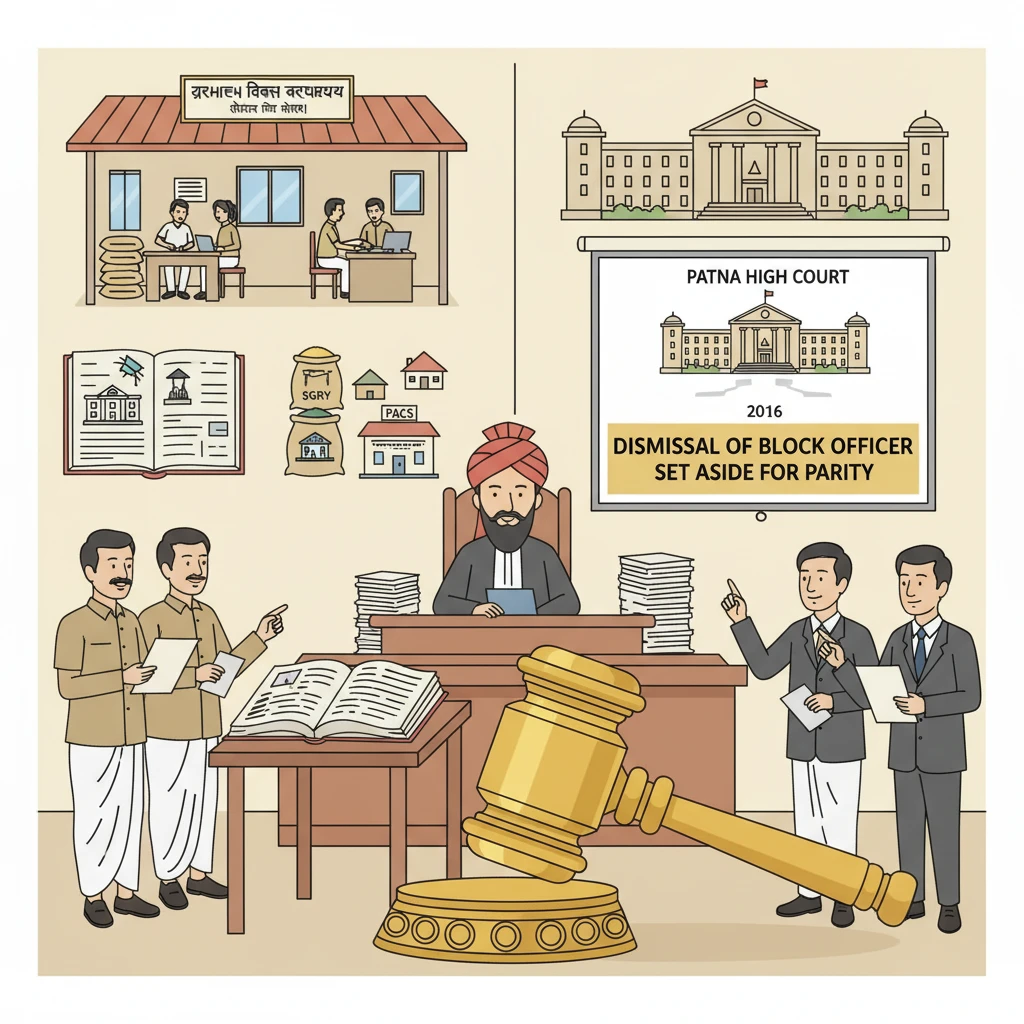
The petitioner had been working as a Block Development Officer (BDO) in Bihar. Between 2004 and 2007, he and three other BDOs – Shamim Akhtar, Surendra Roy and Gayanand Yadav – came under departmental scrutiny.
The core allegation related to management of funds under the Sampoorna Grameen Rozgar Yojana (SGRY). According to the charge, instead of depositing SGRY funds in a nationalised bank or post office, a new account was opened in a Primary Agricultural Credit Society (PACS) and government money was deposited there.
A departmental proceeding was initiated. The first charge sheet, dated 11.02.2009, alleged that SGRY funds were deposited with Dehri (also referred to as Dehti in the judgment) PACS in violation of government circulars, which required deposit in a nationalised bank or a post office. It was also alleged that funds deposited in the PACS account were misused and that the petitioner was fully responsible.
Later, by order dated 09.01.2010, the Chief Secretary of the Government of Bihar directed that a fresh enquiry be held. The purpose was to verify whether payments to beneficiaries under the Indira Aawas Yojana were “mythical” and to record statements or representations from identified beneficiaries about non‑payment of funds to them.
Following this direction, a supplementary or amended charge sheet was issued. The amended charge essentially repeated the earlier allegation about deposit of funds with Dehti PACS instead of a nationalised bank or post office, and added a new, serious allegation that the petitioner had used the funds for personal gain in connivance with the PACS Manager and other intermediaries.
What the Court Examined and Decided
Justice Samarendra Pratap Singh of the Patna High Court heard the writ petition filed under Civil Writ Jurisdiction challenging the dismissal resolution dated 24.02.2012 issued by the General Administration Department, Government of Bihar. Through this resolution, the petitioner had been awarded the punishment of dismissal from service after conclusion of the departmental proceeding.
The Court first noted how the departmental proceeding developed over time. In the original enquiry, the Enquiry Officer submitted a report after examining the charges. He exonerated the petitioner and the other officers of the charge of misuse of money deposited in the PACS. In simple terms, at that stage, the enquiry did not find them guilty of embezzlement or personal misuse of the funds.
However, the Enquiry Officer did hold all of them guilty of violating departmental instructions. They were found guilty of not depositing the SGRY funds in a nationalised bank or post office as required by the guidelines of the Central and State Governments. Instead, they had deposited the funds with the local PACS. The Enquiry Officer observed that the delinquents “ought to have” deposited the fund in a nationalised bank or post office instead of the PACS.
Before this first enquiry could translate into a final punishment order, the Chief Secretary’s order dated 09.01.2010 intervened. The Chief Secretary insisted on a fresh enquiry, focusing on whether payments to Indira Aawas Yojana beneficiaries were real or only on paper, and instructed that statements or representations should be obtained from beneficiaries about non‑payment.
On the basis of this direction, a supplementary charge sheet was drawn up. The second charge sheet was described in the judgment as “not much different” from the first, apart from repeating that funds were deposited in Dehti PACS against government instructions and adding the allegation that the petitioner had used the funds for personal gain in connivance with the PACS Manager and others.
The petitioner denied these charges in his reply. A fresh enquiry was then conducted. In this fresh enquiry, the petitioner and the other delinquents were held guilty of the charges, including the supplementary allegation.
After receiving the enquiry report, the disciplinary authority issued a second show cause notice. Importantly, the Court records that this second show cause notice was issued without enclosing a copy of the enquiry report. The petitioner and the other delinquents protested this omission.
Even though they had protested, all three delinquents, including the petitioner, later obtained copies of the enquiry report on their own and filed their replies to the second show cause notice.
The General Administration Department was not satisfied with their explanations. By separate resolution dated 17.02.2012, it inflicted the punishment of dismissal from service on each of them. It was this dismissal order that the petitioner challenged in the present writ petition.
While hearing the case, the Court looked closely at one key factual aspect: the period of allegation against the petitioner. It would appear from the charge memo, the Court recorded, that the period of allegation was from 2006 to 2008. All the delinquents mentioned in the order had held the post of BDO during some part of that period, though not necessarily at the same time.
The petitioner argued that his case was on a “better footing” than his co‑delinquents Surendra Roy and Gayanand Yadav. He pointed out that he had been transferred from the post of BDO, Palasi, District Araria, on 14.10.2005, whereas the charge period was from 2006 to 2008. This meant that he was alleged to have committed irregularities during a period when, according to him, he was no longer posted in that block.
The petitioner also informed the Court that his co‑delinquents Surendra Roy and Gayanand Yadav had already challenged their dismissal orders in separate writ petitions, being C.W.J.C. No. 14595 of 2012 and C.W.J.C. No. 20812 of 2012. Those petitions had been heard earlier, and by a common order dated 20.05.2016, the Patna High Court had set aside their dismissal orders.
He submitted that all the points raised by those petitioners in their earlier writ petitions were equally available to him. In addition, he argued that his factual position was even stronger, due to his transfer before the period covered by the charges.
Justice Samarendra Pratap Singh considered these submissions and the earlier decision. The Court observed that the case of the present petitioner was “at least on similar footing” to that of Shamim Akhtar, Surendra Roy and Gayanand Yadav, whose dismissal orders had already been set aside by the High Court.
Given this parity, and without separately re‑examining every factual or legal issue already dealt with in the earlier common order, the Court applied the same result to the present petitioner. Consistency in judicial decisions was an important factor: when co‑employees face the same or substantially similar charges arising from the same transaction or period, and earlier orders in their favour have become final, it is generally unfair to treat one of them differently without a clear reason.
Accordingly, the Court held that the writ petition must succeed. It set aside the impugned order of dismissal in terms of the order dated 20.05.2016 passed in C.W.J.C. Nos. 14595 of 2012 and 20812 of 2012. The Court also made it clear that the same “liberty mentioned therein” would apply in the present case as well. Although the present judgment does not spell out that liberty, it indicates that whatever limited freedom was left to the State in the earlier order would equally apply here.
With this, the petitioner’s dismissal was annulled, bringing his writ petition to a successful end.
Why This Judgment Matters
This judgment is important for government employees facing departmental action, especially where multiple officers are proceeded against on the same set of allegations.
The Patna High Court emphasised that similarly placed employees should be treated alike. Where the Court has already set aside dismissal orders of co‑delinquents on the same charges, it is unjust to maintain the dismissal of another officer on identical facts without a separate, sound reason.
For BDOs and other officers handling schemes like SGRY and Indira Aawas Yojana, the case shows that while violation of financial instructions is taken seriously, allegations of personal misuse must be clearly established through a fair enquiry. It also underlines that the period of posting and charge period must match logically.
For affected employees, this decision shows that if co‑workers have obtained relief on the same issue, they can rely on those judgments to seek similar protection, especially in the Patna High Court.
Legal Issues and Answers
- Issue: Whether the petitioner’s dismissal from service pursuant to the departmental proceeding relating to SGRY and Indira Aawas Yojana funds could be sustained when co‑delinquents on the same charges had already had their dismissals set aside by the Patna High Court.
Answer: No. The Court found that the petitioner’s case was at least on similar footing to that of the co‑delinquents whose dismissals were already quashed, and therefore set aside the petitioner’s dismissal in the same terms. - Issue: Whether the departmental findings against the petitioner could stand despite his transfer before the charge period of 2006–2008.
Answer: The Court noted that the petitioner had been transferred on 14.10.2005 and treated his case as not weaker than that of the co‑delinquents; on this basis, his dismissal was also set aside.
Cases Cited by the Court
- The judgment refers to and relies upon the Patna High Court’s common order dated 20.05.2016 in C.W.J.C. No. 14595 of 2012 and C.W.J.C. No. 20812 of 2012, by which the dismissal orders of co‑delinquents were set aside.
Case Details
Case Number: Civil Writ Jurisdiction Case No. 7586 of 2013
Case Title: Ashok Kumar Tiwari v. The State of Bihar & Others
Coram: Hon’ble Mr. Justice Samarendra Pratap Singh
Date of Judgment: 15.07.2016
Citation: 2024 (4) PLJR 903
Advocates:
For the Petitioner: Mr. Abhinav Shrivastava, Advocate
For the Respondents: Mr. Prabhat Kumar, AC to GA 2
Nature of the Case: Writ petition under civil writ jurisdiction challenging a departmental dismissal order issued by the General Administration Department, Government of Bihar.
Link to Judgment: View original judgment on Patna High Court website
If you found this explanation helpful and wish to stay informed about
how legal developments may affect your rights in Bihar,
you may consider following Samvida Law Associates for more updates.







