

Case Background
The writ petition was filed before the Patna High Court as Civil Writ Jurisdiction Case No. 11092 of 2015. The petitioner was the son of a chowkidar posted at Sarsi Police Station in district Purnea.
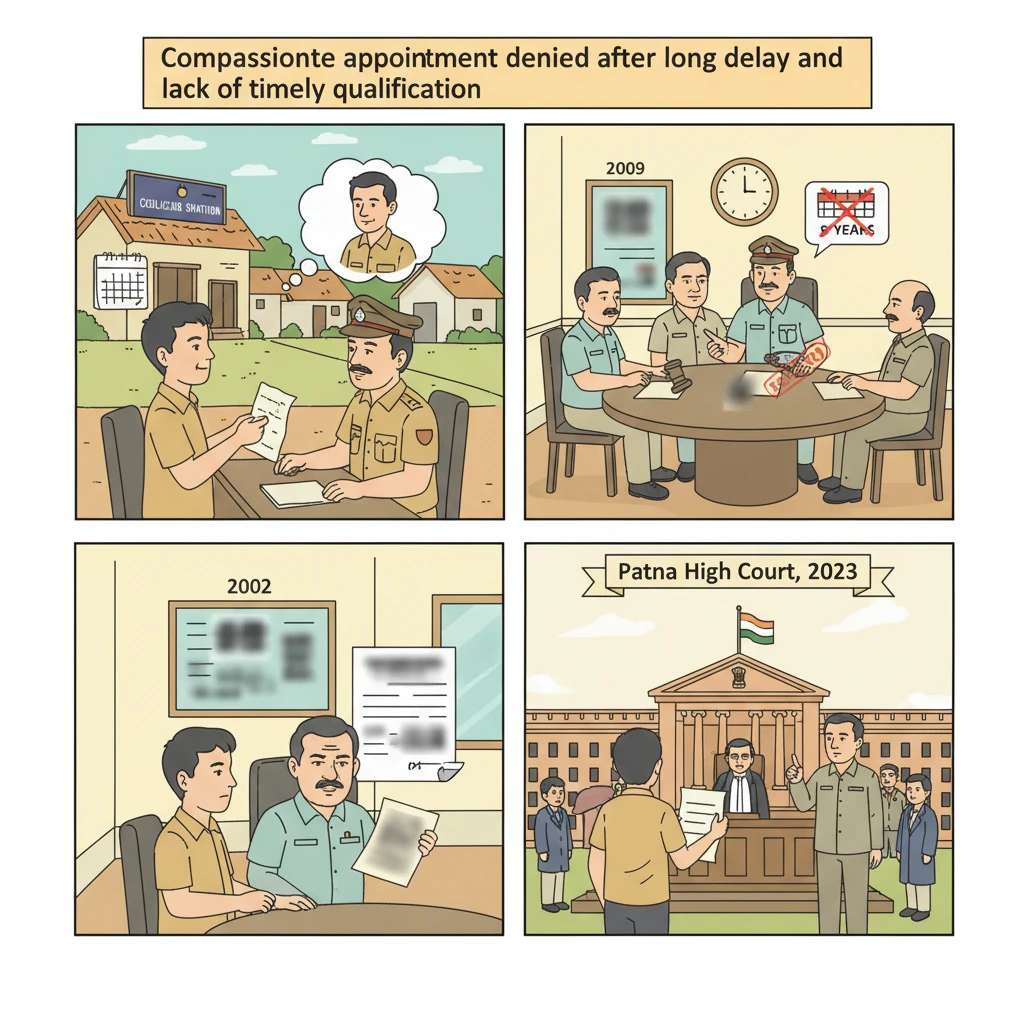
The petitioner’s father died in harness on 30.06.2002 while serving as a chowkidar. After his father’s death, the petitioner applied for appointment on compassionate ground. His application was dated 22.11.2002.
The application was forwarded by the Sub-Divisional Officer, Banmankhi, to the District Chowkidar Officer, Purnea, under letter dated 22.11.2002. The matter then came before the District Compassionate Committee headed by the District Magistrate, Purnea.
In its meeting held on 29.09.2009, the District Compassionate Committee rejected the petitioner’s request for compassionate appointment. This decision was later communicated through Memo dated 15.07.2011.
The petitioner did not accept this decision and filed an appeal before the Divisional Commissioner, Purnea Division, Purnea. The appeal was registered as Miscellaneous Appeal No. 14 of 2012.
By order dated 10.07.2013, the Divisional Commissioner dismissed the appeal and affirmed the decision of the District Compassionate Committee. Thereafter, the petitioner approached the Patna High Court under writ jurisdiction to challenge both the memo dated 15.07.2011 and the appellate order dated 10.07.2013.
What the Court Examined and Decided
The Patna High Court, through Hon’ble Mr. Justice Mohit Kumar Shah, delivered an oral judgment on 24.08.2023. The main question before the Court was whether the petitioner was entitled to appointment on compassionate ground, despite the delay and his educational position.
The petitioner’s case was that his father died while in service and that he, as a dependent, had applied within a few months of that death. He claimed that he had provided his educational qualification certificate showing that he had passed the 8th standard.
According to the petitioner, in the official checklist his qualification was wrongly recorded as 6th pass. On this basis, he argued that he actually fulfilled the educational requirement for appointment as chowkidar on compassionate ground and that the rejection of his claim was unjustified.
The State took a different stand. The State’s counsel submitted that, under the rules applicable to compassionate appointment, there is a specific time limit of five years from the date of death of the deceased employee.
This five-year limit covers two things. First, the dependent must apply for compassionate appointment within five years of the death. Second, the dependent must also acquire the required educational qualification within the same five-year period.
The State pointed out that the petitioner did not acquire the necessary educational qualification within five years from 30.06.2002, the date of his father’s death. On the contrary, the District Compassionate Committee found that the petitioner had started his studies only after five years had already passed.
On this basis, the Committee concluded that, even if the petitioner later became educationally qualified, he was not eligible for appointment within the prescribed five-year window. This was the reason recorded by the District Compassionate Committee in its meeting dated 29.09.2009, communicated through Memo dated 15.07.2011.
The State further argued that by the time the matter came before the High Court, about 21 years had already passed since the death of the petitioner’s father. In such circumstances, it would not be appropriate to grant compassionate employment at this late stage, because the very purpose of such appointment is to provide immediate financial relief to the bereaved family.
The Court heard both sides and examined the materials on record. It focused on two connected aspects: the delay and the nature of compassionate appointment as an exceptional measure designed to meet immediate financial hardship.
The Court noted that if claims for compassionate appointment are entertained after a long gap, there can be several difficulties. Existing government vacancies may already have been filled through regular recruitment. More importantly, there may be many other bereaved families facing fresh and immediate financial crises who also seek relief.
In such a situation, if very old claims are allowed, the basic purpose of the scheme is defeated. Compassionate appointment is not meant to reserve a government job indefinitely for a dependent. It is meant to deal with an urgent crisis at the time of the employee’s death.
To support this reasoning, the Court relied on important Supreme Court decisions. The first was the judgment in Umesh Kumar Nagpal versus State of Haryana and others, reported in (1994) 4 SCC 138. The Court reproduced paragraph 6 of that judgment.
In that paragraph, the Supreme Court clearly held that compassionate employment cannot be granted after the lapse of a reasonable period specified in the rules. It further held that compassionate employment is not a vested right that can be used at any time in the future.
The Supreme Court explained that the object of compassionate appointment is to help the family get over the financial crisis caused by the death of the sole breadwinner. Therefore, once that crisis has passed, a dependent cannot insist on appointment irrespective of time.
The Patna High Court also referred to the Supreme Court decision in State of Gujarat vs. Chitraben, reported in (2015) 14 SCC 574, and quoted paragraph 9 of that judgment.
In Chitraben, the Supreme Court considered a case where the widow of a deceased employee did not possess the minimum educational qualification required at the time of her husband’s death and at the time she applied for compassionate appointment. The Supreme Court held that since she did not have the stipulated qualification under the relevant rules, she was not eligible to claim compassionate appointment.
The Patna High Court found the principles from these Supreme Court cases directly applicable. It emphasised that where the rules fix a time frame for acquiring educational qualification and for applying, those conditions must be satisfied. A candidate cannot demand compassionate employment if the qualification is obtained after the permitted period has expired.
Applying these principles to the facts, the Court accepted the stand of the State. It found that the petitioner had not acquired the requisite educational qualification within five years from 30.06.2002. Rather, he started his studies only after that five-year period had already lapsed.
Thus, even if there was a dispute about whether he was actually 6th pass or 8th pass at some later point, the crucial question was whether he had the necessary qualification within five years of his father’s death. On the record, he did not.
The Court further noted the long passage of time. By the date of hearing, around 21 years had gone by since the death of the petitioner’s father. The Court held that the immediate financial crisis that the family may have faced in 2002 no longer existed in 2023 in the way contemplated by the scheme of compassionate appointment.
Considering all these factors, and the object of the compassionate appointment scheme, the Court concluded that there was no merit in the writ petition. It declined to interfere with either the decision of the District Compassionate Committee contained in Memo dated 15.07.2011 or the appellate order dated 10.07.2013 passed by the Divisional Commissioner, Purnea Division.
Accordingly, the writ petition was dismissed.
Why This Judgment Matters
This judgment is important for families of deceased government employees in Bihar and elsewhere who seek compassionate appointment.
First, it shows that there is a strict time limit not only for applying but also for acquiring the necessary educational qualification. If a dependent becomes qualified after the cut-off period, the courts may still refuse appointment.
Second, the Patna High Court has reinforced that compassionate appointment is only to deal with an immediate financial crisis following the death of a breadwinner. It is not a permanent right that can be claimed after many years.
Third, the decision aligns with Supreme Court rulings and signals that courts will be slow to disturb decisions of compassionate committees when there is long delay and non-compliance with rules.
For dependents, this means that they should act quickly after a government employee’s death, and must ensure that they meet all educational and other conditions within the period prescribed by the rules.
Legal Issues and Answers
- Issue: Whether a dependent is entitled to compassionate appointment when he acquires the required educational qualification only after the expiry of five years from the death of the government employee.
Answer: No. The Patna High Court held that both the application and acquisition of qualification must occur within the five-year period; otherwise, the candidate is not eligible. - Issue: Whether compassionate appointment can be ordered by the Court more than two decades after the death of the employee.
Answer: No. The Court held that compassionate appointment is meant to address immediate financial crisis and cannot be granted after such a long lapse of time.
Cases Cited by the Court
- Umesh Kumar Nagpal versus State of Haryana and others, (1994) 4 SCC 138.
- State of Gujarat vs. Chitraben, (2015) 14 SCC 574.
Case Details
Case Number: Civil Writ Jurisdiction Case No. 11092 of 2015
Case Title: Madho Sharma v. The State of Bihar & Ors.
Citation: 2024 (4) PLJR 901
Coram: Hon’ble Mr. Justice Mohit Kumar Shah
Date of Judgment: 24.08.2023
Advocates: For the petitioner – Mr. Ram Prawesh Kumar, Advocate. For the State – Mr. Raghwanand, GA-11 and Mr. Rajnish Shandilya, AC to GA-11.
Nature of the Case: Writ petition challenging rejection of compassionate appointment and dismissal of appeal by Divisional Commissioner.
Link to Judgment: https://patnahighcourt.gov.in/viewjudgment/MTUjMTEwOTIjMjAxNSMxI04=—ak1–vWhge405a8=
If you found this explanation helpful and wish to stay informed about how legal developments may affect your rights in Bihar, you may consider following Samvida Law Associates for more updates.







