

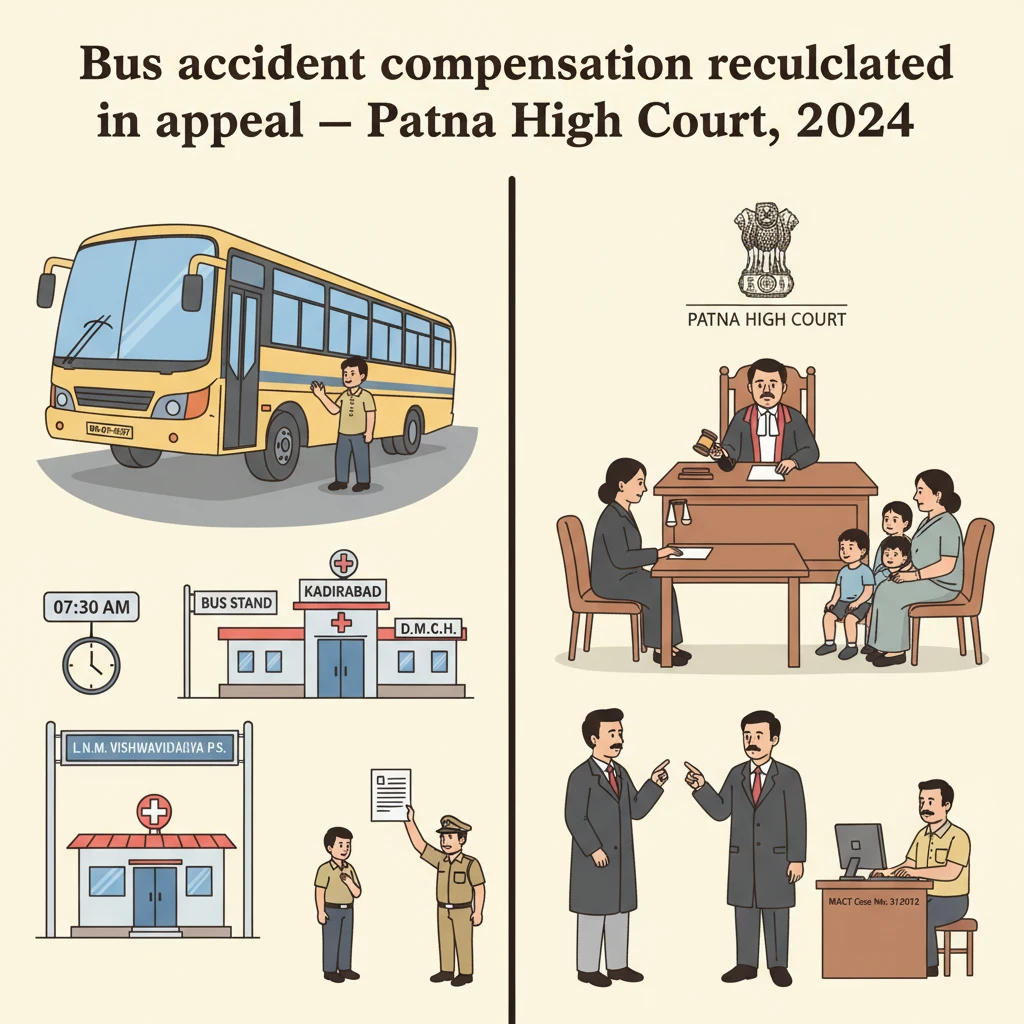
Case Background
The case arises from a road accident that took place on 19.04.2012 at about 07:30 A.M. at Kadirabad, Darbhanga bus stand.
The deceased, Bhimshankar Jha, along with another person, had reached the bus stand to board a bus for Patna to attend a marriage ceremony. While they were standing there, a bus bearing Registration No. BR-07P-0597, owned by Bihar State Road Transport Corporation, came out from the government bus depot.
According to the claimants, the bus was being driven rashly and negligently and hit the deceased. He sustained grievous injuries, was taken to the private clinic of Dr. Shabbir Ahmad, and succumbed to his injuries. A post-mortem was conducted at D.M.C.H., Darbhanga.
Police registered L.N.M. Vishwavidyalaya (Darbhanga) P.S. Case No.81 of 2012 under Sections 279 and 304-A of the Indian Penal Code against the bus driver (O.P. No.3). The driver was caught on the spot by people present and handed over to the police. After investigation, the Investigating Officer submitted Chargesheet No.140 of 2012 under Sections 279 and 304-A IPC against the driver.
The deceased’s wife and three minor children filed Motor Accident Claim Case No.31 of 2012 before the Motor Accident Claims Tribunal, Supaul. They claimed that the deceased was about 40 years old, an LIC agent with annual earnings of Rs.5,70,878/-, an income tax payee and the main breadwinner of the family. They sought Rs.68,80,528/- towards loss of dependency, loss of love and affection, consortium and funeral expenses with 12% interest.
The Chairman and Depot Superintendent of Bihar State Road Transport Corporation (owners of the bus) were made opposite parties along with the driver and the deceased’s parents. The parents were impleaded as O.P. Nos.4 and 5 but did not join as claimants.
The Corporation admitted ownership of the vehicle but questioned maintainability of the claim, denied that people had caught the driver and handed him to police, and contended that the vehicle had been examined by the Motor Vehicle Inspector and found in proper condition. They put the burden on the claimants to prove their case.
The driver did not appear and was proceeded ex parte on 16.11.2013. On 08.06.2015, the Tribunal allowed an application under Section 170 of the Motor Vehicles Act, enabling the Corporation to contest the claim as if it were the driver. An interim award of Rs.50,000/- under Section 140 of the Act was granted on 03.01.2015 and paid to the widow.
On 04.02.2015, the Tribunal framed issues on maintainability, negligence, dependency, entitlement and relief. The claimants examined three witnesses and produced documents including FIR, chargesheet, post-mortem report, owner’s book, M.V.I. report and Income Tax Return of the deceased for Assessment Year 2011–2012. The Corporation led no oral or documentary evidence.
By judgment dated 07.10.2015, the Tribunal held that the accident was caused by rash and negligent driving of the bus and awarded Rs.34,82,512/- with 6% interest from 27.07.2012 till realization. The award was mainly based on the deceased’s income disclosed in the Income Tax Return and a multiplier of 16. Aggrieved, the Corporation filed Miscellaneous Appeal No.884 of 2017 before the Patna High Court.
What the Court Examined and Decided
The Patna High Court, exercising appellate jurisdiction under Section 173(1) of the Motor Vehicles Act, heard the Corporation’s challenge to the Tribunal’s findings and calculations, as well as the claimants’ plea seeking enhancement of conventional heads (though they had not filed a cross‑appeal).
The Corporation argued that the Tribunal had failed to consider contributory negligence of the deceased. They pointed out that the accident took place in a crowded bus stand, and no independent witness was examined. They also contended that the Tribunal had not properly appreciated the M.V.I. report and post-mortem report.
Another major objection was to reliance on the deceased’s Income Tax Return without verification. The Corporation claimed that the deceased was an LIC agent earning commission, not a government employee drawing a stable, permanent income. According to them, such commission-based income should not form the basis for calculating compensation. They also argued that the age of the deceased being 40 years, the Tribunal ought to have used multiplier 15 instead of 16.
On the other side, the claimants’ counsel supported the Tribunal’s findings on negligence and dependency. They emphasized that the FIR and chargesheet established rash and negligent driving by the bus driver. They defended reliance on the Income Tax Return, which showed income from LIC commission and other business, and pointed out that the Supreme Court has accepted ITRs as reliable proof of income.
The claimants did not file a separate appeal, but submitted that the High Court, while exercising appellate powers, could still enhance compensation under the conventional heads (consortium, funeral expenses, loss of estate) in line with recent Supreme Court decisions.
The High Court first considered the question of negligence. It noted that on the basis of the FIR (Ext-2), the police had conducted investigation and submitted a report under Section 173 Cr.P.C. (Ext-1) against the bus driver, who was facing criminal prosecution under Sections 279 and 304-A IPC. The Court reiterated the settled position that when a driver is charge-sheeted after investigation, it is safe to conclude that, prima facie, the accident occurred due to his rash and negligent driving.
The Court also rejected the Corporation’s suggestion that this was a case of false involvement of the bus. It held that merely because no major damage was caused to the vehicle, it cannot be inferred that the vehicle was falsely involved for the purpose of claiming compensation. The Court noted that there was no material to suggest any collusion between the claimants and the driver. The police investigation, leading to filing of the chargesheet, in fact dispelled such doubts.
On the allegation of contributory negligence, the Court found that there was no evidence on record pointing even prima facie to any negligent act on the part of the deceased. Therefore, the plea of contributory negligence was rejected.
The High Court then examined the issue of dependency and deduction for personal expenses. It found that the deceased had left behind his wife and three minor children as claimants, and his parents (respondent nos.5 & 6) were also dependent. Relying on the Supreme Court’s decisions in Sarla Verma & Ors. v. Delhi Transport Corporation & Anr., (2009) 6 SCC 121 and National Insurance Co. Ltd. v. Pranay Sethi & Ors., (2017) 16 SCC 680, the Court held that where dependents are between four and six, one-fourth of the income should be deducted towards personal and living expenses. It found no fault with the Tribunal’s deduction of 1/4th.
The crucial correction came on the question of income and multiplier. The claimants had produced the deceased’s Income Tax Return for Assessment Year 2011–2012, filed on 30.03.2012, prior to the accident. It reflected annual income of Rs.2,81,500/- and tax payable of Rs.3,136/-, leaving net annual income of Rs.2,78,364/-. The Tribunal, however, had treated net annual income as Rs.2,89,376/-, which the High Court found inconsistent with the ITR.
Placing reliance on the Supreme Court judgment in Malarvizhi & Ors. v. United India Insurance Co. Ltd. & Ors., (2020) 4 SCC 228, the Court reiterated that where available, determination of income should be based on the Income Tax Return, which is a statutory document. It therefore modified the net annual income of the deceased to Rs.2,78,364/-.
After deducting one-fourth (Rs.69,591/-) towards personal and living expenses, the net annual contribution to the dependents came to Rs.2,08,773/-.
On the multiplier issue, the Court accepted that, as the deceased was 40 years old, the correct multiplier according to Sarla Verma and Pranay Sethi is 15 (for age group 36–40), not 16 as used by the Tribunal. With multiplier 15, the loss of dependency was recalculated at Rs.31,31,595/- (Rs.2,08,773 x 15).
Next, the Court reviewed the conventional heads. The Tribunal had granted only Rs.5,000/- towards loss of estate and Rs.5,000/- for funeral expenses. The High Court held that this was not “just compensation” and needed enhancement, especially in light of the law declared by the Supreme Court.
The Court discussed the concept of “just compensation” under Section 168 of the Motor Vehicles Act, noting that compensation must be fair, reasonable and equitable, with tribunals having flexibility not restricted by strict arithmetic or evidentiary rules. It also noted that under Order XLI Rule 33 of the Code of Civil Procedure, the appellate court has wide power to pass any order required to do complete justice, even for a party who has not filed appeal or cross-objection. The Court cited Pannalal v. State of Bombay & Ors., AIR 1963 SC 1516, and Chaya & Ors. v. Bapusaheb & Ors., 1994 (2) SCC 41, to underline these principles.
Applying these powers, the Court turned to the question of consortium and other non-pecuniary damages. It referred to Satinder Kaur @ Satwinder Kaur v. United India Insurance Co. Ltd., AIR 2020 SC 3076, and Magma General Insurance Co. v. Nanu Ram @ Chuhru Ram & Ors., (2018) 18 SCC 130. Following these precedents, the Court held that the wife and the three minor children were each entitled to Rs.40,000/- as spousal and parental consortium respectively, totalling Rs.1,60,000/-. It further enhanced funeral expenses and loss of estate to Rs.15,000/- each.
Summarising, the Court recalculated the compensation as:
- Loss of dependency: Rs.31,31,595/-
- Loss of estate: Rs.15,000/-
- Funeral expenses: Rs.15,000/-
- Loss of consortium (wife + three minor children): Rs.1,60,000/-
- Total: Rs.33,21,595/-
Thus, while the loss-of-income component was reduced from the Tribunal’s figure, the amounts under conventional heads were substantially enhanced. The final total stood at Rs.33,21,595/-.
The Court directed that this sum would carry simple interest at 6% per annum from the date of filing of the claim case, i.e. 27.07.2012, until realization, payable by the Bihar State Road Transport Corporation. The Corporation was ordered to deposit the amount, after deducting any sum already paid (such as the interim award), before the Tribunal within six weeks from the date of the High Court judgment.
Except for the modifications discussed above, the rest of the Tribunal’s judgment and award was left undisturbed. The appeal was partly allowed, with no order as to costs. Pending applications, if any, were disposed of, and the record was directed to be sent back to the Tribunal.
Why This Judgment Matters
This decision is important for families of road accident victims in Bihar and beyond, particularly where the deceased was self-employed or earning through commission, like an LIC agent.
First, the Patna High Court has reaffirmed that a police chargesheet under Section 173 Cr.P.C. is strong prima facie proof of rash and negligent driving in motor accident claims. Victims’ families are not required to prove negligence to the same high standard as in a criminal trial.
Second, the Court has clarified that an Income Tax Return filed before the accident is a reliable and accepted basis for computing income, even when the deceased was earning by commission. This protects dependents from attempts to undermine their claim merely because the deceased was not in permanent government service.
Third, the Court has shown that appellate courts can both reduce and increase different parts of compensation to reach a fair, “just compensation”. Here, although the multiplier and income figure were corrected slightly downwards, the Court significantly increased amounts for consortium, funeral expenses and loss of estate in line with Supreme Court standards.
For widows and minor children of accident victims, this judgment confirms their right to consortium—compensation for loss of companionship, love and guidance—over and above loss of income. It also signals to transport corporations and bus operators that they remain liable for negligent driving by their staff, even within bus stands and depots.
Legal Issues and Answers
- Issue: Was the fatal accident caused by rash and negligent driving of the Bihar State Road Transport Corporation bus, or was there contributory negligence by the deceased?
Answer: The Court held that, based on the FIR and chargesheet under Section 173 Cr.P.C., the accident was due to rash and negligent driving by the bus driver. There was no evidence of any negligence by the deceased and no contributory negligence was made out. - Issue: What is the correct method to assess the deceased’s income and compute compensation, including multiplier and deductions?
Answer: The Court ruled that the deceased’s Income Tax Return for A.Y. 2011–2012 should be taken as the basis, giving net income of Rs.2,78,364/-. After one‑fourth deduction for personal expenses and applying multiplier 15 (for age 40), loss of dependency was Rs.31,31,595/-. - Issue: Can the High Court enhance amounts under conventional heads (consortium, funeral, loss of estate) in appeal even without a cross‑appeal from claimants?
Answer: Yes. Invoking the concept of “just compensation” under Section 168 of the Motor Vehicles Act and powers under Order XLI Rule 33 CPC, the Court enhanced consortium to Rs.40,000/- each for wife and three minor children and raised funeral expenses and loss of estate to Rs.15,000/- each, fixing total compensation at Rs.33,21,595/- with 6% interest.
Cases Cited by the Court
- Sarla Verma & Ors. v. Delhi Transport Corporation & Anr., (2009) 6 SCC 121
- National Insurance Co. Ltd. v. Pranay Sethi & Ors., (2017) 16 SCC 680
- Malarvizhi & Ors. v. United India Insurance Co. Ltd. & Ors., (2020) 4 SCC 228
- Pannalal v. State of Bombay & Ors., AIR 1963 SC 1516
- Chaya & Ors. v. Bapusaheb & Ors., 1994 (2) SCC 41
- Satinder Kaur @ Satwinder Kaur v. United India Insurance Co. Ltd., AIR 2020 SC 3076
- Magma General Insurance Co. v. Nanu Ram @ Chuhru Ram & Ors., (2018) 18 SCC 130
Case Details
Case Number: Miscellaneous Appeal No.884 of 2017
Case Title: Chairman (Now Administrator), Bihar State Road Transport Corporation & Anr. v. Vidyut Kumari & Ors.
Citation: 2024 (4) PLJR 108
Coram: Hon’ble Mr. Justice Sunil Dutta Mishra
Advocates:
- For the Appellants: Dr. Anand Kumar, Advocate; Mr. Rajan Prakash, Advocate
- For the Respondents: Mr. Nawnit Kumar Tiwary, Advocate; Mr. Ranjan Kumar Dubey, Advocate; Mr. Kumar Gaurav, Advocate
Nature of the Case: Miscellaneous appeal under Section 173(1) of the Motor Vehicles Act, 1988 against an award of the Motor Accident Claims Tribunal (MACT), Supaul.
Date of High Court Judgment: 28.08.2024
Tribunal Case Reference: Claim Case (MACT Case) No.31 of 2012, Additional District Judge-II-cum-Motor Accident Claims Tribunal, Supaul
Link to Judgment: Click here to access the full Patna High Court judgment
If you found this explanation helpful and wish to stay informed about
how legal developments may affect your rights in Bihar,
you may consider following Samvida Law Associates for more updates.







