

Case Background
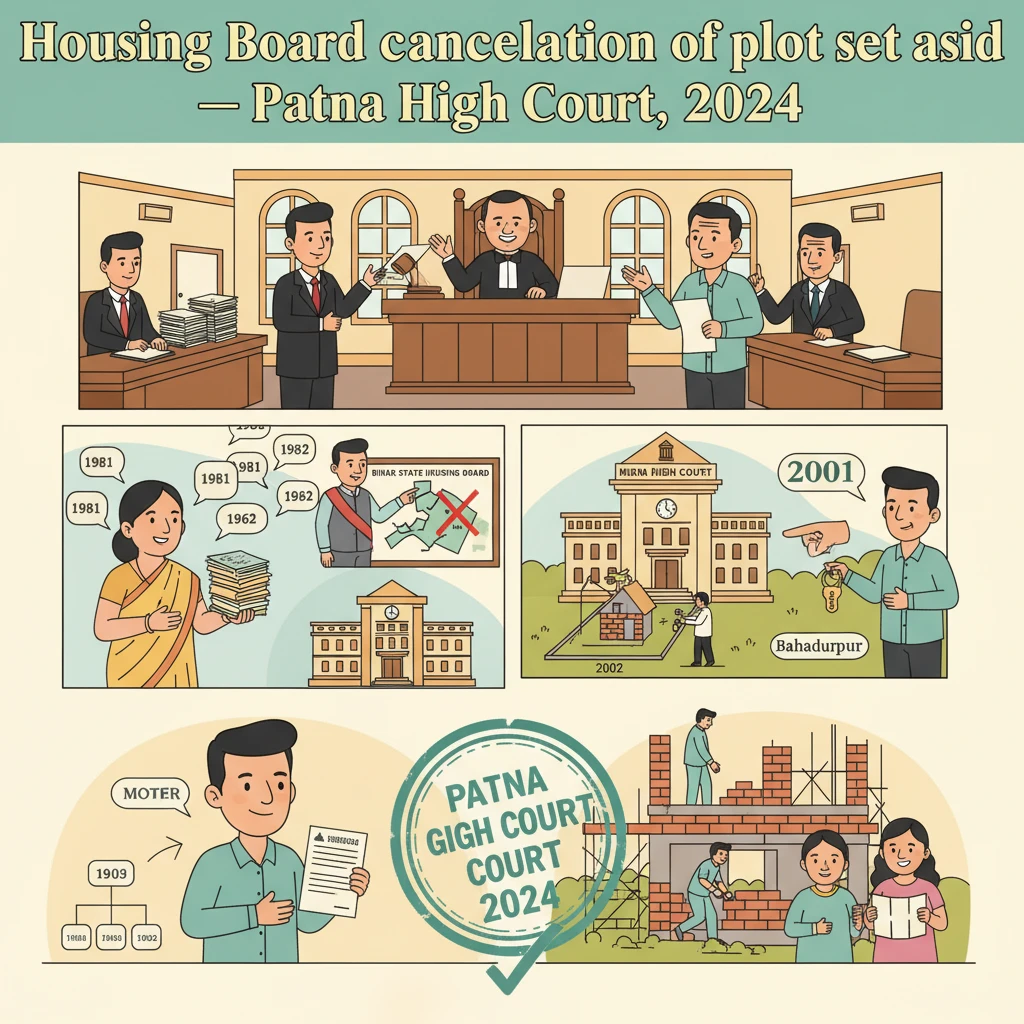
The dispute began in 1980, when the petitioner’s mother registered with the Bihar State Housing Board for allotment of a residential plot. She deposited an advance of Rs.5,000 in 1981, along with necessary documents. After finding her eligible, the Housing Board allotted her plot no. CH/27 at Sri Krishna Nagar, Patna, measuring 2.91 khatas, by letter dated 16.01.1982. She was asked to pay Rs.1,840 by 31.01.1982, which she deposited on 29.01.1982, confirming the allotment.
Despite this, the Housing Board did not execute a formal deed of agreement. The original allottee’s husband wrote to the Chairman on 08.07.1982, requesting completion of formalities. The Board replied that allotments were deferred and would only be processed after August 1982.
On 16.09.1982, the Board published a notice in the newspaper “Search Light”, asking applicants to resubmit information to update files. The petitioner’s mother complied and her documents were acknowledged by receipt dated 28.09.1982. Yet, no deed was executed.
Again, on 17.04.1986, the Board issued another newspaper notice in “Indian Nation”, requiring applicants under the Chairman’s quota between February 1981 and January 1982 to submit details within fifteen days. The original allottee again supplied all information, but nothing concrete followed.
Later, in its 121st meeting on 13.09.1988, the Board considered a request from the then Housing Minister, Shri Awadh Bihari Singh, to change his allotted plot from CH/22 to CH/27, the same plot earlier allotted to the petitioner’s mother. Aggrieved by non-execution of the deed, non-delivery of possession, and the change of allotment to the Minister, she filed C.W.J.C. No.458 of 1989. On 15.12.1989, the High Court passed an interim stay on allotment of that plot.
Despite the stay, the Housing Board transferred plot CH/27 to Postal Cooperative House Construction Society. This led the original allottee to file a contempt petition, M.J.C. No.72 of 2001. On 30.07.2001, the High Court directed the Housing Board to find a suitable alternative plot in Sri Krishna Nagar and allot it within four weeks, or, if not available, allot a suitable plot in a similar colony. Importantly, the Court ordered that the rate applicable would be as on 15.12.1989.
In compliance, the Board allotted plot no. 6H/65 at Bahadurpur, Patna by letter no. 623/AA dated 02.03.2002. Possession was handed over on 01.10.2002. Unfortunately, the petitioner’s mother died on 12.07.2003, within ten months of taking possession and before any construction started.
On 20.11.2003, the petitioner informed the Housing Board of his mother’s death and made an ad-hoc payment of Rs.50,000. On 22.11.2003, legal heirs deposited Rs.1,02,535 against the tentative cost of Rs.1,04,360 mentioned in the allotment letter.
Later, by letter dated 13.06.2008, enclosing letter dated 29.02.2008, the Board demanded Rs.35,089 or Rs.35,410. The petitioner deposited Rs.35,410 on 16.09.2008. He repeatedly pursued substitution of the plot in his name, supported by no-objection from other legal heirs.
However, on 26.05.2009, the Board issued a show cause notice asking why non-construction on the plot should not be treated as default under Clause 13 of the agreement. The petitioner replied on 06.07.2009 that transfer to his name was still pending, and until that was done, building plan could not be sanctioned and construction could not begin.
On 10.09.2013, the Board sought documents from the Land Estate Officer, who wrote on 28.09.2013 to the petitioner for necessary papers. The petitioner again supplied all documents. Then, on 12.12.2013, the petitioner was informed that his request for transfer could not be considered because the allotment had already been cancelled by office order no. 9754 dated 11.11.2011. According to the petitioner, he never received that cancellation letter and came to know of it only in 2013.
What the Court Examined and Decided
The core dispute before the Patna High Court in C.W.J.C. No.2314 of 2016 was whether the Bihar State Housing Board could cancel the allotment of plot 6H/65 for non-construction, when the legal heir was still seeking substitution and had paid the dues.
The petitioner argued that the impugned order dated 11.11.2011 was passed in pursuance of earlier directions of the High Court in C.W.J.C. No.12376 of 2007 and M.J.C. No.999 of 2011, which directed action against defaulting allottees who had not constructed houses within the stipulated time. He submitted that his case did not fall in that category because the plot had never been transferred in his name, and without such transfer the building plan could not be sanctioned.
He emphasised that the reasons for non-construction were beyond his control. Neither he nor his mother was a party in the earlier proceedings where the directions were issued. No notice of the proposed cancellation was given to him. Therefore, applying those directions to his case, without hearing him, was illegal.
The petitioner further submitted that there was no default on his part. Any delay was caused by the Housing Board, which did not complete substitution or grant necessary permissions under Clause 11 of the agreement. That clause required approval of the Housing Board and the relevant authority under the Bihar Restrictions of Uses of Land Act or other law before construction could start.
The petitioner pointed out that possession of plot 6H/65 was given on 01.10.2002, his mother died within ten months, and he promptly informed the Board on 20.11.2003. The legal heirs paid almost the full tentative cost within days. In his submission, this showed bona fide conduct.
He also argued that cancelling the allotment amounted to violation of Article 14 and Article 300A of the Constitution. While right to property is no longer a fundamental right, it remains a constitutional right under Article 300A, which says no person shall be deprived of property except by authority of law. He relied on the Supreme Court decision in State of West Bengal vs. Haresh C. Banerjee, (2006) 7 SCC 651, where this principle was affirmed.
The petitioner relied on Clause 13 of the Hire-Purchase Agreement, which prohibited alteration or addition without prior written permission of the Board and without approval of municipal or other authorities. He also cited Clause 15 of the allotment letter, which stated that if the allottee died after possession and payment, the Board would decide on transfer to legal heirs in its discretion. Clause 10 of the allotment letter required construction only according to sanctioned plans. He argued that since the Board did not exercise its discretion reasonably under Clause 15 and did not complete transfer, he could not obtain sanctions or start construction. Hence, he should not be treated as a defaulter.
The Housing Board, in its counter affidavit, did not dispute the basic chronology. It stressed Clause 10 of the allotment letter dated 02.03.2002 and Clause 12 of the Hire-Purchase Agreement dated 20.05.2002, which required the allottee to start construction within two years of possession and complete ground floor within three years. The Board stated that after the original allottee’s death on 12.07.2003, the petitioner did not immediately take steps for substitution or comply with these clauses.
The Board claimed it had issued letters regarding dues, including a letter dated 22.03.2006, followed by letter dated 29.02.2008 and reminder dated 04.07.2008. It said that only after reminders did the petitioner pay the outstanding amount. It further stated that a show cause notice dated 26.05.2009 was issued for breach of Clause 12, and the petitioner replied on 06.07.2009.
Importantly, the Board explained that, in obedience to the High Court’s order dated 02.09.2008 in C.W.J.C. No.12376 of 2007 (Krishna Murari Prasad Singh vs. State of Bihar & Ors.), and in view of subsequent contempt proceedings in M.J.C. No.999 of 2011, it passed the general cancellation order on 11.11.2011 against 17 defaulting allottees, including the petitioner’s case. It conceded that the main file of plot 6H/65 was not available, so a part file was opened. Because the cancellation order was not in the part file, the Board inadvertently issued letters calling for documents and processing transfer, until the main file revealed that cancellation had already been effected.
In rejoinder, the petitioner highlighted that his mother’s death within ten months of possession and the pending substitution request were never brought before the Court in Krishna Murari Prasad Singh’s case. He disputed the alleged letter dated 22.03.2006 on balance payments, noting that the Board had not produced it. He maintained that he promptly complied with the actual demand letter of 13.06.2008/29.02.2008 by depositing Rs.35,410 on 16.09.2008.
Justice Sandeep Kumar carefully considered the submissions and records. The Court noted that it was undisputed that the original allottee died within ten months of allotment of the plot, and that the petitioner had taken all steps for substitution and deposited the entire amount as directed by the Board.
The Court then referred to its earlier directions in Krishna Murari Prasad Singh’s case. It observed that nothing in that judgment allowed the Board to cancel allotments without giving proper opportunity to the allottees or ignoring principles of natural justice.
The Court also referred to C.W.J.C. No.23195 of 2011 (Anil Kumar vs. Meghan Yadav & Ors.), where the same cancellation order dated 11.11.2011 was challenged. A Single Judge had quashed the cancellation as it applied to that petitioner, and the Division Bench, in L.P.A. No.556 of 2015, had upheld that decision.
The Division Bench had recorded that the Housing Board acted in undue haste and without application of mind. After facing contempt in M.J.C. No.999 of 2011, the Board hurriedly passed the cancellation order on 11.11.2011 to show “substantial compliance” before the Court on 15.11.2011. The Division Bench held that, before cancelling any allotment pursuant to Krishna Murari Prasad Singh, the Board had to enquire into each case, confirm that the allottee was truly a defaulter, and not apply the directions mechanically.
Following that reasoning, the Single Judge in the present case found that the petitioner had diligently followed up his case, sought transfer in his name, and had no objections from other heirs. No notice was given to him before cancellation. The delay in construction was therefore bona fide.
The Court held that the Board was required to issue notice, hold an enquiry, and then decide whether the petitioner was a defaulter. Mere delay, without considering the peculiar facts—death of the original allottee, pending substitution, and payments made—could not justify cancellation.
The Court also found a serious flaw: the cancellation order was passed against a dead person, namely the original allottee who had already passed away on 12.07.2003. Such an order, passed without considering the legal heir’s rights, could not be sustained.
In conclusion, the Patna High Court held that the cancellation order dated 11.11.2011 was not sustainable in law. It set aside the order, directed the Housing Board to complete substitution of the petitioner in place of his mother and to allot plot no. 6H/65 in his favour within two months of receiving the Court’s order. The Court also granted the petitioner two years’ time to construct a building on the plot, as per the hire-purchase agreement terms.
Why This Judgment Matters
This judgment is significant for all Housing Board allottees and their families in Bihar, especially where the original allottee has died. It confirms that the Bihar State Housing Board cannot cancel allotments in a blanket, mechanical manner, simply because houses have not been constructed within a fixed time.
The Patna High Court made it clear that before cancelling, the Board must issue notice, hold a proper enquiry, and consider special circumstances like death of the allottee, pending transfer to legal heirs, and payments already made.
The Court also protected the rights of legal heirs. It held that an order passed against a dead person, ignoring the heir who is actively pursuing transfer, is legally unsound. For families who have lost an allottee and are struggling with paperwork, this decision provides assurance that their rights cannot be taken away without due process.
Further, the judgment reinforces that right to property, though no longer a fundamental right, remains a protected constitutional right under Article 300A. Government bodies like Housing Boards must act fairly and within the law when dealing with someone’s house or plot.
Legal Issues and Answers
- Issue: Could the Bihar State Housing Board cancel the plot allotment for non-construction by relying on earlier High Court directions, without notice, enquiry, or considering the death of the original allottee and pending substitution of the legal heir?
Answer: No. The Patna High Court held that the Board acted mechanically and in undue haste, without following principles of natural justice, and even passed cancellation against a dead person. The cancellation order dated 11.11.2011 was set aside. - Issue: Was the petitioner a defaulter in constructing the house under the hire-purchase agreement and allotment terms?
Answer: The Court held that, in the facts of this case, the delay in construction was bona fide and largely caused by the Board’s failure to complete substitution and grant necessary permissions. Treating the petitioner as a defaulter was unjustified. - Issue: What relief was the petitioner entitled to after wrongful cancellation of the plot?
Answer: The Court directed the Housing Board to complete substitution of the petitioner in place of the original allottee, allot plot no. 6H/65 to him within two months, and granted him two years’ time to construct over the plot as per the hire-purchase agreement.
Cases Cited by the Court
- State of West Bengal vs. Haresh C. Banerjee, (2006) 7 SCC 651.
- Krishna Murari Prasad Singh vs. State of Bihar & Ors., C.W.J.C. No.12376 of 2007, order dated 02.09.2008.
- M.J.C. No.999 of 2011 (Krishna Murari Prasad Singh vs. State of Bihar & Ors.).
- C.W.J.C. No.23195 of 2011, Anil Kumar vs. Meghan Yadav & Ors., judgment dated 11.09.2013.
- L.P.A. No.556 of 2015, affirming the judgment in C.W.J.C. No.23195 of 2011.
Case Details
Case Number: Civil Writ Jurisdiction Case No.2314 of 2016
Case Title: Sanjay Mishra vs. The State of Bihar & Ors.
Citation: 2024 (4) PLJR 161
Coram: Hon’ble Mr. Justice Sandeep Kumar
Advocates:
- For the Petitioner: Mr. Bidhanesh Misra, Advocate
- For the State: Md. Khurshid Alam, AAG-13
- For the Housing Board: Ms. Binita Singh, Advocate
Nature of the Case: Writ petition under civil writ jurisdiction challenging cancellation of Housing Board allotment and seeking substitution and restoration of plot.
Court: High Court of Judicature at Patna
Date of Judgment: 28.08.2024
Impugned Order: Cancellation order no.9754 dated 11.11.2011 passed by Bihar State Housing Board regarding plot no. 6H/65, Bahadurpur, Patna Sector-06.
Link to Judgment: Click here to read the full Patna High Court judgment
If you found this explanation helpful and wish to stay informed about how legal developments may affect your rights in Bihar, you may consider following Samvida Law Associates for more updates.







