

Case Background
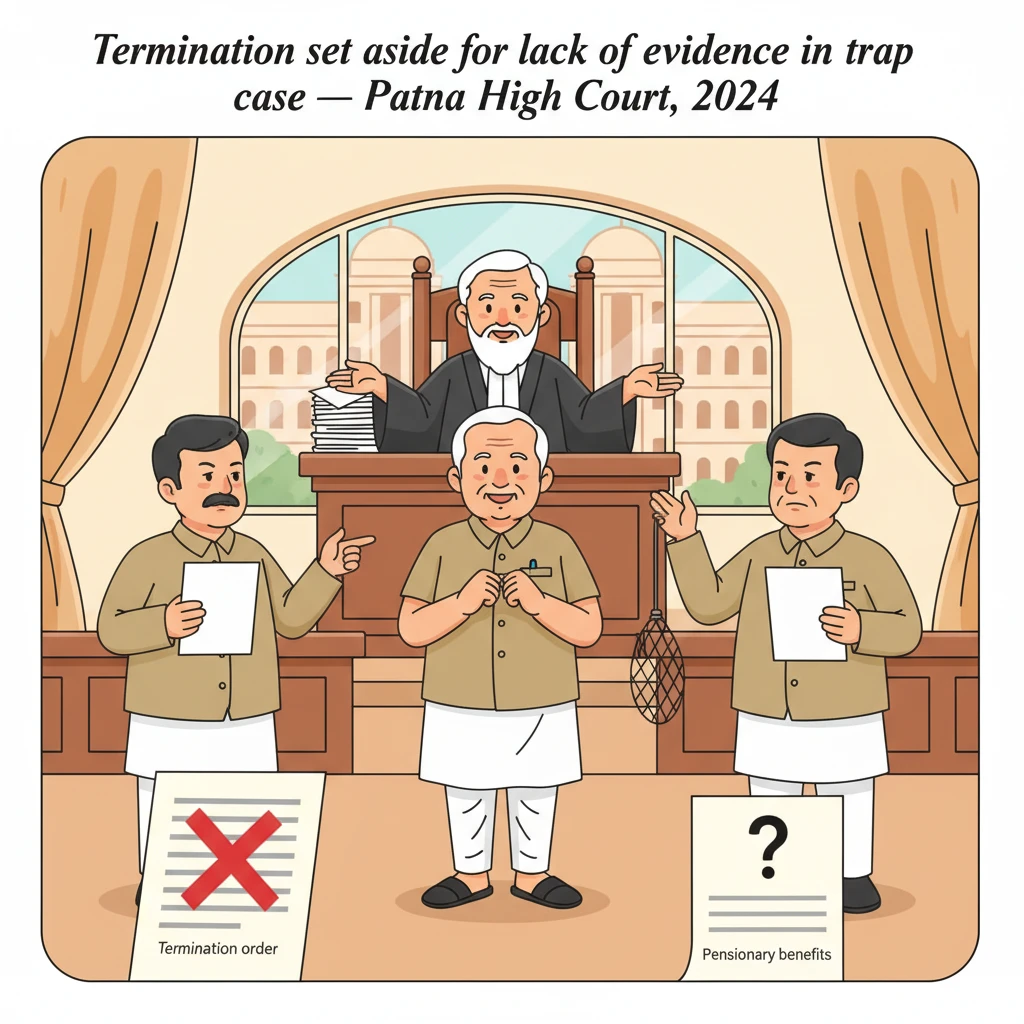
The appellant was a government employee under the Rural Works Department, Government of Bihar. A trap case was registered against him on the allegation that he had demanded a bribe and was caught red handed while accepting it. On the basis of this trap case, the department initiated disciplinary proceedings.
An Enquiry Officer and a Presenting Officer were appointed. However, during the enquiry, no witness was examined. The Presenting Officer only produced certain documents relating to the trap case. Relying merely on those documents, the Enquiry Officer held the employee guilty of misconduct, and the Disciplinary Authority terminated his services by order dated 16.12.2014.
The employee challenged his termination before the Patna High Court in a writ petition (Civil Writ Jurisdiction Case No.7151 of 2015). By the time the writ petition was decided, he had already attained the age of superannuation.
The learned Single Judge found a prima facie case to interfere with the termination. The Single Judge set aside the termination order dated 16.12.2014 and remitted the matter to the Disciplinary Authority/State Government. Liberty was given to initiate a fresh enquiry under Rule 43(b) of the Bihar Pension Rules, 1950, because the employee had already retired. In doing so, the Single Judge relied on ECIL v. B. Karunakar, (1993) 4 SCC 727, Chairman-cum-Managing Director, Coal India Ltd. v. Ananta Saha, (2011) 5 SCC 142, and State of Uttar Pradesh & Ors. v. Prabhat Kumar, 2022 Live Law SC 736.
Aggrieved by the remand and the possibility of facing a fresh enquiry affecting his pensionary benefits, the employee filed the present Letters Patent Appeal No.58 of 2024 before a Division Bench of the Patna High Court.
What the Court Examined and Decided
The Division Bench, comprising Hon’ble the Chief Justice and Hon’ble Mr. Justice Partha Sarthy, heard the appeal. The central question before the Court was whether, after finding the earlier disciplinary enquiry defective, it was proper to remand the case for a fresh enquiry, or whether the employee was entitled to final relief without any remand.
On behalf of the appellant, it was argued that the enquiry was a classic case of “no evidence”. No witness had been examined, neither the complainant nor the officer who conducted the trap. The Enquiry Officer had simply treated unproved documents as sufficient and returned a finding of guilt. The appellant contended that when an enquiry is vitiated due to lack of evidence, the proper course is not to remand but to grant relief, as remand would effectively reward the department for its negligence in conducting the enquiry.
The appellant relied on decisions of the Patna High Court itself, namely Rajendra Prasad vs. State of Bihar, 2024 SCC OnLine Pat 3890, and LPA No.389 of 2024 (Ram Lagan Ram vs. The State of Bihar, disposed of on 06.08.2024). He also invoked the Supreme Court’s decision in Roop Singh Negi v. Punjab National Bank, (2009) 2 SCC 570, to submit that mere production of documents does not amount to valid evidence in a disciplinary enquiry unless witnesses are examined to prove those documents.
On the other hand, the learned Advocate General, appearing for the State, argued that examination of witnesses is not an inflexible rule in every departmental proceeding and that this depends on the facts of each case, relying on Roop Singh Negi itself. He submitted that the appellant had been caught red handed in a trap case after demanding a bribe and should not be allowed to escape on what the State described as “technical reasons”. He supported the judgment of the learned Single Judge and strongly relied on the Supreme Court’s decision in Prabhat Kumar, which had also been cited by the Single Judge.
The Division Bench carefully considered these submissions and revisited its own previous judgment in LPA No.446 of 2024, The State of Bihar & Ors. vs. Vikash Kumar, dated 21.08.2024. In that case too, the State had sought a remand where the enquiry was found to be based on no evidence. The Bench had then discussed the decisions in Union of India v. Mohd. Ramzan Khan, (1991) 1 SCC 588 and ECIL v. B. Karunakar, (1993) 4 SCC 727, which deal with denial of reasonable opportunity when the enquiry report is not furnished to the delinquent employee.
The Court extracted paragraphs 8, 9 and 10 of its judgment in Vikash Kumar. There it had explained that Mohd. Ramzan Khan and B. Karunakar dealt with situations where the enquiry report was not supplied after the 42nd Constitutional Amendment. In such circumstances, non-supply of the report amounts to violation of principles of natural justice. A remand is then justified to cure a technical defect — i.e., to supply the report and allow a representation — so that the delinquent is not prejudiced before punishment is imposed.
However, as the Division Bench had stated in Vikash Kumar, such remand is meant only to cure technical defects of procedure, not to allow the management to fill gaps where it had failed to lead evidence in the first place. The Court had emphasised that the departmental enquiry must not be conducted in a negligent manner without adducing valid evidence.
The Bench then referred to Union of India v. P. Gunasekaran, (2015) 2 SCC 610, also discussed in Vikash Kumar. Quoting paragraphs 12 and 13 from that earlier judgment, the Court reiterated that under Articles 226 and 227 of the Constitution, the High Court can interfere where the finding of fact is based on no evidence. It warned that if in every case of a “no evidence” enquiry the matter were remanded, that would amount to offering a “premium to the negligence” of the Disciplinary Authority and condoning the lax manner in which such enquiries are sometimes conducted.
The Court further recalled the legal position that in disciplinary proceedings the standard of proof is the preponderance of probability, not proof beyond reasonable doubt as in criminal trials. But where no evidence at all is led, no question of drawing any probability arises, and no penalty can be imposed on the basis of bare conclusions.
Applying these principles, the Division Bench turned back to the facts of the present case. Here, it noted, a full-fledged disciplinary enquiry had been initiated. Despite that, no witness was examined. The complainant could have been called. At least the officer who conducted the trap could have been examined. Instead, the Presenting Officer simply produced documents relating to the trap case, without examining any witness to prove those documents.
The Bench highlighted that in Roop Singh Negi the Supreme Court had clearly held that mere production of documents does not constitute valid evidence in a departmental enquiry, unless those documents are proved through witnesses. On this basis, the Division Bench held that the present enquiry was indeed one based on no valid evidence.
The Court then distinguished the facts from the Supreme Court’s decision in Prabhat Kumar. In that case, although a disciplinary enquiry had been constituted, the delinquent employee did not appear. The department terminated his services without holding the enquiry. That was a procedural defect which could be cured by declaring the employee ex parte and proceeding to examine witnesses and prove documents. Therefore, remand in such a case addressed only a technical lapse.
In contrast, in the present case the delinquent employee did face an enquiry. Yet the authorities failed to examine even a single witness. This, the Court said, was not a mere technical defect. It reflected negligence and laxity in conducting the enquiry. Allowing remand in such a situation would effectively permit the department to correct its own failure to bring evidence at the proper time.
Relying on Roop Singh Negi and its own judgment in Vikash Kumar, the Division Bench concluded that the remand ordered by the learned Single Judge could not be sustained. The appeal was therefore allowed.
The Court set aside the order of remand and directed that the appellant be treated as reinstated in service from the date of his termination. He was held entitled to all consequential benefits, including pay and allowances from the date of his suspension, if any, up to the date of his superannuation, with adjustment only of any subsistence allowance already paid during suspension. The appellant was also declared entitled to all applicable retirement benefits.
The Court further ordered that arrears of salary, allowances, retirement benefits and pension be paid within six months from the date of uploading of the judgment. If payment was not made within that period, the appellant would be entitled to simple interest at 5% per annum on the unpaid amounts from the expiry of six months until actual payment.
Importantly, the Bench directed that when arrears are paid, a written computation of the amounts due from the date of suspension must be given to the appellant. It also made the State Government responsible for paying the interest in case of delay, while clarifying that the Government could thereafter proceed against any officer who defaulted in complying with the Court’s directions to recover the interest amount.
With these directions, the Letters Patent Appeal was allowed and any interlocutory applications were closed.
Why This Judgment Matters
This judgment is significant for government employees and retirees facing disciplinary action in Bihar, especially in cases related to alleged corruption or trap cases.
The Patna High Court has made it clear that departments cannot dismiss employees on the strength of unproved documents alone. Even in trap cases, witnesses such as the complainant or the officer conducting the trap must be examined in the departmental enquiry.
The decision also underscores that the Court will not always permit a fresh enquiry after many years when the department failed to lead evidence the first time. Remand is for curing technical defects like non-supply of the enquiry report or not declaring a delinquent ex parte, not for correcting a careless enquiry.
For employees who have already retired, the judgment shows that improper termination orders can still be set aside and full pensionary and salary benefits from the date of suspension till superannuation can be ordered, with interest if payment is delayed.
Legal Issues and Answers
- Issue: Can a departmental enquiry that finds an employee guilty solely on the basis of unproved documents, without examining any witness, be sustained, and should such a case be remanded for fresh enquiry?
Answer: No. The Patna High Court held this to be a “no evidence” enquiry. Mere production of documents without witness examination is not valid evidence. In such circumstances, the Court should not remand the matter to cover up the department’s negligence but grant substantive relief to the employee. - Issue: When is remand appropriate in disciplinary matters after the Court finds procedural defects?
Answer: Remand is appropriate only to cure technical defects, such as non-supply of the enquiry report or failure to provide reasonable opportunity. It is not meant to allow the Disciplinary Authority to fill evidentiary gaps where it failed to lead evidence despite having conducted an enquiry. - Issue: What relief was the appellant entitled to after the enquiry and termination were found unsustainable?
Answer: The appellant was deemed reinstated from the date of termination, entitled to full pay and allowances from the date of suspension (subject to adjustment of subsistence allowance), and to all retirement benefits. Arrears were to be paid within six months, failing which 5% simple interest per annum would apply.
Cases Cited by the Court
- ECIL v. B. Karunakar, (1993) 4 SCC 727
- Union of India v. Mohd. Ramzan Khan, (1991) 1 SCC 588
- Chairman-cum-Managing Director, Coal India Ltd. v. Ananta Saha, (2011) 5 SCC 142
- State of Uttar Pradesh & Ors. v. Prabhat Kumar, 2022 Live Law SC 736
- Union of India v. P. Gunasekaran, (2015) 2 SCC 610
- Roop Singh Negi v. Punjab National Bank, (2009) 2 SCC 570
- State of Bihar & Ors. v. Vikash Kumar, LPA No.446 of 2024 (Patna High Court, judgment dated 21.08.2024)
- Rajendra Prasad vs. State of Bihar, 2024 SCC OnLine Pat 3890
- Ram Lagan Ram vs. The State of Bihar, LPA No.389 of 2024 (Patna High Court, disposed of on 06.08.2024)
Case Details
Case Number: Letters Patent Appeal No.58 of 2024 in Civil Writ Jurisdiction Case No.7151 of 2015
Case Title: Srikant Singh vs. The State of Bihar & Ors.
Citation: 2024 (4) PLJR 299
Coram: Hon’ble the Chief Justice; Hon’ble Mr. Justice Partha Sarthy
Date of Judgment: 03.09.2024
Advocates: For the appellant: Mr. Ranjeet Kumar, Advocate; Mr. Shikharmani, Advocate; Mr. Rishabh Gupta, Advocate; Mr. Rajnish Prakash, Advocate; Ms. Lakshmi Kumari, Advocate. For the respondents: Mr. Vikas Kumar, AC to AG.
Nature of the Case: Letters Patent Appeal arising from a writ petition challenging departmental termination and seeking consequential service and pensionary benefits.
Link to Full Judgment: Click here to access the Patna High Court judgment
If you found this explanation helpful and wish to stay informed about
how legal developments may affect your rights in Bihar,
you may consider following Samvida Law Associates for more updates.







