

Case Background
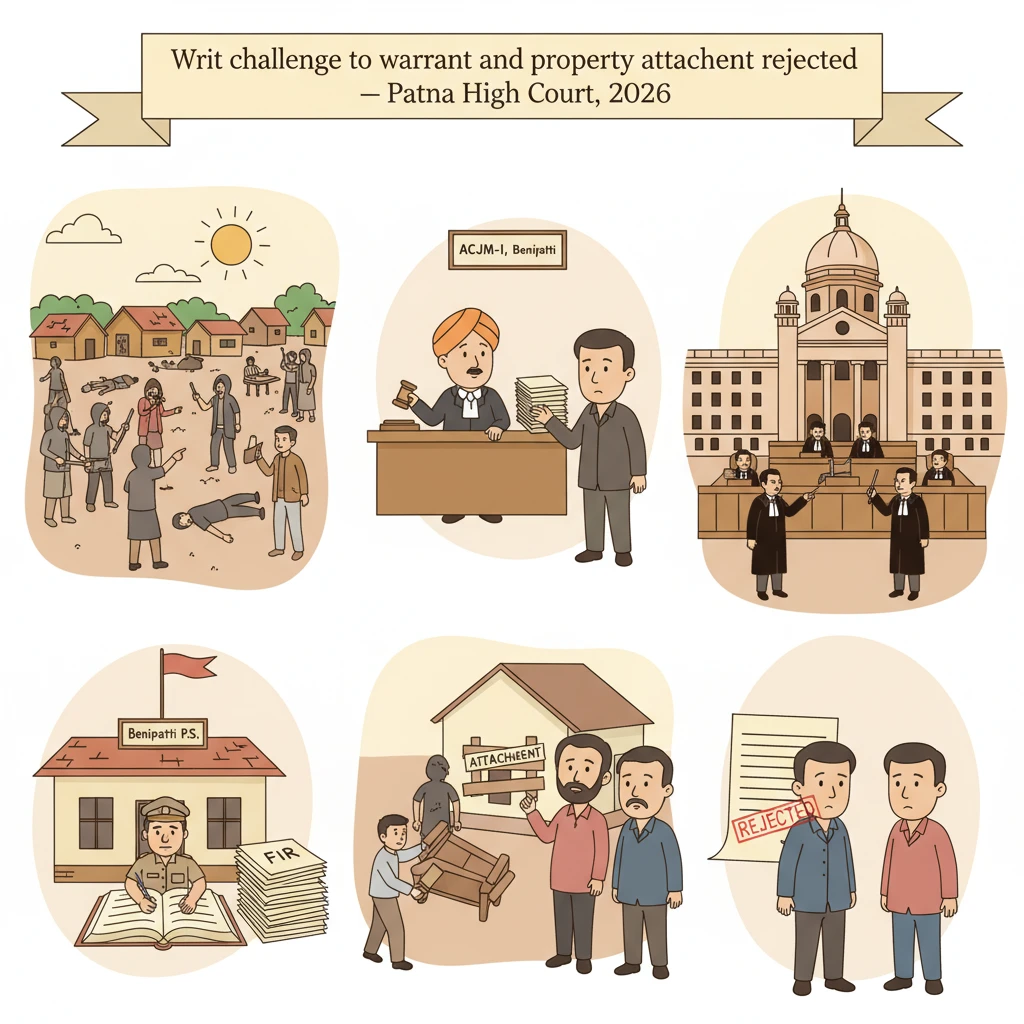
The criminal case started with Benipatti P.S. Case No. 67 of 2021, based on the fardbeyan of the informant, Ram Narayan Singh. He reported that around 1:00 PM on 29.03.2021, near his house, a large group of persons allegedly armed with firearms and other weapons attacked his family members.
According to the fardbeyan, the petitioners along with several co-accused assaulted the son and nephews of the informant, killing them on the spot and seriously injuring three other family members. Later, two of the injured also died during treatment. Altogether, 35 named persons and 10–12 unknown persons were mentioned in the FIR.
The case was registered for offences under Sections 147, 148, 149, 341, 323, 324, 325, 326, 307, 302 and 120B of the Indian Penal Code and Section 27 of the Arms Act. The investigation was carried out by Benipatti police.
Very soon after the incident, on 31.03.2021 and 06.04.2021, the Investigating Officer submitted written requisitions to the court of the Additional Chief Judicial Magistrate-I (ACJM-I), Benipatti. In these requisitions, the police asked the court to issue arrest warrants, proclamation under Section 82 CrPC, and attachment of property under Section 83 CrPC against the petitioners and others.
The ACJM-I, Benipatti allowed these requisitions. On 01.04.2021 and 06.04.2021, the Magistrate passed orders simultaneously issuing arrest warrant, proclamation, and warrant of attachment regarding the petitioners. Attachments were carried out on 11.04.2021 and 25.04.2021.
The two petitioners, Kaushik Singh @ Santosh Singh and Musafir Singh, later filed Criminal Writ Jurisdiction Case No. 374 of 2022 and Criminal Writ Jurisdiction Case No. 343 of 2022 respectively before the Patna High Court. Both writ petitions arose out of G.R. No. 200 of 2021 corresponding to Benipatti P.S. Case No. 67 of 2021, and were heard together.
What the Court Examined and Decided
The first petitioner, Musafir Singh, is an elderly man of about 82 years. His case before the High Court was that he had been sleeping in his house when the incident allegedly occurred. The second petitioner, Kaushik Singh @ Santosh Singh, is his son. They claimed they had no role in the incident and had been falsely implicated because of political rivalry.
The petitioners’ senior counsel argued that, given the Holi festival and the colours and mud on people’s bodies, it was practically impossible for anyone to correctly identify so many people from a distance of 100–500 metres. Yet, the informant named the petitioners and many others in detail. Counsel also pointed to a delay of about 10 hours in lodging the FIR, despite the police station being only 3–4 kilometres away and three persons having already died with three more seriously injured.
According to the petitioners, during investigation, the police initially found that only 5–6 persons might be actually involved. One main accused, Praveen Jha, was arrested and his confessional statement allegedly did not name the petitioners. Similarly, one injured victim, in his statement on camera, reportedly did not name the petitioners as assailants. The informant himself claimed to be an eye-witness, even though about 50 persons were allegedly involved and 25 persons were said to be firing in groups, yet the informant did not suffer any injury. On this background, the petitioners argued that the case against them was doubtful.
However, the main thrust of the writ petitions was not on innocence but on the legality of the Magistrate’s orders for warrant, proclamation and attachment. Counsel argued that the Investigating Officer had filed composite requisitions for all three coercive steps without any supporting affidavit, specific reasons, or evidence, only two days after the FIR in one case and a few days later in the other.
The petitioners submitted that Sections 73, 82 and 83 CrPC operate at different stages and cannot be invoked simultaneously just to help the police arrest an accused. They pointed out that the Magistrate passed orders in a routine manner, without recording satisfaction that the accused were absconding or concealing themselves, and without any material to show that efforts to arrest them had failed.
The petitioners relied on several earlier judgments. In Dawood Ibrahim Kaskar v. State of Maharashtra, (2010) 10 SCC 438, the Supreme Court held that a warrant under Section 73 CrPC can be issued only for producing the accused before the court and not merely to assist police investigation or arrest. The court must apply its own judicial mind.
They also referred to Nalini Kant Agrawal v. State of Bihar, 2003(1) PLJR 350, where this Court held that warrants under Section 73 CrPC are meant to secure appearance before the court, not before the police, and that the Magistrate must record a finding that the accused is evading arrest. The petitioners further cited a coordinate Bench decision in Pinki Kumari & Anr. v. The State of Bihar and Others (Criminal Writ Jurisdiction Case No. 712 of 2022, order dated 26.08.2022), where similar orders passed in haste, without affidavit and without proof of efforts to execute earlier warrants, were set aside.
On Sections 82 and 83 CrPC, the petitioners argued that the Magistrate failed to comply with mandatory requirements. Under Section 82, proclamation can be issued only when the court has reason to believe that the accused has absconded or is concealing himself, and this is normally after a warrant remains unexecuted despite efforts. Under the proviso to Section 83, attachment at the time of proclamation can be ordered only if there is material, by affidavit or otherwise, showing that the person is about to dispose of or remove his property outside the court’s jurisdiction.
The petitioners argued that none of these safeguards were followed. Yet the Magistrate simultaneously ordered warrant, proclamation, and attachment on the same or very next day of police requisition, showing complete non-application of mind.
They further submitted that because the basic police requisitions were illegal, all later actions, including the court’s orders, were void, referring to the maxim “sublato fundamento cadit opus” and the Supreme Court decision in State of Punjab v. Davinder Pal Singh Bhullar, (2011) 14 SCC 770.
On this basis, they sought not only quashing of the orders but also compensation for illegal attachment of their residential house and alleged damage to their property and dignity. For this, they cited Rudul Sah v. State of Bihar, (1983) 4 SCC 141 and Nilabati Behera v. State of Odisha, (1993) 2 SCC 746, where the Supreme Court recognised monetary compensation as a public law remedy for violation of Article 21.
The State’s counsel argued first that the writ petitions were not maintainable because they directly challenged judicial orders of the Magistrate. According to recent Supreme Court decisions in Neeta Singh & Ors. v. State of Uttar Pradesh & Ors., 2024 SCC OnLine SC 5761 and Pradnya Pranjal Kulkarni v. State of Maharashtra & Anr., 2025 SCC OnLine SC 1948, a writ petition under Article 226 is not maintainable against a judicial order.
The State further submitted that the impugned orders had become infructuous after the petitioners were arrested and later granted bail. The investigation had been completed and charge-sheet and supplementary charge-sheet filed, finding the case true against the petitioners.
Importantly, the State’s counsel conceded that the police requisitions were not supported by affidavit, reasons, or evidence, and also admitted that the Magistrate’s orders were not in accordance with the procedure prescribed by law. However, he described the case as one involving the murder of five villagers, arguing that the situation was tense and the impugned orders were passed to control the situation.
During hearing, the petitioners’ senior counsel, in view of the subsequent developments (arrest and bail), did not press the prayer for quashing the Magistrate’s orders. He confined his request to grant of compensation and for directions regarding sensitisation and training of Judicial Officers.
Justice Arun Kumar Jha examined the submissions. The Court agreed with the State that writ petitions cannot be used to directly attack judicial orders of the Magistrate. Referring to the recent Supreme Court rulings, the Court held that against a judicial order no writ petition lies under Article 226.
The Court also noted that since the petitioners had already been arrested and released on bail, the specific orders for warrant, proclamation and attachment had lost practical effect. Thus, the challenge to those orders had become infructuous. Because the petitioners themselves did not press that relief, any further discussion on legality of those orders would only be academic.
On the demand for compensation, the Court held that such relief would be only ancillary. When the main relief (quashing of orders) was no longer being pressed and had become infructuous, there was no scope to consider compensation in criminal writ jurisdiction. The Court clarified that the petitioners were free to pursue other appropriate legal proceedings if they wished to claim compensation for alleged violation of rights.
At the same time, the Court did not ignore the serious procedural irregularities. Justice Jha carefully recorded his “anguish and disappointment” with the working of the trial court. He noted that the Magistrate had passed composite orders issuing warrant under Section 73, proclamation under Section 82, and attachment under Section 83 CrPC without satisfying the necessary preconditions.
The Court recalled the law laid down in Dawood Ibrahim Kaskar and Nalini Kant Agrawal that warrant of arrest cannot be issued merely on police asking and is intended to secure presence of the accused before court, not to aid investigation. It also stressed that unless the court records reasons, based on material, that the accused is evading arrest, Sections 82 and 83 cannot be invoked. The Court further pointed out that proclamation must give at least 30 days for the accused to appear and that simultaneous attachment is allowed only when there is evidence of likely disposal or removal of property.
Justice Jha reiterated the principle from Davinder Pal Singh Bhullar that if initial action is not in accordance with law, all subsequent proceedings fall. He held that the manner in which the ACJM-I, Benipatti had passed the simultaneous orders was “bad in the eyes of law”.
However, considering that five murders had occurred and that this might have influenced the Magistrate, the Court chose to give the matter “quietus” and refrained from directing any further action. Ultimately, both writ petitions and pending interlocutory applications were disposed of without granting any of the substantive reliefs sought.
Why This Judgment Matters
This judgment is important for people facing criminal cases where their property is suddenly attached or they are declared absconders. The Patna High Court has clearly reminded Magistrates and police that warrant, proclamation, and attachment are very strong measures and cannot be issued casually or all at once just to put pressure on an accused.
At the same time, the Court has made it clear that if someone wants to challenge a Magistrate’s judicial order, a writ petition under Article 226 is not the correct route. They must use the remedies provided under criminal procedure law.
For ordinary citizens in Bihar, this decision shows two things. First, courts are watching how police and Magistrates use powers under Sections 73, 82 and 83 CrPC, and will criticise misuse. Second, any claim for compensation for such misuse may need to be brought by a separate and proper legal proceeding, not as an add-on to a criminal writ once the main relief has become infructuous.
Legal Issues and Answers
- Issue: Can orders of a Magistrate simultaneously issuing arrest warrant, proclamation and attachment under Sections 73, 82 and 83 CrPC be quashed in a writ petition under Article 226?
Answer: No. Following Supreme Court rulings, the Patna High Court held that writ petitions are not maintainable against judicial orders. In any case, the challenge had become infructuous after the petitioners’ arrest and bail. - Issue: Could the petitioners be granted compensation in criminal writ jurisdiction for allegedly illegal attachment and violation of fundamental rights?
Answer: No. The Court held that compensation would be only an ancillary relief. When the main relief of quashing the orders was not maintainable and was not pressed, there was no scope to grant compensation in these writ petitions. The petitioners were left free to pursue appropriate legal remedies separately. - Issue: Were there procedural irregularities in issuance of warrant, proclamation and attachment by the Magistrate?
Answer: Yes. The Court observed that the Magistrate’s composite orders, without material showing efforts to arrest, without recording satisfaction about absconding, without observing the 30-day rule for proclamation, and without grounds for simultaneous attachment, were contrary to the CrPC and “bad in the eyes of law”, though no corrective order was passed because of the nature of the case and procedural limits of writ jurisdiction.
Cases Cited by the Court
- Dawood Ibrahim Kaskar v. State of Maharashtra, (2010) 10 SCC 438
- Nalini Kant Agrawal v. State of Bihar, 2003(1) PLJR 350
- Pinki Kumari & Anr. v. The State of Bihar and Others, Criminal Writ Jurisdiction Case No. 712 of 2022, order dated 26.08.2022
- Usha Mishra v. State of Bihar, 2007(3) PLJR 748
- State of Punjab v. Davinder Pal Singh Bhullar, (2011) 14 SCC 770
- Rudul Sah v. State of Bihar, (1983) 4 SCC 141
- Nilabati Behera v. State of Odisha, (1993) 2 SCC 746
- Neeta Singh & Ors. v. State of Uttar Pradesh & Ors., 2024 SCC OnLine SC 5761
- Pradnya Pranjal Kulkarni v. State of Maharashtra & Anr., 2025 SCC OnLine SC 1948
Case Details
Case Number: Criminal Writ Jurisdiction Case No. 374 of 2022 with Criminal Writ Jurisdiction Case No. 343 of 2022
Case Title: Kaushik Singh @ Santosh Singh v. The State of Bihar & Ors.; Musafir Singh v. The State of Bihar & Ors.
Coram: Hon’ble Mr. Justice Arun Kumar Jha
Date of Judgment: 30.03.2026
Citation: 2026(3) PLJR 215
Advocates:
For the petitioners (in both writ petitions): Mr. Anand Kumar Ojha, Senior Advocate; Mr. Ravindra Kumar Singh, Advocate
For the respondents (Cr. WJC No. 374 of 2022): Mr. Suman Kumar Jha, AC to AAG-3
For the respondents (Cr. WJC No. 343 of 2022): Mr. Md. Nadim Seraj, GP-5
Nature of the Case: Criminal writ petitions challenging Magistrate’s orders issuing warrant of arrest, proclamation under Section 82 CrPC, and attachment of property under Section 83 CrPC in a murder case (G.R. No. 200 of 2021, Benipatti P.S. Case No. 67 of 2021)
Link to Judgment: Patna High Court Judgment
If you found this explanation helpful and wish to stay informed about
how legal developments may affect your rights in Bihar,
you may consider following Samvida Law Associates for more updates.







