

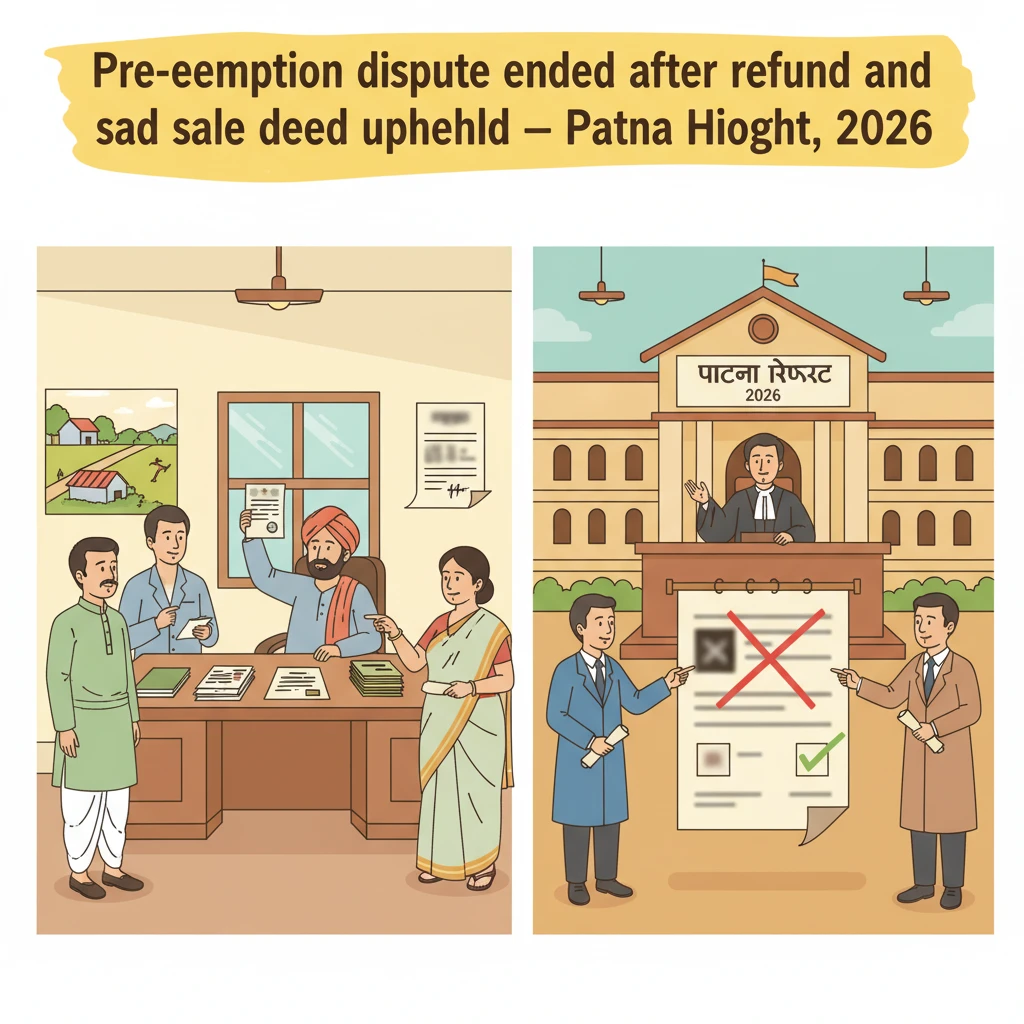
Case Background
The dispute started when a buyer purchased 0.45 acres of land in village Awahariya, recorded as Khata No. 318, Plot No. 2498, through a registered sale deed dated 24.11.2015 from the recorded owner.
The present appellant, described in the judgment as respondent no. 7 before the writ court, claimed to be an adjoining raiyat. He filed a pre-emption application under Section 16(3) of the Bihar Land Reforms (Fixation of Ceiling Area and Acquisition of Surplus Land) Act, 1961 before the Deputy Collector, Land Reforms (DCLR), Mohania.
The appellant’s claim was that, due to a family partition through Partition Suit No. 495 of 2012, his father, Arjun Sah, had obtained and then sold some land adjacent to the disputed plot by a registered deed. On this basis he said he was entitled to pre-emption as an adjoining raiyat.
The purchaser, who later became the writ petitioner before the High Court, objected. She stated in writing that no sale deed had ever been executed in favour of the appellant or his father in respect of any adjoining land, and therefore he was not an adjoining raiyat. She also stated that the land in question was residential in nature, and so the Ceiling Act, 1961 should not apply.
On 19.04.2017, the DCLR allowed the pre-emption case in favour of the appellant. The purchaser challenged this order by filing Pre-emption Appeal No. 02 of 2017‑18 before the Collector. On 13.07.2018, the Collector dismissed the appeal and upheld the DCLR’s decision.
In the meantime, acting on the Collector’s order, a sale deed in favour of the pre-emptor (the present appellant) was executed through the court on 08.09.2018. Mutation was later carried out in his favour in Mutation Case No. 629 of R27 of 2018‑19, and he came into peaceful possession of the land.
Against the Collector’s appellate order, the purchaser filed Pre-emption Revision Case No. 136 of 2018 before the Divisional Commissioner, Patna. While this revision was pending, there was a major legal change: the Bihar Land Reforms (Fixation of Ceiling Area and Acquisition of Surplus Land) (Amendment) Act, 2019 came into force.
By this Amendment Act, Section 16(3) of the Ceiling Act, which granted the right of pre-emption, was repealed. A new Section 16(4)(i) and (ii) was inserted, which stated that all pending pre-emption cases and proceedings would be deemed to have abated, and that any purchase money already legally deposited, along with an additional 10%, would be refunded to the depositor without interest.
In light of this change, the Divisional Commissioner, Patna, by order dated 17.05.2019/07.06.2019, recorded that the revision case stood abated. The Commissioner directed that the pre-emptor should receive the consideration amount deposited in the DCLR’s court, along with an additional 10%.
The pre-emptor was dissatisfied and filed BLT Case No. 547 of 2019 before the Bihar Land Tribunal, Patna. On 06.08.2021, the Tribunal allowed his case, holding that only the revision proceedings before the Commissioner had abated and not the entire pre-emption matter, particularly since the sale deed had already been executed in his favour.
The purchaser then approached the High Court in CWJC No. 18468 of 2021 to challenge the Bihar Land Tribunal’s order dated 06.08.2021. On 11.11.2024, the learned Single Judge allowed the writ petition and set aside the Tribunal’s order. That order of the Single Judge is what gave rise to the present Letters Patent Appeal No. 16 of 2025.
What the Court Examined and Decided
The Division Bench of the Patna High Court, consisting of Hon’ble the Chief Justice and Hon’ble Mr. Justice Harish Kumar, heard the intra-court appeal. The core questions revolved around the impact of the 2019 Amendment on this pre-emption dispute, and what legal effect should be given to the already-executed sale deed and the deposited consideration amount.
The purchaser’s case before the Single Judge was based on a straightforward argument. She argued that because Section 16(3) stood repealed with effect from 25.02.2019 while her revision was pending before the Divisional Commissioner, all proceedings between her and the pre-emptor automatically abated by virtue of Section 16(4) of the amended Act.
According to her, once the law treated the case as abated, there could be no further adjudication regarding pre-emption rights. She argued that the Tribunal ignored this clear statutory effect and wrongly held that only the revision stood abated while the underlying pre-emption orders and sale remained intact.
The Single Judge accepted this line of thinking. The Single Judge also questioned how the DCLR could have permitted withdrawal of the deposited amount in favour of the pre-emptor when the dispute was still sub judice before the High Court and when the Divisional Commissioner had directed refund of the amount to the pre-emptor with 10% addition. On this basis, the Single Judge set aside the Tribunal’s order, terming the DCLR’s act as an illegality that could not be perpetuated by the Court.
Before the Division Bench in appeal, the pre-emptor (now appellant) argued that the Single Judge had failed to appreciate key facts. He stressed that the sale deed in his favour had been executed on 08.09.2018, which was well before the repeal of Section 16(3) on 25.02.2019.
In his submission, once the sale deed was executed in his favour in terms of the Collector’s order, the money lying deposited before the DCLR became the sale consideration payable to the original purchaser. He further pointed out that the purchaser had in fact received this consideration amount. Therefore, according to him, the transaction had attained finality, and subsequent changes in law could not undo a concluded sale.
During the LPA hearing, the purchaser (writ petitioner) filed a supplementary affidavit. In that affidavit she enclosed copies of the order sheet of Pre-emption Case No. 6 of 2015‑16 and her own sworn statement. She clearly admitted that, to bring the long-drawn litigation between the parties to an end, she had withdrawn the deposited amount (the consideration money) held before the DCLR, in pursuance of the execution of the sale deed through court in favour of the pre-emptor.
The Division Bench first considered the legal position after the 2019 Amendment. It reproduced Section 16(4)(i) and (ii). Under these provisions, after repeal of Section 16(3), all cases or proceedings pending before the State Government, Board of Revenue, Bihar Land Tribunal, Divisional Commissioner, Collector, Additional Collector, DCLR or any court are deemed to have abated. It also provided that any purchase money legally deposited, along with 10%, must be refunded without interest to the depositor.
The Bench then referred to an earlier Division Bench judgment in Sudhakar Jha vs. The State of Bihar and Ors. and analogous matters, reported in 2024 (3) PLJR 409. In that decision, the Court had upheld the constitutional validity of the Amendment Acts of 2016 and 2019. It also clarified that, after repeal of Section 16(3), all pending pre-emption proceedings at different stages would abate, and the deposit with an extra 10% would be refunded to the depositor without interest.
However, applying that principle to the present case, the Division Bench highlighted an important nuance. It held that the repeal and the deeming abatement under Section 16(4) applied to cases or proceedings that were still pending. It did not undo or reopen proceedings that had already been concluded before the repeal.
In this case, the sale deed in favour of the pre-emptor had been executed on 08.09.2018. This was on the strength of the Collector’s order dated 13.07.2018 in Pre-emption Appeal No. 2 of 2017‑18. The consideration amount, along with 10%, had already been deposited before the DCLR. In the Bench’s view, these steps meant that the core pre-emption proceedings had concluded before the 2019 Amendment took effect.
What remained after the repeal was not an undecided pre-emption claim, but only the mechanical step of the purchaser receiving the consideration amount. Once she withdrew that amount without objection, as acknowledged in her own affidavit, nothing substantive was left to be adjudicated. The Court therefore concluded that there was no surviving “lis” (dispute) between the parties.
The Division Bench also noted that the Single Judge had himself recorded that the sale deed had been executed much before the Amendment Act, 2019 came into force and that the purchaser had already received the consideration amount in pursuance of the Collector’s order. In such circumstances, the Division Bench found that there was no valid reason or occasion for the Single Judge to interfere with the Bihar Land Tribunal’s order.
The Bench reminded that in Indian jurisprudence, substantive justice should not be defeated by technicalities or procedural requirements. Law should function as a tool for fairness, not as an obstacle. Since both parties had already acted on the sale deed and the purchaser had taken the money to end the litigation, the Court felt that reopening or prolonging the matter would amount to elevating technical arguments over real justice.
On this reasoning, the Division Bench held that the Letters Patent Appeal had merit. It set aside the Single Judge’s order dated 11.11.2024 and allowed the appeal. The Court also observed that once the purchaser had withdrawn the consideration amount without any objection in pursuance of the sale deed, “the dispute between the parties must be given a quietus.”
Why This Judgment Matters
This judgment has practical importance for land buyers, adjoining landholders, and revenue authorities in Bihar, particularly where pre-emption disputes arose under the old Section 16(3) of the Ceiling Act.
First, it clarifies that if a pre-emption case has already reached the stage where the sale deed is executed in favour of the pre-emptor and the consideration has been deposited, later repeal of Section 16(3) does not undo that concluded sale. Abatement under the 2019 Amendment applies to pending proceedings, not to transactions which have already been finalised.
Second, it underlines that once a party voluntarily accepts the consideration amount in pursuance of a court-ordered sale deed, that party cannot continue to fight over the same land. If the money has been taken without protest, courts will treat the dispute as practically ended.
Third, the decision signals to revenue officers and litigants that the focus should be on resolving real disputes instead of prolonging them on technical points, especially where both sides have already acted on a court order.
For ordinary landowners and purchasers, the message is that courts will look at the substance of what has actually happened—who is in possession, whether the sale deed is executed, and whether money has changed hands—before deciding whether any dispute is still alive.
Legal Issues and Answers
- Issue: Does repeal of Section 16(3) of the Ceiling Act, 1961 and insertion of Section 16(4) by the 2019 Amendment automatically nullify a pre-emption sale deed already executed before the repeal?
Answer: No. The Patna High Court held that the repeal leads to abatement of only those cases or proceedings which are still pending. It does not affect proceedings that have already concluded and where a sale deed has been executed prior to the repeal. - Issue: After execution of a pre-emption sale deed, can a purchaser, who later withdraws the deposited consideration amount, continue to litigate against the pre-emptor?
Answer: No. Once the purchaser has withdrawn and received the consideration amount without objection, in pursuance of the sale deed executed through court, there remains no lis to be adjudicated. The dispute must be treated as settled. - Issue: Was the Single Judge justified in setting aside the Bihar Land Tribunal’s order on the basis that the DCLR had committed an illegality in permitting withdrawal of the deposited amount?
Answer: The Division Bench answered in the negative. Given the prior execution of the sale deed and the purchaser’s acceptance of the consideration amount, there was no basis to interfere with the Tribunal’s order. Technical objections could not override the concluded transaction and substantive justice.
Cases Cited by the Court
- The Court relied on the Division Bench judgment in Sudhakar Jha vs. The State of Bihar and Ors. and analogous cases, reported in 2024 (3) PLJR 409, upholding the constitutional validity of the 2016 and 2019 Amendment Acts and explaining the effect of abatement of pending pre-emption cases.
Case Details
Case Number: Letters Patent Appeal No. 16 of 2025 in Civil Writ Jurisdiction Case No. 18468 of 2021
Case Title: Shailendra Kumar Jaiswal @ Vinod Kumar vs. Binita Ojha & Ors.
Citation: 2026 (2) PLJR 611
Coram: Hon’ble the Chief Justice; Hon’ble Mr. Justice Harish Kumar
Date of Judgment: 13.03.2026
Advocates:
- For the appellant: Mr. Parth Gaurav, Advocate; Mr. Divya Prakash, Advocate; Mr. Kumar Saurav, Advocate; Mr. A. K. Pandey, Advocate; Mr. Rahul Kumar, Advocate
- For the respondents (State and others): Mr. Akash Raj, AAG‑12
Nature of the Case: Letters Patent Appeal against a Single Judge order in a writ petition challenging an order of the Bihar Land Tribunal in a pre-emption dispute under the Bihar Land Reforms (Fixation of Ceiling Area and Acquisition of Surplus Land) Act, 1961.
Link to Judgment: Patna High Court Judgment Link
If you found this explanation helpful and wish to stay informed about how legal developments may affect your rights in Bihar, you may consider following Samvida Law Associates for more updates.







