

Case Background
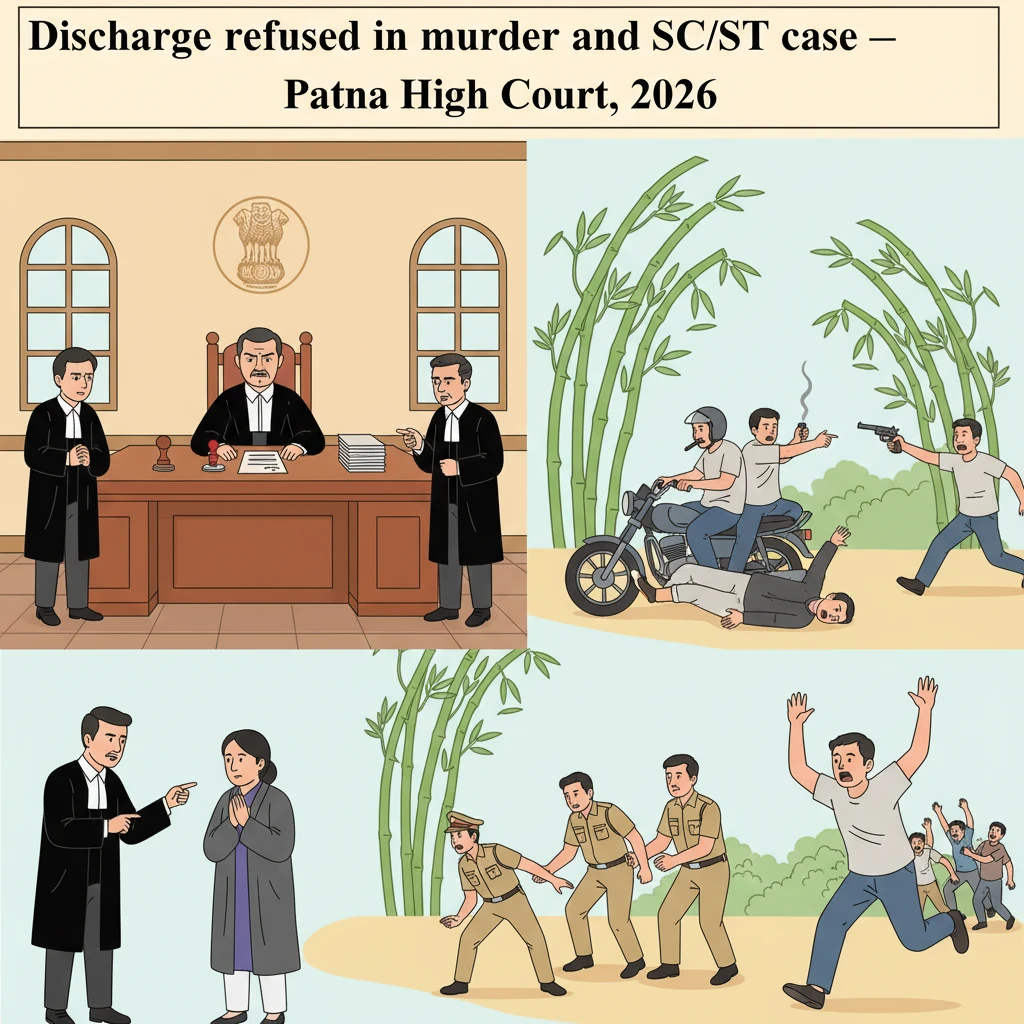
The criminal appeal arose from a serious incident in Village Baikatpur, P.S. Khusrupur, District Patna, in the year 2018. As per the First Information Report (F.I.R.), the informant’s brother, Chotu Kumar, was shot dead near a bamboo orchard locally known as “Tara Baba ke Bagicha”.
On the date of occurrence, around 2:00 P.M., one Praduman Singh visited the informant’s house. He requested the informant’s brother to drop him to the market because his own vehicle was out of order. The informant, his brother and Praduman Singh left together on a motorcycle.
When they reached near the bamboo orchard, Praduman Singh allegedly asked the informant’s brother to stop the motorcycle. As soon as the vehicle stopped, 5–7 persons surrounded them. One of them, named in the F.I.R. as Bholu Singh, allegedly fired at the informant’s brother on the head, causing fatal injury.
The F.I.R. further alleged that, at the time of firing, other named persons, namely Vikas Singh, Doman Singh and Raj Kumar Singh and 3–4 other persons, whose faces the informant could identify but whose names he did not know, were also present there.
Fearing for his own life, the informant raised a hue and cry and ran towards his house. He informed his family members about the incident. When they all returned to the place of occurrence, they found the informant’s brother lying dead on the spot. The body was then taken to the hospital, where the doctor declared him dead.
The F.I.R. also contained allegations that the accused persons used to torture the informant and his family members by taking their caste name, indicating alleged offences attracting provisions of the Scheduled Castes and Scheduled Tribes (Prevention of Atrocities) law.
During investigation, statements of various witnesses were recorded in the case diary. On the basis of these materials, charge-sheet was filed and the case came before the Court of the learned District and Sessions Judge, IV-cum-Special Judge, S.C./S.T., Patna.
The present appellant, Mukesh Kumar, was not named in the original F.I.R. However, his name surfaced later in statements recorded during investigation. He filed a discharge petition before the Special Judge seeking to be released from the case before trial. On 01.11.2018, the Special Judge rejected the discharge petition. Aggrieved, the appellant preferred the present criminal appeal before the Patna High Court.
What the Court Examined and Decided
Hon’ble Mr. Justice Sandeep Kumar of the Patna High Court heard Criminal Appeal (SJ) No. 4823 of 2018. The central question was whether the trial court was right in refusing to discharge the appellant at the pre-trial stage.
The appellant’s counsel argued that his client was falsely implicated. It was emphasised that the appellant was not named in the F.I.R. The main shooter, according to the F.I.R., was Bholu Singh, and other named co-accused were also mentioned. The appellant’s name did not appear in the earliest version of events.
According to the appellant, while the informant and his side were going towards the alleged place of occurrence after the incident, they found the appellant and some others working in the field. The informant’s side allegedly started assaulting the appellant and one Doman Singh. At that time, the police arrived and brought them to the police station. The appellant and his co-accused were allegedly taken into custody on the same day of occurrence, even before the F.I.R. was lodged.
It was further submitted that the informant and the appellant belong to the same village, and due to “village politics” the appellant was roped in later. The informant in his further statement, recorded after the F.I.R., took the name of the appellant and claimed that he was present at the place of occurrence. The defence emphasised that this was an afterthought.
The appellant’s counsel also highlighted that the father of the informant and one Vikram Paswan were not eye-witnesses to the actual shooting. Despite this, in their statements they claimed to have seen the appellant and other accused persons fleeing from the place of occurrence. According to the appellant, these statements were unreliable, and no case should proceed against him.
On the other side, the learned APP for the State and the learned counsel for respondent no. 2 (the informant) strongly opposed the appeal. They argued that this was a case of murder, and that three witnesses had clearly named the appellant as involved in the crime in their statements. They also referred to the allegations that the accused persons, including the appellant, had earlier tortured the informant and his family members by taking their caste name, indicating caste-based hostility.
The High Court first examined the legal principles that govern a discharge application under Section 227 of the Code of Criminal Procedure. The Court relied heavily on a series of Supreme Court decisions.
From State of Bihar v. Ramesh Singh, (1977) 4 SCC 39, the Court noted that at the initial stage, the test is whether there is sufficient ground for proceeding, not whether there is sufficient ground for conviction. If there is prima facie evidence, the matter should be left to be decided at trial, unless the evidence is self-contradictory or intrinsically untrustworthy.
Referring to Ram Prakash Chadha v. State of U.P., (2024) 10 SCC 651, the Court recorded that at the stage of discharge, only “the record of the case and the documents submitted therewith” can be looked into. Defence material produced by the accused cannot be considered at this stage. The Court has to assume that the prosecution material is true and see whether, taken at face value, it discloses the ingredients of the alleged offence.
The judgment also quoted extensively from other Supreme Court decisions such as Yogesh v. State of Maharashtra, State of T.N. v. N. Suresh Rajan, P. Vijayan v. State of Kerala, Union of India v. Prafulla Kumar Samal, Sajjan Kumar v. CBI, Dipakbhai Jagdishchandra Patel v. State of Gujarat & Anr., M.E. Shivalingamurthy v. CBI, and State of Gujarat v. Dilipsinh Kishoresinh Rao.
Collectively, these decisions lay down that:
- The Judge can sift and weigh evidence only to see if a prima facie case exists, not to conduct a mini-trial.
- If the materials create a strong suspicion that the accused might have committed the offence, charges can be framed and discharge should be refused.
- If two views are possible, and one gives rise only to suspicion (not grave suspicion), the accused may be discharged, but that assessment must be based on the prosecution material alone.
- The Judge is not a “post office” but must use judicial mind; nevertheless, he cannot go into detailed weighing of evidence or look at defence material.
The High Court then applied these principles to the appellant’s case. It noted that, although the appellant was not named in the F.I.R., the trial court had, while rejecting the discharge petition, relied on statements recorded in paragraph nos. 2, 4, 13 and 75 of the case diary. In these statements, the witnesses had categorically taken the name of the appellant and stated that he was involved in the crime.
On this basis, the High Court concluded that there was material on record, in the form of witness statements, which created sufficient grounds for proceeding against the appellant. At this stage, the Court could not go into whether those witnesses were truthful or whether village politics played a role. Those issues are to be tested at trial through cross-examination and full evidence.
The Court held that none of the submissions advanced on behalf of the appellant justified interference with the trial court’s order. Reiterating the limited scope at the discharge stage, the Court emphasised that it was not required to assess the probative value of the evidence or decide whether there were sufficient grounds for conviction. Its task was only to see whether there were sufficient grounds for proceeding.
Finding no illegality or infirmity in the order of the District & Sessions Judge, IV-cum-Special Judge, S.C./S.T., Patna, the High Court dismissed the criminal appeal. The discharge petition of the appellant thus stood rejected, and the trial was directed to proceed in accordance with law.
The Court also clarified that it had not expressed any opinion on the merits of the case. The trial court was expressly asked to conduct the trial independently, based on the evidence that would come on record.
Why This Judgment Matters
This decision is important for accused persons seeking discharge in serious criminal cases, especially involving murder and allegations under the SC/ST law. It shows that the Patna High Court will rarely interfere at the discharge stage when there are clear witness statements naming the accused.
Even if an accused is not named in the original F.I.R., later statements recorded during investigation can be enough to send him to trial. Claims of false implication due to village politics or prior enmity are treated as matters for full trial, not for discharge, when there is some supporting material against the accused.
For victims and their families, the judgment reinforces that courts will allow the trial to go forward whenever there is prima facie material, instead of stopping the case early. For accused persons, it underlines that discharge is possible only where the prosecution papers, even if accepted as true, do not link them to the crime at all.
Legal Issues and Answers
- Issue: Whether the appellant, not named in the F.I.R. but later implicated through witness statements, was entitled to be discharged under Section 227 Cr.P.C. from a murder case involving SC/ST allegations.
Answer: No. The Patna High Court held that witness statements in the case diary, which specifically named the appellant and alleged his involvement, created sufficient grounds to proceed against him. Therefore, the trial court rightly refused discharge. - Issue: Whether at the stage of considering a discharge petition, the court can examine the defence version or weigh the reliability of prosecution witnesses.
Answer: No. Relying on several Supreme Court decisions, the Court held that at the Section 227 stage, only the prosecution material can be looked at, and it must be assumed to be true. The court cannot conduct a mini-trial or assess the probative value of the evidence.
Cases Cited by the Court
- State of Bihar v. Ramesh Singh, (1977) 4 SCC 39
- State of Orissa v. Debendra Nath Padhi, (2005) 1 SCC 568 : 2005 SCC (Cri) 415
- Yogesh v. State of Maharashtra, (2008) 10 SCC 394
- State of T.N. v. N. Suresh Rajan, (2014) 11 SCC 709
- B.K. Sharma v. State of U.P., 1987 SCC OnLine All 314
- Stree Atyachar Virodhi Parishad v. Dilip Nathumal Chordia, (1989) 1 SCC 715
- Union of India v. Prafulla Kumar Samal, (1979) 3 SCC 4 : 1979 SCC (Cri) 609
- Om Parkash Sharma v. CBI, (2000) 5 SCC 679
- Kaushalya Devi v. State of M.P., 2003 SCC OnLine MP 672
- Sajjan Kumar v. CBI, (2010) 9 SCC 368
- P. Vijayan v. State of Kerala, (2010) 2 SCC 398 : (2010) 1 SCC (Cri) 1488
- Dipakbhai Jagdishchandra Patel v. State of Gujarat & Anr., (2019) 16 SCC 547
- M.E. Shivalingamurthy v. CBI, (2020) 2 SCC 768
- Ram Prakash Chadha v. State of U.P., (2024) 10 SCC 651
- State of Gujarat v. Dilipsinh Kishoresinh Rao, (2023) 17 SCC 688
Case Details
Case Number: Criminal Appeal (SJ) No. 4823 of 2018, arising out of Khusrupur P.S. Case No. 20 of 2018, District Patna.
Case Title: Mukesh Kumar v. State of Bihar & Anr.
Coram: Hon’ble Mr. Justice Sandeep Kumar
Date of Judgment: 28.01.2026
Citation: 2024(2) PLJR 369
Advocates:
- For the Appellant: Mr. Raj Kumar, Advocate
- For the State: Mr. Binay Krishna, Special Public Prosecutor
- For Respondent No. 2: Mr. Rajen Sahay, Advocate; Mr. Raj Kumar, Advocate
Nature of the Case: Criminal appeal (sessions jurisdiction) against rejection of discharge petition in a murder case before the District & Sessions Judge, IV-cum-Special Judge, S.C./S.T., Patna.
Link to Judgment: Click here to read the full judgment of the Patna High Court
If you found this explanation helpful and wish to stay informed about
how legal developments may affect your rights in Bihar,
you may consider following Samvida Law Associates for more updates.







