

Case Background
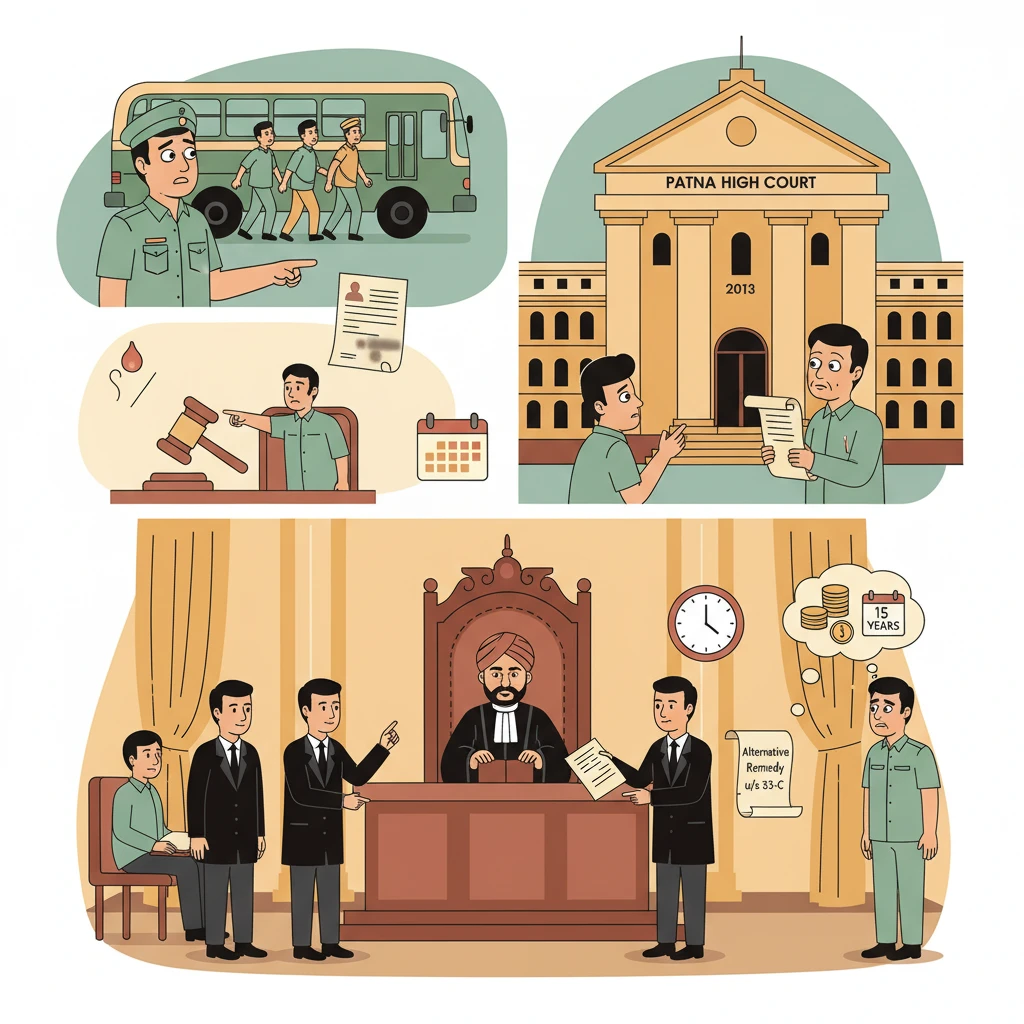
The petitioner was appointed as a driver in Bihar State Road Transport Corporation on 20.06.1988. He was posted on the Patna–Darbhanga Deluxe Bus route.
During an inspection, four passengers were allegedly found travelling without tickets in his bus. A domestic enquiry was started against him. He was suspended on 19.03.1990.
The petitioner claimed that this enquiry was conducted in violation of the principles of natural justice. According to him, he was not given proper opportunity to defend himself. Despite this, the Corporation dismissed him from service by order dated 16.09.1991.
He challenged this dismissal before the Labour Court, Patna. The case was registered as Reference Case No. 39/1995. After hearing, the Presiding Officer, Labour Court, Patna, passed an award on 22.08.2006 directing that the petitioner be reinstated with full back wages and other consequential benefits.
Following this award, the Corporation issued Office Order No. 144 dated 08.02.2008. Under this office order, the petitioner was reinstated in service. However, the same office order further directed that his back wages would not be paid.
The petitioner considered this denial of back wages as illegal and a clear non-compliance of the Labour Court’s award. He stated that since his reinstatement he has been working sincerely. He complained that denial of back wages for nearly 15 years was arbitrary and unsustainable in law.
On these grounds, he filed the present writ petition in the Patna High Court in 2013, seeking quashing of Office Order No. 144 dated 08.02.2008, a direction for payment of entire back wages with statutory interest, and all consequential benefits flowing from the Labour Court’s award dated 22.08.2006.
What the Court Examined and Decided
The Patna High Court, presided over by Hon’ble Justice Smt. G. Anupama Chakravarthy, heard both sides and examined the records.
The primary grievance before the Court was limited. The petitioner did not challenge his reinstatement but only the refusal to pay back wages, despite the Labour Court award that had granted them. He also wanted consequential benefits and interest.
On the other hand, the State of Bihar and the Bihar State Road Transport Corporation opposed the writ petition. Their counsel raised both technical and factual objections.
First, the respondents argued that the writ petition suffered from delay and laches. The Labour Court award was passed on 22.08.2006. The Corporation’s office order denying back wages was issued on 08.02.2008. But the petitioner came to the High Court only in 2013, several years later. According to the respondents, he had not given any convincing explanation for this delay.
Second, the respondents highlighted that the Industrial Disputes Act, 1947 provides a special legal route for a workman to recover money due under an award. This is through Section 33-C(1), which allows for recovery of money as if it were an arrear of land revenue. They submitted that this is the proper statutory mechanism for enforcing monetary parts of an award.
The respondents pointed out that the petitioner had not used this remedy at all. Because of this, they argued that the writ petition under Article 226 of the Constitution was not maintainable.
Third, the respondents relied on Section 17A of the Industrial Disputes Act, which deals with when an award becomes enforceable. They submitted that, read with Section 19 of the Act, the award had become “inoperative” by lapse of time. They argued that the petitioner could not rely on such an award after the expiry of the period prescribed under the Act.
In support of this stand, they also stressed that the petitioner was a habitual offender and had been previously subjected to disciplinary proceedings. They claimed that the misconduct in the present case was serious, involving loss of public revenue and breach of trust in a public transport corporation.
The respondents further pleaded that the Corporation was running at a loss and could not be asked to bear the financial burden of 17 years of back wages for a worker who had not worked during that period. On this basis, they criticised the Labour Court’s grant of back wages and urged the High Court to dismiss the writ petition.
The High Court began by noting that the main challenge was to the office order dated 08.02.2008, which denied back wages, even though the Labour Court’s award dated 22.08.2006 had granted them. However, the Court treated the question of delay as central.
The Court observed that any cause of action for seeking enforcement of the award arose in 2006, when the Labour Court passed its award, and again in 2008 when the Corporation issued the office order refusing back wages. Yet, the writ petition was filed only in 2013.
The judgment records that the petitioner failed to offer a satisfactory explanation for this long delay. This weighed heavily against him in the exercise of writ jurisdiction, which is a discretionary and equitable remedy.
The Court then considered the availability of an alternative statutory remedy. It recorded that the Industrial Disputes Act provides a specific mechanism under Section 33-C(1) for recovery of money due under an award. The petitioner had not availed this route.
The Court referred to the settled principle that when a statute offers an effective alternative remedy, High Courts normally do not entertain a writ petition under Article 226, especially in disputes related to computation and enforceability of monetary benefits. The Court emphasised that this is particularly true when complex or disputed questions of fact are involved.
Next, the Court noted the respondents’ stand that serious allegations of misconduct were levelled against the petitioner and that the Corporation had specifically pleaded loss of confidence in him and financial constraints. These aspects, according to the Court, ought to be examined by the appropriate forum under the Industrial Disputes Act, not in writ jurisdiction.
The Court then turned to the argument based on Section 17A of the Industrial Disputes Act, regarding when an award becomes enforceable and how it operates. The judge observed that issues of operation, enforceability and implementation of the Labour Court’s award fall within the “statutory framework” of the Act.
Such questions, involving technical legal rules and contested facts, were held not suitable for examination under Article 226. The Court reiterated that writ jurisdiction is not meant to replace the specialised mechanisms given in the labour legislation.
An important factual point considered by the Court was the status of the Labour Court award itself. The counsel for the Corporation argued that the award had become inoperative, as the petitioner could not rely on it after the expiry of the period prescribed in the Act.
To clarify this, the High Court had, earlier by order dated 06.01.2024, asked the petitioner to bring on record whether the Labour Court’s award had been published or not. Publication is relevant under Section 17 and Section 17A for determining enforceability and time limits. However, the petitioner failed to produce any such material.
This failure further weakened his case because the Court lacked a key factual foundation needed even to consider enforcement of the award.
Taking all these aspects together—delay, non-use of the alternative remedy, disputed questions of fact, the statutory scheme on enforceability of awards, and the petitioner’s failure to show publication of the award—the Court concluded that the writ petition had no merit.
The Court held that the case did not warrant interference under Article 226 of the Constitution of India. It therefore dismissed the writ petition.
As a result, the office order dated 08.02.2008, which reinstated the petitioner but denied back wages, remains in place. The petitioner continues in service, but without the back wages he had claimed through this writ. Any interlocutory applications in the case were also disposed of in view of the dismissal.
Why This Judgment Matters
This judgment is significant for workers and unions who seek to enforce Labour Court awards through writ petitions.
First, it shows that the Patna High Court expects workers to act promptly. Waiting many years after an award or office order, without a clear explanation, can be fatal to a case.
Second, the decision underlines that when the Industrial Disputes Act provides a specific method for recovering money, such as Section 33-C(1), workers should normally use that route. Directly filing a writ petition may not be entertained, especially where the dispute is about calculation or enforceability of money benefits.
Third, the judgment clarifies that technical questions like when an award becomes enforceable, whether it is still operative, and whether it was properly published are best handled within the labour law system itself. High Courts will be slow to interfere in writ jurisdiction when such disputed issues arise.
For public sector employees, particularly in loss-making corporations, the case also shows that courts will take note of financial constraints and claims of loss of confidence when deciding whether to intervene in matters of back wages.
Legal Issues and Answers
- Issue: Can the petitioner, several years after a Labour Court award and an office order denying back wages, seek payment of back wages directly through a writ petition under Article 226?
Answer: No. The Patna High Court held the writ petition was barred by delay and laches, and that the petitioner should have used the statutory recovery mechanism under Section 33-C(1) of the Industrial Disputes Act. - Issue: Are disputes about enforcement, operation and computation of monetary benefits under a Labour Court award suitable for decision in writ jurisdiction?
Answer: Generally no. The Court held that such questions, especially where facts are disputed and issues of enforceability under Sections 17A and 19 of the Industrial Disputes Act arise, must be addressed within the statutory framework of the Act, not by a writ court.
Cases Cited by the Court
- The judgment text does not mention or rely on any specific reported case law. It proceeds on principles drawn directly from the Industrial Disputes Act and general rules on writ jurisdiction.
Case Details
Case Number: Civil Writ Jurisdiction Case No. 24819 of 2013
Case Title: Kapileshwar Choudhary vs. The State of Bihar & Ors
Coram: Hon’ble Justice Smt. G. Anupama Chakravarthy
Citation: 2026 (2) PLJR 454
Advocates: Mr. Sanjeev Kumar, Advocate for the petitioner; Mr. Ajay, Sr. Advocate for the respondents
Nature of Case: Writ petition under Article 226 of the Constitution of India challenging an office order denying back wages despite a Labour Court award, and seeking directions for payment of back wages and consequential benefits.
Date of Judgment: 20.02.2026
Link to Judgment: Click here to access the official Patna High Court judgment
If you found this explanation helpful and wish to stay informed about how legal developments may affect your rights in Bihar, you may consider following Samvida Law Associates for more updates.







