

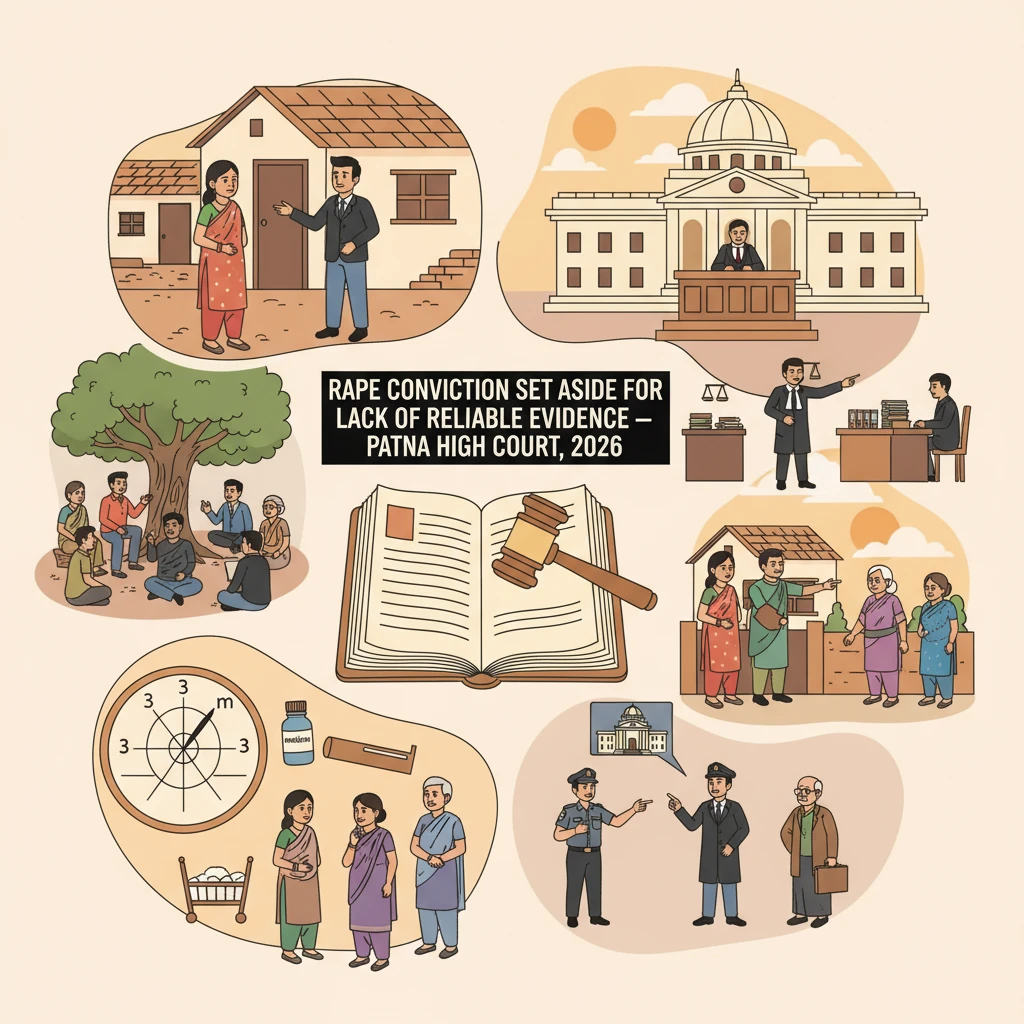
Case Background
This criminal appeal (SJ) No. 11 of 2014 arose from Sessions Trial No. 188 of 2010, which itself came out of Complaint Case No. 1456 of 2007, Katihar. The appellant had been convicted by the court of the Learned Additional Sessions Judge-II, Katihar, by judgment dated 02.11.2013 and sentenced on 07.11.2013 to seven years’ rigorous imprisonment for the offence under Section 376 of the Indian Penal Code.
Besides Section 376 IPC, the appellant and his parents were also charged under Sections 313 and 504 read with Section 34 IPC. The trial court, however, acquitted all of them of these additional charges, and convicted only the appellant for rape.
The victim had approached the Chief Judicial Magistrate, Katihar, by filing a complaint. After examining the complainant and her witnesses, the Magistrate took cognizance and, finding the main offence triable by the Court of Session, committed the case to the Sessions Court. Against the conviction and sentence imposed by the Sessions Court, the appellant filed this appeal before the Patna High Court.
What the Court Examined and Decided
The prosecution story, as narrated by the victim (PW-4) in her complaint, began with an incident alleged to have taken place on 28.02.2007. On that day, her father had gone outside the village to earn livelihood and her mother had gone to the house of her elder sister. Around 5:00 PM, the appellant allegedly entered the victim’s house, inquired about her parents, and on learning that they were away, asked her to come to his nearby house.
When she refused, the appellant is said to have forcibly lifted her. She claimed she resisted, whereupon he assaulted her with fists and legs, tied her mouth with a towel, and took her to his house. There, in the absence of his parents, she alleged that he made her lie on the bed, removed her clothes, and committed rape upon her after making her nude.
According to her version, after the act the appellant told her to run back home. She began weeping. At that time, the other accused (the appellant’s parents) allegedly reached there, threatened her, helped her put her clothes back on, and warned her not to disclose the incident. She stated that as she returned in a weeping condition, neighbours questioned her. Later that night, at about 8:00 PM, her parents returned, found her sleeping in a disturbed state and, on inquiry, she narrated the occurrence.
The victim further said that on 01.03.2007 at about 4:00 PM, a village panchayat was convened by her father. In that meeting, the appellant was said to have accepted his mistake, and his parents allegedly proposed marriage between the appellant and the victim, asking for three months’ time. This proposal was accepted.
During this period, the victim stated that she became pregnant. On 24.05.2007, the accused allegedly took her to their house on the pretext of curing her stomach pain and gave her some medicine. She claimed this caused abortion. On her parents’ return, seeing her deteriorating health, they were told about the abortion. When they complained to the accused, they were assured that the appellant would marry her, but later the accused allegedly cut off relations and refused the marriage.
The victim said that another panchayat meeting was held on 10.06.2007 at about 3:00 PM, where the appellant refused to marry her. On advice of the panches she went to the police station, was told to go to court, and then filed the complaint.
Before the trial court, the prosecution examined seven witnesses: the victim’s father (PW-1), an alleged eye-witness neighbour (PW-2), the victim’s mother (PW-3), the victim herself (PW-4), the doctor who medically examined the victim (PW-5), and two witnesses of the panchayat meeting and “Ekrarnama” (PW-6 and PW-7). Several documents were exhibited, including the victim’s medical report (Exhibit-2) and an agreement/undertaking said to be executed in the panchayat, described as an “Ekrarnama” (Exhibit-3), bearing signatures and thumb impressions of the appellant, his father, the victim and others.
The defence examined three witnesses (DW-1 to DW-3). In his statement under Section 313 CrPC, the appellant denied the incriminating circumstances and claimed innocence, though he did not spell out a detailed defence theory in that statement.
The trial court mainly relied on the testimony of the victim (PW-4) and PW-2, along with the medical examination report and Exhibit-3, treating the Ekrarnama as an admission of guilt. On this basis, the appellant was convicted for rape but acquitted of the charge under Section 313 IPC relating to alleged forcible termination of pregnancy.
In appeal, the learned Amicus Curiae supported the conviction, arguing that the victim’s evidence was reliable and corroborated by PW-2 and the medical report regarding pregnancy. She submitted that delay in filing the complaint was explained by the holding of panchayat meetings and the alleged assurances of marriage by the appellant’s family, and by the later abortion.
The learned APP stressed that the victim was about 14 years old at the time of the alleged offence and that the appellant had accepted his wrong in the panchayat meeting, as reflected in the undertaking.
The Patna High Court, per Hon’ble Mr. Justice Shailendra Singh, first noted the general principle that a conviction for rape can be based solely on the victim’s testimony, but only if the testimony is trustworthy, consistent and inspires full confidence.
The Court then closely examined the evidence. It observed that the victim’s complaint did not mention any eyewitness to the alleged rape apart from herself. She had stated that neighbours met her later, when she was weeping, and asked about the incident. By contrast, PW-2 claimed in her deposition that she heard the victim’s cry, went to the appellant’s house, and actually saw the appellant committing rape, with the victim completely nude.
The High Court pointed out that the victim, in her own deposition before the trial court, did not say that PW-2 came to the spot while the incident was happening. PW-2 also claimed that she informed the victim’s parents of the occurrence, whereas the victim and her parents (PW-1 and PW-3) stated that the victim herself narrated the event to them when they returned home at 8:00 PM. These contradictions led the High Court to conclude that PW-2 appeared to be a “planted” witness, thereby creating serious doubt about the prosecution version.
The Court then considered the panchayat and the Ekrarnama (Exhibit-3). According to the prosecution, there were two panchayat meetings: on 01.03.2007 and 10.06.2007. In these meetings, the appellant allegedly accepted his wrong and agreed to marry the victim, and gave a written undertaking. Exhibit-3 was produced to prove these facts.
However, on examining Exhibit-3, the High Court found that it was written on a non-judicial stamp paper and attested by a Notary Public on 08.01.2008. One panch’s signature also bore this date. This indicated that the alleged undertaking was created on 08.01.2008, several months after the supposed panchayat dates and even after the complaint case had been filed. The Court noted there was no proper explanation from the prosecution as to why such an undertaking would be executed after the initiation of the complaint.
Further, the Court highlighted that Exhibit-1 and Exhibit-3 only showed that the appellant accepted having committed some “wrong” and agreed to marry the victim; there was no explicit admission that he had committed rape. Therefore, these documents could not be treated as an extra-judicial confession of the offence of rape.
The two panchayat witnesses (PW-6 and PW-7), who signed the documents, did not state in their evidence that the appellant confessed to rape. They only said that a panchayat took place between the families and the appellant agreed to marry the victim. PW-6 also admitted in cross-examination that the case was filed when the appellant refused to marry.
The victim’s father (PW-1) admitted that he had spoken to the appellant about marrying the victim even before the alleged occurrence, but the appellant was not agreeable at that time. The appellant’s defence was that the victim’s parents wanted this marriage and, when he did not agree, they filed a false complaint. Three defence witnesses supported this version. In light of Exhibit-3 and the father’s admission, the High Court found no reason to disbelieve this defence.
The Court also considered the physical possibility of the incident. The victim (PW-4) had said there was a common courtyard between her house and the appellant’s house where 8–9 persons often remained. In such a situation, the Court felt it was difficult to believe that the appellant could forcibly lift the victim, carry her into his house despite her resistance, and commit rape without attracting the attention of anyone. Since PW-2’s presence and version were already found doubtful, this further weakened the prosecution case.
On medical evidence, PW-5, the doctor, stated that the victim’s pregnancy had been terminated about twenty days before her examination on 12.06.2007. While this supported the fact of a recent abortion, the prosecution failed to prove that the pregnancy resulted from the alleged sexual assault on 28.02.2007 by the appellant. The trial court itself had disbelieved the charge under Section 313 IPC and acquitted the appellant of that allegation. The High Court thus held that the medical evidence could not conclusively connect the appellant to the pregnancy or abortion.
Considering all these circumstances, the Court concluded that there were “strong circumstances” going against the allegations made by the victim. The victim did not appear to be a “sterling witness”, her testimony lacked sufficient corroboration, and did not inspire the confidence necessary to uphold a conviction for such a serious offence.
Accordingly, the High Court held that the conviction under Section 376 IPC, based largely on the victim’s sole testimony and doubtful supporting evidence, could not be sustained. The judgment of conviction dated 02.11.2013 and the order of sentence dated 07.11.2013 were set aside, and the appeal was allowed.
The appellant was already on bail, so the Court directed that his bail bonds be cancelled and both he and his sureties be discharged from their liabilities. The Court also directed that the learned Amicus Curiae, Ms. Kirti Kumari, be paid remuneration as per the State Government’s notification dated 18.05.2017 by the Patna High Court Legal Services Committee.
Why This Judgment Matters
This judgment shows how the Patna High Court deals with serious charges like rape when the evidence contains major gaps and contradictions. The Court does not say that the incident definitely did not happen. Instead, it focuses on whether the prosecution has proved the charge beyond reasonable doubt.
For complainants and families, the case underlines the importance of giving consistent statements and bringing independent witnesses when available. Documents like village Ekrarnamas, if created much later without clear explanation, may carry little weight.
For accused persons, the decision shows that courts can and do interfere with convictions if the trial court has relied on weak or doubtful evidence, or treated vague undertakings as confessions. The High Court insisted that a conviction for rape cannot rest on a testimony which does not fully inspire confidence and is not supported by surrounding facts.
Legal Issues and Answers
- Issue: Whether the appellant’s conviction for rape under Section 376 IPC could be sustained on the basis of the victim’s testimony, the statement of an alleged eyewitness, medical evidence, and the so-called Ekrarnama.
Answer: No. The Patna High Court held that the victim’s evidence was not of sterling quality, the alleged eyewitness was doubtful, the Ekrarnama was unreliable and not a confession of rape, and the medical evidence did not conclusively link the appellant to the pregnancy. The conviction was set aside. - Issue: Whether the Ekrarnama and signatures treated by the trial court as extra-judicial confession could legally be used to uphold the conviction.
Answer: No. The Court found that the documents only showed that the appellant accepted having done some “wrong” and agreed to marry, without admitting rape, and were executed long after the alleged panchayats and after filing of the complaint. They were not reliable as extra-judicial confession.
Cases Cited by the Court
- No prior case law is expressly cited or relied upon in the reported text of this judgment.
Case Details
Case Number: Criminal Appeal (SJ) No. 11 of 2014; arising out of Complaint Case No. 1456 of 2007; Sessions Trial No. 188 of 2010, Katihar.
Case Title: Mithun Singh v. The State of Bihar.
Coram: Hon’ble Mr. Justice Shailendra Singh.
Citation: 2024(2) PLJR 388.
Advocates: Ms. Kirti Kumari, Amicus Curiae, for the appellant; Mr. Z. Hoda, APP, for the State.
Nature of the Case: Criminal appeal against conviction and sentence under Section 376 IPC passed by the Sessions Court.
Link to Judgment: Click here to read the full judgment of the Patna High Court.
If you found this explanation helpful and wish to stay informed about
how legal developments may affect your rights in Bihar,
you may consider following Samvida Law Associates for more updates.







