

Case Background
The dispute arose out of a small commercial shop in Dehri-on-Sone, Rohtas district. The shop was rented out by the landlady to the tenant for running a confectionery and sweets business.
A written kirayanama (rent deed), marked in evidence as Ext. 1, governed the tenancy. Under this deed, the tenancy began on 01.01.2008 and was to end on 30.11.2008. The agreed monthly rent was Rs. 800, and the agreement stated that the tenant had to vacate the premises after a prior notice of two months.
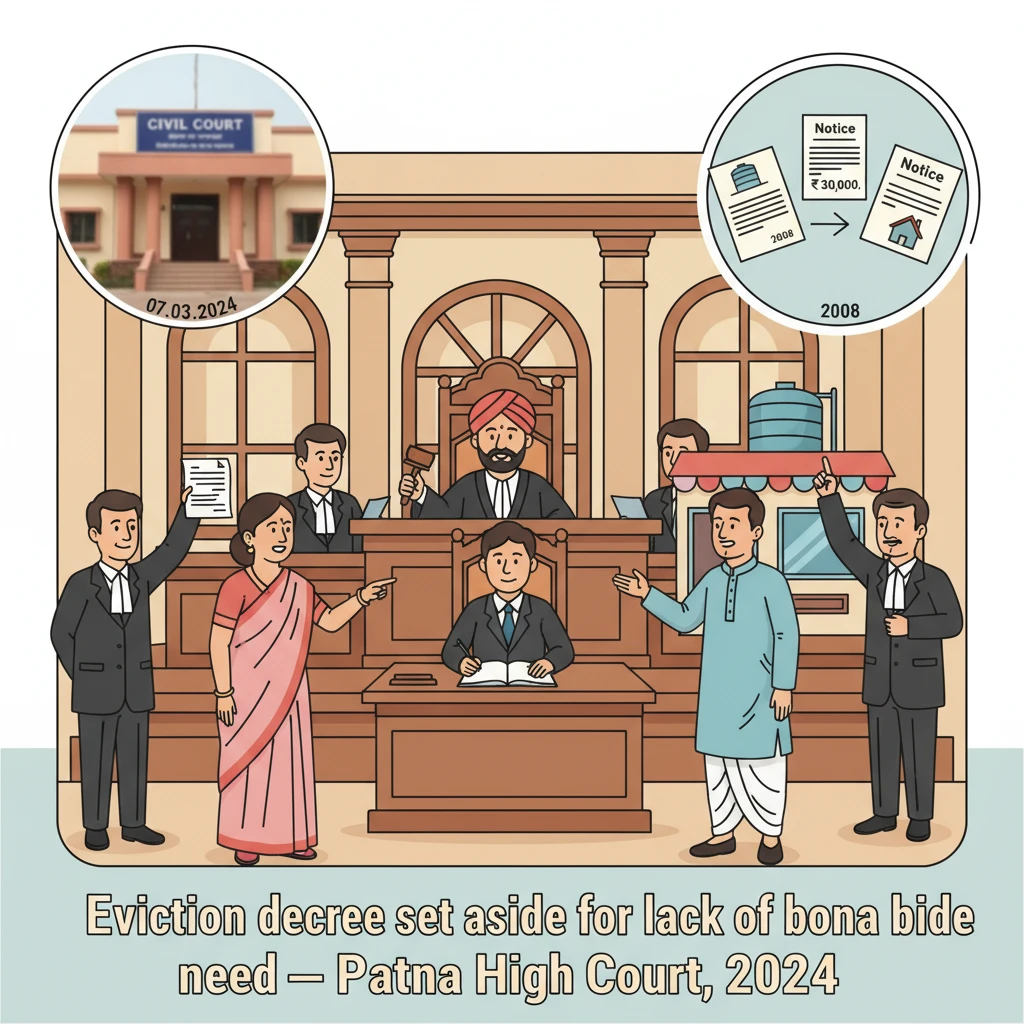
During the tenancy, the tenant installed an overhead water tank in the shop. According to the landlady, this was done without her consent. She sent a letter on 27.05.2008 asking him to remove the tank. The tenant replied by demanding Rs. 30,000 from her towards the cost of installing the tank.
The landlady then sent another notice on 02.06.2008, again asking the tenant to remove the overhead water tank. The tenant did not comply and, on 02.07.2008, sent a reply through the plaintiff’s Advocate and warned that the landlady could go to court.
On 09.07.2008, a third notice was sent by the landlady’s Advocate, this time directing the tenant to vacate the premises by 10.08.2008 on the ground of her personal necessity. In the subsequent eviction suit, she stated that she needed the premises for starting a business for her son and claimed this was her bona fide requirement.
The tenant filed a written statement denying both the alleged breach of the rent agreement and the ground of bona fide personal necessity. Despite this, the trial court (Munsif, Dehri-on-Sone, Rohtas) in Eviction Suit No. 11 of 2008 passed a judgment and order dated 02.05.2014 directing the tenant to vacate the premises.
Aggrieved by that eviction order, the tenant filed Civil Revision No. 85 of 2014 before the Patna High Court. This revision came up before Hon’ble Mr. Justice Nawneet Kumar Pandey, who delivered the present judgment on 07.03.2024.
What the Court Examined and Decided
The Patna High Court closely examined whether the landlady had truly proved a bona fide and reasonable personal necessity for the shop, as required under Section 11(1)(c) of the Bihar Buildings (Lease, Rent & Eviction) Control Act, 1982.
On behalf of the tenant, it was argued that the eviction case was actually driven by annoyance over the overhead water tank, not by any real need for the shop. The tenant’s counsel pointed out that the shop was a sweets and confectionery outlet, and a water tank was necessary for smooth functioning. According to him, installing such a tank did not amount to “material deterioration” or wastage of the property.
The tenant’s counsel highlighted the sequence of notices. The first letter dated 27.05.2008 only demanded removal of the overhead water tank and did not mention any personal need of the landlady or her son. The second notice dated 02.06.2008 also focused solely on removal of the water tank, again with no reference to personal necessity.
Only in the third notice dated 09.07.2008 did the landlady, through her Advocate, raise the plea that she needed the premises for her son’s business and asked the tenant to vacate by 10.08.2008. This, the tenant argued, showed that the ground of personal necessity was an afterthought, introduced only when the dispute over the water tank escalated.
Further, in the plaint, the landlady only broadly claimed that the shop was required for her son’s business but did not specify what business he intended to start. The tenant’s counsel stressed that such vagueness, coupled with the timing of the notices, undermined the claim of a genuine need.
Evidence of the landlady and her son was also scrutinised. The son, examined as P.W.2, stated in paragraph 22 of his deposition that he had read the plaint and that it contained a statement that the premises was needed for opening a shop of “Bajaj Electronics.” The High Court noted that this assertion was factually wrong because there was no such mention anywhere in the plaint.
The landlady herself, examined as P.W.1, admitted in paragraph 12 of her cross-examination that her son had a Bajaj motorcycle agency. This fact also did not appear in the plaint. The Court observed that hiding this detail suggested that the landlady wanted to portray her son as unemployed, strengthening a false picture of need.
The tenant’s counsel also pointed out that P.W.2, in paragraph 20 of his cross-examination, had admitted that there were 13 shops in the same premises. According to the tenant, this showed that the landlady and her son were financially well off and that their claim of pressing need for this particular shop was not convincing.
In legal support, the tenant relied on two Supreme Court judgments:
First, in (2001) 5 SCC 705 (Deena Nath v. Pooran Lal), the Supreme Court had explained that the legislature designed rent control provisions to prevent arbitrary or whimsical eviction. The Court emphasised that the landlord’s requirement must be more than a mere wish or fanciful desire. The requirement must be bona fide, exist in the present (in praesenti), and reflect an actual pressing need, where there is no other reasonably suitable accommodation available.
Second, in (1999) 6 SCC 222 (Shiv Sarup Gupta v. Dr. Mahesh Chand Gupta), the Supreme Court described “bona fide” as meaning genuine, sincere, and in good faith—more than just a desire. The Court there held that a landlord’s requirement must be a felt need arising from an honest desire, not a pretext to evict a tenant.
The landlady’s counsel responded that the trial court had already considered and accepted her personal need. He argued that a landlord is entitled to seek eviction to expand business and that it is not compulsory to spell out the exact nature of the proposed business in the plaint.
To support this, he relied on AIR 2010 SC 721 (Ram Babu Agarwal v. Jay Kishan Das), where the Supreme Court had held that lack of prior experience in a particular business cannot be a ground to reject a landlord’s bona fide need. He also cited (2021) 15 SCC 75, where the Supreme Court, dealing with an NRI landlord’s case, stated that a tenant cannot dictate how much space is sufficient for the landlord’s proposed business.
The Patna High Court, however, distinguished these cases. In Ram Babu Agarwal, the issue was whether a landlord’s lack of experience in the business could defeat a plea of bona fide need. The Supreme Court said experience is not a precondition. In contrast, in the present case, the very existence of a bona fide need was in doubt. The dispute was not about experience but about whether the need itself was genuine.
Similarly, the 2021 Supreme Court decision concerned the extent of space required by an NRI landlord. In this case, the central question was more fundamental: was there any real, present, and honest requirement at all?
After analysing the pleadings, notices, and oral evidence, the Patna High Court concluded that the landlady had failed to establish bona fide and reasonable personal necessity.
The Court placed special weight on the following aspects:
First, the landlady’s own pleadings in paragraph 3 of the plaint admitted that her earlier notices were only for removal of the water tank. If she genuinely needed the premises for her son’s shop, this fact would naturally have been mentioned in the first or second notice. The absence of such a plea at that stage suggested that the later introduction of “personal necessity” in the third notice was an afterthought.
Second, the discrepancy between the evidence and the plaint was serious. P.W.2’s statement that the plaint mentioned a proposed Bajaj Electronics shop was plainly incorrect because the plaint was silent on that point. Likewise, the landlady’s silence in the plaint about her son already having a Bajaj motorcycle agency, despite admitting it in cross-examination, showed intentional concealment.
Third, the statutory test under Section 11(1)(c) of the Bihar Buildings (Lease, Rent & Eviction) Control Act, 1982 requires that the landlord establish both bona fide and reasonable personal necessity. On the record, the Court found that this burden was not discharged.
In view of these findings, the High Court held that the eviction decree passed by the trial court could not be sustained. It found “no merit” in the impugned order dated 02.05.2014 in Eviction Suit No. 11 of 2008 and therefore set it aside.
As a result, the civil revision filed by the tenant was allowed, and the eviction order based on alleged personal necessity stood cancelled.
Why This Judgment Matters
This judgment is important for tenants and landlords across Bihar who are involved in shop and building disputes under the Bihar Buildings (Lease, Rent & Eviction) Control Act, 1982.
The Patna High Court has made it clear that a landlord cannot lightly claim “personal necessity” just because of a quarrel or annoyance with a tenant, such as disagreement over an installation like a water tank. The Court will carefully check the timing of notices, the contents of the plaint, and consistency of evidence.
For landladies and landlords, the ruling underlines that they must state their personal need honestly and clearly from the beginning—especially in early notices and in the plaint. Concealing facts about the existing business of a family member or changing the story later can weaken their case.
For tenants, the decision shows that they are protected against eviction if the landlord’s personal necessity is only a pretext. If there is evidence that the plea of personal need was introduced later, or is contradicted by documents and cross-examination, the Court may refuse eviction.
Overall, the judgment reinforces the principle that “bona fide requirement” under Section 11(1)(c) means a real, present, and honest need, not a tool for pressuring tenants out of commercial premises.
Legal Issues and Answers
- Issue: Did the landlady prove a bona fide and reasonable personal necessity for the tenanted shop, as required under Section 11(1)(c) of the Bihar Buildings (Lease, Rent & Eviction) Control Act, 1982?
Answer: No. The Patna High Court held that the landlady failed to establish bona fide and reasonable personal necessity, and therefore the eviction decree could not stand. - Issue: Was the trial court’s eviction order in Eviction Suit No. 11 of 2008 sustainable in light of the evidence and law on bona fide requirement?
Answer: No. The High Court found no merit in the trial court’s order dated 02.05.2014 and set it aside, allowing the tenant’s civil revision.
Cases Cited by the Court
- (2001) 5 SCC 705, Deena Nath v. Pooran Lal – on the meaning of bona fide requirement and the need for an actual, present, and pressing necessity.
- (1999) 6 SCC 222, Shiv Sarup Gupta v. Dr. Mahesh Chand Gupta – on “bona fide” as genuine, sincere, and in good faith, and distinguishing real need from mere desire.
- AIR 2010 SC 721, Ram Babu Agarwal v. Jay Kishan Das – cited by the landlady but held distinguishable as it concerned experience in business, not existence of need.
- (2021) 15 SCC 75 – cited by the landlady but found not applicable; related to extent of space for an NRI landlord’s business, not the basic existence of bona fide necessity.
Case Details
Case Number: Civil Revision No. 85 of 2014; arising from Eviction Suit No. 11 of 2008
Case Title: Satyendra Singh v. Smt. Rashmi Mehra
Citation: 2024(2) PLJR 205
Coram: Hon’ble Mr. Justice Nawneet Kumar Pandey
Advocates for the Petitioner (Tenant/Defendant): Mr. S.S. Dwivedi, Senior Advocate; Mr. Uma Shankar Singh
Advocates for the Respondent (Landlady/Plaintiff): Mr. Sanjay Kumar Giri; Mr. Vikas Ratan Bharti; Mr. Manoj Kumar Singh
Date of Patna High Court Judgment: 07.03.2024
CAV Date: 15.12.2023
Nature of the Case: Civil revision against an eviction decree passed in a rent control eviction suit based on alleged bona fide personal necessity.
Link to the Judgment: View full judgment on Patna High Court website
If you found this explanation helpful and wish to stay informed about
how legal developments may affect your rights in Bihar,
you may consider following Samvida Law Associates for more updates.







