

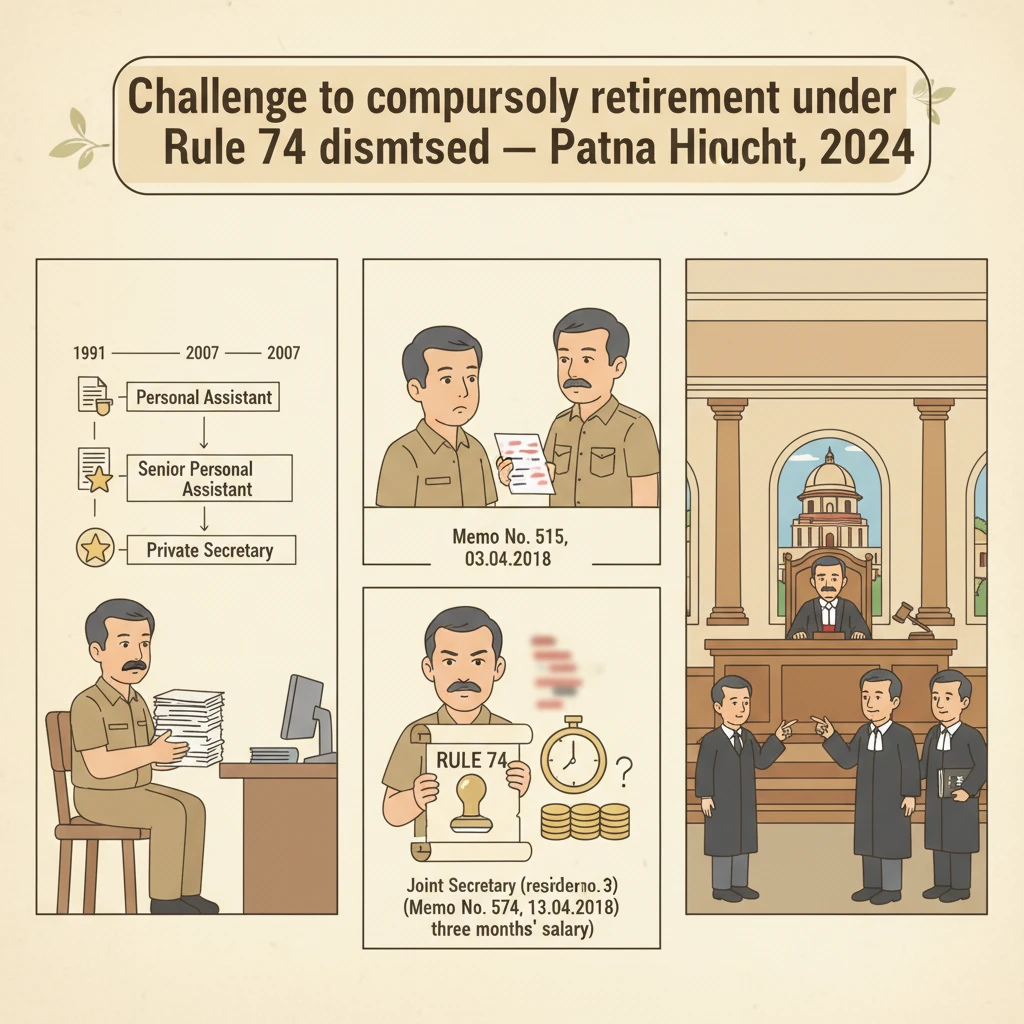
Case Background
The petitioner had been associated with the Governor’s Secretariat, Bihar, since 1991. He was first appointed on a daily wage basis and later brought into the regular establishment.
By order No. Estb.88/90-3193/GS(3) dated 27.11.1991, his appointment followed the procedure of regular appointment. On 05.06.1995, under the signature of the Principal Secretary, Governor’s Secretariat, he was appointed to a regular vacant post of Personal Assistant. His services were confirmed with effect from 05.06.1998 by Memo No. Estb.15/95-1244/GS(3) dated 16.05.2000.
In 2004, he was promoted to the post of Senior Personal Assistant by Office Order No. Estb.88/90-3322/GS(3) dated 09.12.2004. Later, by Memo No. 2437 dated 07.05.2007, he was designated as Private Secretary.
On 03.04.2018, by Memo No. 515, the petitioner was suspended on the basis of an allegation that he had leaked certain confidential documents from the office of the Governor’s Secretariat. Shortly afterwards, by Memo No. 574 dated 13.04.2018 issued by the Joint Secretary, he was compulsorily retired from service under Rule 74 of the Bihar Service Code, 1952. He was given three months’ salary and made entitled to pension, gratuity, and other retiral benefits in accordance with law.
The writ petition (CWJC No. 20954 of 2018) was filed challenging Memo No. 574 dated 13.04.2018, seeking quashing of the compulsory retirement order and reinstatement in service.
What the Court Examined and Decided
The main question before the Patna High Court was whether the compulsory retirement order under Rule 74 of the Bihar Service Code, 1952 was in fact a punitive order carrying stigma, which would require a prior departmental proceeding, or whether it was a valid order made in public and administrative interest.
The petitioner’s senior counsel argued that the impugned order was illegal because it effectively punished the petitioner without holding any departmental enquiry. According to him, the order proceeded on an allegation that the petitioner had leaked confidential documents and had violated the Bihar Government Servant’s Conduct Rules, 1976. He submitted that such findings amounted to stigma on the employee.
The petitioner relied heavily on earlier decisions of the Patna High Court. These included:
- Shyam Sundar Sharma vs. The State of Bihar and Others (CWJC No. 407/2021, decided on 28.08.2023);
- Mahfooz Alam vs. The State of Bihar and Others (CWJC No. 23655/2018, decided on 18.05.2022);
- Bihar State Road Transport Corporation vs. Vidya Nand Sharma and Others, reported in 2009(2) PLJR 559 (L.P.A. No. 180/2006);
- Satish Kumar Singh vs. The State of Bihar and Others (judgment dated 12.10.2023, along with analogous cases).
On the strength of these decisions, counsel for the petitioner submitted that whenever an order of compulsory retirement under Rule 74 is connected with allegations or proposed disciplinary proceedings, and carries a stigma, such an order is unsustainable. He contended that in all those cited cases, the Court had set aside the compulsory retirement orders because the authorities had abruptly invoked Rule 74 instead of continuing with the departmental proceedings, thereby inflicting a punitive stigma without due process.
In the present case, the petitioner specifically pointed to the fourth paragraph of the impugned order dated 13.04.2018. In that part, the order recorded allegations that the petitioner had leaked confidential government work, affected the dignity of the Governor’s Secretariat, and violated provisions of the Bihar Government Servant’s Conduct Rules. The petitioner argued that such language clearly imputed misconduct, and therefore the order must be treated as punitive and stigmatic.
On the other hand, learned counsel for the Governor’s Secretariat emphasized that the petitioner had served for about 27 years, from 1991 to 2018. He submitted that the compulsory retirement was not a punishment but an administrative decision taken in public and administrative interest as permitted under Rule 74 of the Bihar Service Code, 1952. He pointed out that the petitioner had been paid three months’ salary and was allowed pension, gratuity, and other retiral benefits, which supported the conclusion that the action was not punitive.
The respondents also distinguished the precedents cited by the petitioner. They argued that in cases like Mahfooz Alam, there had been a conscious decision by the authorities to initiate departmental proceedings, and only thereafter, without assigning reasons, the Government invoked Rule 74. Because the authorities had first chosen the path of disciplinary enquiry, a sudden shift to compulsory retirement was found objectionable by the Court. According to the respondents, that factual situation did not exist here.
In the present matter, the Governor’s Secretariat maintained that at no stage was any decision taken to initiate departmental proceedings against the petitioner. Thus, there was no abrupt change of course from disciplinary proceedings to compulsory retirement. The impugned action, they argued, was a straightforward exercise of power under Rule 74(b)(ii), based on public and administrative interest.
Addressing the petitioner’s reliance on the allegedly stigmatic language in the fourth paragraph of the order, counsel for the Governor’s Secretariat argued that this paragraph merely recorded the factual background: the alleged leak of confidential documents and the suspension memo. He submitted that the operative decision lay in the next two paragraphs, which clearly stated that, considering the seriousness of the incident, it was not in public and administrative interest to retain the petitioner in service and that he was therefore compulsorily retired under Rule 74 with three months’ salary and full retiral benefits.
The Court then examined Rule 74 of the Bihar Service Code, 1952 in detail. The rule allows the State Government to require a government servant to retire after certain years of service if his efficiency or conduct is not such as to justify his retention, and further allows compulsory retirement in public interest after completion of specified service or age, with three months’ notice or pay in lieu thereof and entitlement to pension and gratuity.
The Court also revisited the earlier judgments cited by the petitioner.
In Shyam Sundar Sharma, the Court had held that the notification in that case left the petitioner with stigma and was based on alleged acts of omission and commission set out in the order itself. Therefore, it was punitive and beyond the scope of Rule 74. The notification was quashed.
In Mahfooz Alam, the Court found that the authorities had initially decided to initiate disciplinary proceedings but then abruptly invoked Rule 74 to retire the petitioner compulsorily. On that basis, it held that the compulsory retirement order could not stand and set it aside.
In Satish Kumar Singh, the coordinate Bench had found that the observations in the impugned notification cast stigma on the petitioners as consequences of alleged acts of omission and commission, making the notification punitive in nature and outside the proper scope of Rule 74. Those notifications were also quashed.
The Division Bench decision in Bihar State Road Transport Corporation vs. Vidya Nand Sharma was also examined. In that case, the Court noted that although Rule 74(b)(ii) had been made applicable, there was no material to show that the compulsory retirement was genuinely in public interest. Further, the language used in the order cast aspersions on the employee’s conduct, making it stigmatic. The Division Bench upheld the single judge’s interference, holding that the order was effectively punitive.
Having surveyed these authorities, the Patna High Court turned back to the specific wording of the impugned Memo No. 574 dated 13.04.2018 in this case. The Court carefully analysed the last three paragraphs of the order. It found that the last two paragraphs formed the operative part and were framed purely in terms of public and administrative interest, and the decision to compulsorily retire the petitioner with full retiral benefits.
The Court observed that, in these operative paragraphs, there was “absolutely no stigma” attached to the petitioner. The earlier portion of the order, including the paragraph cited by the petitioner, was treated by the Court as merely a narration or “replica of the facts” leading up to the decision. It was not, in the Court’s view, the basis of any recorded finding of guilt or imposition of punishment.
The Court also referred to Clause 3 of the Bihar Government Servant’s Conduct Rules, 1976, which requires every government servant to maintain absolute integrity, devotion to duty, and to do nothing unbecoming of a government servant. However, after going through the conduct rules and the earlier authorities, the Court concluded that those provisions did not assist the petitioner because the compulsory retirement order in this case did not cross the line into punishment.
On this reasoning, the Court held that the decision of the authorities, as contained in Memo No. 574 dated 13.04.2018 (Annexure P/7), was passed completely in accordance with law under Rule 74 of the Bihar Service Code, 1952, and was based on public and administrative interest. There was no requirement to hold a departmental proceeding when the order itself was not punitive or stigmatic.
Consequently, the Patna High Court refused to interfere with the order of compulsory retirement. The writ petition was dismissed.
Why This Judgment Matters
This judgment is significant for government servants in Bihar, especially those facing compulsory retirement under Rule 74 of the Bihar Service Code, 1952.
First, the Court has clarified that not every reference to alleged misconduct in the preamble of an order will make a compulsory retirement order “stigmatic.” What matters is the operative part of the order and whether the authority has clearly acted in public and administrative interest without recording a finding of guilt.
Second, the decision distinguishes between cases where authorities first decide to start departmental proceedings and later abruptly switch to Rule 74, and cases like this one where no such decision for departmental enquiry was taken. In the former type of case, courts may find the compulsory retirement to be punitive, but in the latter, the authority’s power to retire in public interest remains intact, provided the order is not stigmatic and retiral benefits are preserved.
Third, for employees, the ruling underscores that courts will not lightly interfere with administrative assessments of public interest when the order grants pension and other benefits and does not contain adverse, condemnatory findings. Mere suspicion or allegation, narrated as background, may not be enough to overturn compulsory retirement.
For administrators, the judgment indicates the importance of careful drafting. If the operative portion of the order is framed strictly in terms of public and administrative interest, and avoids language of blame or punishment, the chances of the order being upheld are higher.
Legal Issues and Answers
- Issue: Whether the order dated 13.04.2018 compulsorily retiring the petitioner under Rule 74 of the Bihar Service Code, 1952 was stigmatic and punitive, thereby requiring a prior departmental proceeding.
Answer: No. The Patna High Court held that the operative part of the order contained no stigma, was based on public and administrative interest, granted full retiral benefits, and thus constituted a valid exercise of power under Rule 74 without the need for a departmental enquiry. - Issue: Whether earlier judgments setting aside compulsory retirement orders under Rule 74, such as in Shyam Sundar Sharma, Mahfooz Alam, Satish Kumar Singh, and Vidya Nand Sharma, compelled a similar result in this case.
Answer: No. The Court distinguished those cases on facts, noting that they involved stigmatic language or prior decisions to initiate departmental proceedings. In the present case, no such decision for disciplinary proceedings had been taken and the operative order was non-stigmatic.
Cases Cited by the Court
- Shyam Sundar Sharma vs. The State of Bihar and Others, CWJC No. 407/2021, judgment dated 28.08.2023.
- Mahfooz Alam vs. The State of Bihar and Others, CWJC No. 23655/2018, judgment dated 18.05.2022.
- Satish Kumar Singh vs. The State of Bihar and Others, judgment dated 12.10.2023 (with analogous cases).
- Bihar State Road Transport Corporation vs. Vidya Nand Sharma and Others, 2009(2) PLJR 559 (L.P.A. No. 180/2006).
Case Details
Case Number: Civil Writ Jurisdiction Case No. 20954 of 2018
Case Title: Rajesh Kumar vs. The State of Bihar & Others
Citation: 2024(2) PLJR 161
Court: High Court of Judicature at Patna
Coram: Hon’ble Mr. Justice Dr. Anshuman
Date of Judgment: 29.01.2024
Advocates:
- For the Petitioner: Mr. D. K. Sinha, Senior Advocate; Mr. Abhinay Raj, Advocate; Mr. Alexander Ashok, Advocate; Ms. Akansha Malviya, Advocate.
- For the State: Md. Raisul Haque, SC-10.
- For Respondent Nos. 2 and 3 (Governor’s Secretariat): Mr. Rana Vikram Singh, Advocate.
Nature of the Case: Writ petition under Article 226 challenging order of compulsory retirement under Rule 74 of the Bihar Service Code, 1952.
Final Outcome: Writ petition dismissed; Memo No. 574 dated 13.04.2018 upholding compulsory retirement maintained.
Link to Judgment: View full judgment on Patna High Court website
If you found this explanation helpful and wish to stay informed about
how legal developments may affect your rights in Bihar,
you may consider following Samvida Law Associates for more updates.







