

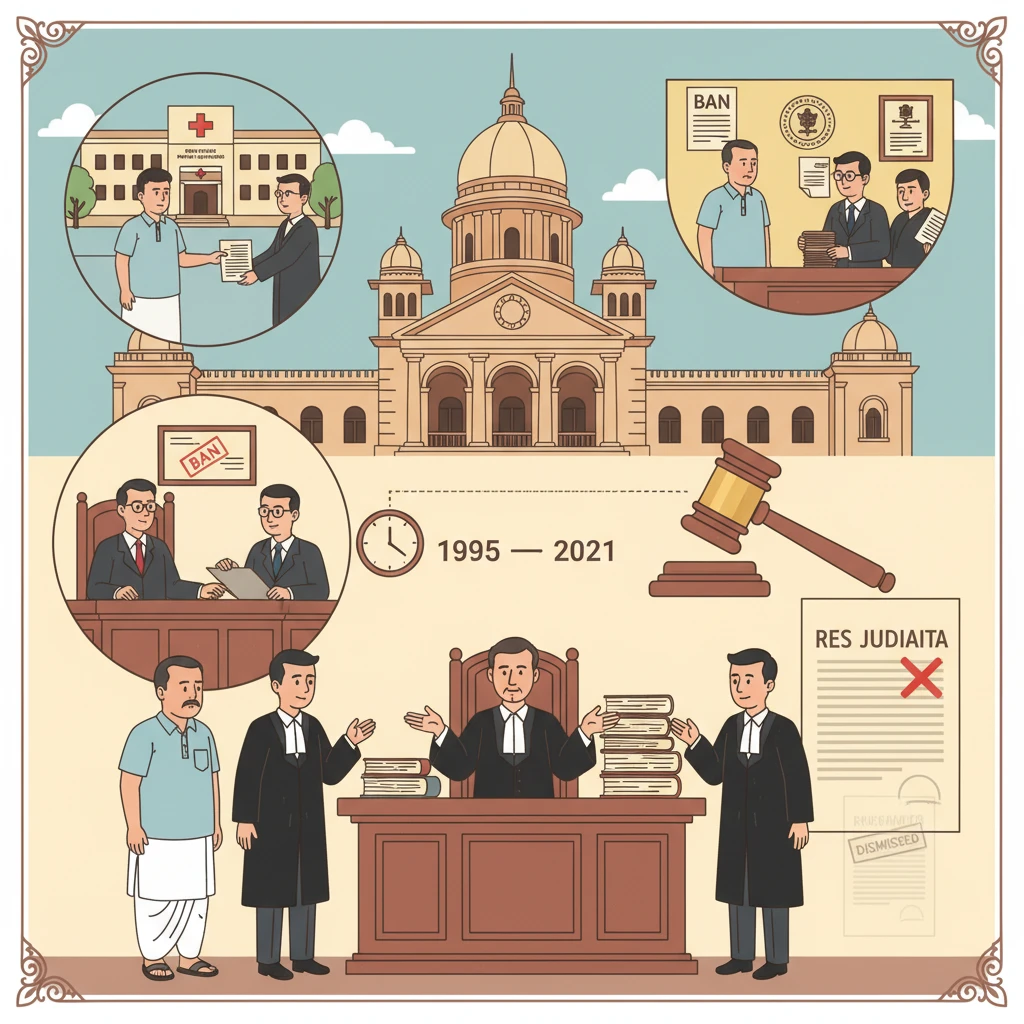
The Court refused, saying an earlier writ on the same claim had already been dismissed.
It also held that the worker had come back after an unexplained delay of nearly three decades.
The writ petition was dismissed and no relief was granted.
Case Background
The petitioner claimed that he was appointed in 1978 on the post of Kakshpal (a Class IV post) at Patna Medical College and Hospital, Patna (PMCH).
According to him, his services were suddenly terminated in 1990. After this termination, he first approached the Patna High Court by filing Civil Writ Jurisdiction Case No. 6580 of 1995.
In that earlier case, he had asked for regularisation of his services in PMCH. The High Court dismissed that writ petition on 21.05.1996. However, while dismissing it, the Court had observed that if PMCH made regular appointments in future after proper advertisement and procedure, then the petitioner, along with other eligible candidates, would be entitled to be considered.
The petitioner then kept submitting representations before the District Magistrate, Patna and the Superintendent, PMCH. He claimed that in spite of these representations, his services were never regularised.
In 2021, about 25 years after the earlier writ was dismissed and over 30 years after his alleged termination, he again approached the Patna High Court. This time he filed Civil Writ Jurisdiction Case No. 13980 of 2021.
In this second writ, he asked the Court to set aside the termination of his services from the Class IV post in PMCH and to direct the authorities to regularise his services as a fourth grade employee.
What the Court Examined and Decided
The case was heard by Hon’ble Mr. Justice Mohit Kumar Shah of the Patna High Court. The State of Bihar and PMCH authorities opposed the petition.
The State relied on a counter affidavit filed by the District Magistrate, Patna (respondent no. 5) and the Superintendent, PMCH (respondent no. 6). Based on this affidavit, the State argued that the present writ petition suffered from two major legal defects:
First, it was barred by the principle of res judicata, because the petitioner had already filed an earlier writ petition (CWJC No. 6580 of 1995) raising the same grievance regarding regularisation and appointment in PMCH, and that petition had been dismissed in 1996.
Second, the petition was hit by the principle of delay and laches, because the petitioner had approached the High Court again after more than two decades without any satisfactory explanation for such a long gap.
The State also pointed out that in the earlier writ, the Court had clearly refused to give any positive direction to appoint or regularise the petitioner. Instead, the Court had only said that if regular appointments were made in the future after proper advertisement and following the legal procedure, the petitioner, along with other eligible candidates, would be entitled to be considered for appointment.
The relevant portion of the 1996 order was reproduced in the present judgment. That extract records that a committee had been constituted by the State Government to examine the cases of “Awaj Karamcharies” for regularisation of their services in PMCH.
The committee had found that the petitioner’s claim that he had worked in PMCH between 1984 and 1990 was not supported by the records. On that basis, his case was not included among those whose services were recommended for regularisation.
The 1996 order also recorded that the Health Department, by letter dated 04.11.1986, had totally banned the system of engaging “Awaj Karamcharies” and had directed the Superintendent, PMCH not to keep any such persons. In view of these clear assertions, the earlier writ was dismissed, but with the general observation that any future regular appointment in government establishments, including PMCH, must be made only after proper advertisement and procedure.
In the present case, the State further submitted that, even up to date, no new appointments of fourth grade staff had been made by the Superintendent, PMCH. This meant that the situation contemplated in the 1996 order, namely regular appointments after advertisement, had not arisen so far.
After hearing both sides and going through the record, the Court first noted that the petitioner’s earlier writ petition of 1995 had been dismissed on 21.05.1996. In that petition, he had sought regularisation of his services and appointment as sweeper/Awaj Karamchari in PMCH.
The Court observed that in the present writ petition also, the petitioner was essentially seeking regularisation of his services and removal of termination, even though at the time of filing the earlier writ he was already not in service. Therefore, the second petition was, in substance, an attempt to reopen the same dispute.
On this basis, the Court held that the present writ was barred not only by res judicata but also by the principle of constructive res judicata. Constructive res judicata means that a person cannot file a new case to raise issues that ought to have been raised, or could have been raised, in the earlier case.
To support this conclusion, the Court referred to and relied upon several judgments of the Supreme Court, including:
Devilal Modi v. STO, AIR 1965 SC 1150.
State of U.P. v. Nawab Hussain, (1977) 2 SCC 806.
Central Bank of India v. Dragendra Singh Jadon, (2022) 8 SCC 378.
Beerbal Singh v. State of U.P., (2018) 13 SCC 675.
Orissa Power Transmission Corpn. Ltd. v. Asian School of Business Management Trust, (2013) 8 SCC 738.
The Court also underlined that the Supreme Court has repeatedly disapproved the practice of filing repeated writ petitions for the same or similar relief.
In this connection, the Court cited further Supreme Court decisions:
AIR 1968 SC 111 (Hular Rai Baijnath Firm v. K.B. Das and Company).
AIR 1999 SC 509 (Upadhyay and Company v. State of U.P.).
(1996) 4 SCC 378 (Staff Association and others v. State Bank of India and others).
(1997) 2 SCC 534 (Avinash Nagra v. Navodaya Vidyalaya Samiti and others).
Next, the Court considered the aspect of delay and laches. It noted that the petitioner had approached the Court after a very long time — about 31 years from the date of his alleged termination, or at least 27 years from the disposal of the earlier writ petition.
The Court observed that under Article 226 of the Constitution, writ jurisdiction is an extraordinary and equitable jurisdiction. While the Court must protect the rights of citizens, it must also recognise that a person who sleeps over his rights for long periods without adequate reason cannot expect relief from a writ court.
The Court held that when an aggrieved person approaches the Court belatedly at his own leisure or pleasure, the writ court is not required to grant any indulgence. On the ground of delay and laches alone, such a writ petition can be rejected at the threshold.
For this proposition, the Court referred to several Supreme Court judgments, including:
Chennai Metropolitan Water Supply & Sewerage Board & Others v. T.T. Murali Babu, (2014) 4 SCC 108.
State of Uttranchal & Anr. v. Shiv Charan Singh Bhandari & Ors., 2013 AIR SCW 6627.
C. Jacob v. Director of Geology & Mining & Anr., AIR 2009 SC 264.
State of Jammu & Kashmir v. R.K. Zalpuri & Others, AIR 2016 SC 3006.
State of Tamil Nadu v. Seshachalam, (2007) 10 SCC 137.
Taking all these aspects together, the Court concluded that the present writ petition was not maintainable. It was barred by res judicata, was hit by delay and laches, and was otherwise devoid of merit.
Consequently, the writ petition was dismissed and no direction was issued for reinstatement or regularisation of the petitioner’s services.
Why This Judgment Matters
This judgment from the Patna High Court sends an important message to workers who feel wrongly removed from service, especially casual or Class IV staff.
It shows that if a person has already gone to court once and lost, they generally cannot keep filing new writ petitions asking for the same relief. Courts treat such repeat cases as barred by res judicata or constructive res judicata.
The judgment also makes clear that delay is crucial. Someone who waits for decades before again approaching the court is very unlikely to get relief, particularly in service matters.
For employees and daily-wage workers, this decision underlines the need to act promptly, to bring all available claims in the first case itself, and to follow lawful recruitment procedures when applying for government posts.
Legal Issues and Answers
- Issue: Can the petitioner seek setting aside of his alleged termination and regularisation of his services in PMCH through a fresh writ petition after his earlier writ for similar relief was dismissed in 1996?
Answer: No. The Patna High Court held that the second writ petition was barred by res judicata and constructive res judicata, as the petitioner was again seeking substantially the same relief already refused earlier. - Issue: Is a writ petition filed decades after termination or after dismissal of an earlier writ maintainable in service matters?
Answer: No. The Court held that approaching the Court after about 31 years from termination, or at least 27 years from the earlier writ, is hit by delay and laches, and the writ petition is liable to be dismissed on that ground alone.
Cases Cited by the Court
- Devilal Modi v. STO, AIR 1965 SC 1150.
- State of U.P. v. Nawab Hussain, (1977) 2 SCC 806.
- Central Bank of India v. Dragendra Singh Jadon, (2022) 8 SCC 378.
- Beerbal Singh v. State of U.P., (2018) 13 SCC 675.
- Orissa Power Transmission Corpn. Ltd. v. Asian School of Business Management Trust, (2013) 8 SCC 738.
- Hular Rai Baijnath Firm v. K.B. Das and Company, AIR 1968 SC 111.
- Upadhyay and Company v. State of U.P., AIR 1999 SC 509.
- Staff Association and others v. State Bank of India and others, (1996) 4 SCC 378.
- Avinash Nagra v. Navodaya Vidyalaya Samiti and others, (1997) 2 SCC 534.
- Chennai Metropolitan Water Supply & Sewerage Board & Others v. T.T. Murali Babu, (2014) 4 SCC 108.
- State of Uttranchal & Anr. v. Shiv Charan Singh Bhandari & Ors., 2013 AIR SCW 6627.
- C. Jacob v. Director of Geology & Mining & Anr., AIR 2009 SC 264.
- State of Jammu & Kashmir v. R.K. Zalpuri & Others, AIR 2016 SC 3006.
- State of Tamil Nadu v. Seshachalam, (2007) 10 SCC 137.
Case Details
Case Number: Civil Writ Jurisdiction Case No. 13980 of 2021
Case Title: Surendra Ram v. The State of Bihar & Ors.
Coram: Hon’ble Mr. Justice Mohit Kumar Shah
Date of Judgment: 13-12-2023
Citation: 2024(2) PLJR 110
Advocates: Mr. Rabindra Prasad Singh, Advocate for the petitioner; Mr. Kamlesh Kishore, AC to SC-12 for the respondents.
Nature of the Case: Writ petition under Article 226 of the Constitution of India challenging termination from Class IV post and seeking regularisation of service.
Link to the Judgment: Click here to read the full judgment of the Patna High Court
If you found this explanation helpful and wish to stay informed about
how legal developments may affect your rights in Bihar,
you may consider following Samvida Law Associates for more updates.







