

Case Background
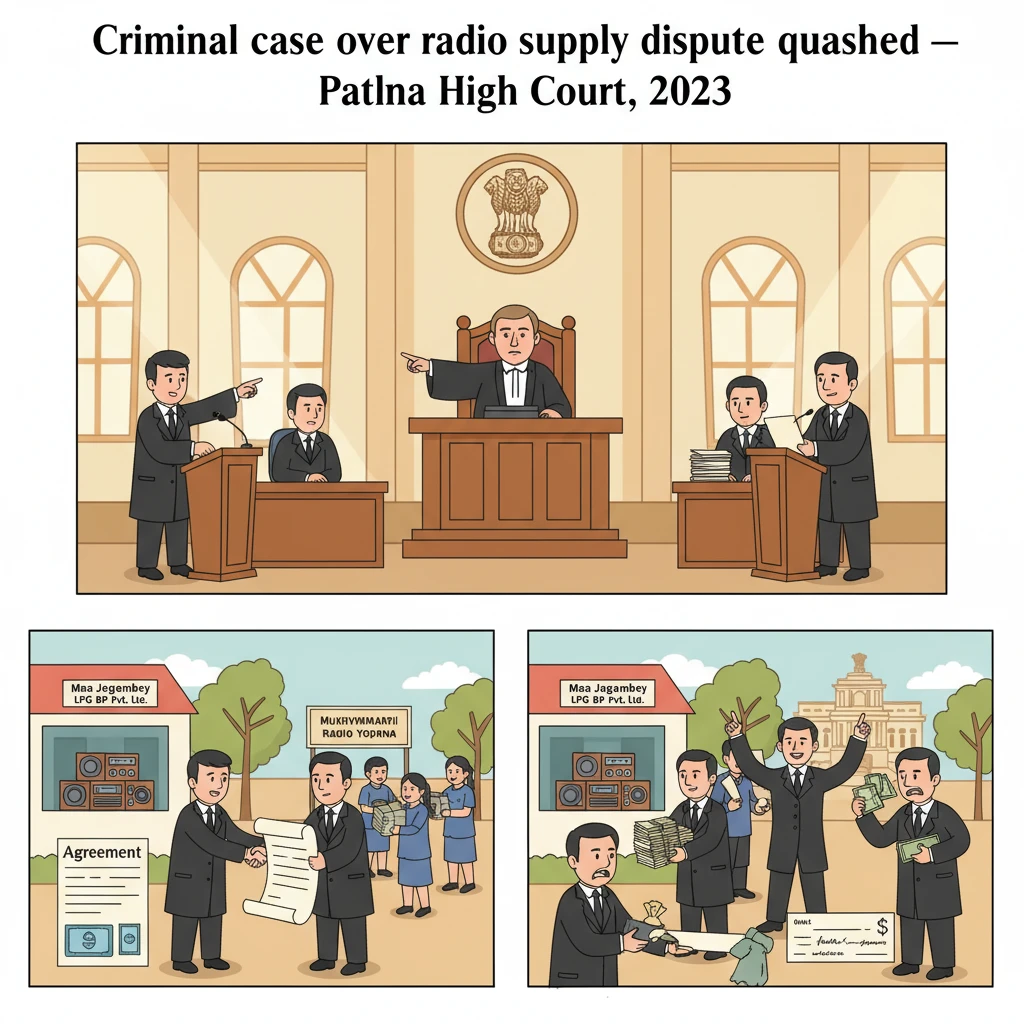
The Government of Bihar launched the Mukhyamantri Radio Yojana to distribute radio sets to Mahadalit families. For this work, a public limited company (accused company) participated in a government tender and was selected to supply and distribute radios across the State.
The complainant company, Maa Jagdambey LPG BP Pvt. Ltd., claimed that it was in the business of acting as dealer and distributor for radios of the accused company. According to the complaint, some officers of the accused company knew the complainant’s capacity to operate in remote villages and approached it to work as distributor under the scheme.
A registered distribution agreement dated 30.11.2011 was executed between the accused company, represented by one of its officers, and the complainant company, represented by its Managing Director. Under this agreement, the complainant had to submit a bank guarantee of Rs. 1 crore and a demand draft of Rs. 58 lakhs. Upon encashment of the draft, radios were to be supplied to the complainant, who would then collect coupons from Block Development Officers, distribute radios to identified beneficiaries, and raise bills.
The complainant alleged that during an initial “pilot project” in four districts, the work was executed properly. In paragraph 14 of the complaint, the complainant clearly admitted that after submitting coupons and bills, the accused company paid the agreed commission for the pilot phase. The dispute arose later, when work allegedly expanded to all 38 districts and larger bills and tax questions came up.
Instead of lodging a First Information Report, the complainant filed a private complaint case (Complaint Case No. 27367/2014) before the Chief Judicial Magistrate, Patna, alleging offences under Sections 406 and 420 of the Indian Penal Code. After examining the complainant’s representative on oath, the Judicial Magistrate, 1st Class, Patna took cognizance and issued summons by order dated 25.02.2015.
The accused company and its officers then approached the Patna High Court in two criminal miscellaneous applications (Cr. Misc. No. 49450 of 2015 and Cr. Misc. No. 49449 of 2015) under Section 482 Cr.P.C., seeking quashing of the cognizance order and the entire criminal proceeding.
What the Court Examined and Decided
The High Court, through Hon’ble Mr. Justice Rajeev Ranjan Prasad, carefully examined the complaint, the admitted distribution agreement, the submissions of both sides, and the legal provisions on criminal breach of trust and cheating.
The petitioners argued that the complaint showed only a commercial dispute under a contract. They relied heavily on the complainant’s own admission that commission for the pilot project was fully paid. They submitted that the later dispute about around Rs. 1 crore and service tax was a matter of accounts and contractual obligations, not criminal conduct.
They also pointed to the dispute resolution clause in the agreement (referred to as Clause 15) which provided a mechanism for settling disagreements arising out of the contract. According to them, when a proper civil remedy and contractual mechanism existed, using criminal law was an abuse of process.
The petitioners further challenged the allegation that money was paid to them to “manage” government officials for clearance of bills. They relied on earlier decisions, including Vijay Sharma v. State of Bihar (2011) 1 PLJR 780, to say that such an understanding is itself illegal and cannot be the basis of criminal breach of trust or cheating. Such arrangements are hit by Section 23 of the Indian Contract Act as being unlawful and opposed to public policy.
On the legal side, they cited leading Supreme Court authorities: State of Haryana v. Bhajan Lal, Indian Oil Corporation v. NEPC India Ltd., Inder Mohan Goswami v. State of Uttaranchal, Rajiv Thapar v. Madan Lal Kapoor, S.W. Palanitkar v. State of Bihar, and a Bench decision of the Patna High Court in Arun Kumar Sharma @ Arun Sharma v. State of Bihar. These cases lay down when High Courts can quash criminal proceedings, especially where civil disputes are wrongly projected as criminal cases.
The complainant, on the other hand, focused mainly on paragraph 25 of the complaint. Counsel argued that the accused company had made a false promise to pay service tax, asked the complainant to raise bills without service tax on the assurance that they would pay the tax directly to the department, and then failed to do so. This, according to the complainant, was misrepresentation and justified a criminal case.
The High Court first identified that the “crux” of the complaint lay in paragraphs 24 and 25. In paragraph 24, the complainant alleged that when he demanded payment of about Rs. 1 crore, the accused refused. In paragraph 25, he alleged that service tax, though promised to be paid by the accused company, was not paid, leaving tax liability on the complainant.
The Court treated these core allegations as essentially financial and contractual disputes. It noted that a claim that “I demanded Rs. 1 crore and they did not pay” is, by itself, a simple money dispute. Under a continuing business relationship and a written agreement with a dispute resolution clause, such a non-payment cannot automatically become a criminal matter.
Regarding the service tax issue, the Court examined the clauses from the distribution agreement placed on record: Clause 7.15(C) and Clause 20.3 of Annexure 4. These clauses dealt with responsibility for taxes, duties, levies and adjustments in payment if deductions were required by law. On a reading of these clauses, the Court found that questions about who should ultimately pay service tax were clearly covered within the contractual framework and were meant to be resolved using the mechanisms provided in the agreement.
The Court then set out the statutory definitions of criminal breach of trust (Sections 405 and 406 IPC) and cheating (Sections 415 and 420 IPC). It explained that for criminal breach of trust, there must first be “entrustment” of property, followed by dishonest misappropriation, conversion, or disposal in violation of law or contract. For cheating, there must be deception and dishonest or fraudulent inducement at the time of the transaction.
Applying these tests, the Court found that the complaint did not disclose any entrustment of property by the complainant to the accused which was then misappropriated. The complaint only showed a distributor-principal relationship under contract, with payment of commission for work done. The handing over of bills and coupons to certain officers to facilitate government payment did not amount to entrustment of property in the criminal sense, nor did it show that any property was delivered because of dishonest inducement.
The Court noted that business dealings were carried out openly, and the complainant had been paid commission for the pilot phase, which contradicted any claim of initial cheating. The subsequent non-payment claim appeared to be about accounting and settlements, not deception from the beginning.
On the allegation of money paid to be passed on as bribes to government officials, the Court held that even if the allegation is taken at face value, such an agreement is unlawful and falls foul of Section 23 of the Contract Act. Relying on Vijay Sharma, the Court held that both parties would be in pari delicto (equally at fault) in trying to enter into an illegal arrangement. In such a setting, the criminality lies in giving or taking illegal gratification itself, not in alleged non-return of the money. The Supreme Court decision in Chelloor Mankkal Narayan Ittiravi Nambudiri v. State of Travancore-Cochin (AIR 1953 SC 479) was cited, where it was held that money paid as illegal gratification does not create “entrustment” necessary for criminal breach of trust.
The Court stressed an important policy concern recorded in Indian Oil Corporation v. NEPC India Ltd. and Inder Mohan Goswami: there is a growing tendency to convert civil disputes into criminal cases to put pressure on the other side. The Supreme Court has repeatedly warned that criminal law is not a shortcut to recover money or settle commercial disagreements.
Referring to Bhajan Lal, the Court reiterated that when, even if all allegations are taken at face value, they do not make out any criminal offence, the High Court can and should quash proceedings under Section 482 Cr.P.C. Similarly, relying on Rajiv Thapar, it noted that continuing a criminal trial where no offence is made out would be an abuse of process and a waste of court time.
Finally, after reviewing the entire complaint and the admitted agreement, the Patna High Court concluded that there was no allegation of fraudulent inducement at the time of entering into the distribution agreement and no factual foundation for offences under Sections 406 or 420 IPC. The prosecution was held to be an abuse of the process of court. The order dated 25.02.2015 taking cognizance and issuing summons, and the entire criminal proceedings in the complaint case, were quashed. Both criminal miscellaneous applications were allowed.
Why This Judgment Matters
This decision is important for businesses, contractors, distributors, and small vendors working under government-linked projects in Bihar and beyond. It sends a clear message that not every dispute over payment, commission, or tax between contracting parties can be turned into a criminal case.
If work is done under a written contract with agreed clauses for dispute resolution and tax sharing, disagreements over money, delayed payments, or interpretation of tax obligations are meant to be resolved through civil routes, not by accusing the other side of cheating or breach of trust without clear criminal ingredients.
The judgment also warns that arrangements to pay money for influencing government officials are unlawful. Even if such money is not returned, this by itself will not support criminal breach of trust or cheating charges. Parties who enter such arrangements cannot later take shelter of criminal law when things go wrong.
For lower courts, the ruling reinforces that they must carefully examine complaints before taking cognizance, and avoid mechanically converting commercial disputes into criminal trials. For ordinary traders and small companies, it highlights the importance of written contracts and using civil remedies, instead of trying to use criminal process as a pressure tactic.
Legal Issues and Answers
- Issue: Do the allegations of non-payment of about Rs. 1 crore and failure to pay service tax under a distribution agreement make out offences of criminal breach of trust (Section 406 IPC) or cheating (Section 420 IPC)?
Answer: No. The Court held that the dispute is purely contractual and financial, without any entrustment of property or fraudulent inducement. It does not satisfy the essential ingredients of Sections 406 or 420 IPC. - Issue: Can alleged payments made to accused persons for influencing government officials to release payments form the basis of criminal breach of trust or cheating?
Answer: No. Such an agreement is unlawful and hit by Section 23 of the Contract Act. As held in Vijay Sharma and Chelloor Mankkal Narayan Ittiravi Nambudiri, money paid as illegal gratification does not amount to “entrustment” and cannot ground these offences, though civil consequences may be separately examined. - Issue: When should the High Court use its power under Section 482 Cr.P.C. to quash criminal proceedings arising from commercial contracts?
Answer: Where, even taking the complaint at face value, no criminal offence is made out and the matter is essentially a civil dispute, continuing the prosecution would be an abuse of process. In such cases, as guided by Bhajan Lal, Indian Oil Corporation, Rajiv Thapar and S.W. Palanitkar, the High Court can and should quash the proceedings.
Cases Cited by the Court
- State of Haryana and others v. Bhajan Lal and others, 1992 Supp. (1) SCC 335
- Indian Oil Corporation v. NEPC India Ltd. and others, (2006) 6 SCC 736
- Inder Mohan Goswami and another v. State of Uttaranchal and others, (2007) 12 SCC 1
- Rajiv Thapar and others v. Madan Lal Kapoor, (2013) 3 SCC 330
- S.W. Palanitkar and others v. State of Bihar and another, 2002 (1) SCC 241
- National Bank of Oman v. Barakara Abdul Aziz and another, (2013) 2 SCC 488
- Chelloor Mankkal Narayan Ittiravi Nambudiri v. State of Travancore, AIR 1953 SC 479
- Vijay Sharma and another v. State of Bihar, (2011) 1 PLJR 780
- Arun Kumar Sharma @ Arun Sharma & others v. State of Bihar & another, (2010) 4 PLJR 1096
Case Details
Case Numbers: Criminal Miscellaneous No. 49450 of 2015 with Criminal Miscellaneous No. 49449 of 2015; arising out of Complaint Case No. 27367 of 2014, Patna
Case Title: Philips India Limited & Ors v. The State of Bihar & Maa Jagdambey LPG BP Pvt. Ltd.; with P.T.N. Charlu @ P.N.T. Charlu v. The State of Bihar & Maa Jagdambey LPG BP Pvt. Ltd.
Citation: 2024 (2) PLJR 337
Court: High Court of Judicature at Patna
Coram: Hon’ble Mr. Justice Rajeev Ranjan Prasad
Date of Judgment: 13.09.2023
Advocates (Cr. Misc. No. 49450 of 2015): Mr. Jitendra Singh, Senior Advocate; Mr. Harsh Singh, Advocate; Mr. Ambar Bhushan, Advocate (for the petitioners); Mr. Sanjeev Ranjan, Advocate (for opposite party no. 2 – complainant company); Mr. B.N. Pandey, APP (for the State of Bihar)
Advocates (Cr. Misc. No. 49449 of 2015): Mr. Jitendra Singh, Senior Advocate; Mr. Harsh Singh, Advocate; Mr. Ambar Bhushan, Advocate (for the petitioner); Mr. Sanjeev Ranjan, Advocate (for opposite party no. 2 – complainant company); Mr. Md. Fahimuddin, APP (for the State of Bihar)
Nature of Case: Petitions under Section 482 Cr.P.C. seeking quashing of order taking cognizance under Sections 406 and 420 IPC and issuance of summons in a private complaint case arising out of a commercial distribution agreement under a government welfare scheme.
Link to Judgement; https://patnahighcourt.gov.in/viewjudgment/NiM0OTQ1MCMyMDE1IzEjTg==-jifODTRKbVA=
If you found this explanation helpful and wish to stay informed about how legal developments may affect your rights in Bihar, you may consider following Samvida Law Associates for more updates.







