

Case Background
A criminal case was registered at Phulwarisharif Police Station, Patna, as P.S. Case No. 776 of 2014. It was based on a typed written report dated 09.12.2014 submitted by the informant, Nilofar Sheharyar, to the Officer In‑Charge of the police station. On the basis of this report, G.R. No. 7891 of 2014 was initiated before the Judicial Magistrate 1st Class, Patna.
The informant alleged serious acts of cruelty, dowry demands, and harassment by her husband and his family members, both in India and abroad. She described events from the time of her marriage on 28.03.2010, the dowry that was allegedly given, and what she said happened after marriage at Patna, in Dubai, and later at Ramgarh.
After investigation, the learned Judicial Magistrate 1st Class, Patna, by order dated 23.07.2015, took cognizance of offences under Sections 3 and 4 of the Dowry Prohibition Act and Section 498‑A of the Indian Penal Code against several accused, including distant relatives and collateral in‑laws of the informant’s husband.
Feeling aggrieved by being made to face a dowry cruelty trial on the basis of what they said were vague and exaggerated claims, these relatives approached the Patna High Court under its criminal miscellaneous jurisdiction. They filed Criminal Miscellaneous No. 51768 of 2015 and Criminal Miscellaneous No. 22404 of 2016, both arising out of the same police case.
What the Court Examined and Decided
Justice Chandra Shekhar Jha heard both applications together. In each, the petitioners sought quashing of the Magistrate’s cognizance order dated 23.07.2015 in G.R. No. 7891 of 2014, to the extent it related to them.
In Criminal Miscellaneous No. 51768 of 2015, the petitioners were in‑laws of the informant who were not part of her immediate household. They argued through counsel that they lived separately and had no connection with the daily and domestic affairs of the informant. They contended that all allegations against them in the complaint were “general and omnibus” in nature, without specific dates, acts or roles attributed to any of them individually.
The prosecution, represented by the learned APP, and supported by counsel for the informant, opposed the plea to quash. They argued that the petitioners had actively participated in the alleged acts of dowry harassment and cruelty, and therefore a prima facie case existed. However, they fairly conceded that the petitioners were living separately and had no connection with the day‑to‑day domestic life of the informant.
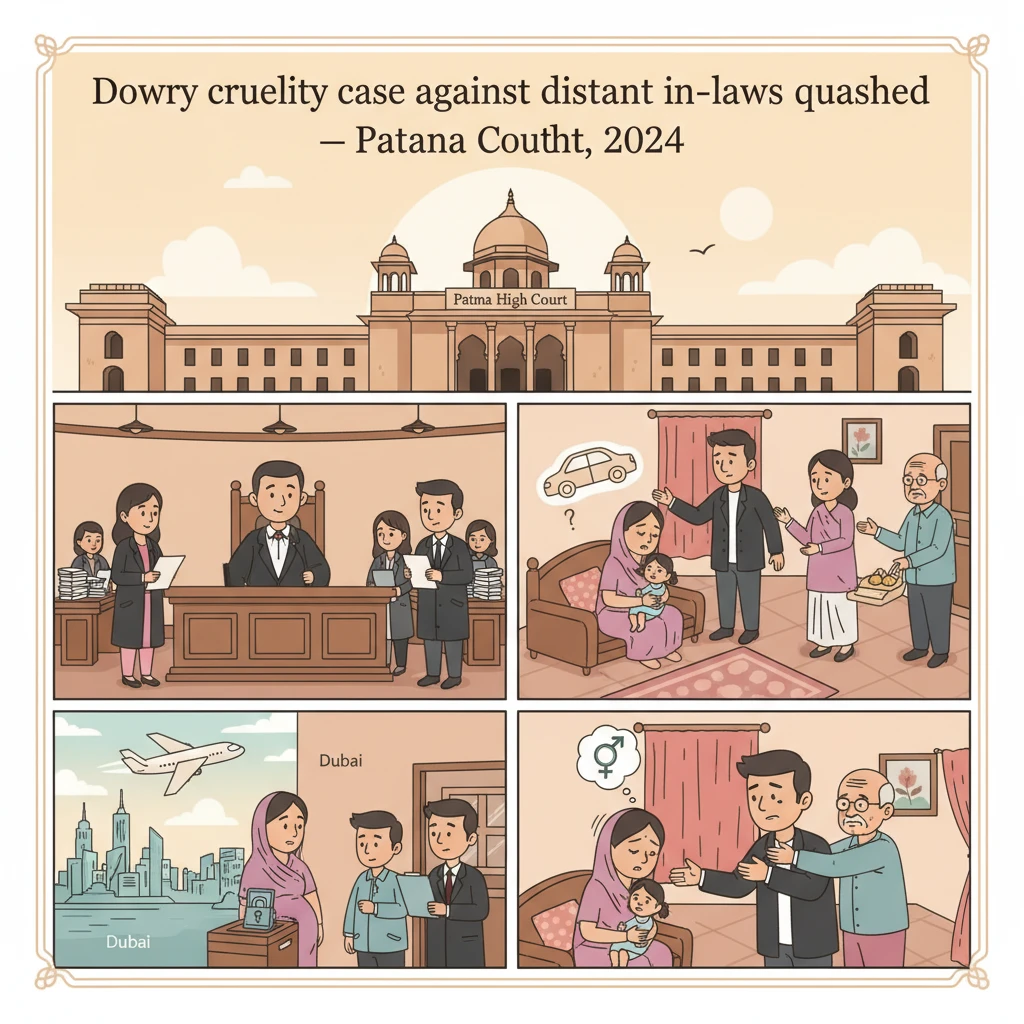
The Court then closely looked at the narrative given by the informant in her written report dated 09.12.2014, which was the foundation of the FIR. The report described the following key events:
The informant stated that she married Yunis (also written as Yonis) Wahab on 28.03.2010 at Patna according to Muslim rites. She alleged that at the time of marriage, Rs. 5 lakhs in cash and articles worth Rs. 5 lakhs were given. After marriage, she claimed that her husband and his other family members started taunting her because no car had been given as dowry, and they made fun of her parents.
She alleged that both her nanads (married sisters of her husband), whose houses were in the same colony, spent a lot of time in their maika (parental home) and that they, along with others, taunted her. She further alleged that her father‑in‑law and mother‑in‑law took her ornaments on the pretext of keeping them in a locker and retained them.
The informant stated that her husband, an engineer working in Dubai, also started pressuring her for a car. She claimed that one day the entire family assaulted her, and when she complained to her husband about torture, he did not act.
She further alleged that in November 2010 she was taken to Dubai, where she was mentally tortured. When she became pregnant, she returned to Patna and gave birth to a female child on 12.08.2011. According to her, her father bore the hospital expenses; her husband paid nothing. She alleged that on her return to Patna she was taunted for giving birth to a girl, and family members said they would arrange a second marriage of her husband for a male child. She later went back to Dubai.
The informant added that her devar (younger brother‑in‑law) was sent to Dubai and that the torture continued. She said her passport and mobile phone were snatched, she was not allowed to go out, and she was told to get money for the child’s expenses from her father. She alleged that when she again became pregnant, her husband wanted a sex determination test. On her refusal, she claimed she was assaulted on 10.05.2013 and her husband tried to kill her by pressing her neck. She escaped and informed her mausi and mausa in Abu Dhabi, who came and took her away.
According to the report, her husband then assured her of good treatment, and she again joined him. She was shocked to see her parents‑in‑law also present there, and she alleged that they again tortured her for dowry. She returned to Patna on 19.11.2013 and gave birth to a male child at Ramgarh, but alleged that no one from her matrimonial side came to see her.
She further alleged that on 13.08.2014, her parents and other relatives went to her husband’s place, where both husbands of her nanads were present. She claimed that they abused her parents and declared that they would not accept her as the wife of their brother. According to her, operation of the bank locker was stopped to prevent her from taking her belongings. She said that from January 2014 her husband stopped talking to her, and from April 2014 he stopped giving any maintenance, forcing her to stay at her parental home with two small children.
The High Court noted that while these allegations were elaborate, they were directed mainly at the husband, the parents‑in‑law, and certain close family members who were directly involved in her married life. In contrast, the petitioners before the High Court were described in the judgment as “distant relatives” or collateral in‑laws living separately, with no specific overt acts clearly attributed to them.
The Court then turned to the settled position of law laid down by the Supreme Court in several leading decisions. It referred to:
Geeta Mehrotra and Another v. State of U.P. and Another, (2012) 10 SCC 741, and Preeti Gupta and Another v. State of Jharkhand and Another, (2010) 7 SCC 667. In these cases, the Supreme Court held that criminal proceedings against relatives of the husband in matrimonial and dowry cases should not be allowed to continue on the basis of vague and omnibus allegations. There must be clear, specific allegations of particular acts.
The Court also cited Monju Roy and Others v. State of West Bengal, (2015) 13 SCC 693, and Kans Raj v. State of Punjab, (2000) 5 SCC 207. In Kans Raj, the Supreme Court warned against the growing tendency to rope in every relative of the in‑laws’ family in dowry cases. It observed that such over‑inclusion may ultimately weaken the prosecution even against the real culprits.
Further reliance was placed on Arnesh Kumar v. State of Bihar and Another, (2014) 8 SCC 273, where the Supreme Court highlighted the misuse of Section 498‑A IPC. It noted that Section 498‑A, being cognizable and non‑bailable, can be misused as a “weapon” by disgruntled spouses, and cautioned courts and police to act with care, particularly when distant relatives are named.
Applying these principles to the facts before it, the Patna High Court observed that the petitioners were distant relatives of the husband of the informant and that they were admittedly living separately without involvement in her daily domestic affairs. The Court held that the allegations against them in the complaint were general and omnibus, not specific or detailed enough to make out a prima facie case for offences under Sections 3 and 4 of the Dowry Prohibition Act and Section 498‑A IPC.
On this reasoning, the Court concluded that allowing the criminal proceedings to continue against such petitioners would amount to an abuse of the process of law. It therefore quashed the order of cognizance dated 23.07.2015 and all consequential proceedings “qua the petitioners” in G.R. No. 7891 of 2014, arising out of Phulwarisharif P.S. Case No. 776 of 2014, pending before the Judicial Magistrate 1st Class, Patna.
Accordingly, in Criminal Miscellaneous No. 51768 of 2015, the application was allowed and the trial court records, if called for, were directed to be returned with a copy of the High Court judgment.
In Criminal Miscellaneous No. 22404 of 2016, one of the petitioners (petitioner no. 1, described as the father‑in‑law of the informant) had died on 18.03.2022. The petition thus survived only for petitioners nos. 2 and 3, who were described as elder brother‑in‑law (bhaisur) and sister‑in‑law (jethani) of the informant. The factual allegations, arguments, and legal position were the same as in the earlier application.
Again, the Court found that these petitioners were also living separately and the allegations against them were general and omnibus. Applying the same Supreme Court precedents and reasoning, the Court quashed the cognizance order dated 23.07.2015 and all consequential proceedings insofar as they related to these petitioners as well. This application too was allowed, and the trial court records, if any, were ordered to be returned with a copy of the judgment.
Why This Judgment Matters
This judgment is significant for families entangled in dowry and matrimonial disputes in Bihar and beyond. It reinforces that criminal law is a serious matter and that relatives who live separately and are not clearly shown to have taken part in cruelty or dowry demands should not be dragged into criminal trials on the strength of broad, unspecific accusations.
For genuine victims of dowry harassment, the judgment serves as a reminder to give detailed, factual accounts pinpointing who did what, when, and how. For distant in‑laws, it underlines that the High Court can step in and protect them from the hardship and stigma of a criminal trial where the complaint does not make out a specific case against them.
At the same time, the judgment does not dilute the seriousness of dowry offences. The Court does not comment on the merits of the case against the husband or close in‑laws. It only clarifies that the process of law must not be misused to implicate every relative by naming them generally, without clear material.
Legal Issues and Answers
- Issue: Can distant relatives and separately residing in‑laws be made to face trial for offences under Sections 3 and 4 of the Dowry Prohibition Act and Section 498‑A IPC on the basis of general and omnibus allegations in a complaint?
Answer: No. The Patna High Court held that where petitioners are distant relatives, living separately, and only vague, omnibus allegations are made against them, no prima facie case is made out. Continuing criminal proceedings against them would be an abuse of process, and cognizance must be quashed.
Cases Cited by the Court
- Geeta Mehrotra and Another v. State of U.P. and Another, (2012) 10 SCC 741
- Preeti Gupta and Another v. State of Jharkhand and Another, (2010) 7 SCC 667
- Monju Roy and Others v. State of West Bengal, (2015) 13 SCC 693
- Kans Raj v. State of Punjab, (2000) 5 SCC 207
- Arnesh Kumar v. State of Bihar and Another, (2014) 8 SCC 273
Case Details
Case Numbers: Criminal Miscellaneous No. 51768 of 2015; Criminal Miscellaneous No. 22404 of 2016
Trial Court Case: G.R. No. 7891 of 2014 arising out of Phulwarisharif P.S. Case No. 776 of 2014, District Patna
Case Title (CR. MISC. No. 51768 of 2015): Farahat Wahab @ Farhat Bahab @ Farhat Wahab & Ors. v. State of Bihar & Nilofar Sheharyar
Case Title (CR. MISC. No. 22404 of 2016): Abdul Wahab & Ors. v. State of Bihar & Nilofar Sheharyar
Coram: Hon’ble Mr. Justice Chandra Shekhar Jha
Date of Judgment: 04.03.2024
Citation: 2024 (2) PLJR 309
Advocates (CR. MISC. No. 51768 of 2015): Mr. Surendra Kumar Singh, Advocate for the petitioners; Mr. Arshad Jameel Hashmi, Advocate for the opposite party; Mr. Kamal Kishore Singh, Advocate for the opposite party; Mr. J. Upadhyay, APP
Advocates (CR. MISC. No. 22404 of 2016): Mr. Anirudh Kumar Singh, Advocate for the petitioners; Ms. Meena Singh, APP for the State
Nature of the Case: Criminal miscellaneous applications seeking quashing of order taking cognizance under Sections 3 and 4 of the Dowry Prohibition Act and Section 498‑A IPC
Link to Judgment: Patna High Court Judgment
If you found this explanation helpful and wish to stay informed about
how legal developments may affect your rights in Bihar,
you may consider following Samvida Law Associates for more updates.







