

Case Background
This case arose from Saharsa Sadar P.S. Case No. 576 of 2019. The informant, a married woman (prosecutrix), gave a computer-typed written report on 28.06.2019 to the Officer-in-Charge, Sadar P.S., Saharsa.
On the basis of this report, a case was registered for offences under Sections 384, 386, 506 read with Section 34 of the Indian Penal Code (IPC). Later, more serious charges were added, including Sections 354C, 354D, 376, 420, 500 and 501 of the IPC and Sections 67 and 67A of the Information Technology Act, 2000.
Investigation was carried out. The prosecutrix’s statement under Section 164 of the Code of Criminal Procedure (CrPC) was recorded by a Judicial Magistrate at Saharsa on 26.07.2019.
Police submitted a chargesheet on 22.08.2019 against the appellant and his wife, and the Chief Judicial Magistrate took cognizance on 02.09.2019. The case went to trial as Sessions Trial No. 180 of 2019 before the Additional Sessions Judge-1-cum-Special Judge, Saharsa.
The trial court convicted the appellant under Sections 376 and 384 IPC by judgment dated 27.01.2021, and sentenced him on 30.01.2021 to 20 years’ rigorous imprisonment and fine for rape, and three years’ rigorous imprisonment and fine for extortion. His wife was acquitted of all charges. The appellant then filed Criminal Appeal (DB) No. 304 of 2021 before the Patna High Court under Section 374(2) CrPC.
What the Court Examined and Decided
The Patna High Court (Division Bench) carefully went through the trial court judgment, lower court records, evidence of all witnesses, and written arguments from both sides. The main question was whether the conviction for rape (Section 376 IPC) and extortion (Section 384 IPC) could stand on the available evidence.
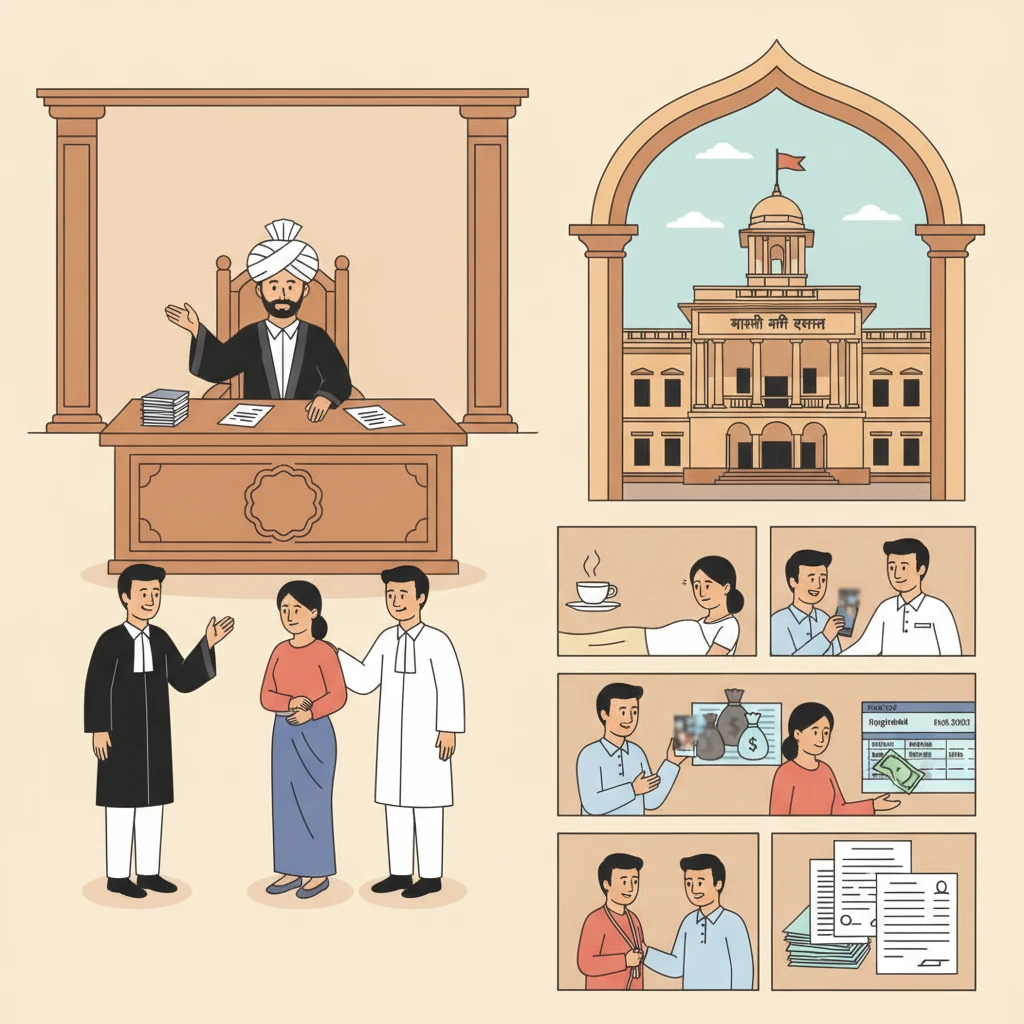
The prosecution case, as per the FIR, was that when the prosecutrix’s husband was posted at Gaya, the appellant worked in her house as a domestic help. One day, when her husband and children were away, the appellant prepared tea for her. After drinking it, she allegedly became unconscious. On regaining consciousness, she felt that “something wrong” had been done with her and found that the appellant had disappeared.
She said that out of fear she did not tell her husband. The next day, the appellant allegedly came again, showed her photographs and videos of what he had done, and threatened to make them viral on social media unless she followed his wishes. Under this threat, he is said to have undressed her, committed rape again, and taken more photos and videos. According to the FIR, he kept repeating such acts and also took money from her on several occasions.
The FIR further stated that she had made payments of Rs. 50,000 twice and Rs. 30,000 once. She said she got her husband to transfer money to the appellant’s accounts, using the excuse that the appellant’s wife was ill. Later, when the appellant went home to West Bengal and her husband was transferred from Gaya to Saharsa, the appellant and his wife allegedly started blackmailing her from there, demanding Rs. 1,00,000 initially and then Rs. 3 lakhs to be deposited in the wife’s account by 26.06.2019. Fearing that the videos and photos would be made viral, she claimed she attempted suicide on 20.06.2019 but was saved by her husband, to whom she then disclosed everything. Copies of bank statements and WhatsApp printouts were enclosed with the written report.
In her Section 164 CrPC statement recorded a month later, she repeated that she had become unconscious after tea, and on regaining consciousness found herself nude and suspected wrongdoing. She again mentioned that the appellant later returned as a domestic help, showed her photographs and videos, and threatened to make them viral. However, in this statement, she mainly spoke of continuous blackmail for money and did not clearly state that she was repeatedly forced into sexual intercourse under threat after the first incident.
At trial, she returned to the version in the FIR and said the appellant raped her multiple times at Gaya using the threat of photos and videos. She repeated the details of payments, including two transfers of Rs. 50,000 and later Rs. 30,000, and then further amounts from Saharsa in two different bank accounts of the appellant. She also said the appellant’s wife demanded Rs. 3 lakhs by 26.06.2019 and that finally she and her husband approached the Superintendent of Police to get the FIR registered.
The defence version, supported by four defence witnesses, was that the appellant was working on a temporary basis with Power Grid Corporation at Gaya and that the prosecutrix’s husband had allegedly taken money from him with an assurance of making his job permanent. According to the defence, when this did not happen, some of that money was returned by the couple to the appellant through bank transfers. The appellant denied all allegations of rape and blackmail when examined under Section 313 CrPC.
The High Court closely checked the consistency and reliability of the prosecutrix’s statements. It noted several important differences between her FIR, her Section 164 CrPC statement, and her oral testimony.
In the FIR and in court, she alleged multiple acts of rape after the first incident, all under threat of publishing photos and videos. In the Section 164 statement, she did not allege this continued sexual intercourse under threat and mainly spoke of blackmail for money. The Court treated this as a material contradiction on the “core spectrum” of the case.
The Court also pointed out that in the FIR she said the demand by the appellant’s wife was for Rs. 3 lakhs, whereas in the Section 164 statement she mentioned a demand of Rs. 4 lakhs, and before the trial court she again went back to Rs. 3 lakhs. Further, although the FIR claimed she attempted suicide on 20.06.2019, there was no such statement in her deposition at trial; there she only said her husband saw her weeping and she then disclosed the facts to him.
Another serious doubt arose from her cross-examination. She insisted she had typed the written report herself on a computer without anyone’s help. But in further cross-examination she admitted she did not know which keys to press even to type her own name in Hindi. She could not state her own mobile number. She also admitted that although she had been threatened that her photographs would be made viral, this was never actually done.
The Court also examined the documents attached with the FIR. Photostat copies of WhatsApp chats and three bank account statements were enclosed along with the written report. However, the bank statements themselves were clearly dated 29.06.2019, while the FIR was lodged and registered on 28.06.2019. The detailed ICICI Bank statement in the prosecutrix’s name, the SBI statement of her husband’s account, and another SBI statement of her own account all bore the date 29.06.2019.
The Bench held that statements of account issued on 29.06.2019 could not, in a natural way, form part of an FIR registered on 28.06.2019. It described this as an “act of interpolation and fabrication”. This finding further weakened the reliability of the prosecution story from the very starting point.
The Court then applied the legal test for when a conviction for rape can be based solely on the testimony of the victim. Relying on the Supreme Court’s decisions in Rai Sandeep v. State (NCT of Delhi) and Santosh Prasad v. State of Bihar, it noted that a conviction can rest only on the sole testimony of a “sterling witness” – a witness of high quality whose version is consistent from beginning to end, withstands cross-examination, and is free from major contradictions or gaps.
After comparing the FIR, the Section 164 statement, and the court testimony, and noticing the bank-statement interpolation and the lack of investigation at the actual place of alleged rape at Gaya, the Patna High Court concluded that the prosecutrix could not be treated as such a sterling witness. It emphasised that the investigating officer (PW-4) admitted he had never visited the place of occurrence at Gaya. Thus neither the date, nor the month, nor the place of the alleged rape was properly established during the trial.
The Court therefore held that it would be unsafe to uphold the conviction under Section 376 IPC solely on this uncorroborated and inconsistent testimony, particularly in the face of fabrication concerns regarding documents filed with the FIR.
On the extortion charge under Section 384 IPC, the Court reproduced the statutory definition of “extortion” under Section 383 IPC, which requires that a person be intentionally put in fear of injury and thereby dishonestly induced to deliver property or valuable security.
Even though there was evidence that some amounts were deposited in the appellant’s bank account, the Court held that the prosecution had not proved beyond reasonable doubt that these payments were made because the prosecutrix was put in fear of injury by the appellant. Given the doubts about the FIR, the contradictions in the prosecutrix’s statements, and the disputed background of the payments, mere proof that money went into the appellant’s account could not conclusively show extortion.
The Court agreed with the trial court’s earlier finding that the prosecution had failed to prove the offences under Sections 67 and 67A of the IT Act and other IPC provisions such as Section 386, 500, etc. It also noted that the prosecutrix’s husband (PW-1) was only a hearsay witness regarding the alleged sexual acts, since he was not present during any occurrence and only came to know of events when she narrated them to him.
Taking a holistic view of all these weaknesses, the Patna High Court held that the conviction for both rape and extortion could not stand. The appellant was entitled to the benefit of doubt.
Accordingly, the Bench set aside the judgment of conviction dated 27.01.2021 and the order of sentence dated 30.01.2021. It acquitted the appellant of offences under Sections 376 and 384 IPC and directed that he be released forthwith if not required in any other case.
Why This Judgment Matters
This judgment shows how carefully courts examine evidence in serious criminal cases, especially sexual offence cases. It underlines that even in sensitive matters, conviction cannot rest on doubtful or shifting testimony.
For complainants, the case highlights the importance of giving one clear, consistent version from the very beginning—FIR, statement before Magistrate, and court deposition. It also shows that documents attached to an FIR must be genuine; any sign of later insertion can damage the entire case.
For accused persons, the ruling illustrates that appellate courts will interfere if the trial court relies on weak or inconsistent evidence, or if the investigation is incomplete—for example, when the alleged place of crime is never even visited.
It further clarifies that, for extortion, merely showing bank transfers is not enough. The prosecution must prove, beyond reasonable doubt, that money was paid because the victim was put in fear of harm.
Legal Issues and Answers
- Issue: Could the appellant’s conviction for rape under Section 376 IPC be sustained solely on the prosecutrix’s testimony?
Answer: No. The Patna High Court found major inconsistencies between her FIR, Section 164 CrPC statement, and trial deposition, plus signs of document interpolation, and held she was not a “sterling witness”. Conviction based only on her uncorroborated evidence was unsafe, so the appellant was acquitted giving benefit of doubt. - Issue: Was the conviction for extortion under Section 384 IPC justified merely because money was transferred to the appellant’s bank account?
Answer: No. The Court held that while transfers occurred, the prosecution failed to prove beyond reasonable doubt that these were made after the prosecutrix was intentionally put in fear of injury. Given the doubts over the FIR and evidence, extortion was not established. - Issue: Were there defects in investigation and documentary evidence affecting the reliability of the prosecution case?
Answer: Yes. The investigating officer did not visit or prove the alleged place of rape at Gaya, and bank statements dated 29.06.2019 were shown as part of an FIR registered on 28.06.2019, which the Court termed interpolation and fabrication. These factors contributed to granting benefit of doubt.
Cases Cited by the Court
- Rai Sandeep v. State (NCT of Delhi), (2012) 8 SCC 21
- Santosh Prasad v. State of Bihar, (2020) 3 SCC 443
- Anvar P.V. v. P.K. Basheer & Ors., (2014) 10 SCC 473 (relied upon in argument by informant’s counsel, discussed by the Court)
Case Details
Case Number: Criminal Appeal (DB) No. 304 of 2021; arising out of Saharsa Sadar P.S. Case No. 576 of 2019; Sessions Trial No. 180 of 2019.
Case Title: Sukumar Jana v. The State of Bihar
Citation: 2024 (1) PLJR 293
Coram: Hon’ble Mr. Justice Chakradhari Sharan Singh; Hon’ble Mr. Justice Nawneet Kumar Pandey
Advocates: Mr. Sanjeev Kumar, Advocate; Mr. Ashish Kumar Sinha, Advocate; Ms. Preeti, Advocate (for the appellant). Mr. Shashank Shekhar Sinha, Advocate; Mr. Rishit Deo Kumar Singh, Advocate (for the informant). Mr. Dilip Kumar Sinha, APP (for the State).
Nature of the Case: Criminal appeal (Division Bench) under Section 374(2) CrPC against conviction and sentence by the trial court for offences under Sections 376 and 384 IPC.
Date of High Court Judgment: 06.12.2023
Trial Court Judgment and Sentence: Judgment of conviction dated 27.01.2021 and order of sentence dated 30.01.2021 by Additional Sessions Judge-1-cum-Special Judge, Saharsa.
Final Outcome: Appeal allowed; conviction and sentence set aside; appellant acquitted of offences under Sections 376 and 384 IPC and ordered to be released if not required in any other case.
Link to Judgment: Patna High Court Judgment in Cr. Appeal (DB) No. 304 of 2021
If you found this explanation helpful and wish to stay informed about how legal developments may affect your rights in Bihar, you may consider following Samvida Law Associates for more updates.







