

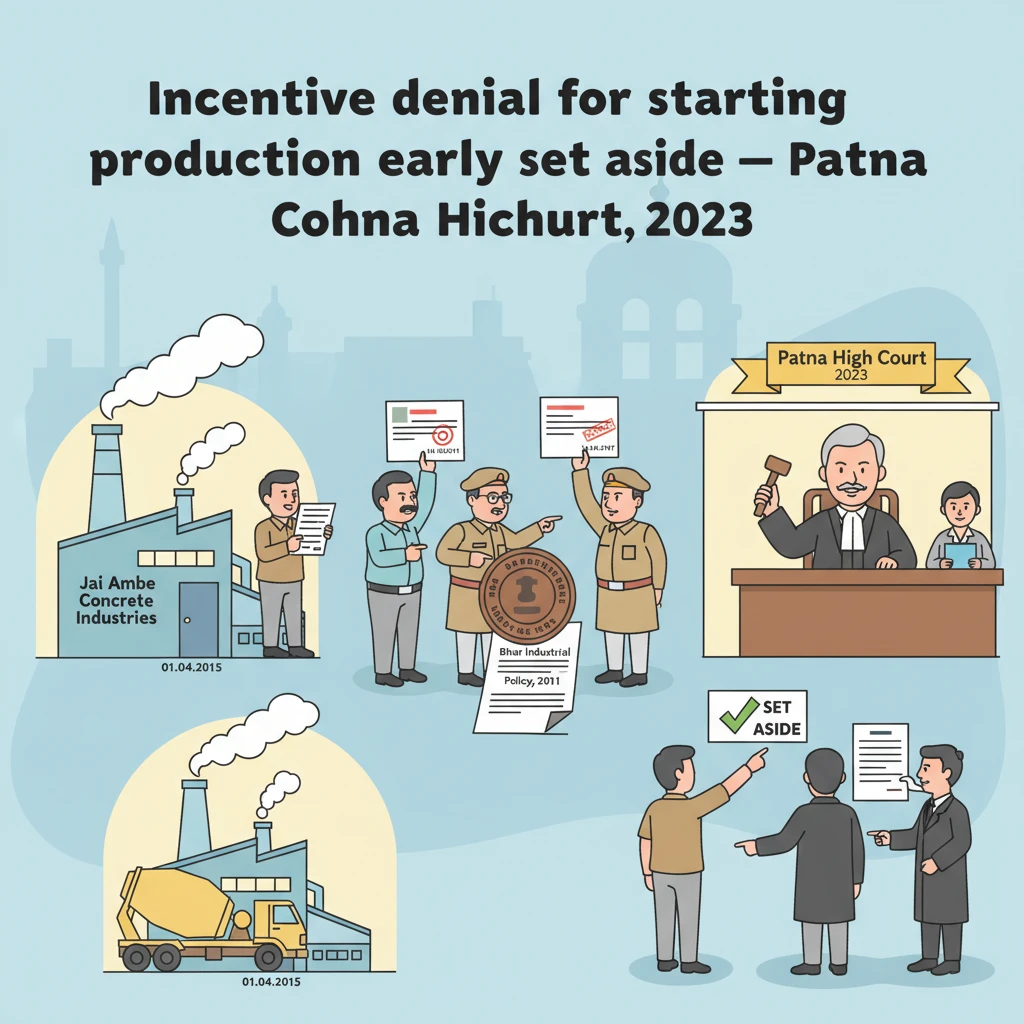
Case Background
The State of Bihar introduced the Bihar Industrial Incentive Policy, 2011 to attract industries to the State. Under this policy, eligible units could get reimbursement of taxes such as VAT, Entry Tax (ET) and SGST as post-production incentives.
The petitioner, an industrial unit engaged in concrete products, set up its unit and applied to the State Investment Promotion Board (SIPB), which is the competent authority to approve proposals for incentives. The SIPB granted approval to the petitioner on 31.08.2015.
However, the petitioner had already started commercial production from 01.04.2015, i.e., a few months before the formal SIPB approval. When the petitioner later claimed reimbursement of VAT/ET/SGST under the 2011 Policy, the authorities rejected the claim.
The rejection was first communicated through an email dated 14.10.2011 and later through a letter dated 23.11.2017 bearing Memo No. 3473, to the extent it related to the petitioner. The authorities stated that the petitioner’s proposal had either been approved after the date of commercial production or was not approved by the competent authority in the required manner.
Feeling aggrieved, the petitioner filed a writ petition before the Patna High Court in Civil Writ Jurisdiction Case No. 5938 of 2023. The petitioner challenged the rejection of its claim and sought directions for release of the incentives under the Bihar Industrial Incentive Policy, 2011.
What the Court Examined and Decided
The writ petition came up before Hon’ble Mr. Justice A. Abhishek Reddy. The petitioner asked for several reliefs, mainly aimed at setting aside the rejection of its claim and securing payment of incentives under the 2011 Policy.
The petitioner requested:
(i) Setting aside of the email dated 14.10.2011 and its attachment, by which its claim for incentives under the 2011 Policy had been rejected on the ground that the SIPB accepted its proposal after the unit had already started commercial production.
(ii) Setting aside of the letter dated 23.11.2017 bearing Memo No. 3473 (insofar as it concerned the petitioner), where again the claim was rejected on the ground that the petitioner’s proposal did not have approval of the competent authority.
(iii) A writ of mandamus directing the respondents to pay the petitioner its entitlement under the head of reimbursement of VAT/ET/SGST under the Bihar Industrial Incentive Policy, 2011.
(iv) A declaration that payments for post-production incentives like reimbursement of VAT/ET/GST cannot be kept pending or denied and must be paid in a timely manner.
(v) A declaration that once the proposal of investment has been accepted and the petitioner is declared entitled under the Policy, the respondents cannot interfere with disbursal of reimbursement or subsidy.
(vi) A holding that the respondents erred in not releasing full reimbursements and subsidies, and that they have no authority to refuse or stop payments once the State Investment Promotion Board accepts the investment proposal.
(vii) A holding that it is the duty of the respondents to release payments for reimbursement under the head of VAT/GST every time the petitioner submits an application, without forcing the petitioner to go through unnecessary technicalities and procedures repeatedly.
(viii) A holding that the respondents cannot make the petitioner “run from pillar to post” for reimbursement or subsidy once entitlement is recognized.
(ix) Any other relief to which the petitioner was entitled.
The core dispute, however, revolved around a single question: Can the State deny industrial incentives solely because an industrial unit started commercial production before getting SIPB approval, when the policy itself does not say so?
The petitioner’s counsel argued that the authorities had rejected the claim only because the unit had started production before SIPB’s formal approval. According to the petitioner, there was nothing in the Bihar Industrial Incentive Policy, 2011, or in any related regulation, which made SIPB approval a condition that must come before commencement of commercial production.
The petitioner’s side stressed that the State had itself floated the 2011 Policy to invite investment, and that denying incentives on a ground not mentioned in the policy was arbitrary, illegal and contrary to the very purpose of the scheme. Therefore, the petitioner requested the Court to quash the rejection orders and direct release of incentives.
On the other hand, the State’s counsel firmly opposed the writ petition. The State argued that the petitioner had violated the terms and conditions of the policy by starting production without prior SIPB approval.
According to the State, starting production before approval was itself a breach of the incentive policy and therefore the petitioner became ineligible for any incentive under the 2011 Policy. The State also mentioned that in a similar matter concerning M/s Jagaran Prakash Limited, Gaya, incentives had been denied after obtaining an opinion from the Law Department, and the petitioner’s case was treated in the same manner.
The Court examined the admitted facts. It noted that the Bihar Industrial Incentive Policy, 2011 had indeed been floated to attract investment into Bihar. There was no dispute that the petitioner applied to the SIPB and received approval on 31.08.2015. There was also no dispute that commercial production had started earlier, on 01.04.2015.
The rejection of the petitioner’s claim was based only on this timing difference, i.e., that commercial production began before SIPB granted approval. The Court took a close look at this stand of the authorities.
The Court observed that the policy invited investors and industrialists to set up industries in Bihar and offered certain incentives, including reimbursement of VAT/ET/SGST, to those who established their units. However, the policy did not contain any guideline or restriction stating that production could not be started before SIPB approval, nor did it say that starting production earlier would disqualify an investor from receiving incentives.
The Court held that the stand of the respondents that the petitioner started production before approval and hence could not receive incentives was “without any legal basis.” The Court further described the stand of the official respondents as “arbitrary and frivolous.”
Importantly, the Court clarified how the timing of approval might affect incentives. Even though production had started earlier, the Court reasoned that at the most the incentives could be restricted to the period after the SIPB’s approval. But the authorities could not use the earlier production start date as a ground to deny the incentives completely.
Therefore, according to the Court, the petitioner’s entitlement to incentives under the Bihar Industrial Incentive Policy, 2011 could not be disallowed merely because commercial production had commenced before 31.08.2015. The proper approach was to grant incentives from the date of SIPB approval, not to reject the claim in its entirety.
After considering the submissions, the Court concluded that there was no valid reason to uphold the impugned orders passed by the authorities. It set aside the rejection orders and directed the respondents to grant the incentives under the Bihar Industrial Incentive Policy, 2011 from the date of SIPB’s approval, i.e., 31.08.2015.
The Court further directed that necessary payments be made to the petitioner as per its entitlement within three months from the date the authorities receive a copy of the judgment.
Why This Judgment Matters
This judgment is significant for industries in Bihar that have invested under the Bihar Industrial Incentive Policy, 2011 but face refusal of benefits on technical grounds.
The Patna High Court has made it clear that the State cannot deny incentives on conditions that are not actually written in the policy. If a policy does not say that prior approval must come before production begins, the authorities cannot later introduce such a requirement to reject claims.
For industrial units, this means that starting production before final approval from the SIPB, by itself, does not wipe out the right to incentives, as long as the unit ultimately secures approval. At most, the benefits may start from the date of approval, but they cannot be refused entirely on this ground.
Practically, this ruling offers protection to entrepreneurs who begin operations while their applications are pending, often to avoid delay and losses. It restricts the power of departments to use procedural objections to deny financial benefits that were promised to attract investment.
Legal Issues and Answers
- Issue: Can the State refuse incentives under the Bihar Industrial Incentive Policy, 2011 solely because an industrial unit started commercial production before the SIPB formally approved its proposal?
Answer: No. The Patna High Court held that the policy does not require SIPB approval as a condition to precede commercial production, and denial of incentives on this ground is arbitrary and without legal basis. Incentives must be granted from the date of SIPB approval.
Cases Cited by the Court
The respondents referred to a similar rejection in the case of M/s Jagaran Prakash Limited, Gaya after seeking opinion from the Law Department. However, no reported judgments or case law were cited or relied upon by the Court in its reasoning.
Case Details
Case Number: Civil Writ Jurisdiction Case No. 5938 of 2023
Case Title: Jai Ambe Concrete Industries v. The State of Bihar & Ors.
Citation: 2024 (1) PLJR 291
Court: High Court of Judicature at Patna
Coram: Hon’ble Mr. Justice A. Abhishek Reddy
Date of Judgment: 16.08.2023
Advocates:
- For the petitioner: Mr. Abhishek Kumar, Advocate
- For the respondents: Mr. Vivek Prasad, Government Pleader 7
Respondents: State of Bihar through Chief Secretary; Principal Secretary, Department of Industry; State Investment Promotion Board through its Secretary; Commissioner-cum-Secretary, Department of State Taxes; Director, Industries; Director (Technical Development), Department of Industry; General Manager, District Industries Centre, Nalanda.
Nature of the Case: Writ petition under civil writ jurisdiction challenging rejection of industrial incentives and seeking direction for reimbursement of VAT/ET/SGST under the Bihar Industrial Incentive Policy, 2011.
Link to Judgment: View full judgment on Patna High Court website
If you found this explanation helpful and wish to stay informed about how legal developments may affect your rights in Bihar, you may consider following Samvida Law Associates for more updates.







