

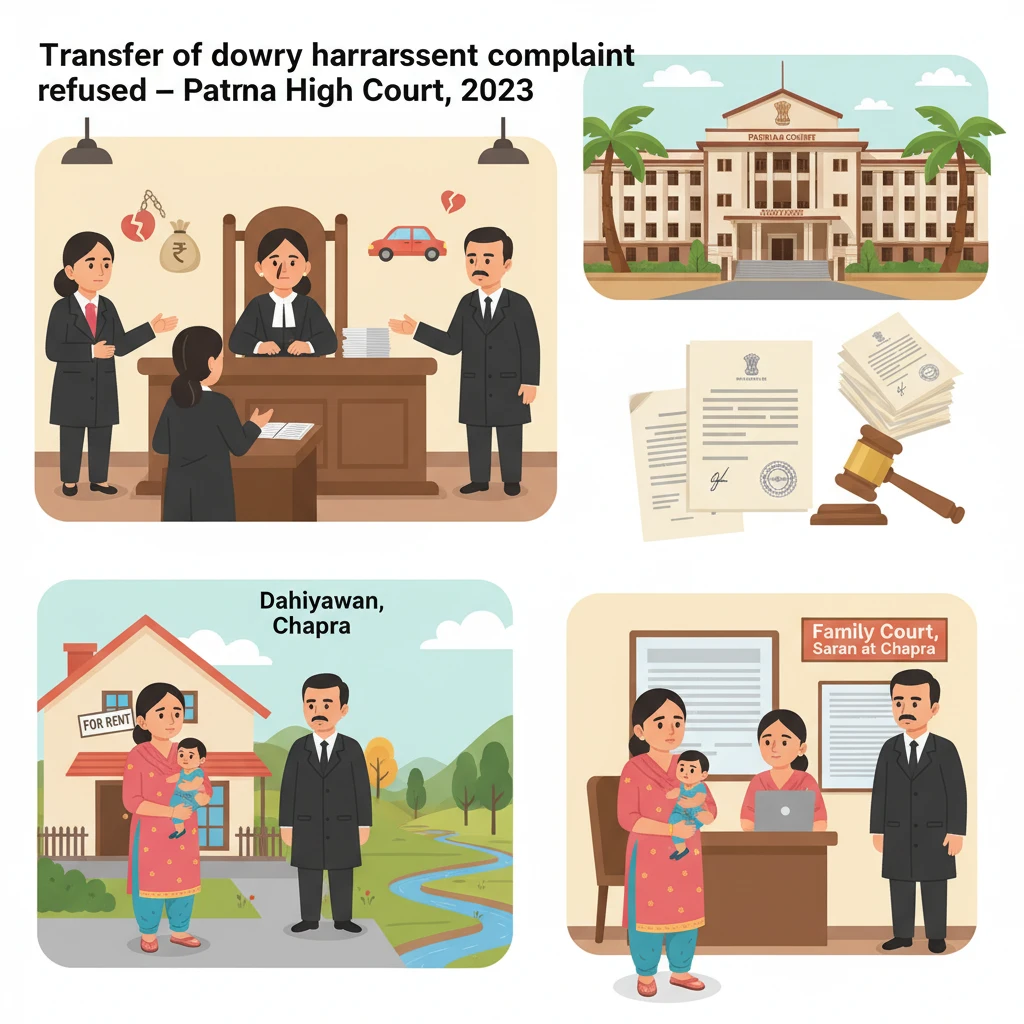
Case Background
The case arises out of a matrimonial dispute between a wife and her husband and his family members.
The marriage between the petitioner-wife and Opposite Party No. 2, her husband, was solemnised on 27.03.2018 according to Muslim rites.
According to the complaint, after some time of marriage, the behaviour of her in-laws changed. They allegedly started demanding Rs. 5 lakhs and one Alto car as dowry. On her failure to meet this demand, she claims she was subjected to torture and harassment.
The wife further alleged that when she became pregnant she was sent to her parental home, where she gave birth to a female child on 04.02.2020. She says that when she returned to her matrimonial home, the demand for dowry continued and, finally, on 29.02.2020 she was ousted from the matrimonial house.
Attempts by family members and well-wishers to settle the dispute allegedly failed. The wife then filed Complaint Case No. 688 (C) of 2020 on 25.11.2020 before the Sub Divisional Judicial Magistrate, Patna City, against her husband and his entire family, Opposite Party Nos. 2 to 8.
She alleged offences punishable under Sections 498-A, 323, 341, 307, 120-B and 34 of the Indian Penal Code and Sections 3 and 4 of the Dowry Prohibition Act.
On the basis of her statement and the statements of enquiry witnesses, the District Court, by order dated 09.03.2021, took cognizance for offences under Sections 323, 498-A and 34 of the Indian Penal Code and Section 4 of the Dowry Prohibition Act against her husband and her in-laws.
Meanwhile, the husband filed Criminal Miscellaneous No. 59685 of 2021 seeking anticipatory bail. By order dated 10.11.2022, the High Court granted him anticipatory bail on the condition that he would pay Rs. 3,500 per month as maintenance to the wife.
During the pendency of that anticipatory bail case, the wife had earlier filed Criminal Miscellaneous No. 18161 of 2022 on 07.04.2022, seeking transfer of the same complaint from Patna to Chapra. She later withdrew that petition because a compromise was reached and she was taken back to her matrimonial home. However, she alleges she was again assaulted and driven out after some time.
According to the wife, after being ousted she lived at Dargah Road, Sultanganj, Patna City. Due to the COVID-19 pandemic, she says survival with her sole daughter became impossible there. Her father then brought her to their native place. She now resides at Dahiyawan, Chapra, with her infant daughter.
From Chapra, she again approached the Patna High Court in Criminal Miscellaneous No. 6335 of 2023 under Section 407 of the Code of Criminal Procedure, 1973. Her prayer was to transfer Complaint Case No. 688 (C) of 2020 from the court of the Sub Divisional Judicial Magistrate, Patna City, to a court within the Sessions Division of Saran at Chapra.
What the Court Examined and Decided
The wife’s main ground for transfer was hardship and inconvenience. Her counsel argued that she is presently residing in Chapra with her small daughter. She has no one except her father to look after her and the child. Her father is an agent of ICICI Prudential and works purely on a private basis, so it is difficult for him to accompany her regularly.
The counsel further submitted that the distance between Chapra and Patna is about 80 kilometres. There is no direct train route between the two places. For this reason, it was said, it is very difficult for the wife to travel to Patna and properly pursue the criminal complaint.
It was also highlighted that another case between the same parties, Maintenance Case No. 140 of 2022, is pending before the Principal Judge, Family Court, Saran at Chapra. Because of this, the wife argued, it would be convenient and just to have her complaint case heard in Chapra as well.
On the other side, counsel for Opposite Party Nos. 2 to 8 opposed the transfer. He alleged that the wife had filed the complaint only to harass the husband and his family members, and that the entire family had been unnecessarily made accused, even though some had no connection with the matrimonial affairs of the couple.
According to the husband’s side, the wife is in the habit of leaving Patna for Chapra without informing her husband or his family. Attempts by the husband to bring her back allegedly failed because she was not ready to live with his family members from the time of marriage, although he was the only son residing in Patna to look after his parents.
The husband claimed he had always tried, and was still ready, to keep the wife with him. The opposite parties also asserted that she mistreated and misbehaved with him and his family, for which they had filed Information Petition No. 795 of 2020 on 02.06.2020.
To counter the allegation that the wife had been ousted from her matrimonial home during pregnancy and did not give birth there, the husband produced photographs with his counter affidavit. These photographs, he said, showed that the child’s birth ceremony was held at the matrimonial home.
He further submitted that the child was born at Mona Hassan Clinic, Nala Road, Patna, and that the medical expenses were borne by him and his company.
The husband’s counsel also disputed the claim about his income. While the wife asserted that he was working as an auditor in Nelson India Pvt. Limited at Patna and earning more than Rs. 50,000 per month, his side said he was only a surveyor in a private company, earning Rs. 20,000 per month. It was argued that it would be difficult for him to get leave and attend a shifted case in Chapra on every date.
It was further pointed out that Opposite Party Nos. 3 and 4, the father-in-law and mother-in-law, were old and suffering from age-related ailments. According to them, the wife was still residing at Patna, and she had filed this transfer petition only to harass the opposite parties.
After hearing both sides and perusing the record, the Patna High Court turned to the legal test for transfer of criminal cases within the State under Section 407 CrPC.
The Court summarised four situations where transfer may be allowed:
(i) where it is not possible to conduct a fair and impartial trial at the present place;
(ii) where there is a clearly visible apprehension of threat to the life of the petitioner;
(iii) where witnesses are not coming forward to depose or are turning hostile due to pressure tactics of the accused; and
(iv) where no prejudice will be caused to the other side by such transfer.
The Court then examined whether the wife’s grounds met any of these four criteria.
First, it noted that no evidence had yet been adduced by the complainant. Therefore, the question of witnesses turning hostile did not arise.
Secondly, the Court observed that the wife had not alleged any circumstance showing that a fair and impartial trial was not possible at Patna. There was no allegation of bias of the court or of any local influence preventing justice at Patna City.
Thirdly, the Court found that the wife had not been able to show any threat to her life or to that of her witnesses from the opposite parties. No material had been placed on record to support any such apprehension.
Because the first three grounds were absent, the Court concluded that the case did not fit the first three transfer conditions.
As to the fourth aspect, the Court considered possible prejudice to the other side if transfer were granted. It noted that cognizance had been taken against seven family members of the husband for offences under Sections 323, 498-A, 34 of the IPC and Section 4 of the Dowry Prohibition Act.
The Court recorded that some of these accused lived at different places and had no interference in the affairs of the couple, yet they had been made accused in the case.
Significantly, the Court also took into account that the holding tax receipt showed the wife herself had a house in Patna. In that context, the Court felt that transferring the case from Patna to Chapra, at the instance of the complainant, would cause more hardship to the opposite parties, especially to the elderly in-laws and the husband who worked in Patna.
In the Court’s view, it would “not be expedient, in the ends of justice” to transfer Complaint Case No. 688 (C) of 2020 from Patna City to any court in Saran at Chapra.
On this reasoning, the High Court held that the wife’s application under Section 407 CrPC lacked merit.
The transfer petition, Criminal Miscellaneous No. 6335 of 2023, was accordingly dismissed. There was no order as to costs.
Why This Judgment Matters
This decision is important for victims of matrimonial cruelty and dowry harassment who consider shifting their criminal cases for convenience.
The Patna High Court makes it clear that transfer of a criminal case is not allowed merely because one party finds it difficult to attend court at the place where the case is pending. Hardship, distance or lack of support, by themselves, are not enough.
The Court emphasised that transfer within the State is an exceptional step. The applicant must show one of the recognised grounds, such as a real threat to life, absence of fair trial, or witnesses being prevented from speaking freely.
The judgment also shows that the Court will look at hardship to both sides. Even when the complainant is a woman alleging dowry harassment, the Court will consider whether the accused, including elderly parents-in-law, will suffer more prejudice if the case is shifted.
For women in similar situations, this means that if a dowry or domestic violence case is already filed in one district, it may continue there unless very strong legal reasons exist for transfer. Convenience alone is not enough.
Legal Issues and Answers
-
Issue: Can a criminal complaint case for dowry harassment and cruelty filed in Patna be transferred to Chapra on the ground of the wife’s difficulty in travelling and living circumstances?
Answer: No. The Patna High Court held that the wife’s reasons did not fit any of the recognised grounds for transfer under Section 407 CrPC, and that such transfer would cause greater hardship to the accused family members. -
Issue: What conditions must exist for transfer of a criminal case within the State under Section 407 CrPC?
Answer: The Court reiterated four conditions: lack of possibility of a fair and impartial trial at the current place; clear apprehension of threat to the petitioner’s life; witnesses not coming forward or turning hostile due to pressure; and ensuring that no prejudice is caused to the other side.
Cases Cited by the Court
- No prior judgments have been cited or relied upon in the text of this decision.
Case Details
Case Number: Criminal Miscellaneous No. 6335 of 2023, arising out of Complaint Case No. 688 (C) of 2020
Case Title: Shaziya Naaz v. The State of Bihar & Others
Citation: 2024(1) PLJR 464
Court: High Court of Judicature at Patna
Coram: Hon’ble Mr. Justice Anil Kumar Sinha
Date of Judgment: 03.11.2023
Advocates: Mr. Vijay Anand for the petitioner; Mr. Md. Matloob Rab for the State; Mr. Md. Azimuddin for Opposite Party Nos. 2 to 8
Nature of the Case: Criminal miscellaneous petition under Section 407 of the Code of Criminal Procedure, 1973, seeking transfer of a criminal complaint case relating to alleged offences under Sections 323, 498-A, 34 of the Indian Penal Code and Section 4 of the Dowry Prohibition Act.
Link to Judgment: Read full judgment on the Patna High Court website
If you found this explanation helpful and wish to stay informed about
how legal developments may affect your rights in Bihar,
you may consider following Samvida Law Associates for more updates.







