

Case Background
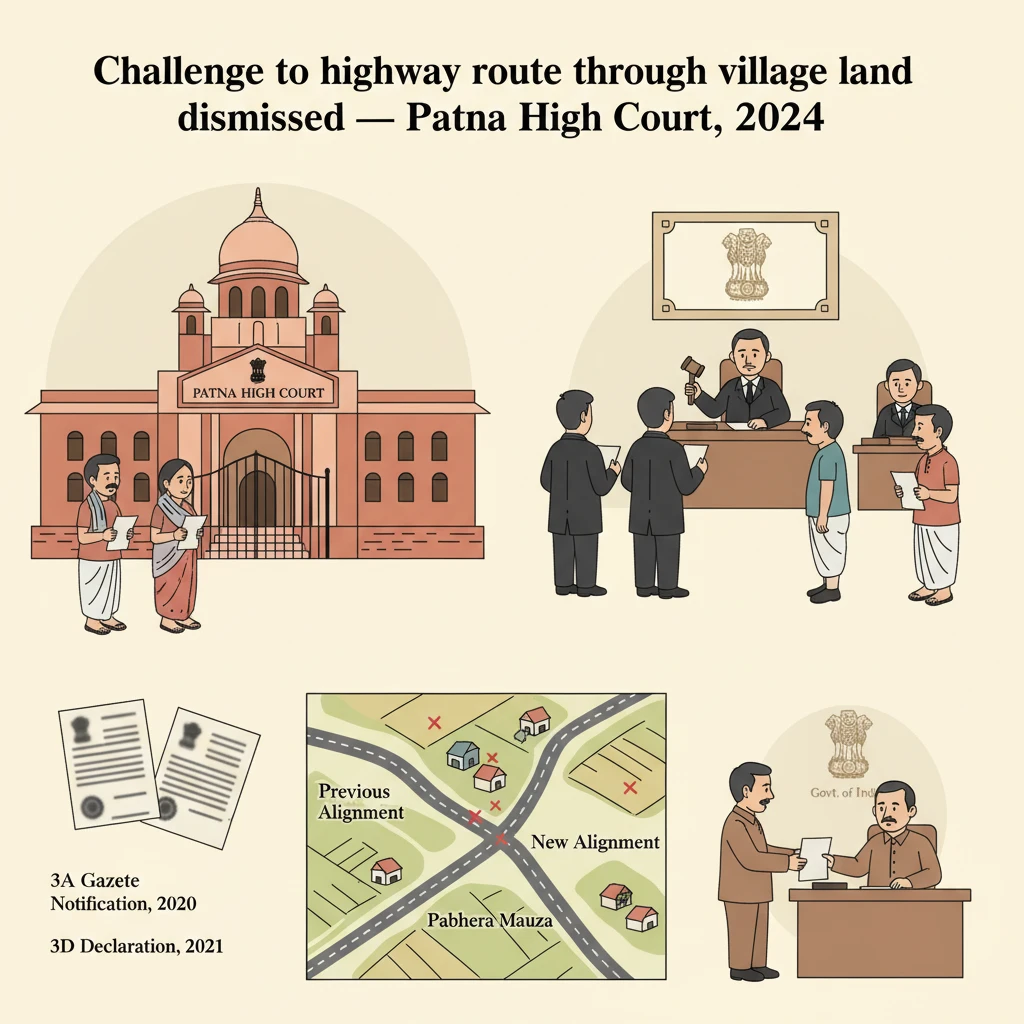
The case was filed as a civil writ petition before the Patna High Court. The petitioners were three villagers from Pabhera Mauza in Dhanarua police station, Patna district.
They approached the Court against the State of Bihar and various authorities connected with the National Highways Authority of India (NHAI), including the Project Director, the Regional Director, and district-level land acquisition officials.
The dispute arose from the Jai-Nagar Aurangabad North-South Corridor, part of the Bharat Mala Sringkhala project. According to the petitioners, a new alignment of this corridor was proposed, which passed through Pabhera Mauza and the village area.
The villagers claimed that this new route caused unnecessary encroachment on their land and also on the land of other villagers. They wanted the authorities to go back to the earlier alignment of the road, which, according to them, also passed through the village but did not affect their land in the same way.
Feeling aggrieved by the change and the resulting acquisition of land, they filed the writ petition in 2021, asking the Patna High Court to cancel the new alignment and accept the earlier one.
What the Court Examined and Decided
The Patna High Court, through Hon’ble Mr. Justice Prabhat Kumar Singh, heard the parties and delivered an oral judgment on 01-02-2024.
The key relief sought by the petitioners was a direction to cancel the new alignment of the Jai-Nagar Aurangabad North-South Corridor running through Pabhera Mauza and to accept the previous alignment of the same road. Their challenge was essentially to the route chosen for the highway and the resulting land acquisition.
On behalf of the NHAI authorities, respondents no. 3 and 4, a counter affidavit was filed. This counter affidavit became central to the Court’s consideration.
In paragraph 5 of the counter affidavit, the NHAI authorities pointed out that statutory land acquisition steps under the National Highways Act, 1956 had already been completed. They stated that a notification under Section 3A of the National Highways Act (3A Gazette Notification) had been issued vide S.O. No. 3244(E) dated 23-09-2020.
They further stated that a declaration under Section 3D of the Act had been published vide S.O. No. 1311(E) dated 24-03-2021. According to Section 3D, once the declaration is published in the Official Gazette, the land described in it vests in the Central Government free from all encumbrances.
The counter affidavit explained that, after publication of the Gazette notification under Section 3D, the land in question had already vested in the Central Government. Photocopies of both Gazette Notifications — S.O. No. 3244(E) dated 23-09-2020 and S.O. No. 1311(E) dated 24-03-2021 — were filed as Annexures R 3&4-1 and 1A.
This meant that, by the time the writ petition was being heard, the statutory process of acquisition under the National Highways Act had already crossed the crucial stage where land ownership passes to the Government.
After taking note of these facts, the Court turned to the legal position regarding judicial interference in the alignment of national highways and large infrastructure projects.
The Court observed that the law is well settled: courts are not equipped to decide on the viability and feasibility of particular projects or on whether one alignment of a highway is better than another from the point of view of public interest.
In such matters, the scope of judicial review is very limited. The judge referred to and relied upon the decision of the Hon’ble Supreme Court in Union of India vs. Kushala Shetty & Ors, reported in (2011) 12 SCC 69.
Paragraph 24 of that Supreme Court judgment was reproduced in the Patna High Court’s order. In that paragraph, the Supreme Court emphasised that NHAI is a professionally managed statutory body with expertise in development and maintenance of national highways.
The Supreme Court had noted that highway projects, including construction and widening, are vital for infrastructure development. These projects are prepared and implemented after thorough study by experts in different fields, and detailed project reports are made keeping in view heavy traffic and larger public interest.
Most importantly, the Supreme Court had held that courts are not at all equipped to decide whether a particular alignment is appropriate or whether it best serves public interest. Judicial review is confined to checking if the project or acquisition is ex facie contrary to law or tainted by mala fides (bad faith).
The Supreme Court clarified that a court may nullify acquisition or, in the rarest of rare cases, the project itself, only if there is clear proof of violation of the statutory mandate or of malice in fact.
Applying this binding precedent, the Patna High Court looked at the material on record in the present case. There is no discussion in the judgment about any specific plea of mala fides or any established violation of the National Highways Act, 1956, in relation to the Jai-Nagar Aurangabad North-South Corridor.
The judgment notes that the Gazette notifications under Sections 3A and 3D were duly issued and that, following Section 3D, the land had vested in the Central Government free from encumbrances. There is no finding of any defect in these notifications.
Therefore, after hearing the learned counsel for all parties and perusing the materials, the Court concluded that the petitioners had not made out a case falling within the narrow window where courts can interfere.
The judge stated explicitly that, having regard to the law laid down by the Supreme Court in Union of India vs. Kushala Shetty & Ors, he did not find any merit in the writ petition.
On that basis, the Court dismissed the writ petition. No other directions or reliefs are mentioned in the judgment. With this dismissal, the land acquisition and the new alignment of the Jai-Nagar Aurangabad North-South Corridor, as notified, remain undisturbed and can proceed further.
Why This Judgment Matters
This judgment is important for landowners and villagers facing acquisition for national highway projects, especially in Bihar.
First, it confirms that once the Government has completed the process under Sections 3A and 3D of the National Highways Act, and land has vested in the Central Government, courts will be very slow to interfere with the project’s alignment.
Second, the decision reinforces that the Patna High Court will follow the Supreme Court’s view that decisions on the route and design of highways are for expert bodies like NHAI, not for courts. People cannot use writ petitions simply to ask the Court to shift or revert the alignment, unless they can clearly show that the law has been broken or that the action is motivated by bad faith.
For villagers, this means that challenges based only on hardship or disagreement with the alignment, without proof of illegality or mala fides, are unlikely to succeed once the statutory notifications are issued and published.
Legal Issues and Answers
Issue: Can the Patna High Court cancel or change the alignment of a national highway passing through village land when statutory acquisition notifications under Sections 3A and 3D of the National Highways Act have already been issued?
Answer: No. Relying on Supreme Court precedent, the Court held that alignment and feasibility are matters for expert authorities like NHAI, and judicial review is very limited once valid acquisition notifications have been issued and land has vested in the Central Government.
Cases Cited by the Court
- Union of India vs Kushala Shetty & Ors, (2011) 12 SCC 69
Case Details
Case Number: Civil Writ Jurisdiction Case No. 12244 of 2021
Case Title: Angad Kumar @ Angad Prasad Yadav & Ors vs The State of Bihar & Ors
Coram: Hon’ble Mr. Justice Prabhat Kumar Singh
Citation: 2024 (1) PLJR 812
Advocates:
- For the petitioners: Mr. Y.C. Verma, Senior Advocate; Mr. Ashok Kumar, Advocate
- For the State: Ms/Mrs. Pushpanjali Sharma, AC to SC 20
- For NHAI: Mr. Kumar Gautam, Advocate
Nature of the case: Writ petition challenging highway alignment and related land acquisition
Link to judgment: Patna High Court Judgment
If you found this explanation helpful and wish to stay informed about
how legal developments may affect your rights in Bihar,
you may consider following Samvida Law Associates for more updates.







