

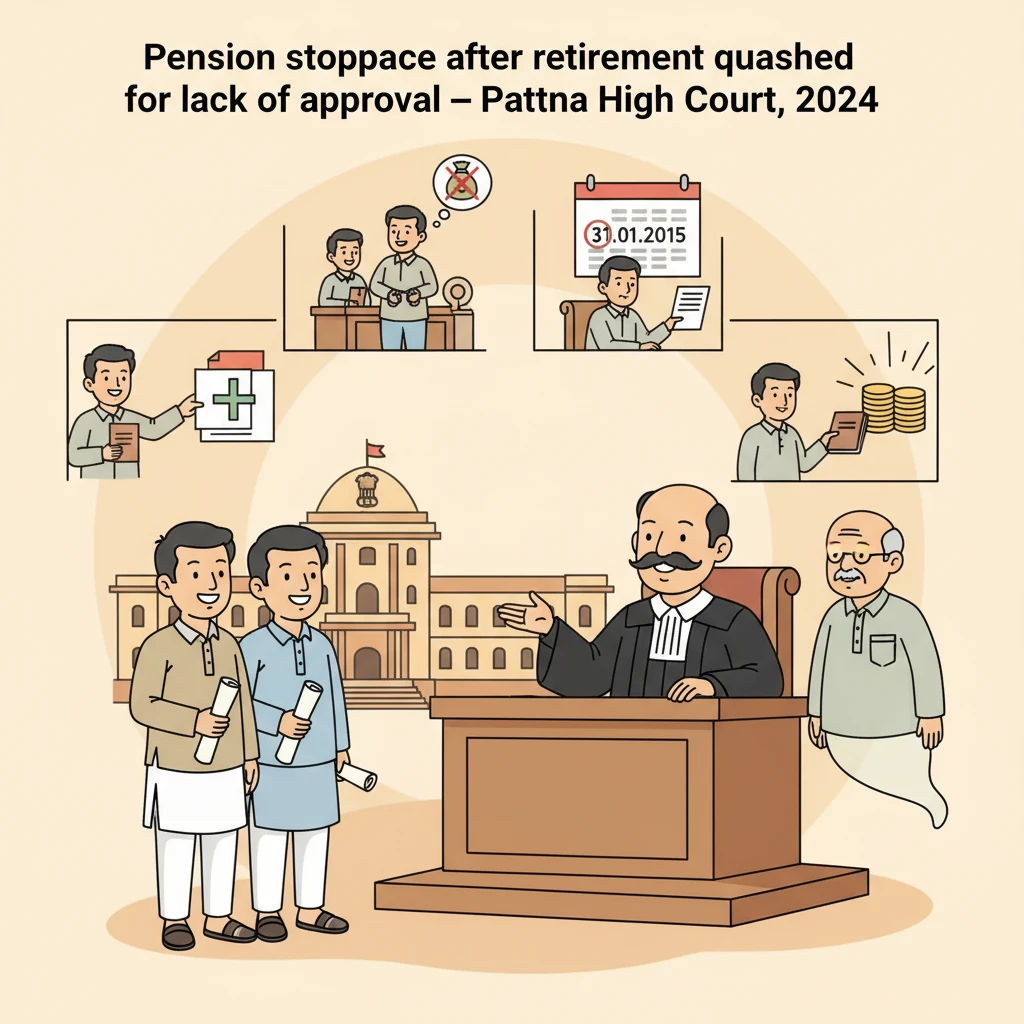
Case Background
The petition was filed by the sons of a deceased clerk who had served in Sadar Hospital, Purnea. He worked in the office of the Superintendent of Sadar Hospital and also held additional charge in the office of the Licensing Officer, Sadar Hospital.
A Vigilance Case No. 076 of 2014 was registered against him under the Prevention of Corruption Act. According to the State, he was allegedly caught red-handed while taking bribe money and was arrested by the Vigilance team on 20.10.2014. The petitioners have stated that he was arrested on 21.10.2014 and was later granted bail on 04.03.2015.
The clerk was placed under suspension on 21.10.2014, the day after his arrest. During his custody in jail, he reached the age of superannuation and retired on 31.01.2015.
After his retirement and release on bail, a departmental proceeding was initiated against him. The Civil Surgeon-cum-Chief Medical Officer, Purnea issued Memo No. 1686 dated 02.06.2015, serving it upon him on 24.06.2015, initiating the departmental enquiry. The Health Department relied on a direction said to have been issued by the Director-in-Chief, Health Services through letter No. 559(4) dated 22.05.2015.
On completion of the enquiry, the Enquiry Officer-cum-Additional Chief Medical Officer, Purnea submitted an enquiry report contained in letter No. 233 dated 04.08.2016, holding the charges of misconduct proved.
Based on this report, the Civil Surgeon-cum-Chief Medical Officer, Purnea passed an order of punishment vide Memo No. 2027 dated 03.08.2017. By this order, 100% pension and gratuity of the retired clerk were permanently withheld, and he was held entitled only to subsistence allowance for the suspension period.
The retired employee filed a service appeal before the Director-in-Chief (Disease Control), Health Services, Bihar, Patna. This appeal was rejected by a reasoned order contained in Memo No. 1295(4) dated 25.10.2018.
During pendency of the present writ petition, the retired employee died. His heirs and legal representatives, already on record as petitioners, continued the case to seek restoration of pensionary benefits.
What the Court Examined and Decided
The core question before the Patna High Court was whether the departmental proceeding, initiated after the employee’s retirement, was validly started under Rule 43(b) of the Bihar Pension Rules, 1950. This question was important because the punishment of withholding 100% pension and gratuity flowed directly from that proceeding.
The petitioners’ counsel argued that after retirement, any departmental proceeding to affect pension must strictly follow Rule 43(b) of the Bihar Pension Rules, 1950. Under this provision, the State Government has to take a specific decision to initiate such proceeding against a retired employee. They submitted that in this case, there was no decision by the State Government, and that the alleged decision through letter No. 559(4) dated 25.05.2015 was not issued by the State Government.
The petitioners drew attention to an earlier order of the High Court dated 18.12.2023, by which the Court had directed the State to produce the original disciplinary record. On examining those records, counsel submitted that the decision to initiate departmental proceedings was taken only on 25.05.2015, i.e., after the employee’s retirement on 31.01.2015. Therefore, according to them, compliance with Rule 43(b) was mandatory and missing.
On the other side, the State argued that the writ petition was not maintainable because the employee had been caught red-handed in a Vigilance trap and arrested. It was contended that the suspension order dated 21.10.2014, issued soon after his arrest, should be read as an indication that the competent authority had already decided to continue or initiate departmental proceedings.
The State further relied on a Full Bench judgment of the Patna High Court in Shambhu Sharan vs. State of Bihar, reported in 2000 (1) PLJR 665. In that decision, the Full Bench held that where a disciplinary proceeding is initiated before an employee’s superannuation, it can continue after retirement and in such cases there is no need for any separate order under Rule 43(b) of the Bihar Pension Rules, 1950.
Placing reliance on this principle, the State argued that because a suspension order had been issued before retirement under Rule 9 of the Bihar Government Servants (Classification, Control & Appeal) Rules, 2005 (CCA Rules, 2005), it should be assumed that the decision to initiate departmental proceedings had already been taken. The State also pointed to Rules 15 and 16 of the CCA Rules, 2005, to say that the Director-in-Chief of Health Services is a competent authority to initiate proceedings, and therefore could take a decision under Rule 43(b) of the Bihar Pension Rules on behalf of the State.
The Court carefully considered these rival submissions and examined the original departmental record produced by the State. From the documents, the Court found certain undisputed facts:
First, the employee was arrested on 20.10.2014 and suspended on 21.10.2014. Second, he retired on 31.01.2015. Third, he was granted bail on 04.03.2015. Fourth, the decision to initiate departmental proceedings was communicated through Memo No. 1686 dated 02.06.2015 and served on him on 24.06.2015, clearly after his retirement.
On these facts, the Court held that the role of the CCA Rules, 2005 generally ends once an employee retires or superannuates. The Court recognised only two exceptions to this rule:
One, where a decision to initiate departmental proceedings has already been taken before retirement, as recognised by the Full Bench in Shambhu Sharan vs. State of Bihar, 2000 (1) PLJR 665. In such a situation, proceedings may legally continue after retirement.
Two, where proceedings are initiated under Rule 43(b) of the Bihar Pension Rules, 1950. Under this Rule, before 13.05.2020, only the State Government was competent to take a decision to initiate such proceedings within four years from the date of the cause of action. From 13.05.2020 onwards, by virtue of a legal change, the appointing authority could take such a decision.
Applying these legal principles, the Court rejected the State’s contention that the suspension order could be treated as a decision to initiate departmental proceedings sufficient to satisfy Rule 43(b). The Court stated that while authorities may decide on disciplinary action before retirement under the CCA Rules, after retirement only the State Government (up to 12.05.2020) had the power to approve initiation of proceedings under Rule 43(b). Therefore, the plea that appointing or disciplinary authorities could unilaterally continue the proceeding after retirement was held to be a wrong statement of law.
On perusal of the original record, the Court further found that order No. 559(4) dated 25.05.2015 had not been made by the State Government. Therefore, the decision to initiate the departmental proceeding under Rule 43(b) of the Bihar Pension Rules, 1950 was not valid in law.
The Court also reasoned that if the suspension order itself were enough to show that proceedings had already been validly initiated before retirement, there would have been no need for the authority to separately pass an order under Rule 43(b) after retirement. The very act of passing such a post-retirement order showed that the authorities themselves understood that a fresh decision under Rule 43(b) was required because the employee had already retired.
In light of these findings, the Court concluded that Memo No. 1686 dated 02.06.2015, by which the departmental proceeding was initiated after retirement, had not been passed in accordance with law. This memo was therefore quashed.
Once the foundation for the departmental proceeding was held invalid, all subsequent actions based on that memo also fell. Accordingly, the Court set aside:
The enquiry report contained in letter No. 233 dated 04.08.2016 submitted by the Enquiry Officer-cum-Additional Chief Medical Officer, Purnea.
The disciplinary order contained in Memo No. 2027 dated 03.08.2017 issued by the Civil Surgeon-cum-Chief Medical Officer, Purnea, by which 100% pension and gratuity were permanently withheld.
The appellate order contained in Memo No. 1295(4) dated 25.10.2018 passed by the Director-in-Chief (Disease Control), Health Services, Bihar, Patna, which had rejected the service appeal.
Finally, noting that the delinquent employee had died during the proceeding and his heirs had already been substituted, the Court issued a direction to the State-respondents. It held that upon filing a representation by the substituted legal heirs, the State must calculate all dues payable to the deceased employee in accordance with law and ensure payment within six months from the date of receipt or production of a copy of the Court’s order.
Why This Judgment Matters
This judgment is important for retired government employees and their families, especially in Bihar. It clarifies that once an employee retires, the department cannot casually start or continue a departmental case that affects pension.
The Court has stressed that before 13.05.2020 only the State Government, and not just any departmental officer, could authorise initiation of proceedings under Rule 43(b) of the Bihar Pension Rules, 1950. Without this proper approval, any later enquiry and punishment affecting pension are invalid.
For families of deceased or retired employees, this ruling shows that if pension or gratuity has been stopped on the basis of a post-retirement departmental proceeding, they can check whether Rule 43(b) was properly followed. If not, they may have a strong ground to challenge the stoppage and seek release of dues.
For departments, the judgment is a reminder that strict legal process must be followed when dealing with pension, even in serious cases such as vigilance traps. Suspicion of misconduct alone cannot justify ignoring mandatory rules.
Legal Issues and Answers
- Issue: Could the Health Department validly initiate a departmental proceeding after the employee’s retirement and withhold 100% of his pension and gratuity without a decision of the State Government under Rule 43(b) of the Bihar Pension Rules, 1950?
Answer: No. The Patna High Court held that after retirement, only a proceeding properly initiated under Rule 43(b) on the decision of the State Government (for the period in question) could affect pension. Since order No. 559(4) dated 25.05.2015 was not issued by the State Government, Memo No. 1686 dated 02.06.2015 initiating the proceeding was illegal, and all subsequent enquiry, punishment, and appellate orders were quashed. - Issue: Does issuance of a suspension order before retirement automatically prove that departmental proceedings had been validly initiated so as to avoid the need for Rule 43(b) approval?
Answer: No. The Court rejected this argument, holding that mere suspension under the CCA Rules, 2005 cannot replace the specific decision required under Rule 43(b) after retirement. If suspension were enough, there would have been no need for the authorities to attempt a separate post-retirement order under Rule 43(b). - Issue: Who was competent to authorise post-retirement departmental proceedings affecting pension during the period relevant to this case?
Answer: For the period up to 12.05.2020, including the dates in this case, only the State Government was competent to take a decision under Rule 43(b) of the Bihar Pension Rules, 1950. The later change substituting the “appointing authority” from 13.05.2020 did not apply.
Cases Cited by the Court
- Shambhu Sharan vs. State of Bihar, 2000 (1) PLJR 665 (Full Bench), cited to explain that a disciplinary proceeding initiated before retirement can continue after superannuation without a fresh order under Rule 43(b) of the Bihar Pension Rules, 1950.
Case Details
Case Number: Civil Writ Jurisdiction Case No. 2752 of 2018
Case Title: Diwakar Singh & Anr vs. The State of Bihar & Ors
Coram: Hon’ble Mr. Justice Dr. Anshuman
Citation: 2024(1) PLJR 919
Advocates:
- For the Petitioners: Mr. Ranjeet Kumar, Advocate
- For the Respondents (State): Mr. S. D. Yadav, AAG-9; Mr. Atul Kumar Verma, AC to AAG-9
Nature of the Case: Writ petition challenging departmental enquiry, punishment order withholding pension and gratuity, and appellate order under service and pension rules.
Link to the Judgment: Click here to read the full judgment of the Patna High Court
If you found this explanation helpful and wish to stay informed about how legal developments may affect your rights in Bihar, you may consider following Samvida Law Associates for more updates.







