

Case Background
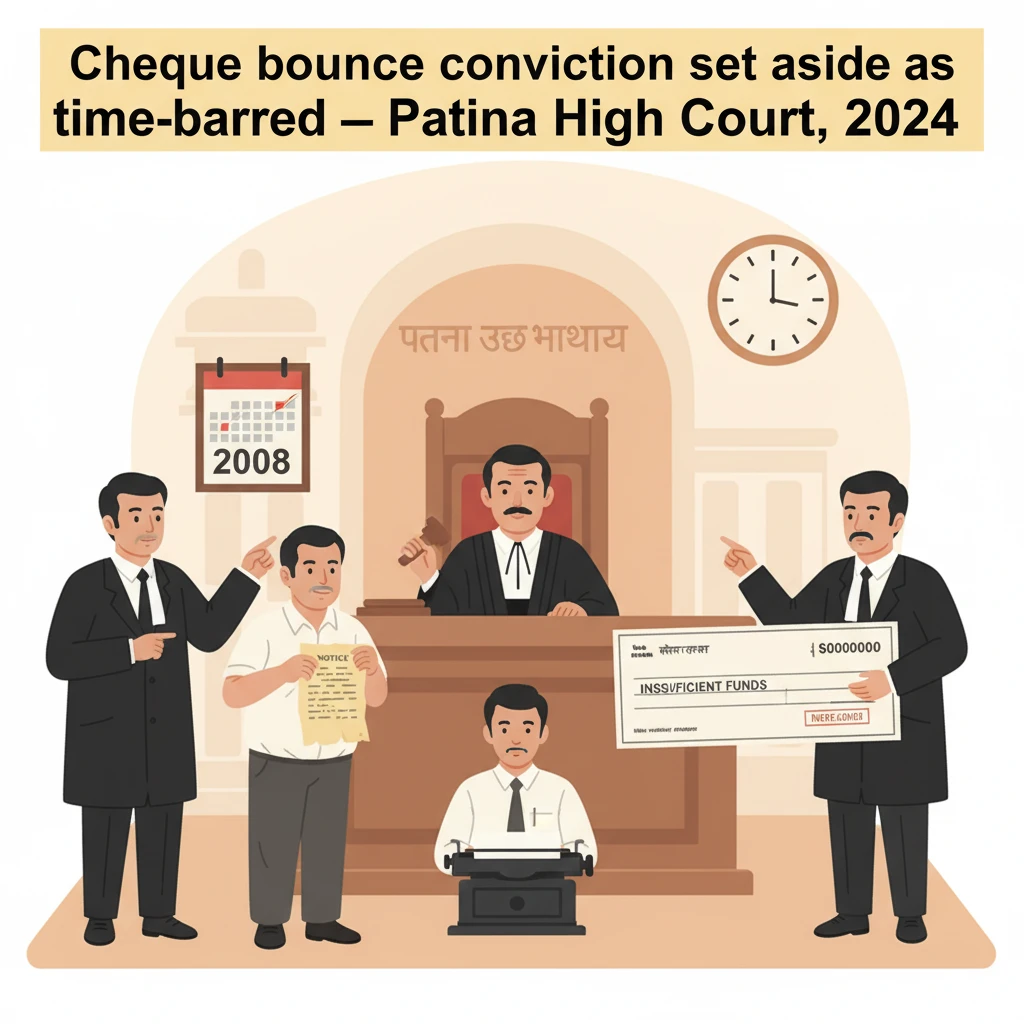
The dispute started with a business transaction between a book agency and a partnership firm dealing in paper. To clear an alleged outstanding liability, the accused issued an account payee cheque dated 12 May 2008 for Rs. 2,80,848/- in favour of the partnership firm, M/s Patna Paper Company. The cheque was drawn on State Bank of India, Chauhatta Branch, Patna.
The complainant, a partner of the paper company, deposited the cheque with his bank. On 6 September 2008, the bank returned the cheque unpaid with the remark “insufficient funds”. This dishonour of cheque triggered the legal process under Section 138 of the Negotiable Instruments Act.
After the cheque was dishonoured, the complainant sent a legal notice dated 18 September 2008 through his advocate, under Section 138 of the Negotiable Instruments Act. The notice was sent by registered post on 20 September 2008, demanding payment of the cheque amount from the accused.
According to the complainant, the accused manipulated to get this notice returned with the postal endorsement “Always not met”, suggesting deliberate avoidance of service. The complainant further alleged that he sent another notice on 4 October 2008 by registered post, but even then payment was not made.
When no payment was received within the statutory period, the complainant filed a complaint on 12 November 2008 in the Court of the Judicial Magistrate, 1st Class, Patna. The complaint alleged offences under Sections 420, 406, 120B of the Indian Penal Code and Section 138 of the Negotiable Instruments Act.
The Magistrate took cognizance of the case and issued summons to the accused. The accused appeared, the trial went ahead, and evidence was recorded. At the end of the trial, the Magistrate held the accused guilty under Section 138 of the Negotiable Instruments Act.
The Magistrate sentenced the accused to simple imprisonment for one year and directed him to pay Rs. 3,81,000/- to the complainant in lieu of the cheque amount of Rs. 2,80,848/-. This amount was treated as compensation towards the dishonoured cheque.
The accused challenged this conviction and sentence in Criminal Appeal No. 174 of 2013 before the Additional Sessions Judge, 6th Court, Patna. The appellate court, however, dismissed the appeal on contest and confirmed the judgment of the trial court.
Aggrieved by the concurrent findings of conviction and sentence, the accused approached the Patna High Court in Criminal Revision No. 1236 of 2019. Justice Bibek Chaudhuri heard the matter and delivered the oral judgment on 9 February 2024.
What the Court Examined and Decided
Before the Patna High Court, the accused raised several legal objections. The focus of the Court’s final reasoning, however, centred on limitation under Section 138 read with Section 142 of the Negotiable Instruments Act as amended in 2002.
First, the accused argued that the complainant, in his personal capacity, was not the proper person to file the complaint. The cheque was drawn in favour of M/s Patna Paper Company, a partnership firm. According to the accused, the complainant, being only one of its partners, had filed the complaint without a letter of authorisation from the other partners. On this basis, it was argued that the complaint was defective as it was not instituted by the payee or holder in due course in a proper legal form.
Secondly, the accused contended that only one notice dated 18 September 2008 was actually sent and presumed to have been received, and that no separate notice dated 4 October 2008 was ever served on him.
The principal legal submission, however, related to the mandatory time limits for sending notice and filing the complaint. The defence relied on the scheme of Section 138 of the Negotiable Instruments Act and its proviso, especially clause (c). The accused pointed out that under this provision, the payee or holder in due course must first send a written demand notice within 30 days from receiving information of dishonour from the bank.
After such notice is received, the drawer of the cheque gets 15 days’ time to pay the cheque amount. If he still does not pay within this period, then and only then is an offence under Section 138 deemed to have been committed. Thereafter, as per Section 142 of the Act, the complaint must be filed within one month from the date when such cause of action arises.
In support of the general legal position, the accused’s counsel referred to the Supreme Court decision in N. Parameswaran Unni v. G. Kannan & Anr., reported in (2017) 5 SCC 737. The Patna High Court clarified that this Supreme Court decision dealt with cheques issued before the 2003 amendment to the Negotiable Instruments Act. In that earlier period, the wording of Section 138 was different. The present case, however, arose after the amendment brought in by Act 55 of 2002, effective from 6 February 2003.
The High Court then reproduced the amended text of Section 138 in full, including the proviso clauses (a), (b) and (c) and the Explanation. The Court emphasised that under the amended law, the payee or holder in due course is under an obligation to issue a demand notice within 30 days of receiving information from the bank regarding the return of the cheque unpaid.
Applying these provisions to the facts, the Court noted the admitted dates on record. The bank’s memo showing dishonour of the cheque was dated 6 September 2008. The complainant’s notice under Section 138 was sent by registered post on 20 September 2008. This date fell well within the permitted 30 days from the date of dishonour, so the notice itself was not time-barred.
The accused himself contended that he is presumed to have received this notice, as it was sent to the correct address of the firm by registered post on 20 September 2008. Proceeding on this basis, the Court held that the accused was obliged to pay the cheque amount within 15 days from that date. Therefore, the outer date for payment by the accused was 5 October 2008.
When the accused did not pay within those 15 days, the cause of action for filing a complaint under Section 138 arose. Under Section 142(1)(a) and (b) of the Negotiable Instruments Act, the complaint had to be filed within one month from the date of accrual of that cause of action.
On this calculation, the complaint ought to have been filed on or before 6 November 2008. However, the actual complaint was filed only on 12 November 2008. This filing date was beyond the statutory period of one month from the date when the cause of action under Section 138 matured.
The High Court therefore held that the complaint was barred by limitation. Since the complaint itself was filed late, the Magistrate could not have taken cognizance of the offence in light of Section 142 of the Act. Neither the trial court nor the appellate court had examined this crucial aspect of limitation, although it went to the root of the jurisdiction to proceed.
On this basis, the High Court concluded that cognizance of the offence was bad in law. As the complaint could not be entertained for being beyond the statutory period, no relief could be granted to the complainant on the basis of such a time-barred complaint.
Consequently, the Patna High Court quashed and set aside the judgment and order of conviction and sentence passed by the Judicial Magistrate, 1st Class, Patna, as well as the appellate judgment affirming it. The criminal revision filed by the accused was allowed.
Why This Judgment Matters
This judgment is important for both business persons and ordinary citizens who deal with cheques. It highlights that in cheque bounce cases, time limits are strict and cannot be ignored.
Even if the cheque is dishonoured and all other conditions are satisfied, the complaint will fail if it is filed late. The Court made it clear that filing even a few days beyond the statutory period can make the entire prosecution invalid.
For complainants, including firms and small traders, this case is a reminder to carefully track dates: date of dishonour, date of notice, expiry of 15 days after notice, and the deadline for filing the complaint. A small delay can result in loss of the criminal remedy under Section 138.
For accused persons, the case shows that courts will examine whether basic statutory requirements under the Negotiable Instruments Act, such as limitation under Section 142, are met. If the complaint is time-barred, prior convictions can be set aside even after trial and appeal.
Legal Issues and Answers
Issue: Whether a complaint under Section 138 of the Negotiable Instruments Act filed after expiry of the one-month period prescribed in Section 142 is maintainable.
Answer: No. The Patna High Court held that when the complaint was filed beyond the prescribed one-month period from accrual of cause of action, cognizance could not be taken, rendering the conviction unsustainable.
Issue: From which dates should the limitation under Section 138 and Section 142 of the Negotiable Instruments Act be computed in this case.
Answer: The Court computed limitation from 20 September 2008 (date of dispatch of notice by registered post, presumed served), allowing 15 days until 5 October 2008 for payment, and one month thereafter up to 6 November 2008 for filing the complaint. As the complaint was filed on 12 November 2008, it was held to be time-barred.
Cases Cited by the Court
- N. Parameswaran Unni v. G. Kannan & Anr., (2017) 5 SCC 737 (referred to explain that it dealt with the pre-amendment position of the Negotiable Instruments Act).
Case Details
Case Number: Criminal Revision No. 1236 of 2019; arising out of Complaint Case No. 3070 (C) of 2008.
Case Title: Ashok Kumar Mishra v. The State of Bihar & Anr.
Coram: Hon’ble Mr. Justice Bibek Chaudhuri
Citation: 2024 (1) PLJR 877
Advocates:
- For the Petitioner (accused/revisionist): Mr. Bimlendu Mishra, Advocate; Ms. Poonam Mishra, Advocate.
- For the State: Mr. Md. Matloob Rab, APP.
- For the Opposite Party No. 2 (complainant): Mr. Jitendra Prasad Singh, Advocate; Mr. Kunal Ranjan, Advocate.
Nature of the Case: Criminal revision challenging conviction and sentence under Section 138 of the Negotiable Instruments Act, 1881.
Link to Judgment: Patna High Court Judgment
If you found this explanation helpful and wish to stay informed about
how legal developments may affect your rights in Bihar,
you may consider following Samvida Law Associates for more updates.







