

Case Background
The criminal proceedings started from Madhaura P.S. Case No. 198 of 2016 in District Saran. The FIR was lodged on the basis of the self-statement of a Sub-Inspector of Police.
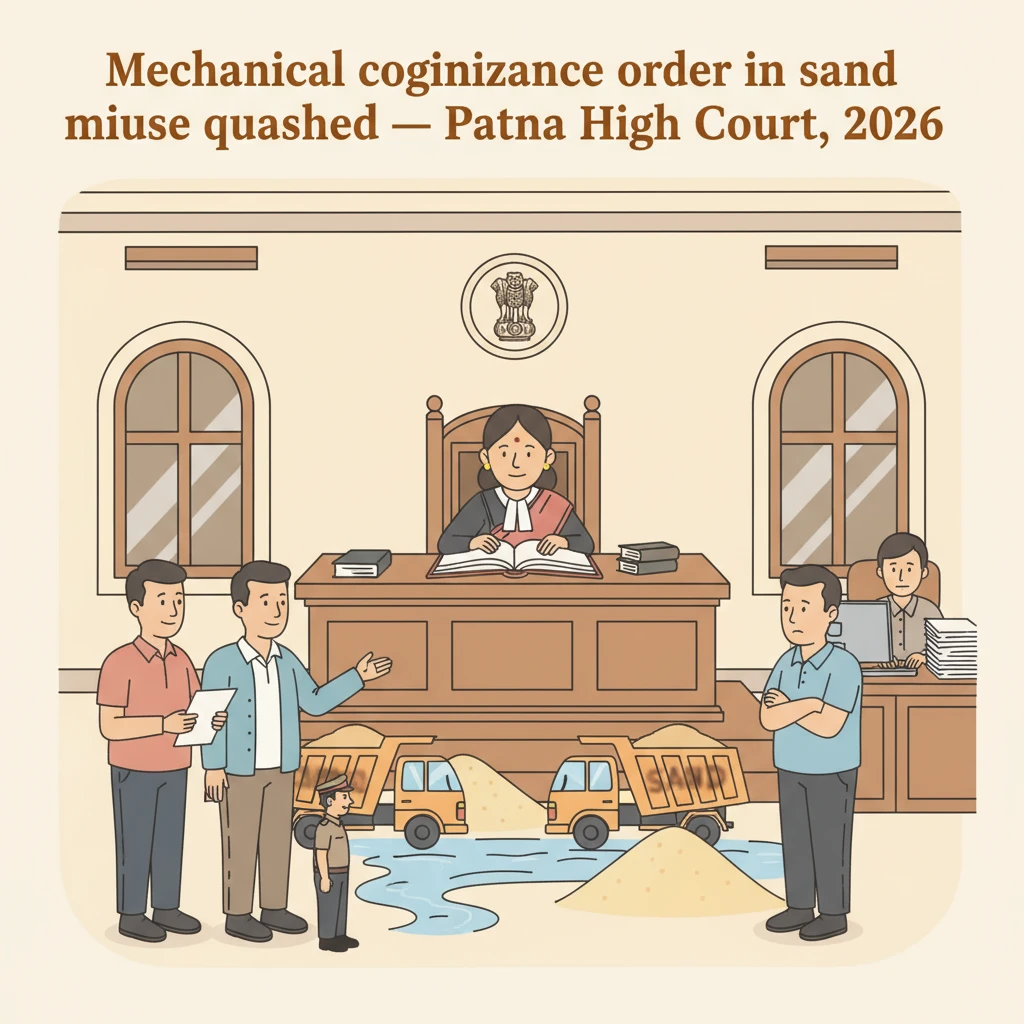
According to the FIR, two trucks loaded with sand were intercepted at a time when there was a total ban on excavation and transportation of sand, which falls under mines and minerals. On this basis, allegations of illegal mining and transportation of sand were made.
In the FIR, it was recorded that, on inquiry, the driver of one of the trucks disclosed the name of the present petitioner as the owner of that truck. Later, during investigation, this statement was retracted; it transpired that the driver had not named the petitioner as owner and had instead taken the name of some other person.
Despite this, after investigation the police submitted charge-sheet against the accused persons including the petitioner. On 30.09.2019, the court of the Additional Chief Judicial Magistrate, XIV, Chapra (ACJM-14) took cognizance in Trial No. 2892 of 2019 for offences under Sections 188, 379, 420, 409 read with Section 34 of the Indian Penal Code and issued summons.
The case did not progress beyond the stage of taking cognizance. No further stage, such as framing of charge or trial, had been reached when the petitioner approached the Patna High Court.
The petitioner filed Criminal Miscellaneous No. 11247 of 2021 before the Patna High Court seeking quashing of the cognizance order dated 30.09.2019 in Madhaura P.S. Case No. 198 of 2016, primarily on legal and factual grounds.
What the Court Examined and Decided
The Patna High Court, presided over by Hon’ble Justice Smt. Soni Shrivastava, heard the matter on 08.01.2026. Counsel for the petitioner argued both legal defects in the cognizance order and lack of factual basis for the offences alleged.
First, on the legal side, it was argued that the impugned order of the learned Magistrate suffered from total non-application of judicial mind. According to the petitioner, the order was routine, patterned and mechanical, reflecting no independent consideration of the materials to see whether a prima facie case existed against the petitioner.
To support this, reliance was placed on earlier judgments of coordinate Benches of the Patna High Court, namely:
- Dharmesh Prasad Verma vs. State of Bihar, 2017 (1) PLJR 401;
- Shambhu Sharan Sharma vs. State of Bihar & Anr., 2023 (1) PLJR 871;
- Birendra Pd. Singh vs. State of Bihar, 2023 (2) PLJR 931.
These cases emphasise that an order taking cognizance must show application of mind to the materials on record and cannot be passed in a standard template manner.
Second, the petitioner raised a specific legal bar under Section 195(1)(a) of the Code of Criminal Procedure (Cr.P.C.) with respect to offences under Section 188 of the IPC. Section 188 deals with disobedience to an order duly promulgated by a public servant. Section 195(1)(a) Cr.P.C. bars any court from taking cognizance of offences under Sections 172 to 188 IPC (and related abetment, attempts or conspiracies) except on a complaint in writing of the concerned public servant or a public servant to whom he is administratively subordinate.
The defence argued that in this case, there was no such written complaint by a public servant to the Magistrate. Instead, an FIR had been registered by the police on the basis of the Sub-Inspector’s self-statement and the police had investigated the matter like an ordinary case. This, according to the petitioner, violated Section 195(1)(a) Cr.P.C. and rendered the cognizance under Section 188 IPC illegal.
The petitioner relied on the judgment in Vijay Kumar vs. The State of Bihar and Another, reported in 2025 (1) BLJ 649, where a coordinate Bench of the Patna High Court clearly held that Section 195 Cr.P.C. prohibits taking cognizance under Section 188 IPC except on the written complaint of the public servant concerned. That judgment further noted, with the help of other precedents, that Section 195 Cr.P.C. is mandatory and non-compliance vitiates the prosecution and all consequential orders.
Further reliance was placed again on Dharmesh Pd. Verma vs. State of Bihar, 2017 (1) PLJR 401, which explained that Section 195 Cr.P.C. is an exception to the general rule under Section 190 Cr.P.C. and prohibits courts from taking cognizance of certain offences unless a complaint is made by a particular authority or person.
Third, beyond the legal defects, counsel for the petitioner challenged the very factual basis of the offences. The FIR alleged that two sand-laden trucks were intercepted during a complete ban on sand excavation and transport, and that on inquiry the driver named the petitioner as owner of one truck. But during investigation, this was retracted; the driver did not name the petitioner as owner and instead named some other person.
Despite this, charge-sheet was filed and the Magistrate took cognizance under Sections 188, 379, 420, 409/34 IPC. Importantly, there was no cognizance taken under the Mines and Minerals (Development and Regulation) Act, which is the special statute dealing with illegal mining and transportation of minerals.
On behalf of the State, the learned APP opposed the application and argued that there was no illegality in the cognizance order and that a prima facie case had been made out on the facts.
After hearing both sides, the High Court closely examined the cognizance order and the legal framework. On the first issue—application of mind—it found that the order of the Magistrate did appear to be mechanical and routine. The order had been passed only on the ground that charge-sheet was submitted, without reflecting any consideration of the materials to identify a prima facie case against the petitioner.
The Court noted that it is settled law that an order taking cognizance cannot be passed in a standardised format by merely filling in details, whether typed or otherwise. It must show that the Magistrate has genuinely examined the facts and law. The Court also recalled the Supreme Court’s decision in Pepsi Foods Ltd. and Anr. vs. Special Judicial Magistrate and Ors., (1998) 5 SCC 749, which underlined that summoning an accused in a criminal case has serious consequences and the Magistrate’s order must show that he has applied his mind.
Therefore, any routine or mechanical order, with perfunctory details pointing to non-application of mind, cannot be legally sustained. On this test, the impugned order failed.
On the second issue—the bar under Section 195(1)(a) Cr.P.C.—the Court quoted the full text of Section 188 IPC and Section 195(1)(a) Cr.P.C. It then held that Section 188 IPC clearly falls within the bar created by Section 195(1)(a). For such offences, a written complaint must be filed before the jurisdictional Magistrate by the concerned public servant or his superior. It is not open to the police to simply register an FIR for an offence involving Section 188 IPC and investigate it like a regular case.
The Court observed that allowing such police-initiated cases to proceed would frustrate the purpose of Section 195 Cr.P.C., which is to prevent frivolous cases being filed for these particular offences. On this basis, the Court agreed with the petitioner that there was a legal bar to the cognizance taken under Section 188 IPC.
Ordinarily, given these two legal infirmities, the High Court could have simply remitted the matter back to the Magistrate for fresh consideration. However, the Court went further and evaluated the factual allegations as well.
On facts, the Court found that the alleged offences under Sections 188, 379, 420 and 409 IPC were not made out. There was no allegation of theft, no clear claim of ownership, and the offence of cheating was also not made out from the allegations. At best, the FIR contained a bald allegation of illegal transportation of sand, which would fall under the special Mines and Minerals (Development and Regulation) Act, not under the general provisions of the IPC beyond Section 188.
Regarding Sections 379, 420 and 409 IPC, the Court held that the ingredients of these offences were not satisfied on the basis of the materials. Thus, even if the allegations were taken at face value, they did not constitute the offences alleged against the petitioner.
The Court then referred to the landmark Supreme Court judgment in State of Haryana & Others vs. Bhajan Lal & Ors., 1992 Supp (1) SCC 335. It found that the present case fell within clause (1) and clause (6) of the illustrative categories laid down in Bhajan Lal:
- First, where the allegations in the FIR or complaint, even if taken at their face value and accepted entirely, do not prima facie constitute any offence or make out a case against the accused; and
- Sixth, where there is an express legal bar in the Code or concerned Act to the institution or continuance of proceedings.
Applying these principles, the Court concluded that not only was there non-application of mind and violation of Section 195 Cr.P.C., but also that the basic ingredients of the alleged IPC offences were missing.
In light of the legal and factual defects, the Patna High Court held that the cognizance order dated 30.09.2019 passed by the Additional Chief Judicial Magistrate, XIV, Chapra in Madhaura P.S. Case No. 198 of 2016 was not legally sustainable. The order taking cognizance was set aside in its entirety, and the criminal miscellaneous application was allowed.
Why This Judgment Matters
This judgment is important for anyone facing criminal cases arising out of alleged violation of prohibitory orders, especially in situations like sand mining bans.
First, it reinforces that Magistrates cannot mechanically take cognizance just because a charge-sheet is filed. They must carefully look at the evidence and see whether the basic ingredients of the alleged offences are met. If not, they must refuse to proceed.
Second, it clearly reiterates that offences under Section 188 IPC cannot be initiated through a simple FIR and police investigation. A specific written complaint by the concerned public servant to the Magistrate is mandatory. Where this procedure is not followed, the entire prosecution under Section 188 IPC is vitiated.
Third, for cases linked with specialised areas like mining, the judgment highlights that a bald allegation of illegal transport of minerals cannot automatically attract general IPC offences like theft, cheating or criminal breach of trust unless their specific ingredients are clearly present.
Overall, the ruling offers relief to those who may have been dragged into criminal cases without proper legal basis and gives a clear signal to investigating agencies and Magistrates in Bihar on how to handle such prosecutions in line with law.
Legal Issues and Answers
Issue: Can a Magistrate validly take cognizance under Section 188 IPC based on a police FIR and charge-sheet, without a written complaint by the concerned public servant under Section 195(1)(a) Cr.P.C.?
Answer: No. The Patna High Court held that Section 195(1)(a) Cr.P.C. creates a legal bar and cognizance under Section 188 IPC can only be taken on a written complaint by the concerned public servant or his superior. A police FIR and investigation route is not permissible.
Issue: Is a stereotyped, mechanical cognizance order, passed only because a charge-sheet has been filed, legally sustainable?
Answer: No. The Court held that the impugned order showed non-application of judicial mind, was routine and patterned, and therefore could not stand in law.
Issue: Do the allegations in the FIR and investigation materials disclose offences under Sections 379, 420 and 409 IPC in the facts of this sand transportation case?
Answer: No. The Court found that there was no allegation of theft, no clear claim of ownership, and no ingredients of cheating or criminal breach of trust, and thus these IPC offences were not made out. The case was covered by clauses (1) and (6) of Bhajan Lal, warranting quashing.
Cases Cited by the Court
- Dharmesh Prasad Verma vs. State of Bihar, 2017 (1) PLJR 401 (Patna High Court).
- Shambhu Sharan Sharma vs. State of Bihar & Anr., 2023 (1) PLJR 871 (Patna High Court).
- Birendra Pd. Singh vs. State of Bihar, 2023 (2) PLJR 931 (Patna High Court).
- Vijay Kumar vs. The State of Bihar and Another, 2025 (1) BLJ 649 (Patna High Court).
- Pepsi Foods Ltd. and Anr. vs. Special Judicial Magistrate and Ors., (1998) 5 SCC 749 (Supreme Court).
- State of Haryana & Others vs. Bhajan Lal & Ors., 1992 Supp (1) SCC 335 (Supreme Court).
Case Details
Case Number: Criminal Miscellaneous No. 11247 of 2021; arising out of Madhaura P.S. Case No. 198 of 2016 (Trial No. 2892 of 2019).
Case Title: Kumar Vansh Giri @ Kumar Raghuvansh Giri @ Kumar Vansh @ Harivansh Giri @ Raghuvansh Giri vs. The State of Bihar.
Citation: 2026 (2) PLJR 280.
Coram: Hon’ble Justice Smt. Soni Shrivastava.
Advocates: For the petitioner – Mr. Y.V. Giri, Senior Advocate; Mr. Vikas Ratan Bharti, Advocate; Mr. Kumar Abhishek, Advocate; Mr. Deepak Kumar, Advocate. For the State – Mr. Ram Priya Sharan Singh, APP.
Date of Judgment: 08.01.2026 (Uploading and Transmission Date: 13.01.2026).
Nature of the Case: Criminal miscellaneous application seeking quashing of cognizance order in a police case relating to alleged illegal sand mining and transportation.
Link to Judgment: Click here to read the full judgment of the Patna High Court.
If you found this explanation helpful and wish to stay informed about
how legal developments may affect your rights in Bihar,
you may consider following Samvida Law Associates for more updates.







