

Case Background
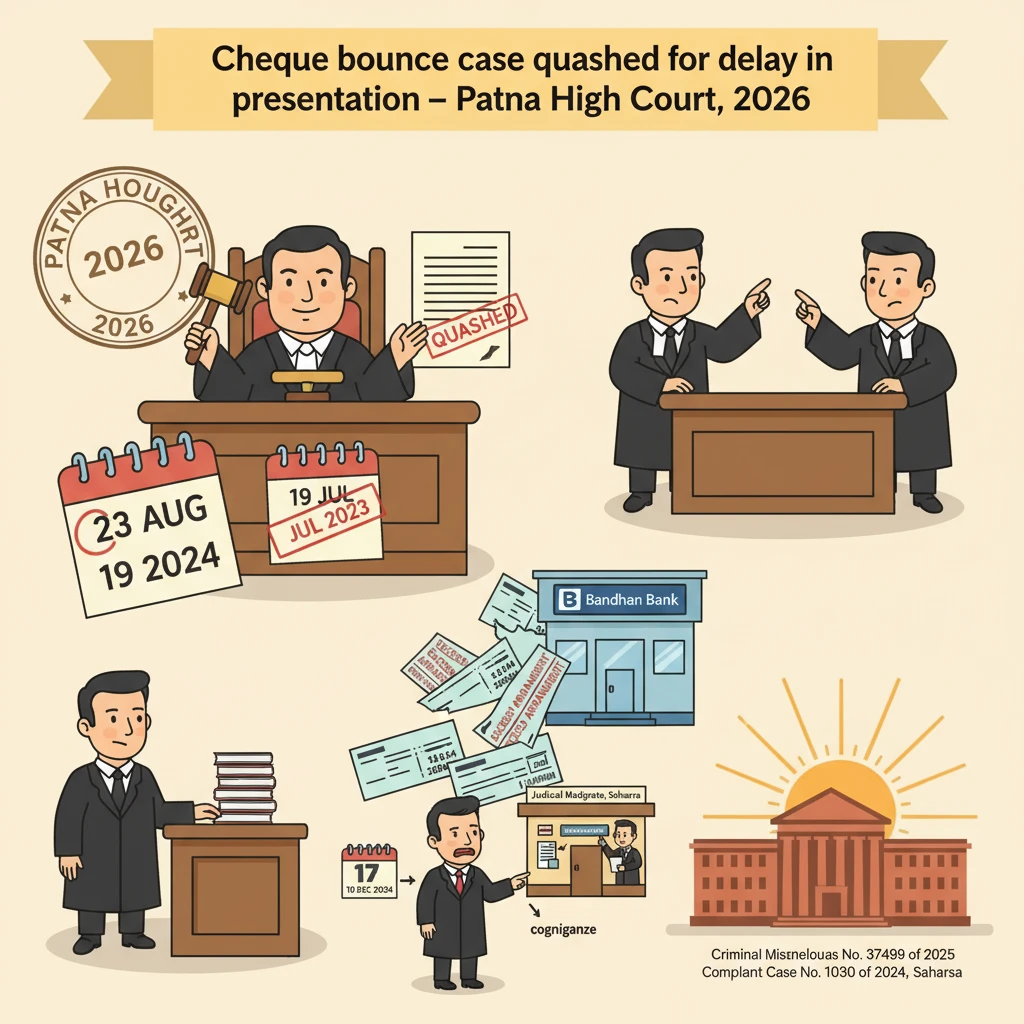
This case arose from a complaint filed in Saharsa district under Section 138 of the Negotiable Instruments Act, 1881. The complainant alleged that the accused, who later became the petitioner before the Patna High Court, had issued six cheques in his favour.
According to the complaint petition, especially paragraph 4, the accused-petitioner issued six cheques, each for an amount of ₹3,00,000, on 19.07.2023. These cheques were allegedly issued in connection with a land purchase dispute between the parties.
The complainant did not present these cheques immediately. Instead, he presented all six cheques on 23.08.2024 in his bank account maintained with Bandhan Bank. The bank dishonoured the cheques and returned them unpaid with the endorsement “Exceeds Arrangement,” meaning the account did not have sufficient arrangement or funds for clearance.
On this basis, the complainant filed Complaint Case No. 1030 of 2024 before the Judicial Magistrate, First Class, Saharsa. The case was registered under Section 138 of the Negotiable Instruments Act, which deals with cheque dishonour.
On 17.12.2024, the learned Judicial Magistrate, First Class, Saharsa took cognizance of the offence against the accused-petitioner. Feeling aggrieved by this order, the accused approached the Patna High Court by filing Criminal Miscellaneous No. 37499 of 2025. He sought quashing of the Magistrate’s order and the proceedings on the ground that the basic legal conditions for a cheque bounce case had not been followed.
What the Court Examined and Decided
Hon’ble Mr. Justice Rudra Prakash Mishra of the Patna High Court heard the matter. Notice had been issued to Opposite Party No. 2, the complainant, and he entered appearance through counsel. The State was also represented.
The central question before the Court was whether the complaint under Section 138 of the Negotiable Instruments Act could legally continue when the cheques were presented more than a year after the date of issue.
The petitioner’s counsel first argued that the cheques were not presented within the statutory period. It was pointed out that the cheques were issued on 19.07.2023, but were presented only on 23.08.2024. This meant there was a gap of more than one year between the issue and presentation of the cheques.
Section 138 of the Negotiable Instruments Act contains certain time-bound conditions. One of these is that the cheque must be presented to the bank within its period of validity. The petitioner argued that presenting the cheques after more than one year was contrary to these mandatory requirements. Therefore, the complaint could not be maintained and the Magistrate should not have taken cognizance.
The petitioner’s counsel then submitted that another criminal case relating to the same land purchase transaction and cause of action was already pending between the parties. This earlier criminal case, according to the petitioner, related to the same dispute which gave rise to the present complaint under Section 138.
On this basis, it was argued that the second complaint amounted to a multiplicity of proceedings on identical facts. The petitioner contended that such repetitive criminal proceedings were an attempt to put unnecessary pressure on him and to convert what was essentially a civil land dispute into a criminal matter. He submitted that this was an abuse of the process of the court.
The petitioner’s counsel also argued that the criminal machinery was being misused as a tool for recovery of money. In support of this, reliance was placed on an earlier judgment of the Patna High Court in Deepak Kumar vs. State of Bihar, Cr. Misc. No. 17078 of 2020. In that case, the Court had held that criminal proceedings under Section 138 of the Negotiable Instruments Act cannot be allowed to continue if the statutory requirements of the provision are not met.
On the other side, the learned counsel appearing for the State and for the complainant supported the Magistrate’s order. The complainant’s counsel tried to explain the delay in presenting the cheques. He submitted that the complainant had not presented the cheques earlier because he was waiting for information from the petitioner. The petitioner had allegedly assured him that he would inform the complainant when sufficient funds were available in his bank account, and therefore the complainant delayed presentation of the cheques.
The Patna High Court carefully heard both sides and examined the materials on record. The Court took note of the complainant’s own version in the complaint and the admitted dates.
The Court found that the complainant had failed to exercise due diligence in presenting the cheques within the period prescribed by law. The explanation that the complainant was waiting for the petitioner’s intimation about availability of funds was considered by the Court. However, the Court held that such an explanation could not extend or override the clear statutory mandate of Section 138.
The Court emphasised that Section 138 of the Negotiable Instruments Act is a penal provision. Penal provisions must be strictly complied with. The conditions laid down in the section are not mere formalities; they are essential ingredients of the offence.
To support this view, the Court relied on decisions of the Hon’ble Supreme Court. It referred to Dashrath Rupsingh Rathod v. State of Maharashtra, (2014) 9 SCC 129, where the Supreme Court held that the ingredients of Section 138 are mandatory in nature and any deviation from them will vitiate the prosecution.
The Court also cited MSR Leathers v. S. Palaniappan, (2013) 1 SCC 177. In that case, the Supreme Court reiterated that presentation of the cheque within its period of validity is a sine qua non, that is, a basic pre-condition, for maintaining a complaint under Section 138. Without such timely presentation, a complaint under this section cannot legally stand.
Applying these principles, the Patna High Court held that in this case, by the complainant’s own showing, the cheques were presented after the period prescribed under law. The complainant had not given any legally sustainable explanation that could cure this basic defect.
The Court also reminded that law helps those who are vigilant and not those who sleep over their rights, using the Latin maxim “vigilantibus et non dormientibus jura subveniunt.” In simple terms, a person must act within time and cannot expect law to help if he is negligent in taking timely steps.
Because the cheques were presented after the allowed period, one of the essential ingredients of the offence under Section 138 was missing. Once a key requirement is not met, the entire criminal case based on that section becomes legally unsustainable.
On this reasoning, the Court concluded that the Magistrate had erred in taking cognizance of the offence. Continuing the proceedings in such circumstances would amount to an abuse of the process of law, since the basic legal foundation for a cheque bounce prosecution was absent.
Therefore, in paragraph 13 of the judgment, the Patna High Court quashed the impugned order dated 17.12.2024 passed in Complaint Case No. 1030 of 2024. In paragraph 14, the Court allowed the present application filed by the accused-petitioner.
The practical outcome is that the criminal complaint under Section 138 of the Negotiable Instruments Act, based on the six cheques dated 19.07.2023 and presented on 23.08.2024, cannot proceed further before the Magistrate.
Why This Judgment Matters
This judgment is important for both cheque issuers and cheque holders in Bihar and beyond. It reinforces that in cheque bounce cases under Section 138, time limits are strict and non-negotiable.
If a cheque is not presented within its validity period, even if there is a genuine dispute or unpaid amount between the parties, a criminal case under Section 138 will not be maintainable. Civil remedies may still be open, but criminal law cannot be used if the basic timeline is missed.
The decision also cautions complainants not to delay cheque presentation based on informal assurances from the drawer. Waiting for the other side to confirm that sufficient funds are available, while ignoring the legal validity period of the cheque, can completely defeat a future cheque bounce case.
For accused persons, the judgment shows that the Patna High Court will intervene through its inherent or supervisory jurisdiction when Magistrates take cognizance in cheque cases without strict compliance with statutory requirements. This prevents misuse of criminal law for pure money recovery when the legislature’s conditions are not met.
Legal Issues and Answers
Issue: Can a complaint under Section 138 of the Negotiable Instruments Act proceed when cheques are presented more than one year after the date of issue, beyond the period prescribed under law?
Answer: No. The Patna High Court held that timely presentation of the cheque within its period of validity is a mandatory requirement. In this case, the cheques were presented beyond the statutory period, so the essential ingredients of Section 138 were not satisfied and the prosecution was legally unsustainable.
Issue: Was the Magistrate justified in taking cognizance of the offence under Section 138 in Complaint Case No. 1030 of 2024 on these facts?
Answer: No. The Court held that the learned Magistrate erred in taking cognizance despite non-compliance with Section 138, and that continuation of the proceedings would amount to abuse of law. The cognizance order dated 17.12.2024 was therefore quashed.
Cases Cited by the Court
- Dashrath Rupsingh Rathod v. State of Maharashtra, (2014) 9 SCC 129
- MSR Leathers v. S. Palaniappan, (2013) 1 SCC 177
- Deepak Kumar vs. State of Bihar, Cr. Misc. No. 17078 of 2020 (relied on by petitioner)
Case Details
Case Number: Criminal Miscellaneous No. 37499 of 2025; arising out of Complaint Case No. 1030 of 2024, P.S. Case No. 1030 of 2024, Saharsa
Case Title: Arun Kumar Choudhary @ Arun Choudhary vs. The State of Bihar & Anr.
Coram: Hon’ble Mr. Justice Rudra Prakash Mishra
Citation: 2026 (2) 285
Date of Judgment: 19.01.2026
CAV Date: 08.01.2026
Nature of the Case: Criminal miscellaneous application seeking quashing of cognizance order in a complaint under Section 138 of the Negotiable Instruments Act, 1881
Advocates:
For the Petitioner: Mr. Pramod Mishra, Advocate
For the State/Opposite Party: Mr. Arun Kumar Singh, APP
For Opposite Party No. 2 (Complainant): Mr. Arun Kumar Sinha, Advocate
Relevant Statute: Section 138 of the Negotiable Instruments Act, 1881
Link to Judgment: Click here to read the full judgment of the Patna High Court
If you found this explanation helpful and wish to stay informed about
how legal developments may affect your rights in Bihar,
you may consider following Samvida Law Associates for more updates.







