

Case Background
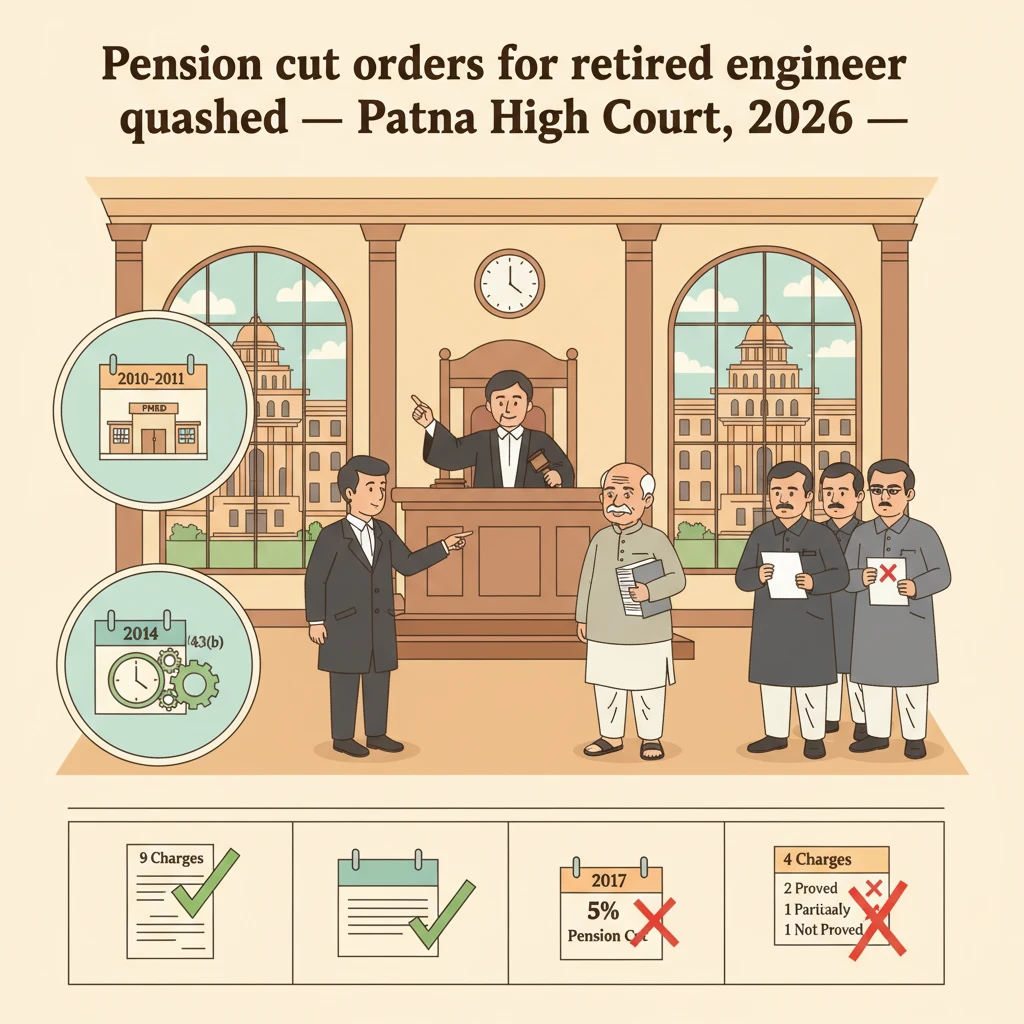
The petitioner was a government engineer in the Public Health Engineering Department (PHED), Bihar. He worked as Executive Engineer at Sasaram between June 2010 and December 2011.
On 25.10.2013, while he was still in service, he received Memo No. 489 along with a memorandum of charges. A departmental proceeding under the Bihar Government Servants (Classification, Control & Appeal) Rules, 2005 (CCA Rules, 2005) was started. This proceeding was numbered as Departmental Proceeding No. 57 of 2013 and contained nine charges.
The petitioner participated in the enquiry. After the enquiry was completed, the Enquiry Officer exonerated him from all nine charges, holding that none were proved.
The petitioner retired from service on 31.01.2014. The enquiry, however, concluded after his retirement. Later, on 16.07.2017, the disciplinary authority issued a second show cause notice, disagreeing with the Enquiry Officer’s findings. As the petitioner was already a pensioner, the proceeding was treated as one under Rule 43(b) of the Bihar Pension Rules, 1950, and punishment of withholding 5% of pension for five years was imposed by Resolution in Memo No. 303 dated 02.05.2017.
On the date of his retirement, 31.01.2014, another charge memo was issued to him, containing four allegations. This gave rise to a second departmental proceeding. After enquiry, two of the four charges were not proved, one was proved and one was partially proved. Because he had already retired, this proceeding was also converted into one under Rule 43(b) of the Bihar Pension Rules, 1950. A second show cause notice was issued, and a final order in Memo No. 900 dated 21.08.2018 was passed by the disciplinary authority.
Apart from these two cases, a third charge memo issued on the date of retirement had earlier led to writ petition CWJC No. 16576 of 2017. That writ petition was allowed by a Coordinate Bench of the Patna High Court on 03.08.2021 in Ganesh Prasad Yadav vs. State of Bihar & Ors., where action under Rule 43(b) had already been quashed.
The present common judgment deals with two writ petitions: CWJC No. 5541 of 2022 and CWJC No. 2398 of 2022, both filed by the same petitioner, challenging the above two pension-cut orders.
What the Court Examined and Decided
In CWJC No. 5541 of 2022, the petitioner asked the Court to set aside Memo No. 303 dated 02.05.2017 issued by the PHED. Through this memo, he was punished by withholding 5% of his pension for five years under Rule 43(b) of the Bihar Pension Rules, 1950.
The petitioner argued that the entire dispute related to his posting at Sasaram between June 2010 and December 2011. The earlier departmental proceeding (Departmental Proceeding No. 57 of 2013) had ended with a clear finding of “not proved” on all nine charges. Despite this, the disciplinary authority later disagreed with the enquiry report and issued a second show cause notice on 16.07.2017.
The key complaint was about how this second stage was handled. The petitioner said the final order under Rule 43(b) contained only a single line stating that his reply to the second show cause was “considered” and all allegations were “found proved”. No reasons, no discussion of his defence, and no explanation of how he was guilty of any specific act were provided.
The petitioner also relied on Rule 43(b) of the Bihar Pension Rules, 1950. This Rule allows withholding or withdrawing pension only when, in departmental or judicial proceedings, the pensioner is found guilty of grave misconduct, or is found to have caused pecuniary loss to the Government by misconduct or negligence during service. He argued that neither condition was satisfied in his case. There was no finding of grave misconduct and no finding of any monetary loss caused by him.
The State defended the order. It argued that the charge memo and enquiry under the CCA Rules, 2005 were legally valid. It said that even if the Enquiry Officer did not find charges proved, the disciplinary authority had the right under the CCA Rules, 2005 to disagree, issue a second show cause notice and then pass a final order after giving the officer a chance to reply. According to the State, this had been done, and since the petitioner had retired, the order was correctly passed under Rule 43(b). The State’s stand was that there was no procedural or legal defect and the writ petition should be dismissed.
In CWJC No. 2398 of 2022, the second writ petition, the petitioner challenged Memo No. 900 dated 21.08.2018. This memo also imposed punishment under Rule 43(b) after a departmental proceeding arising from the charge memo issued on 31.01.2014.
Here too, the petitioner raised the same two broad points. First, he said the final order merely stated, in one cursory line, that after analysis, his reply to the second show cause was not acceptable. None of the points he had raised in his reply were discussed or answered. Second, there was still no finding of grave misconduct or pecuniary loss. According to him, the only allegation was that he did not “properly supervise” work for which funds were released to the local Mukhiya by the competent authorities.
The petitioner pointed out that he was neither the authority who released funds, nor the checking authority, nor a member of any supervisory committee relating to that work. Therefore, he claimed there was no basis to treat this as misconduct attracting Rule 43(b).
The State again argued that the petitioner was governed by the CCA Rules, 2005. It said that a valid charge memo was issued, an enquiry was conducted, and out of four charges, one was proved and one partially proved. After issuing a second show cause and considering the reply, the disciplinary authority passed the order as per law.
Hearing both matters together, the Court focused on two central questions. First, whether the disciplinary authority’s orders in both cases were legally sustainable in light of the petitioner’s specific pleadings. Second, whether the requirements of Rule 43(b) of the Bihar Pension Rules, 1950 were met.
On the first question, the Court noted that in both cases the final orders contained only a one-line observation that the replies to the second show cause notices were found not acceptable. The Court held that such a mode of decision-making is unacceptable in any judicial or quasi-judicial proceeding.
The Court stressed that every judicial or quasi-judicial order must be supported by reasons. An order without reasons is treated as no order in law. A disciplinary proceeding is quasi-judicial in nature. Therefore, it is the duty of the disciplinary authority to record reasons and explain why each important point in the delinquent officer’s defence has been rejected. This had not been done in either impugned order.
On the second question, the Court examined Rule 43(b) of the Bihar Pension Rules, 1950. It held that two essential ingredients must exist before an order under this Rule can be passed: (i) the pensioner must be found guilty of grave misconduct; or (ii) it must be found that he caused pecuniary loss to the Government by misconduct or negligence.
To clarify the meaning of “misconduct” and “grave misconduct”, the Court relied heavily on the earlier Patna High Court judgment in Ganesh Prasad Yadav vs. State of Bihar & Ors., decided on 03.08.2021 by a Coordinate Bench. That judgment had discussed several Supreme Court decisions, including:
- Union of India v. J Ahmed, (1979) 2 SCC 286
- State of Punjab v. Ex-Constable Ram Singh, (1992) 4 SCC 54
- Zunjarrao Bhikaji Nagarkar v. Union of India and Others, (1999) 7 SCC 409
- Inspector Prem Chand v. Govt. of NCT of Delhi and Others, (2007) 4 SCC 566
Quoting these decisions as summarised in the earlier Coordinate Bench judgment, the Court highlighted several principles:
- Misconduct means blameworthy or forbidden conduct, involving wrongful intention, not mere error of judgment, carelessness or simple negligence.
- Failure to reach the highest standard of efficiency in duty, or simple negligence without grave consequences, does not by itself amount to misconduct.
- An error of judgment per se is not misconduct, and negligence simpliciter is also not misconduct unless the consequences are so serious that the degree of culpability is very high.
The Court noted that the Coordinate Bench, applying these principles, had earlier held that no case of grave misconduct had been made out against the same petitioner in respect of another proceeding, and had therefore quashed an order of pension withholding passed under Rule 43(b).
In the present two writ petitions, the Court found itself in full agreement with that reasoning. It saw no clear finding in the impugned orders that the petitioner was guilty of grave misconduct or that he had caused any pecuniary loss to the State. The allegations against him, even as summarised by the authorities, related at best to alleged deficiency in supervision, with no specific wrongful act or loss to the exchequer recorded.
Because both the requirements of Rule 43(b) and the duty to give reasons in a quasi-judicial order had been violated, the Court held that both pension-cut orders were legally unsustainable.
Accordingly, the Patna High Court set aside:
- Order dated 02.05.2017 contained in Memo No. 303 issued by the Special Secretary, Public Health Engineering Department, Government of Bihar; and
- Order dated 21.08.2018 contained in Memo No. 900 passed by the Engineer-in-Chief-cum-Special Secretary, Public Health Engineering Department, Government of Bihar.
The Court directed the authorities to ensure payment of the entire admissible retiral dues of the petitioner within three months from the date they receive or are shown a copy of the judgment. Both writ petitions were allowed.
Why This Judgment Matters
This judgment is significant for retired government servants across Bihar and beyond. It clearly states that pension is not to be cut casually or mechanically.
Departments cannot simply disagree with an enquiry report, issue a brief order and withhold pension. They must show, with reasons, that the retired employee committed grave misconduct or caused a clear financial loss to the Government.
For officers facing departmental action around the time of retirement, the case shows that the Patna High Court will insist on full compliance with Rule 43(b) of the Bihar Pension Rules, 1950 and on speaking, reasoned orders.
The decision also reinforces that mere allegations of poor supervision or simple negligence, without more, do not automatically become “grave misconduct”. This offers reassurance to many public employees who fear arbitrary reduction of pension after decades of service.
Legal Issues and Answers
-
Issue: Can pension be withheld under Rule 43(b) of the Bihar Pension Rules, 1950 without a clear finding of grave misconduct or pecuniary loss, and without a reasoned order dealing with the retired employee’s reply?
Answer: No. The Court held that Rule 43(b) requires a clear finding of grave misconduct or pecuniary loss, and disciplinary orders must be reasoned and cannot merely state that the reply is “not acceptable”. -
Issue: Are the disciplinary authority’s orders in Memo No. 303 dated 02.05.2017 and Memo No. 900 dated 21.08.2018 legally sustainable?
Answer: No. Both orders were set aside because they lacked reasons and did not establish the essential ingredients of Rule 43(b).
Cases Cited by the Court
- The Court relied on a prior Patna High Court judgment in Ganesh Prasad Yadav vs. State of Bihar & Ors., decided on 03.08.2021, which in turn discussed and applied several Supreme Court decisions, including:
- Union of India v. J Ahmed, (1979) 2 SCC 286
- State of Punjab v. Ex-Constable Ram Singh, (1992) 4 SCC 54
- Zunjarrao Bhikaji Nagarkar v. Union of India and Others, (1999) 7 SCC 409
- Inspector Prem Chand v. Govt. of NCT of Delhi and Others, (2007) 4 SCC 566
Case Details
Case Numbers: Civil Writ Jurisdiction Case No. 5541 of 2022; Civil Writ Jurisdiction Case No. 2398 of 2022
Case Title: Ganesh Prasad Yadav v. The State of Bihar & Ors. (in both writ petitions)
Coram: Hon’ble Mr. Justice Dr. Anshuman
Date of Judgment: 22.01.2026
Citation: 2026(2) PLJR 170
Advocates (CWJC No. 5541 of 2022):
- For the Petitioner: Mr. Satyam Shivam Sundaram, Advocate; Mr. Anchit, Advocate; Mr. Sanjeev Kumar, Advocate
- For the State: Mr. Vishwambhar Prasad, AC to AAG5
- For Respondent No. 6 (Accountant General): Ms. Ritika Rani, Advocate
Advocates (CWJC No. 2398 of 2022):
- For the Petitioner: Mr. Satyam Shivam Sundaram, Advocate; Mr. Anchit, Advocate; Mr. Sanjeev Kumar, Advocate
- For the Respondents: Mr. Arvind Ujjwal, Standing Counsel 4
Nature of the Case: Writ petitions under civil writ jurisdiction challenging departmental orders passed under Rule 43(b) of the Bihar Pension Rules, 1950, relating to withholding of pension and retiral benefits.
Link to Judgment: Click here to access the official Patna High Court judgment
If you found this explanation helpful and wish to stay informed about
how legal developments may affect your rights in Bihar,
you may consider following Samvida Law Associates for more updates.







