

Case Background
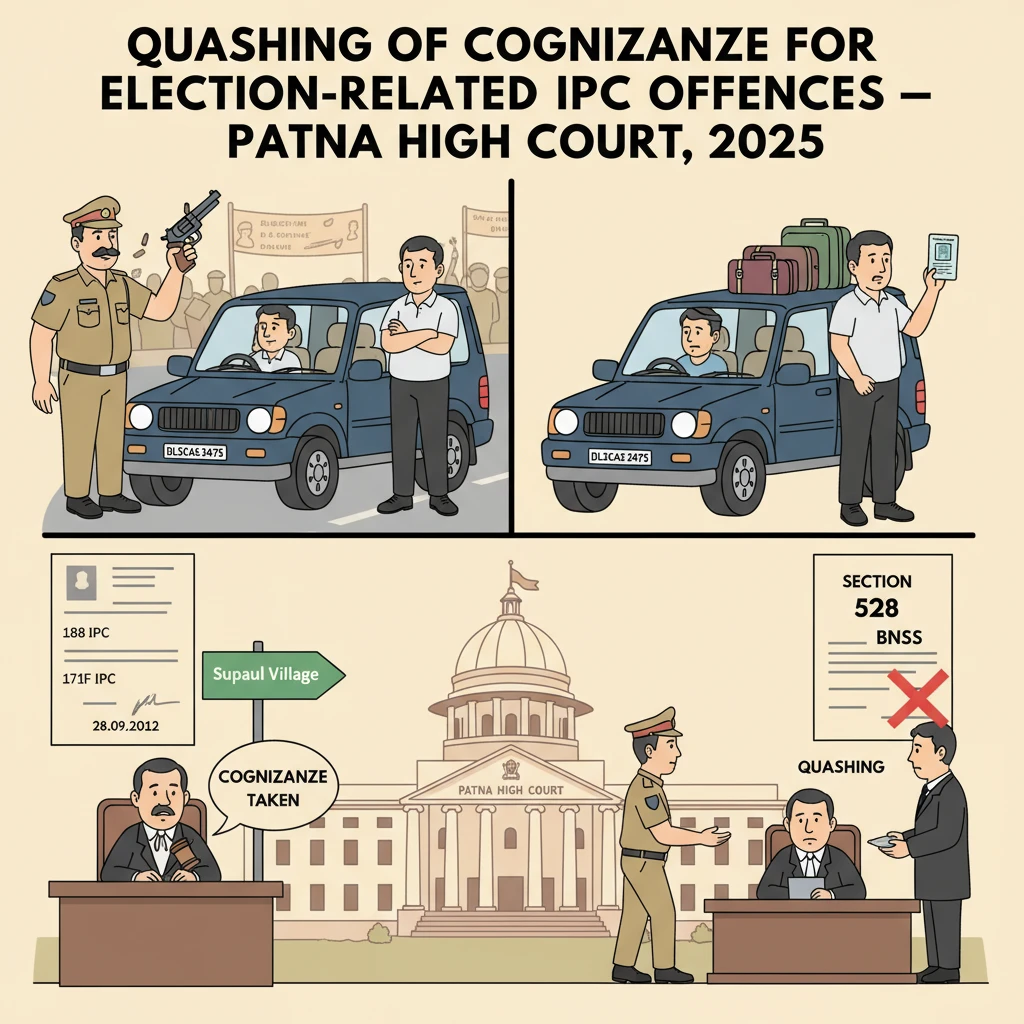
The case arose from Patahi Police Station Case No. 25 of 2009 in East Champaran district, registered during the 2009 parliamentary elections.
According to the First Information Report (FIR), on 17.04.2009 a police personnel on patrol duty stopped a Scorpio vehicle near Champapur village. The vehicle bore Registration No. DL3CAS 2475 and was registered in the name of the present petitioner.
The police alleged that when the vehicle was stopped for checking, the petitioner could not produce any paper relating to the vehicle and, along with the driver, fled from the spot. One co-accused, named in the record as Ram Chandra Sah (also referred to as Ram Chandra Shah), was allegedly apprehended on the spot, and the vehicle was seized.
Based on this, an FIR was lodged. Later, the learned Sub-Divisional Judicial Magistrate, Sikrahna at Motihari, East Champaran, by order dated 28.09.2012, took cognizance of offences under Sections 188 and 171F of the Indian Penal Code (IPC) against the petitioner and others.
In 2025, the petitioner approached the Patna High Court through Criminal Miscellaneous No. 80298 of 2025 under Section 528 of the Bharatiya Nagarik Suraksha Sanhita (BNSS). He sought quashing of the cognizance order dated 28.09.2012, contending that the case against him was not legally maintainable.
What the Court Examined and Decided
The matter was heard by Hon’ble Mr. Justice Purnendu Singh on 09.12.2025. Counsel for the petitioner and the learned Additional Public Prosecutor for the State were heard.
The petitioner’s main case was that he was travelling by his own vehicle to his native place in Supaul district to cast his vote. He was driving along National Highway NH 227F and, while crossing Champapur village, his vehicle was stopped by police personnel.
He claimed that the police tried to force him to surrender his vehicle for election duty. When he refused, a criminal case was allegedly foisted upon him. He further submitted that no incriminating articles were recovered from his vehicle.
According to the petitioner, the FIR had initially been lodged against unknown persons. Later, the driver and the petitioner were made accused only because the vehicle was registered in his name. He also pointed out that arms were recovered from the co-accused Ram Chandra Shah, who, according to him, was merely a passer-by and unknown to him.
On these facts, the petitioner argued that even if the FIR was read as it was, there was no allegation showing violation of any lawful order or any act of undue influence or personation at an election. Therefore, he contended, no offence under Sections 188 and 171F IPC was made out against him.
On the other side, the learned A.P.P. for the State argued that the petitioner was accompanying the co-accused Ram Chandra Shah, who was allegedly apprehended with a loaded pistol and live cartridges. It was submitted that the contents of the FIR indicated that the petitioner had taken part in an offence along with the co-accused to obstruct the election process under the influence of some political parties.
The State further relied on the existence of prohibitory orders and the promulgation of the Model Code of Conduct, alleging that the petitioner and co-accused had violated these orders. On this basis, a charge-sheet was submitted, and cognizance had been validly taken under Sections 188 and 171F IPC.
After hearing both sides, the Court first framed the key legal question: whether cognizance under Sections 188 and 171F IPC could at all be taken in the manner it was done, and whether the materials in the FIR and charge-sheet disclosed the basic ingredients of these offences.
To answer this, the Court examined Section 195(1)(a) of the Code of Criminal Procedure (Cr.P.C.), which governs how courts can take cognizance of offences under Sections 171 to 188 IPC.
Section 195(1)(a) Cr.P.C. clearly states that no court shall take cognizance of any offence punishable under Sections 172 to 188 IPC, or related abetment, attempt, or conspiracy, except on a written complaint of the public servant concerned or of another public servant to whom he is administratively subordinate.
The Court then reproduced and considered Section 171F IPC, which prescribes punishment for undue influence or personation at an election, and Section 188 IPC, which deals with disobedience to an order duly promulgated by a public servant.
To reinforce the importance of Section 195 Cr.P.C., the Patna High Court relied on several Supreme Court decisions.
In State of U.P. vs. Mata Bhikh & Ors., (1994) 4 SCC 95, the Supreme Court had held that the object of Section 195 Cr.P.C. is to protect persons from vexatious prosecutions on inadequate materials or due to malice. It emphasised that a written complaint by the concerned public servant is a sine qua non for prosecution under Section 188 IPC. Without such a complaint, any trial under Section 188 IPC is void ab initio.
The Supreme Court also clarified that if the public servant who issued the order does not file a complaint, a superior officer to whom he is administratively subordinate can file it. The word “subordinate” was explained to mean “administratively subordinate”.
The Patna High Court then referred to another Supreme Court judgment, Manchu Mohan Babu vs. State of Andhra Pradesh & Another (Criminal Appeal No. 3298 of 2025). In that case, the Supreme Court, while dealing with the right to freedom of speech, expression, and peaceful assembly, had held that where the FIR and charge-sheet, even if accepted at face value, do not disclose the essential ingredients of offences such as Sections 290, 341, 171F IPC and Section 34 of the Police Act, continuation of prosecution serves no purpose.
In that case, the Supreme Court found no material showing undue influence at elections, impersonation, interference with electoral rights, or public obstruction in the manner required by the relevant sections, and thus held that prosecution need not continue.
The Patna High Court further relied on C. Muniappan vs. State of T.N., (2010) 9 SCC 567. There, the Supreme Court summarised that there must be a written complaint by the public servant whose order was disobeyed. The requirements of Section 195 Cr.P.C. are mandatory, and non-compliance vitiates the entire prosecution and all consequential orders. Cognizance taken in the absence of such complaint is without jurisdiction and void ab initio.
Having considered these binding precedents, the Court turned to the facts of the present case.
From the FIR, the charge-sheet, and the cognizance order, the Court noted that there was no reference to any specific order said to have been violated by the petitioner or the co-accused. There was also nothing to show that the informant (the police personnel who lodged the FIR) was either the public servant who had issued any prohibitory order or the superior or subordinate of such an officer in the official hierarchy.
In other words, the necessary foundation required by Section 195 Cr.P.C. — namely, a written complaint by the concerned public servant or his administrative superior regarding violation of his order — was completely missing.
The Court also found, on reading the relevant provisions, that the police had no right to file a case under Sections 171F and 188 IPC and to investigate the same in the absence of the mandate of Section 195 Cr.P.C. being followed.
Given these defects, the Patna High Court concluded that allowing the criminal proceedings to continue against the petitioner would be an abuse of the process of law.
Accordingly, the Court held that the order taking cognizance dated 28.09.2012, so far as it related to the petitioner, was illegal and without jurisdiction. The Court therefore quashed and set aside the cognizance order to that extent.
With this, the criminal miscellaneous application was disposed of, and the proceedings against the petitioner under Sections 188 and 171F IPC stood terminated.
Why This Judgment Matters
This judgment is important for people who face criminal cases during elections, especially under Sections 188 and 171F IPC.
The Patna High Court has clearly shown that the police cannot simply register such cases and proceed to investigation and charge-sheet without following Section 195 Cr.P.C.
When a case is based on alleged violation of a prohibitory order (like election-time restrictions), it is essential that the officer who issued the order, or his official superior, files a written complaint. Without this, a Magistrate cannot legally take cognizance.
The judgment also shows that if the basic ingredients of election offences like “undue influence” or “personation” are not clearly mentioned in the FIR and charge-sheet, courts can refuse to allow the prosecution to continue.
Practically, this decision offers protection to ordinary citizens, voters, and vehicle owners who may be dragged into criminal cases during election duties without proper legal basis. It reinforces that procedural safeguards are not empty formalities; they are mandatory and can lead to quashing of proceedings if ignored.
Legal Issues and Answers
Issue: Can a Magistrate validly take cognizance of offences under Sections 188 and 171F IPC in the absence of a written complaint by the public servant whose order is alleged to have been violated, or his administrative superior, as required by Section 195(1)(a) Cr.P.C.?
Answer: No. The Court held that without such a complaint, cognizance under Section 188 IPC cannot be taken, the police have no right to register and investigate such offences, and the prosecution is void ab initio. The cognizance order was therefore quashed as an abuse of process.
Issue: Do the FIR, charge-sheet and materials on record disclose the essential ingredients of offences under Section 171F IPC against the petitioner?
Answer: The Court found that the allegations did not show any undue influence, personation, or other acts affecting free exercise of electoral rights. Following Supreme Court guidance, it held that continuation of proceedings in such circumstances is unwarranted.
Cases Cited by the Court
- State of U.P. vs. Mata Bhikh & Ors., (1994) 4 SCC 95
- Manchu Mohan Babu vs. State of Andhra Pradesh & Another, Criminal Appeal No. 3298 of 2025
- C. Muniappan vs. State of T.N., (2010) 9 SCC 567
Case Details
Case Number: Criminal Miscellaneous No. 80298 of 2025, arising out of Patahi P.S. Case No. 25 of 2009
Case Title: Sanjay Singh vs. The State of Bihar
Coram: Hon’ble Mr. Justice Purnendu Singh
Date of Judgment: 09.12.2025
Citation: 2026 (2) PLJR 67
Advocates:
- For the Petitioner: Mr. Navendu Kumar, Advocate
- For the State/Opposite Party: Mr. Ajit Kumar, A.P.P.
Nature of the Case: Criminal miscellaneous application under Section 528 BNSS seeking quashing of cognizance order in a police case involving alleged offences under Sections 188 and 171F IPC.
Link to Full Judgment: Patna High Court Judgment – Criminal Misc. No. 80298 of 2025
If you found this explanation helpful and wish to stay informed about
how legal developments may affect your rights in Bihar,
you may consider following Samvida Law Associates for more updates.







